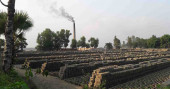
DoE

Overuse of chemical fertilisers threatens soil health in northern Bangladesh
Soil fertility in eight districts of northern Bangladesh is steadily deteriorating, raising concerns about long-term agricultural productivity, according to a new research report by the Rangpur Divisional Soil Resource Development Institute (SRDI).
Researchers say that fertility loss, nutrient imbalance, and increasing soil acidity are spreading rapidly across the region, with organic matter, the foundation of healthy soil, falling to its lowest recorded levels in some areas.
“The decline is so severe that even heavy application of chemical fertilisers is failing to translate into higher productivity,” the report warns.
Researchers estimate that fertilisers worth hundreds of crores of taka are wasted annually, as crops are unable to absorb essential nutrients.
The SRDI conducted tests on soil samples from 38 upazilas across five districts in the Rangpur division. Md. Saifur Rahman, chief scientific officer of the institute, said healthy soil must contain adequate levels of nitrogen, phosphorus, potassium, sulfur, zinc, calcium, magnesium, boron, molybdenum, iron, manganese, copper, chlorine and organic matter to sustain crop production.
Read more: Enough fertilizer in stock to last till December: Agriculture Secretary
“Fertilisers should be applied based on soil health tests and nutrient requirements. This ensures satisfactory crop yields while preventing qualitative deterioration of the soil caused by arbitrary fertiliser use, which can reduce production,” he said.
The alarming soil condition is not confined to the north, he noted, but is also seen across other regions of Bangladesh.
Fertiliser Misuse
Md Sirajul Islam, additional director of the Rangpur Agricultural Extension Department, highlighted the widespread use of chemical fertilisers. “At least 20 types of fertilisers, both legal and illegal, are being used in agriculture. Farmers are most familiar with seven, including urea, molybdenum, magnesium, phosphorus, boron, potassium, and sulfur,” he said.
Farmers often rely on estimates rather than scientific measurement, resulting in imbalanced or inadequate application.
“Proper application is essential for soil health,” he said, warning that the issue affects not only the Rangpur and Rajshahi-Barendra regions but also districts across other river basins.
Experts pointed out that about 80% of farmers directly involved in agriculture are uneducated and apply fertilisers without guidance, exacerbating the decline in soil health.
Read more: Shahjalal Fertilizer Factory resumes production after five-month closure
Alarming Decline of Essential Nutrients
SRDI scientists say a healthy crop requires 16 essential nutrients, 13 of which must come from the soil. Latest tests, however, show nine of these nutrients are now at minimum or critical levels in many parts of northern Bangladesh.
Organic matter has dropped to 1–2% instead of the ideal 5%, soil pH has fallen to 4.4–5.5 rather than 6.0–7.5, nitrogen levels are 0.09–0.18% against a recommended 0.27–0.36%, and sulphur is far below the optimum 22–30 ppm.
Biological Systems under Threat
Excessive chemical use, coupled with reduced application of cow dung, compost, crop residues and other organic materials, has sharply reduced soil biodiversity. Beneficial organisms such as earthworms, which naturally mix soil layers and maintain fertility, have declined significantly.
“This breakdown of biological processes is damaging the soil’s long-term health,” said Saifur Rahman.
Although Bangladesh has 39 fixed soil-testing laboratories and several mobile labs, the majority of farmers never have their soil tested. Experts warn that without accessible soil testing and proper fertiliser use training, the country could face significant drops in food production in the coming years.
Read more: Hidden hands in the fields: Dealers blamed for artificial fertiliser shortage in north
Looming National Crisis
The SRDI report cautions that if current trends continue, Bangladesh may face reduced yields in staple crops, increased pest outbreaks, and a rising dependence on fertiliser imports. These challenges could make cultivation costlier and reduce farmers’ profit margins.
10 months ago
Unregulated poultry farms push Feni into a growing environmental crisis
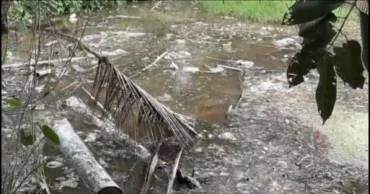
Unplanned, unregulated and unapproved poultry farms across Feni district are triggering severe environmental pollution, disrupting local biodiversity and putting thousands of residents at risk, according to locals and officials.
Residents have filed repeated complaints with government offices over the growing pollution caused by the mushrooming farms.
The district administration has responded with assurances of action, but meaningful intervention is yet to be seen.
According to data from the Department of Environment (DoE), Feni has 1,367 registered poultry farms, while another 1,814 have applied for environmental clearance.
Among these are 544 layer farms, 856 broiler farms, 384 Sonali farms, eight parent stock layer farms and 22 parent stock broiler farms.
However, the number of illegal and unapproved farms remains unknown. Officials estimate the actual figure to be more than double the number of registered farms.
A visit to several parts of Sonagazi upazila revealed poultry farms built haphazardly on rooftops, in residential yards, beside ponds, on croplands, along canals and directly next to roads.
Despite clear guidelines requiring clearance from the Livestock Department and compliance with structural standards, the vast majority of these farms have ignored the rules altogether.
During recent inspections, this correspondent found many farms operating without environmental clearance or Livestock Department licences, even though existing regulations require either DoE approval or registration with the Livestock Department before a farm can be established.
Because these farms have expanded outside the legal framework, environmental pollution has intensified across Sonagazi and other unions.
Read more: How Green Industries Can Reduce River Water Pollution in Dhaka City
The impact on local ecology is profound, while residents say their daily lives have become increasingly unbearable.
Agricultural lands are suffering extensive damage, with waste from an estimated 95% of the farms polluting water bodies and soil.
Dumped waste is contaminating canals, disrupting irrigation and creating shortages of clean water.
Although guidelines dictate that poultry farms must be located at least 200 metres from residential areas, many have been set up right beside homes, schools and mosques.
The foul odour makes nearby roads difficult to use, and locals report rising illness among residents and students of surrounding educational institutions.
Many residents say farm owners often wield local influence, making it difficult to protest. Those who raise concerns are reportedly harassed or threatened.
Farm waste has also reduced crop yields, while the constant stench makes it difficult for children and adults alike to move around the affected areas.
Mamtaz Begum, a 70-year-old resident of Char Elahi village under Motiganj Union, said she once lived peacefully.
But over the past four to five years, influential locals have set up layer farms near her home.
Waste from the farms has polluted ponds and croplands, while the smell, carried by the south wind, has worsened her breathing problems.
She fears she may eventually have to abandon her ancestral home.
Similar conditions prevail across Bogadana, Amirabad, Mongalkandi and Nawabpur unions, where unplanned and unapproved farms continue to proliferate without environmental clearance, livestock licences or even basic trade licences from the Union Parishad.
Residents say repeated complaints and even human-chain protests have failed to yield results, largely due to weak monitoring.
They demand strict action against the illegal farms.
With 100M birds dead, poultry industry could serve as example as dairy farmers confront bird flu
In Char Elahi village, a farm near the house of Mishu Soudagar was found just 15 yards from residential houses.
Between 40 and 50 households live within a 150-yard radius.
Waste is dumped into a small pit and nearby cropland, attracting flies and mosquitoes and producing an overpowering stench.
Dead chickens wrapped in plastic bags were also seen dumped in roadside drains and fields.
Kamal Hossain, a resident of the area, said locals must use the road beside the farm several times a day, enduring the unbearable odour.
Children face difficulties travelling to school, while mosquito infestations have escalated sharply.
Some farm owners, however, insist they are trying to comply. Ahsan Ullah of Bogadana Union said he started his farm to become self-reliant after returning from abroad.
Closing it now would cause severe financial loss, he said, adding that he has applied for clearance.
But nearby residents, including Pulak, Farida Begum, Khadija Begum and Abdul Shukur, said the farm’s waste has made life intolerable.
Strong hatchery, skilled workforce vital for sustainable growth of poultry sector
10 months ago

6 arrested over attack on DoE official at Chawkbazar polythene factory
A joint team of the Detective Branch (DB) and Chawkbazar police has arrested six individuals in connection with a violent attack on an operation conducted by the Department of Environment (DoE) at a polythene factory in Dhaka’s Chawkbazar.
The arrested individuals have been identified as Md Humayun Kabir (28), Md Ariful Islam (40), Anwar Hossain Khokon (48), Md Shahabuddin (45), Md Nazmul Alam Ujjal (36), and Md Sumon (26).
According to DMP Deputy Commissioner (Media), the arrests were made during raids conducted in various parts of the city on Monday and Tuesday, following a case filed over the attack.
The incident occurred on Sunday morning when a mobile court, led by DoE Executive Magistrate Faizunnesa Akter, raided a polythene factory in the West Islambagh area of Chawkbazar. The operation, conducted in collaboration with police and Rapid Action Battalion (RAB), seized 40 sacks of illegal polythene from a rented house.
As officials attempted to transport the seized items using a pickup truck, a mob of 150-200 people armed with sticks, bricks, and iron rods intercepted the team. The mob launched a violent attack, injuring Md Shawkat Ali, Director (Deputy Secretary) of the DoE’s Monitoring and Enforcement Wing.
The attackers also vandalized the pickup truck and forcibly took away the confiscated polythene. Shawkat Ali sustained serious injuries and was rushed to Dhaka Medical College Hospital, where he is currently undergoing treatment.
21-year-old stabbed to death over drug dispute in Bogura
In the aftermath of the attack, Md Motaher Hossain, Inspector at the DoE, filed a case at Chawkbazar Model Police Station. The case named six individuals while also identifying 150-200 others as unknown attackers.
The DB and Chawkbazar Police launched immediate raids following the incident, which led to the arrest of the six suspects. Legal proceedings are currently underway, while police continue their efforts to identify and apprehend other individuals involved in the attack.
1 year ago
Illegal brick kilns flourish in Jashore: 114 out of 144 operate illegally
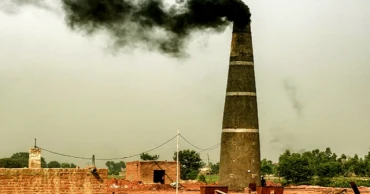
Illegal brick kilns continue to proliferate across Jashore, with 114 out of 144 operating without the requisite environmental clearance or licences from the district administration, in flagrant violation of the law.
A report from the Department of Environment (DoE) reveals that none of the brick kilns in the district fully comply with legal requirements.
Of the total, only 30 kilns employing the zigzag method meet partial standards, while the remaining 114 blatantly disregard regulations.
Despite warnings and legal amendments aimed at curbing unauthorised operations, illegal kilns remain rampant, contributing to significant environmental damage and posing a severe threat to public health.
Law and Violations
The Brick Manufacturing and Brick Kiln Establishment (Control) Act, amended in 2013 and again in 2019, mandates licensing for all brick kilns.
The law prohibits brick production within one kilometre of residential areas, forests, wetlands, agricultural land, or sensitive establishments such as schools and hospitals.
Besides, traditional kilns with 120-foot chimneys are no longer permitted, with all operators required to adopt the environmentally safer zigzag method.
Violations of the law are punishable by up to two years of imprisonment and fines of up to Tk 20 lakh.
Read: 4 acres of forestland recovered in Gazipur, 7 illegal brick kilns demolished in Tangail
But field investigations reveal rampant disregard for these provisions.
Kilns have been found as close as 20 yards to residential homes and within 100 yards of densely populated villages.
Many have been established on agricultural land, destroying fertile soil and jeopardising livelihoods.
Sources indicate that 110 of these kilns are located within one kilometre of educational institutions, breaching regulations and exposing vulnerable populations to harmful emissions.
Enforcement Challenges
Despite the severity of the violations, law enforcement has been sporadic.
Several years ago, the DoE’s Jashore office submitted a report to its headquarters in Dhaka, recommending action against 33 illegal kilns.
But most continue to operate with impunity.
To address the issue, the DoE has recently intensified its monitoring and enforcement activities.
On 27 December last year and 8 January this year, mobile courts conducted drives against 18 kilns, imposing fines and partially demolishing some structures.
Read more: Illegal brick kilns fined Tk 1.24 crore, 11 shut down, 15 ordered closed
Emdadul Haque, Deputy Director of the DoE in Jashore, vowed tougher action against violators.
“No irregularities will be tolerated. Immediate steps will be taken to ensure all kilns comply with the law,” he said.
Government Response
The Ministry of Environment, Forest, and Climate Change has pledged to dismantle all kilns operating in violation of environmental regulations. Additionally, the 30 kilns currently classified as legal will undergo further scrutiny to ensure full compliance with the law.
While recent enforcement measures mark a step forward, environmental advocates argue that sustained action is necessary to tackle the deep-rooted problem of illegal brick kiln operations in Jashore. Without consistent oversight, they warn, the environmental and public health risks posed by these kilns will persist.
1 year ago
Govt may provide loans for producing eco-friendly bricks: Environment Minister
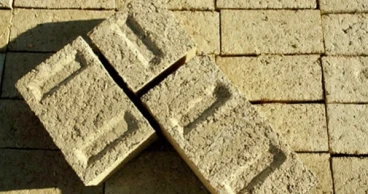
The government of Bangladesh has taken a decision to provide bank loans on easy terms to those involved in producing environment-friendly bricks, Environment, Forest and Climate Change Minister Shahab Uddin said today (January 25, 2023).
The environment minister said this while talking to reporters after a meeting with deputy commissioners at Osmani Memorial Auditorium in Dhaka.
The meeting also discussed protecting forests and actions of DCs to combat climate change impacts, he said.
He also sought assistance from the DCs in stopping hill cutting, deforestation, establishment of illegal brick fields and soil cutting. The DCs were asked to take legal steps in this regard.
Read More: COP27: Bangladesh prioritises realisation of green climate fund, Environment Minister tells UNB
Replying to a question on any proposal coming from DCs, the minister said there are only 50 offices under the Department of Environment (DoE) in the 50 districts while the ministry has no office in the rest 14 districts.
He also assured of establishing offices in the 14 districts.
Besides, the DCs have been asked to stop operation of illegal brick kilns as the government has taken an initiative to use environment-friendly bricks for government structures by 2025.
“The more we can provide eco-friendly bricks, the more we can stop production of illegal brick kilns. If we are able to meet the demand with eco-friendly block bricks, the old illegal brick kilns can be stopped,” he said.
Read More: 2022 was fifth or sixth warmest on record as Earth heats up
3 years ago

Walton signs HCFC phase-out agreement with DoE
Walton signed an agreement with the Department of Environment (DoE) Sunday at the event titled "HCFC Phase-Out Management Plan Stage II" project in the capital.
DoE Director General Md Ashraf Uddin and Walton Hi-Tech Industries Managing Director Golam Murshed signed the deal.
Read Walton launches 3 new desktop PC series
Golam Murshed said, "We know that chlorofluorocarbon gas is harmful to the environment. Thanks to the DoE and the UNDP for taking the initiative to cut the use and emission of this gas. We will do our best to implement the HCFC phase-out project successfully."
"Earlier, Walton implemented the world's first HFC phase-out project with the support of the DoE and the UNDP. Under this project, eco-friendly HC-600a (isobutene) refrigerant is being used instead of HFC-134a refrigerant in refrigerators and compressors. The successful implementation of the project has reduced the annual emissions of about 230 metric tonnes of HFC gas into the atmosphere," he added.
Read Walton Plaza inks deal with Walcart
To phase out the production of ozone-depleting substances in AC manufacturing, the DoE undertook the "HCFC Phase-Out Management Plan (HPMP) Stage-II" with support from the UNDP.
Walton Hi-Tech Industries and five other enterprises took part in the two-year project to completely phase out the production of HCFC refrigerants.
Read Walton TV gets good response in Romania
Under the project, Walton will implement technology conversion of R-22 refrigerant to the environmentally friendly R-290 and R-32 refrigerants in its two production lines for ACs.
The implementation of this new project will further reduce the emission of ozone-depleting potential substances by about 12.22 tonnes, according to a media statement.
Read Walton Primo ZX4 Review with Price in Bangladesh
5 years ago
.jpg)
Six factories fined Tk 2.10 crore for polluting environment
The Department of Environment (DoE) on Tuesday slapped a fine of Tk 2.10 crore on six factories for harming the environment in the city.
As part of the drive against the environment pollution, DoE Director (Monitoring and Enforcement) Mohammad Masud Hasan Patwary slapped the penalty following hearings of the charges.
READ: Aedes Larvae: Bombay Sweets among 23 buildings fined
The highest fine of Tk 1,90,27,200 crore was slapped on Rafique Textile Dying and Printing Workshop, while Tk 17,63,200 on Maya Textile and Printing Industries, and Tk 1,43,770 on Pailuck Chemical Company.
READ: Lockdown Day 3: Banks reopen, 587 arrested, Tk 12.7 lakh fined
Besides, Mozammel Rubber was fined Tk 20,000, Yasin Furniture Tk 13,890 and Monir Furniture Tk 13,890, said a DoE release.
5 years ago
.jpg)
DoE's top bureaucrat dies of Covid-19
The Director-General of the Department of Environment (DoE), Dr AKM Rafique Ahammed, died at a hospital in Dhaka early on Saturday morning, days after contracting Covid-19.
Dr Rafique passed away at Central Police Hospital around 4.14 am, said Dipankar Bar, Senior Information Officer of the Ministry of Environment, Forests and Climate Change.
The top environment officer was undergoing treatment at the hospital since March 23 and put on life support after his condition worsened on Friday.
A BCS (administration) cadre of 10th batch who joined government service in 1991, Dr Rafique is survived by his wife and two sons.
Before joining DoE on May 22, 2019, Rafique served as a commercial counsellor at the Consulate of Bangladesh in Dubai.
Also read: Covid-19: Hasina for balancing livelihoods and public health
Environment, Forests and Climate Change Minister Md Shahab Uddin, deputy minister Habibun Nahar, secretary Ziaul Hasan, and employees of the ministry have expressed deep shock at the demise of Dr Rafique.
Covid-19 situation
Bangladesh on Friday recorded more than 7,000 coronavirus cases for the fifth time in six days.
The country has registered 7,462 new cases and 63 Covid-related deaths in 24 hours, the Directorate General of Health Services said on Friday. A day before, the country recorded 74 deaths, its highest.
Bangladesh has so far recorded 673,594 coronavirus cases, according to DGHS.
Also read: Covid-19: Bangladesh records 7000+ cases for fifth day
Although the government enforced a 7-day lockdown from Monday, people have been moving around freely, posing risks of more transmission. The government has hinted at imposing a complete lockdown from April 14.
Bangladesh reported its first coronavirus cases on March 8 last year and the first death 10 days later.
Vaccination drive
The government launched a countrywide vaccination campaign on February 7, with doses received from the Serum Institute of India.
Bangladesh on April 8 began its second phase of inoculating people amid uncertainty over the availability of vaccines.
5 years ago

5 illegal brick kilns fined Tk 11 lakh in Kurigram
Five illegal brick kilns were fined Tk 11 lakh on Tuesday in Kurigram’s Fulbari upazila.
5 years ago
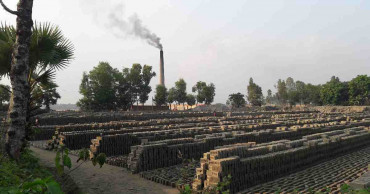
HC directs closure of all illegal brick kilns in Ctg by Feb 18
The High Court (HC) on Sunday directed the authority concerned to shut down all illegal brick kilns that do not have license within February 18.
5 years ago