Commerce Minister
Consumer rights body to get more manpower, digital push: Commerce Minister
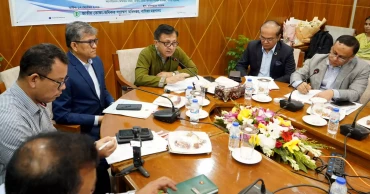
The Directorate of National Consumers' Right Protection (DNCRP) will be strengthened in terms of technology, manpower and institutional capacity to ensure people's right to safe, pure and quality products, Commerce Minister Khandakar Abdul Muktadir said on Thursday.
Muktadir was speaking as chief guest at a views exchange meeting with officials at the DNCRP conference room.
The minister said ensuring that no one is forced to buy adulterated, substandard or harmful products with their hard-earned money is an important responsibility of the state, adding that the department has a crucial role in protecting the consumer rights of the country's 170-180 million people.
He said training, manpower expansion, and greater use of modern equipment and technology would be undertaken to make the department more modern and effective. “Existing services will also be gradually brought onto digital platforms.”
The size or reputation of an institution matters less than the real impact of its work on people's lives, the minister said, noting that the DNCRP's work carries significant importance in that regard.
To draw on international experience, the Bangladesh Institute of Development Studies (BIDS) will be engaged to conduct research on the structure, manpower and service activities of consumer rights protection organisations in various countries, Muktadir said.
He said the department's activities would be further expanded and made more people-friendly in light of the research recommendations, adding that a number of new initiatives would be taken soon to make DNCRP's services more accessible and effective for consumers.
The meeting discussed the department's ongoing activities, use of technology, manpower structure, future plans, and ways to make consumer services simpler and more effective.
23 days ago

Govt working to accelerate economic growth, boost investment: Muktadir
Commerce, Industries, Textiles and Jute Minister Khandakar Abdul Muktadir on Tuesday said the government is working to accelerate economic growth, expand industrialisation and increase domestic and foreign investment.
Key sectors of industry and trade will be strengthened by removing existing barriers to economic development, including the energy crisis, power management and logistics, he said while briefing journalists after attending a programme marking the 48th founding anniversary of BNP in Sylhet city.
Muktadir said BNP, founded in 1978 under the leadership of late President Ziaur Rahman, had governed the country with the support of the people through various elections.
He said former BNP Chairperson Begum Khaleda Zia had led the party and the country through difficult times and worked to protect the country's sovereignty. “At present, her eldest son, BNP Chairman and Prime Minister Tarique Rahman, is leading the country.”
The minister said addressing the challenges of nation-building is currently the government's main priority rather than celebrations.
He said Prime Minister Tarique Rahman is working round the clock to improve the country's economy and people's living standards. “The government has taken initiatives to make the industry, trade and every sector of the economy that plays an important role in national production more dynamic,” he said.
Muktadir said industrialisation is being given priority alongside developing necessary infrastructure and improving the business environment to expand investment.
As part of the initiative, the government has recently announced plans to establish a BSCIC industrial estate in Sylhet, he said.
“Such initiatives will help develop industries, create employment, accelerate the national economy and increase domestic and foreign investment,” he said.
The minister said the government will also work to improve the law-and-order situation alongside economic development.
He said the government is taking necessary steps in line with the expectations of the people.
“Our goal is to build a strong, prosperous and dynamic economy. Efforts to expand industry and trade, increase investment and remove barriers to economic development will continue,” Muktadir said.
Sylhet city BNP President Nasim Hossain, General Secretary Emdad Hossain Chowdhury, BNP Central Assistant Organising Secretary Miftah Siddiqui, National Executive Committee member Abul Kaher Chowdhury Shamim, former city BNP General Secretary Badruzzaman Selim and other party leaders were also present.
1 month ago
Halal economy can be a major area of opportunity: Commerce Minister
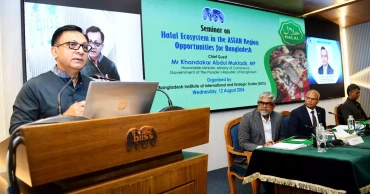
Commerce Minister Khandakar Abdul Muktadir stressed the need for reducing its reliance on traditional export products and explore emerging sectors, particularly by developing a strong and internationally competitive halal ecosystem based on the experience of ASEAN countries.
He made the call while addressing a seminar titled “Halal Ecosystem in the ASEAN Region: Prospects for Bangladesh,” organised by the Bangladesh Institute of International and Strategic Studies (BIISS).
The minister said the halal economy can no longer be viewed as being limited to food and beverages.
It has evolved into a broad global economic system covering food, pharmaceuticals, cosmetics, modest fashion, tourism, logistics, technology, finance and international certification, he said..“We must first enhance our domestic production capacity to increase exports. This requires both local and foreign investment, as well as ensuring a safe and attractive environment for investors,” he said.
Muktadir said preferential access to international markets is one of the key conditions for attracting investment.
He said the government is working to sign free trade agreements (FTAs), preferential trade agreements (PTAs) and economic partnership agreements (EPAs) with different countries to retain Bangladesh’s export advantages after its graduation from the least developed country (LDC) category.
He stressed the need for an independent, reliable and internationally recognised halal certification system to tap the growing global halal market.
Such a system would increase international confidence in Bangladeshi products and help the country enter new markets, he said.
Speakers at the seminar said Bangladesh’s export sector has long been heavily dependent on the readymade garment industry.
To remain competitive in the changing global trading environment, the country needs to diversify both its products and markets, with the halal economy offering significant potential.
They stressed that Bangladesh needs an integrated system covering production, quality control and certification to enter the global halal market.
Participants highlighted Malaysia’s halal ecosystem as a useful model for Bangladesh.
Speakers said Bangladesh has a large domestic market and strong capabilities in agriculture, food processing, pharmaceuticals, leather and garments.
These strengths could help the country become an important partner in the global halal supply chain.
The seminar identified five strategic priorities for making Bangladesh’s halal sector globally competitive: establishing an internationally recognised national halal assurance framework; developing specialised halal industrial clusters with modern laboratories and logistics facilities; upgrading existing industries to international standards; involving small and medium enterprises, researchers and young entrepreneurs; and establishing a “Bangladesh Halal” brand globally through economic diplomacy.
BIISS Director General Maj Gen A S M Ridwanur Rahman delivered the welcome address, while BIISS Research Director Dr Mahfuz Kabir presented the keynote paper.
1 month ago
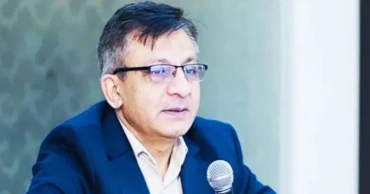
Bangladesh earned $44.17bn from exports in FY25: Commerce Minister
Commerce Minister Khandakar Abdul Muktadir on Thursday said Bangladesh exported 812 products to 202 destinations across the globe during the 2024-25 fiscal year, with the United States, Germany and the United Kingdom remaining among the country’s largest export markets.
Replying to a written question from treasury bench MP Selina Sultana (women seat-35), the minister said Bangladesh’s major export destinations also include Spain, France, the Netherlands, Poland, India, Italy, Canada, Japan, Denmark, Australia, Sweden, Belgium, China, Türkiye, South Korea, Mexico and Russia.
He said the country’s principal export items during the July-June period of FY2024-25 were woven garments, knitwear, home textiles, frozen and live fish, agricultural products, jute and jute goods, leather and leather products, footwear, and engineering products.
The commerce minister informed the House that Bangladesh earned US$44,167.84 million from exports of these products during FY2024-25.
He added that the export earnings from these products accounted for 91.48 percent of the country’s total export income during the fiscal year.
3 months ago
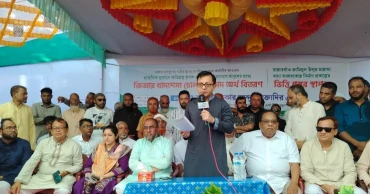
Govt to build disaster-resilient infrastructure, boost agriculture: Commerce Minister
Commerce, Industries, Textiles and Jute Minister Khandaker Abdul Muktadir on Saturday said the government is implementing a range of development programmes to improve people's living standards and build disaster-resilient infrastructure, with particular focus on agriculture, irrigation, communication and disaster management.
Speaking as the chief guest at a programme in Sylhet Sadar, he said the government's development strategy prioritises sustainable infrastructure and social protection to strengthen resilience against natural disasters.
The event marked the distribution of GR rice and cash assistance among farmers, poor and vulnerable people affected by recent natural disasters, as well as the foundation stone-laying ceremony for the Rajargaon Jamiul Uloom Madrasa Flood Shelter project.
Muktadir said around 2,000 beneficiaries will receive 30 kg of rice each under the ongoing relief programme, while nearly 700 people will receive cash assistance of Tk 1,000 each.
He said the three-storey Rajargaon Jamiul Uloom Madrasa and Flood Shelter will serve as an educational institution during normal times and function as a shelter during floods and other natural disasters after its completion.
The building will include separate rooms and bathrooms for women, children, elderly people and persons with disabilities to ensure safe accommodation during emergencies, he added.
The Minister said an infrastructure development project worth approximately Tk 8.7 crore is currently being implemented to strengthen disaster resilience and improve overall development in the area.
He also said the government has approved another project worth nearly Tk 50 billion for the development of roads, construction of new road networks, installation of drainage systems and tube wells across Sylhet division.
The government is also taking steps to bring fallow land under cultivation by addressing temporary waterlogging and irrigation shortages, he said.
Muktadir added that canal excavation programmes will be expanded to strengthen irrigation facilities, enabling year-round cultivation on agricultural land in Sylhet.
He expressed hope that the phased implementation of these projects would resolve many of the region's longstanding problems and improve the quality of life for local residents.
The programme was chaired by Sylhet Sadar Upazila Nirbahi Officer Khoshnur Rubaiyat.
Among others present were Sylhet City Corporation Administrator Abdul Qayyum Chowdhury, Sylhet Development Authority Chairman Rezaul Hasan Qayes Lodi, Sylhet Zila Parishad Administrator Abul Kaher Chowdhury Shamim, Sylhet city BNP General Secretary Emdad Hossain Chowdhury, Sylhet Sadar Upazila BNP President Abul Kashem, government officials, elected representatives and journalists.
3 months ago

Govt to introduce AI-based market monitoring system for agriculture, trade: Commerce Minister
The government is set to introduce an artificial intelligence (AI)-based market monitoring system to make agricultural production and market management more data-driven and effective, Commerce, Industries, Textiles and Jute Minister Khandaker Abdul Muktadir said on Friday.
The proposed system will analyze production data, weather forecasts, international market trends, import requirements and supply conditions to facilitate timely policy decisions, he told reporters after a prize-giving ceremony marking National Education Week 2026 at Sylhet Sadar Upazila Auditorium.
The event was organized by the Sylhet Sadar Upazila administration and the Upazila Secondary Education Office.
Muktadir said the AI-based platform would be developed in coordination with the ministries concerned, including agriculture, fisheries and livestock.
"Once operational, the system will make market monitoring more institutionalized, data-driven and effective. It will enable the government to respond more quickly to artificial shortages, abnormal price hikes and market volatility," he said.
The minister also announced that the government is implementing an integrated plan to develop Sylhet into one of Bangladesh's leading vegetable export hubs.
As part of the initiative, a modern packaging centre will be established in Sylhet, while farmers will receive training on international production standards and a traceability system will be introduced to meet export market requirements.
Although Sylhet produces large quantities of vegetables, export potential remains underutilized due to inadequate packaging and logistical facilities, he said.
"Removing these constraints will help transform Sylhet into one of the country's major vegetable exporting regions," he added.
Responding to a question on commodity prices, Muktadir said prices of most products in Bangladesh are determined by market forces. However, the government is working to formulate an effective pricing framework for essential commodities to maintain market stability.
The framework will be finalized following consultations with relevant stakeholders, he said.
Asked whether exports would increase this year, the minister said ongoing global conflicts and geopolitical instability have affected international trade and exports.
He expressed optimism that Bangladesh's exports would expand once the global situation stabilizes, adding that the government is also taking steps to ensure uninterrupted energy supply to the industrial sector.
The programme was chaired by Sylhet Sadar Upazila Nirbahi Officer Khoshnur Rubaiyat.
Among others, Sylhet City Corporation Administrator Abdul Qayyum Chowdhury, Sylhet Development Authority Chairman Rezaul Hasan Qayes Lodhi, Sylhet Zila Parishad Administrator Abul Kaher Chowdhury Shamim, Sylhet Metropolitan BNP General Secretary Emdad Hossain Chowdhury, Deputy Director of the Department of Agricultural Extension in Sylhet Md Shamsuzzaman and Sylhet Sadar Upazila BNP President Abul Kashem attended the event.
Earlier in the day, Muktadir distributed financial assistance from his discretionary fund, handed over wheelchairs to persons with disabilities, distributed goat feed among members of disadvantaged small ethnic communities, participated in a tree plantation programme in Sylhet Sadar and attended a Partner Congress organized by the Sadar Agriculture Office as the chief guest.
3 months ago
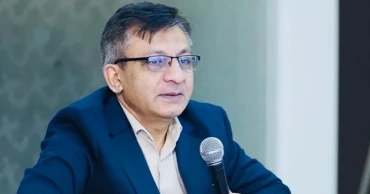
New industrial parks on the cards to expand MSME sector: Commerce Minister
Commerce Minister Khandaker Abdul Muktadir on Sunday announced that the government has taken various initiatives to expand the Micro, Small, and Medium Enterprises (MSME) sector including plans to establish new industrial parks alongside existing BSCIC industrial estates.
The minister made the announcement while addressing an event organised at the Bangladesh Investment Development Authority (BIDA) auditorium in the capital to mark the International Day of Micro, Small, and Medium-sized Enterprises.
Highlighting the sector's economic significance, Muktadir said MSMEs currently contribute 34 percent to the national economy.
"As the lifeline of our economy, the more dynamic this sector becomes, the higher our GDP growth will be," he said.
Reflecting on past challenges, the Commerce Minister pointed out that the rate of creating new entrepreneurs over the last 17 years was critically low.
Furthermore, existing industrial units could not utilise their full production capacity due to acute gas shortages, which ultimately widened income inequality, he said.
Assuring business owners of policy interventions, the minister emphasised that the current government is working with sincere dedication to resolve the prevailing gas crisis to boost the manufacturing capacity of factories across the country.
Senior government officials, business leaders, and representatives from the SME sectors were present at the event.
3 months ago
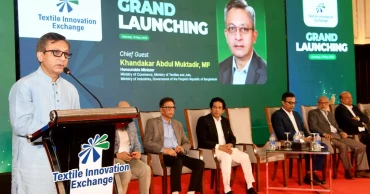
Textile sector must embrace innovation for long-term competitiveness: Commerce Minister
Commerce Minister Khandakar Abdul Muktadir on Saturday said Bangladesh’s readymade garment (RMG) and textile industry must prioritise sustainable production, innovation, research and product diversification to maintain its long-term global competitiveness.
“Sustainability is no longer just a slogan; it is now an essential condition for the industry’s survival and future growth,” Muktadir said while addressing the Grand Launching Event of Textile Innovation Exchange at a hotel.
The minister stressed the need for ensuring efficient use of electricity, gas and water through energy-saving measures, water recycling, circular production systems and improved management practices.
Muktadir said although the country’s apparel industry has achieved remarkable success over the past decades, exports still remain heavily dependent on a limited range of products. “It will be difficult to stay ahead in global competition unless we move quickly into high-value-added products such as sportswear, man-made fibre-based garments and technical textiles.”
He also said Bangladesh must become more proactive in diversifying products and exploring new export destinations to remain competitive in the European Union market and tackle potential challenges after the country’s graduation from the least developed country (LDC) status.
He also underscored the importance of research, design development, skills enhancement and the adoption of modern technologies to take the industry to new heights.
Highlighting the textile sector’s contribution to Bangladesh’s economic development, the minister said the industry has been a major driving force behind industrialisation and export growth by generating large-scale employment with relatively low investment. “With proper planning and innovation, the sector still has vast untapped potential.”
Referring to the government’s plan to utilise closed industrial units, Muktadir said no funds would be wasted on reviving inefficient factories by retaining outdated machinery.
Instead, he said, industry-specific solutions would be adopted, including developing industrial parks, attracting fresh investment through public-private partnerships (PPP) and leasing arrangements.
He said decisions in this regard would be taken in consultation with experienced private-sector entrepreneurs.
The minister also said promising sectors such as leather, light engineering and shipbuilding would be revitalised through modern technology, skills development and international cooperation.
Welcoming the Textile Innovation Exchange initiative, Muktadir said stronger collaboration between industry and academia, along with the exchange of experiences among entrepreneurs, would help make Bangladesh’s textile sector more modern, environmentally friendly and competitive.
The minister later inaugurated the Textile Innovation Exchange platform and visited different stalls at the event.
4 months ago
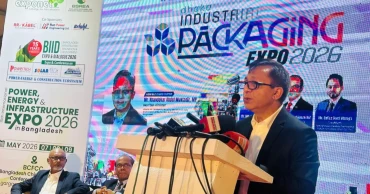
Commerce Minister stresses cut in red tape, faster business approvals to attract investment
Commerce Minister Khandakar Abdul Muktadir on Thursday stressed the need to cut bureaucratic red tape, reduce logistics costs, improve port efficiency and unlock idle state-owned assets to make Bangladesh competitive in tomorrow's global economy.
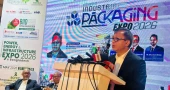
“We cannot move forward by dwelling on old problems. The time has come for pragmatic reforms and swift implementation of commitments,” Muktadir said while addressing the inauguration of the ‘Dhaka Industrial Packaging Expo 2026’ at the Bangladesh-China Friendship Convention Centre in the capital.
The minister said entrepreneurs currently need 25 to 26 separate approvals and licences to start a business in Bangladesh, making the investment environment unnecessarily cumbersome. “To address this, the government is working to streamline the business registration process.”
He said that in future, any enterprise completing registration through BIDA or the relevant authority will receive a ‘provisional clearance’ at the outset, allowing entrepreneurs to begin operations without delay.
Muktadir highlighted that Bangladesh's logistics cost stands at around 16 percent of GDP, well above the global average of approximately 10 percent. “Inefficiencies in port management are inflating cargo transportation costs and eroding the country's international competitiveness. To reverse this, internationally recognised foreign operators are being brought in to manage port operations.”
He said a Danish company has already begun operating a container terminal, with more international-standard firms to be engaged in port activities going forward.
The minister said Bangladesh is on its path from Least Developed Country (LDC) to developing country status, leaving no room for stop-gap measures. “Sustainable reform must be implemented consistently; there is no shortcut.”
On state-owned enterprises, Muktadir said dozens of large industrial units have been lying idle or running at a loss for years, creating a massive subsidy burden on the exchequer. “Around 40 enterprises fall under the Ministry of Industries and another 50 under the textiles and jute sector. The government is gradually opening these units to private investment to bring their vast landholdings and assets into productive use.”
“Our goal is to turn these dormant industrial units into hubs of investment and employment within the next one to two years: some will be modernised, some will host new industries, and others will be developed into export-oriented production centres,” he said.
He noted that each sugar mill in the country sits on an average of 1,000 bighas of land or more. Developing modern industrial parks or multi-purpose industrial facilities on these sites, he said, could generate substantial investment, employment, and government revenue.
Turning to the packaging sector, the minister urged entrepreneurs to think big. “You cannot reach a big destination with a small vision. The government will provide policy and institutional support, but it is the entrepreneurs who must drive industrial growth.”
Muktadir reiterated the government's commitment to expanding domestic industry, creating new jobs, strengthening Bangladesh's presence in international markets, and injecting new momentum into the economy through higher export earnings.
Export Promotion Bureau (EPB) Vice Chairman Mohammad Hasan Arif also addressed the event as special guest. Entrepreneurs, business leaders, institutional representatives, and domestic and foreign stakeholders attended the expo.
5 months ago
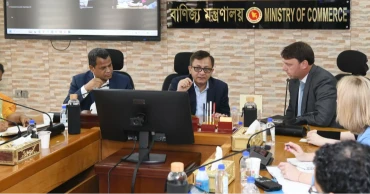
No reason for concern, Bangladesh-US trade deal designed for mutual benefit: Minister
Commerce Minister Khandakar Abdul Muktadir on Tuesday said the Bangladesh-US trade agreement should be utilised for mutual benefit, stressing that there is no reason for concern over the deal.
He made the remarks while talking to reporters after a meeting with US Assistant US Trade Representative for South and Central Asia Brendan Lynch at the conference room of his ministry in the morning.
The minister said international agreements are always built on mutual cooperation. “Any international agreement is shaped by both parties. It is designed to create a win-win situation, taking into account the interests of both sides. Therefore, there is nothing to worry about this agreement,” he said.
He noted that the current government did not initiate the agreement but inherited it as part of state continuity.
“A state-level agreement is not like a personal contract that can be cancelled at will. It is a reality, and we want to utilise it to expand trade and investment in the country,” Muktadir added.
He also referred to a recent investigation initiated by the United States, saying Bangladesh had sought clarification on the matter and responded with its observations after receiving explanations. “We have clearly stated that such an investigation would have been more positive if it had not been initiated in the context of the existing agreement,” he said.
Highlighting Bangladesh’s production and trade reality, the minister said the country does not have overcapacity in any sector and rejected allegations of dumping.
“We import most of our goods. Our exports, particularly in the ready-made garment sector, operate under strict international compliance. There is no scope for labour law violations or child labour,” he said.
On the possibility of cancelling the agreement with the US, Muktadir said the government, as the elected representative of the people, always prioritises national interest.
“If any clause in the agreement goes against Bangladesh’s interests, there is scope for amendment within the agreement itself. It has a self-correcting mechanism,” he said.
The minister added that there is no reason for panic or worry regarding the issue.
During the meeting, both sides discussed strengthening Bangladesh-US trade and investment relations, along with other issues of mutual interest.
Senior officials, including Secretary (Routine Duty) of the Ministry of Commerce Md Abdur Rahim Khan, were present.
5 months ago