Bangladesh air pollution
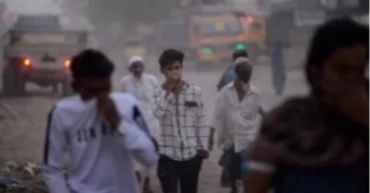
Air pollution costs Bangladeshis 5.5 years of life: AQLI report
The average Bangladeshi people could live 5.5 years longer if particulate pollution (PM2.5) met the World Health Organization (WHO) guideline of 5 µg/m, said a new report on Thursday.
In the most polluted areas of Bangladesh, such as the Gazipur, Narayanganj, and Dhaka districts, people could gain more than 6.5 years of life expectancy, according to new data from the Air Quality Life Index (AQLI).
Air pollution is the greatest external threat to life expectancy in Bangladesh, it said.
All of Bangladesh’s 166.8 million people live in areas where the annual average particulate pollution level exceeds both the WHO guideline and the country’s national standard of 35 µg/m.
Even in the least polluted district of Lalmonirhat, particulate pollution is 7 times the WHO guideline.
Between 1998 and 2023, particulate concentrations in Bangladesh increased by 66.2 percent, further reducing life expectancy by 2.4 years.
In the most polluted divisions in the country—Dhaka and Chittagong—76.2 million residents or 45.6 percent of Bangladesh’s population could potentially gain 6.2 years of life expectancy if particulate concentrations were reduced to meet the WHO guideline.
In Dhaka—the most populous district in Bangladesh—an average resident could potentially gain 6.9 years of life expectancy if air quality met the WHO guideline while Chittagong—the country’s second most populous district—residents would gain 6.2 years.
How to protect yourself from wildfire-related air pollution
If pollution levels in Dhaka and Chittagong met Bangladesh’s national standard, life expectancy in these districts would still increase by 4.1 and 3.3 years, respectively.
All annual average PM2.5 values (measured in micrograms per cubic meter: µg/m) are population weighted and exclude the dust fraction from natural dust and sea-salt.
Air Pollution in South Asia
In South Asia, pollution increased by 2.8 percent from 2022 to 2023, after a slight dip in 2022 compared to 2021.
Despite these fluctuations, South Asia remains the most polluted region in the world—with pollution cutting life expectancy short by 3 years on average and more than 8 years in the most polluted areas.
Particulate pollution is the greatest external threat to life expectancy in all South Asian countries.
In the region’s most polluted countries, particulate pollution’s impact on life expectancy is nearly twice that of childhood and maternal malnutrition and more than five times that of unsafe water, sanitation and handwashing.
Climate-Driven Wildfires are Reversing Clean Air Progress
The United States and Canada suffered the largest increase in fine particulate pollution (PM2.5) globally in 2023, fueled by the worst wildfire season in Canada’s history, according to new data from the Air Quality Life Index (AQLI).
Govt focused on reducing dust to control air pollution in Dhaka: Rizwana
The change is part of a trend—recent research suggests that climate change is causing an increase in the frequency of wildfires that is reversing decades of clean air progress made in the United States and potentially in other regions around the world.
Air pollution remains the world’s greatest external risk to human health
The AQLI data found that, globally, pollution increased slightly in 2023. If the world were to permanently reduce particulate pollution to meet the WHO guideline, the average person would add 1.9 years onto their life expectancy—or a combined 15.1 billion life-years saved worldwide.
This data makes clear that particulate pollution is the world’s greatest external risk to human health. Its impact on life expectancy is comparable to that of smoking, more than 4 times that of high alcohol use, 5 times that of transport injuries like car crashes, and more than 6 times that of HIV/AIDS.
“Air pollution remains a top reason why people are living shorter lives throughout the world.” says AQLI Director Tanushree Ganguly. “Throughout history, countries have both grown and developed and improved their air quality. Targeting fossil fuels at their sources will improve local air, as well as help confront climate change. Countries need the tools to set such policies—starting with better information about their air.”
1 year ago

Dhaka's air quality is 'good'
Dhaka's air quality has turned 'good'.
With an air quality index (AQI) score of 37 at 9.04am, the densely populated metropolis ranked 39th in the list of world cities with the worst air quality.
Indonesia’s Jakarta, Pakistan’s Lahore and Chile’s Santiago occupied the first three spots in the list, with AQI scores of 160, 151 and 124, respectively.
An AQI between 101 and 200 is considered 'unhealthy', particularly for sensitive groups.
Similarly, an AQI between 201 and 300 is said to be 'poor', while a reading of 301 to 400 is considered 'hazardous', posing serious health risks to residents.
Read: Global pollution kills 9 million people a year, study finds
AQI, an index for reporting daily air quality, is used by government agencies to inform people how clean or polluted the air of a certain city is, and what associated health effects might be a concern for them.
In Bangladesh, the AQI is based on five criteria pollutants -- Particulate Matter (PM10 and PM2.5), NO2, CO, SO2 and Ozone.
Dhaka has long been grappling with air pollution issues. Its air quality usually turns unhealthy in winter and improves during the monsoon.
A report by the Department of Environment (DoE) and the World Bank in March 2019 pointed out that the three main sources of air pollution in Dhaka "are brick kilns, fumes from vehicles and dust from construction sites".
With the advent of winter, the city’s air quality starts deteriorating sharply due to the massive discharge of pollutant particles from construction work, rundown roads, brick kilns and other sources.
Air pollution consistently ranks among the top risk factors for death and disability worldwide. Breathing polluted air has long been recognised as increasing a person’s chances of developing a heart disease, chronic respiratory diseases, lung infections and cancer, according to several studies.
As per the World Health Organization (WHO), air pollution kills an estimated seven million people worldwide every year, largely as a result of increased mortality from stroke, heart disease, chronic obstructive pulmonary disease, lung cancer and acute respiratory infections.
4 years ago

Air Quality Index: Dhaka ranks 15th worst
The air of Bangladesh’s capital Dhaka showed signs of slight improvement Sunday morning but it was still classified as ‘unhealthy’ in the Air Quality Index.
6 years ago

Bangladesh faces uphill battle to tackle air pollution
Despite efforts by the government, Bangladesh’s citizens continue to breathe in the most polluted air in the world exposing themselves to various diseases in addition to financial loss.
6 years ago