ILO
ILO chief arrives in Dhaka on two-day visit
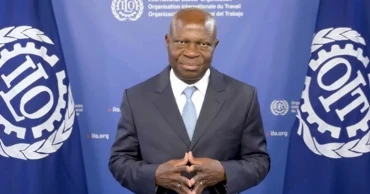
International Labour Organization (ILO) Director-General Gilbert F Houngbo arrived in Dhaka on Sunday morning on a two-day visit to Bangladesh.
Houngbo is scheduled to hold a courtesy meeting with Labour and Employment Minister Ariful Haque Choudhury today, and meet Prime Minister Tarique Rahman on Monday, according to a press release issued by the Ministry of Labour and Employment.
Discussions during the visit are likely to cover the improvement of labour standards, workplace conditions, workers' rights, social protection, skills development and labour market issues in Bangladesh, sources concerned said.
Talks are expected to particularly focus on the ready-made garment sector, the informal labour market and the implementation of international labour standards.
Houngbo, a national of Togo in West Africa, took office as the 11th director-general of the ILO in October 2022. He is the first African to lead the organisation in its century-long history.
2 months ago

ILO finalises international convention for workers in the gig economy
The International Labour Organization (ILO) has finalised a landmark International Convention aimed at securing decent working conditions for millions of digital gig workers worldwide.
The final text of the "Decent Work in the Platform Economy Convention, 2026" was released by the Standard-Setting Committee during the 114th Session of the International Labour Conference in Geneva.
Recognizing the differences among Member States regarding the development of the platform economy, as well as the diversity of business models and work arrangements within it, the convention prioritises the need to support an enabling environment for sustainable enterprises and promotion of fair business competition.
The convention addresses the rapid transformation of the global labor market driven by digital labor platforms.
While recognising that the platform economy has generated significant income, enterprise opportunities, and pathways for formalising work, the ILO highlighted critical "decent work deficits" that require strict international standards.
Because digital platforms frequently operate across borders—often leaving clients, platforms, and workers in separate countries—the framework establishes a unified baseline for protection. The convention applies universally to all digital labor platforms and platform workers, encompassing those in both the formal and informal economies. Under the new treaty, member states are obligated to respect, promote, and realize Fundamental principles Rights at Work(FPRW), including:
Freedom of association and the recognition of collective bargaining rights.
The elimination of forced labor, child labor, and workplace discrimination.
A safe and healthy working environment, including the right of workers to remove themselves from situations posing imminent danger to their life or health without retaliation.
Protection against violence and harassment, explicitly covering online abuse and threats involving third-party clients.
In a major step toward addressing modern technological challenges, the convention introduces strict guidelines regarding automated decision-making and algorithmic management.
Member states must require digital platforms to inform workers and their representative organisations before utilising automated systems to monitor, evaluate, or generate work-related decisions.
Furthermore, the treaty mandates that platforms ensure "appropriate human involvement". Workers will have the right to request written explanations for significant automated decisions that adversely impact their access to work or schedule.
They can also demand a formal review of critical account actions, such as the non-disbursement of payments, account suspensions, or account deactivations.
The text also establishes safeguards for personal data, granting workers the right to access, rectify, and erase their information, subject to local data retention laws. Account suspensions or terminations based on discriminatory or unlawful grounds are strictly prohibited.
The treaty pushes for the correct classification of platform workers’ employment status based on the actual performance of work and remuneration, rather than how a company self-labels its workforce.
It requires that payments be made in full, on time, and via lawful means. For platform workers recognised in an employment relationship, member states must guarantee compensation that meets or exceeds statutory minimum wages, excluding tips, and ensures reimbursement for operational expenses.
Additionally, the convention orders nations to implement measures preventing the abuse of vulnerable demographics, explicitly naming migrants and refugees engaged in platform work.
The convention will become legally binding for ratifying member states 12 months after the official registrations of two ILO members are logged with the Director-General of the International Labour Office.
Governments are expected to implement these provisions in consultation with major employers' and workers' organisations through domestic legislation, collective agreements, or court decisions.
While the framework allows member nations to temporarily exclude limited categories of platforms or workers due to substantial native complexities, they must progressively work toward expanding full protection to those sectors and document their challenges in routine reports to the ILO.
3 months ago
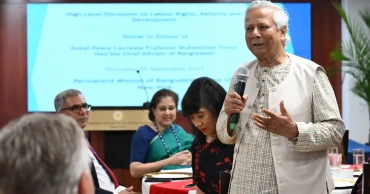
Labour reforms crucial in attracting large-scale FDI to Bangladesh: Prof Yunus
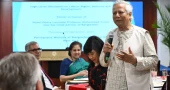
Chief Adviser Professor Muhammad Yunus on Thursday underscored the critical role of labour reforms in attracting large-scale foreign direct investment to Bangladesh.
Speaking at a discussion followed by dinner, he reaffirmed the interim government’s commitment to implementing key reforms, aligned with International Labour Organization (ILO) conventions, before the upcoming national election in February.
The high-level dinner hosted at the Bangladesh Permanent Mission to the United Nations brought together diplomats, UN officials and senior political leaders from Bangladesh for a focused dialogue on labour laws, workers’ rights, and ongoing reform efforts in the country.
Leaders from three major political parties in Bangladesh participated, contributing to an open and constructive exchange on labour issues.
The discussion, moderated by Lutfey Siddiqi, Special Envoy to the Chief Adviser, included comments from the Director-General of the ILO and senior representatives from various UN agencies.
Participants commented on the broader implications of labour reform for Bangladesh’s economic future and international standing, said Chief Adviser’s Deputy Press Secretary Abul Kalam Azad Majumder.
Before the formal address by the Chief Adviser, political leaders from the three major parties were invited to share informal remarks.
Each emphasised the importance of the garment industry and expressed support for continued labour sector reform.
Key issues that Prof Yunus may raise in UNGA speech Friday
1 year ago
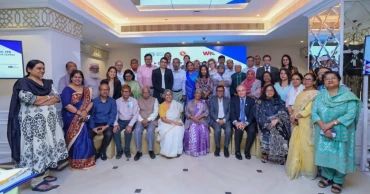
Bangladesh moves toward ratifying ILO C190 to end workplace harassment
Bangladesh is taking a decisive step toward ensuring safer, violence-free workplaces for all as government officials, trade union leaders, employers’ representatives, and development partners gathered in Dhaka for a national dialogue reaffirming the country’s commitment to ratify ILO Convention No. 190 (C190).
The dialogue held on Wednesday which addresses violence and harassment in the world of work, marks a landmark international agreement aimed at protecting workers in all sectors, especially women who face abuse not just in the workplace but also during commutes and at home.
At the event, organised by the Trade Union International Labour Standards (TU ILS) Committee with support from the European Union and other partners, key figures from the Ministry of Women and Children Affairs and the Ministry of Labour and Employment underscored their readiness to align national laws with C190.
The dialogue comes at a pivotal moment as Bangladesh undertakes long-awaited reforms to the Bangladesh Labour Act and prepares new legislation targeting sexual harassment.
"There is no reason it shouldn’t be ratified, and my ministry stands ready to fully support its ratification and implementation,” adviser to Ministry of Women and Children Affairs Sharmeen S. Murshid said in the national dialogue.
“Violence and harassment aren’t confined to the workplace—they happen at home, during commutes, and on the journey back. How can women truly thrive professionally under such conditions? Convention 190 addresses all these dimensions comprehensively.
The TU ILS Committee, set up under the National Coordination Committee for Workers’ Education (NCCWE) and the Industrial Bangladesh Council (IBC), are playing a crucial role in promoting ratifications and application of ratified Conventions both in law and practices.
The event is supported by the Advancing Decent Work in Bangladesh project with a funding of the Team Europe Initiative on Decent Work in Bangladesh by the European Union, Denmark, the Netherlands, and Sweden.
Secretary to Ministry of Labour and Employment A H M Shafiquzzamansaid, “It is a sobering reality that, even in 2025, we continue to grapple with violence and harassment in the workplace despite the progress our society has made. I am fully committed to aligning the Bangladesh Labour Act with C190 to establish a strong legal framework that truly protects workers. Before I retire, I am determined to ratify Conventions Nos 155, 187, and 190 along with ensuring Bangladesh Labour Act amendment completion.”
“For Bangladesh, ratification would demonstrate strong national and global commitment to decent work. It would further contribute to enhancing laws and practices aimed at producing safe, harassment and violence free workplaces for women and men in in Bangladesh,” said Tuomo Poutiainen, Country Director, ILO.
Workers’ representatives emphasised that ratifying C190 will reinforce Bangladesh’s commitment to safe and dignified workplaces and support the implementation of national policies on violence and harassment.
The dialogue included information session on C190 and ongoing reform of the Bangladesh Labour Act to be more aligned with the Convention, conducted by Elena Gerasimova, Labour Law and Labour Standards Specialist, ILO and Mohammad Mashooqur Rahman Sikder, Joint Secretary to the Ministry of Labour and Employment.
The session was followed by a panel discussion where speakers explored the current violations faced by workers, especially women workers, in the workplace, and the role of workers’ and employers’ organizations to ensure eradication of violence and harassment at work.
Syed Sultan Uddin Ahmed, Executive Director, Bangladesh Institute of Labour Studies (BILS) and Head of Labour Reform Commission, Shireen Pervin Huq, Chairperson, Women Affairs Reform Commission, Badal Khan, Chairperson, NCCWE, Towhidur Rahman, President, Bangladesh Apparels Workers Federation (BAWF), Rafiqul Islam, Secretary, BGMEA, Saki Rezwana, Chairperson, Women's Committee, NCCWE, and China Rahman, Women Secretary, IBC attended this panel discussion.
1 year ago
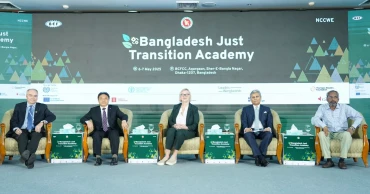
Bangladesh Just Transition Academy underway in Dhaka
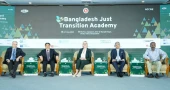
The International Labour Organization (ILO), Food and Agriculture Organization (FAO) of the United Nations, Laudes Foundation, and Thomson Reuters Foundation (TRF) came together to organize the Bangladesh Just Transition Academy on Tuesday.
The Bangladesh Just Transition Academy is a two-day event happening in Dhaka on the 6-7th May 2025 convening key national stakeholders to reflect on and improve the understanding of what a just transition towards an environmentally sustainable and resilient economy and society means for Bangladesh.
The Academy involves panel discussions among stakeholders, presentations from youth climate entrepreneurs, interactive breakout sessions, and is expected to culminate in a call to action between the government, employers’, and workers’ organizations to work collectively towards a just transition.
Philippine fighter jet crashes, killing two pilots during anti-guerrilla mission.
Launching the academy, Advisor to the Ministry of Environment, Forests, and Climate Change Syeda Rizwana Hasan urged every public to enshrine just transition values in the vision and interventions of the government for Bangladesh economy and society to move towards sustainability.
This shift should be “protective of our labourers, soil and air” and “prepare for the future of our children”.
ILO Country Director Tuomo Poutiainen said that ILO’s just transition framework speaks not only about the workers from formal and informal sectors but also includes communities to give them agency and voice on issues affecting their lives.
Maria Stridsman, Head of Cooperation, Embassy of Sweden called to avoid for piecemeal approaches in policy making, and for inclusion of women and informal sector workers in policy dialogues and policy processes to ensure that they too benefit from just transition.
Jiaoqun Shi, FAO Representative in Bangladesh, FAO, said that the UN is supporting the Government of Bangladesh to access and leverage climate finance—including through the Green Climate Fund and other mechanisms—to scale up investments in adaptation and resilience.
Chairperson of National Coordination Committee for Workers Education (NCCWE) Badal Khan and President of Bangladesh Employers’ Federation (BEF) Ardashir Kabir also attended the opening session of the Academy, and underscored the critical roles of workers, communities and the employers in advancing Just Transition in the country.
Naureen Chowdhury, head of the Laudes Foundation in Dhaka, moderated the first panel discussion on defining what a Just Transition means for Bangladesh in collaboration with ILOs Just Tranistion action programme, FAO, the head of the Bangladeshi labour reform commission and the Unilever ESG specialist.
The event is also being supported by the Team Europe Initiative- European Union, Denmark, Netherlands, Sweden- and Global Affairs Canada.
Participants from ILOs social partners, government ministries, line departments, corporate and business, workers, youth organizations and funding partners are participating in this academy.
1 year ago
Wage inequality has declined in two-thirds of all countries since 2000: ILO
Wage inequality has decreased in about two-thirds of all countries since 2000, says a new report released by the International Labour Organization (ILO) on Thursday.
Despite this positive trend, significant wage inequality persists worldwide.
‘The Global Wage Report 2024-25: Is wage inequality decreasing globally?’ finds that since the early 2000s, on average, wage inequality, which compares the wages of high and low wage earners, decreased in many countries at an average rate that ranged from 0.5 to 1.7 percent annually, depending on the measure used.
The most significant decreases occurred among low-income countries where the average annual decrease ranged from 3.2 to 9.6 percent in the past two decades.
Wage inequality is declining at a slower pace in wealthier countries, shrinking annually between 0.3 and 1.3 percent in upper-middle-income countries, and between 0.3 to 0.7 percent in high-income countries.
ILO to launch new report highlighting wage trends, inequality today
Moreover, even though wage inequality narrowed overall, decreases were more significant among wage workers at the upper end of the pay scale.
Real wages rose globally but regional differences persist
The report also finds that global wages have been growing faster than inflation in recent times.
In 2023, global real wages grew by 1.8 percent with projections reaching 2.7 percent growth for 2024, the highest increase in more than15 years.
Such positive outcomes mark a notable recovery when compared to the negative global wage growth, of -0.9 percent, observed in 2022, a period when high inflation rates outpaced nominal wage growth.
However, wage growth has been uneven across regions, with emerging economies experiencing stronger growth than advanced economies, the report finds.
While advanced G20 economies registered a decline in real wages for two consecutive years (−2.8 percent in 2022 and −0.5 percent in 2023), real wage growth remained positive for both years in emerging G20 economies (1.8 percent in 2022 and 6.0 percent in 2023).
Regional wage growth patterns varied considerably
Wage workers in Asia and the Pacific, Central and Western Asia, and Eastern Europe experienced their real wage increases at a faster rate than those in other parts of the world, according to the report.
"The return to positive real wage growth is a welcome development," said ILO Director-General, Gilbert F. Houngbo.
Bangladesh ranks 9th among countries at the highest risk of climate-induced disasters: ILO Report
"However, we must not forget that millions of workers and their families continue to suffer from the cost-of-living crisis that has eroded their living standards and that wage disparities between and within countries remain unacceptably high."
Persistent wage inequality
Despite recent progress, high levels of wage inequality remain a pressing issue.
The report shows that globally, the lowest-paid 10 percent of workers earn just 0.5 percent of the global wage bill, while the highest-paid 10 percent earn nearly 38 percent of this wage bill.
Wage inequality is the highest in low-income countries, with close to 22 percent of wage workers there classified as low-paid.
Women and wage workers in the informal economy are more likely to be among the lowest paid.
This finding reinforces the need for targeted actions to close wage and employment gaps and ensure fair wages for all wage workers.
Wage inequality is relevant in all countries and regions. Globally, however, one in every three workers is a non-wage worker.
In most low- and middle-income countries the majority are self-employed workers, who can only find opportunities to earn a living in the informal economy.
It is for this reason that the report broadens its analysis to include the self-employed in the case of low- and middle- income countries.
As a result, measured labour income inequality increases significantly in these regions, as compared to that measured based only on wages from wage workers.
"National strategies to reduce inequalities require strengthening wage policies and institutions," says Giulia De Lazzari, ILO Economist and one of the main authors of the report.
"But equally important is to design policies that promote productivity, decent work and the formalization of the informal economy."
Strengthening wage policies to reduce inequality
The study emphasizes the need for targeted policies to foster inclusive economic growth.
The report concludes that reducing wage inequality requires both strong wage policies and structural support for equitable growth. By addressing these challenges countries can make real progress toward reducing wage gaps and promoting fair, sustainable, economic growth for workers worldwide.
Key ILO recommendations include:
Setting wages through social dialogue: wages should be set and adjusted through collective bargaining or agreed minimum wage systems involving governments, workers and employers.
Taking an informed approach: wage-setting should take into account both the needs of workers and their families and economic factors.
Promoting equality, and equal opportunity of treatment and outcomes: wage policies should support gender equality, equity and non-discrimination.
Using strong data: decisions should be based on reliable data and statistics.
Addressing root causes of low pay: national policies should reflect each country’s specific context and address the causes of low pay such as informality, low productivity and the under-valuing of jobs in sectors such as the care economy.
1 year ago
ILO to launch new report highlighting wage trends, inequality today
The International Labour Organization (ILO) will unveil the latest edition of its Global Wage Report today (3:30 pm Dhaka time).
'The Global Wage Report 2024-25: Is wage inequality decreasing globally?' provides a detailed look at wage trends around the world and in different regions, highlighting changes in wage inequality and real wage growth.
It explores key challenges workers face globally and sheds light on patterns of income differences between and within countries, said the ILO.
The ILO Director-General, Gilbert H. Houngbo, and Rosalía Vázquez-Alvarez, ILO Economist and Wage Specialist, will present the report at an online press briefing.
1 year ago

Aligning labour law with international standards ‘essential’ to consider GSP+, EU Ambassador says
Ambassador of the European Union (EU) to Bangladesh Charles Whiteley on Wednesday said aligning labour law with international standards will be an “essential element” for the European Parliament and the Commission in considering Bangladesh’s application for market access, the GSP+.
“Bangladesh has the option to accede to GSP+ which is the next most generous GSP programme after the Everything but Arms (EBA),” he said while speaking at a seminar in Dhaka.
Commerce Minister Tipu Munshi attended the seminar as the chief guest while President of Dhaka Chamber of Commerce and Industry (DCCI) Md Sameer Sattar delivered welcome remarks.
Executive Chairman of the Bangladesh Investment Development Authority (BIDA) Lokman Hossain Miah, among others, spoke at the seminar.
The DCCI and European Union Delegation to Bangladesh jointly hosted the seminar, titled “Unlocking Trade and Investment for European Companies in Bangladesh.”
Read: EU urged to extend transition period of GSP up to 6 years for smooth graduation of Bangladesh
The EU ambassador said the implementation of the National Action Plan on the labour sector, which Bangladesh agreed with the EU, will be key deciding factor for GSP+.
“We are closely following the ongoing amendments of the Bangladesh Labour Act. We hope that the amendments will be effective with full transparency, in consultation with tripartite stakeholders, and with technical assistance from ILO,” he said.
The envoy said Bangladesh is a rising economy with a great story of economic development and social progress.
The graduation to a lower middle-income and to a developing country status are historic milestones which bring new opportunities and which call for a reinvigoration of EU-Bangladesh ties, he said.
3 years ago

PM returns home from Switzerland
Bangladesh's Prime Minister Sheikh Hasina has returned home from Geneva, wrapping up her three-day official visit to Switzerland.
A regular flight of Biman Bangladesh Airlines carrying the prime minister and her entourage landed at Hazrat Shahjalal International Airport early Saturday (June 17 at 1:55 am).
Earlier, the flight took off from Geneva International Airport at 11:50am local time (3:50pm Bangladesh time) on Friday.
The Prime Minister exchanged pleasentaries with the passengers in the flight and inquired about their well-beings.
Read: PM leaves Geneva for home ending 3-day visit
The PM went to Geneva on June 13 to attend the "World of Work Summit: Social Justice for All" held on June 14 and 15 in the Swiss city.
She addressed the plenary session of 'World of Work Summit 2023' at Palais de Nations on Wednesday.
The ILO's summit is a high-level forum for global voices to address the need for increased, coordinated and coherent action in support of social justice.
The summit brought together over a dozen heads of state and government, high-level representatives from the United Nations, other international organizations, and employers’ and workers’ organizations.
Read: Next general election to be held in time: PM Hasina tells Geneva reception
Hasina also had two separate meetings with President of South Africa Matamela Cyril Ramaphosa and President of Malta Dr George Vella.
Besides, she held meetings separately with UNHCR chief Flippo Grandi, Prince Rahim Aga Khan, President of the Swiss Confederation Alain Berset and Director General of International Labour Organisation (ILO) Gilbert F. Houngbo there on the day.
After the meeting with Swiss President Berset, a Memorandum of Understanding (MoU) on Knowledge and Skills enhancement between Bangladesh and Switzerland was signed.
In the evening, the PM attended a dinner with high level dignitaries hosted by the ILO Director General at its headquarters.
Read: WTO chief meets PM Hasina, wants Dhaka to reduce subsidies on fisheries
On June 15, she joined “A talk at the WEF”, followed by a meeting with WEF founder Prof Klaus Schwab at WEF Office.
She also addressed an event on “New Economy and Society in Smart Bangladesh” organised by the World Economic Forum (WEF) there.
Besides, Qatar Minister of Labour Dr Ali Bin Samik Al Marri and WTO Director General Dr Okonjo-Iweala separately met her at her place of residence.
Hasina also attended a civic reception in the evening.
Read more: PM takes regular commercial flight on the way home from Geneva, exchanges pleasantries with passengers
3 years ago

PM Hasina leaves for Geneva to attend World of Work Summit
Prime Minister Sheikh Hasina left Dhaka for Geneva, Switzerland on Tuesday (June 13, 2023) morning to attend the two-day "World of Work Summit: Social Justice for All" to be held in the Swiss city on June 14-15.
A commercial flight of Biman Bangladesh Airlines carrying the prime minister departed Hazrat Shahjalal International Airport at 10.01 am. The flight is scheduled to land at Geneva International airport at 5:30 pm local time (9:30 pm Bangladesh Time).
On June 14, UNHCR chief Flippo Grandi will call on the prime minister at the bilateral room of Hotel President Wilson.
Later the PM will call on President of the Swiss Confederation Alain Berset at Palais de Nations. After the call-on there will be a possibility of signing a Memorandum of Understanding (MoU) on Knowledge and Skills enhancement between Bangladesh and Switzerland.
Read: Work together to sustain national development: PM Hasina tells Awami League members
In the afternoon, the prime minister will address the Plenary of 'World of Work Summit 2023' at Palais de Nations.
On her arrival there, she will be greeted by ADG and Regional Director of ILO.
There will be a red carpet reception and Guard of Honour from the gate to the meeting venue.
She will also have a call on with President of Malta Dr. George Vella.
Read: PM Hasina wants greater cooperation between Bangladesh and Indian armies
In the evening, the PM will attend a dinner with high level dignitaries hosted by the DG ILO at its headquarters.
On June 15, she will attend the 'A talk at the WEF', followed by a meeting with founder of WEF Prof Klaus Schwab at WEF Office.
There, she will address at the event on "New Economy and Society in Smart Bangladesh" organised by the World Economic Forum.
In the evening, WTO DG Dr. Okonjo- Iweala will call on her at Hotel President Wilson. She will also attend a community event in the evening.
Read: Volatile global situation likely to worsen further: PM Hasina tells parliament
Hasina will leave Geneva at 11am on June 16 and she is expected to arrive in Dhaka in the early hours of June 17.
"The World of Work Summit 2023: Social Justice for All" is a high-level forum for global voices to address the need for increased, coordinated and coherent action in support of social justice, according to organisers.
It will provide an opportunity to discuss and inform the proposal to forge a Global Coalition for Social Justice, which was welcomed by the Governing Body of the International Labour Office at its 347th Session.
A number of high-level guests, including former President of France, Francois Hollande, former President of Panama, Juan Carlos Varela, and the 2014 Nobel Peace Prize Laureate Kailash Satyarthi, as well as representatives of employers and workers, will address the conference.
Read: President Erdogan and PM Hasina vow to take Dhaka-Ankara ties to new height
3 years ago