Aachol Foundation
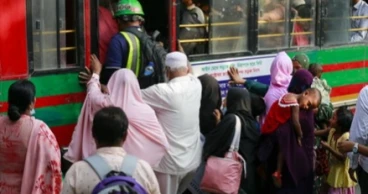
Dedicated mass transport for women in Dhaka remains largely a dream
Dedicated mass transport for women in Dhaka remains largely a dream, despite the growing demand for safer and more comfortable travel options.
Women make up approximately 51% of Bangladesh’s population. Yet, studies show that only around 21% of public transport users are women.
A recent survey by the Aachol Foundation revealed that over 60% of female adolescents in Dhaka who use public transport have experienced some form of harassment.
There is no shortage of accounts and reports of women facing harassment, danger, and discomfort while using mass transportation, particularly where vehicles are overcrowded, poorly regulated, or lack adequate safety measures.
Despite this, government initiatives have yet to meet the urgency of the problem.
In a bustling city like Dhaka, Sarah, a working professional, relies on public transport for her daily commute.
Each morning, she boards an overcrowded bus filled with commuters.
As the vehicle winds through congested streets, she finds herself squeezed between strangers, struggling to maintain personal space. For her, this isn’t merely uncomfortable—it’s a daily safety concern.
BRTC bus services introduced amid nationwide rail disruption
One day, during rush hour, the bus was particularly packed. Sarah experienced unwanted physical contact from a man who stood next to her and repeatedly brushed against her inappropriately.
With no room to move and no way to escape, she felt trapped. She tried to make eye contact with other passengers in the hope someone would intervene, but most looked away.
As the bus neared her stop, Sarah forced her way through the crowd, shaken and harassed. She was left feeling angry, embarrassed, and afraid.
What made the situation worse was the absence of surveillance or visible security on board, and the lack of a clear, responsive system for reporting such incidents.
Though not the first time Sarah had faced harassment, this particular incident left her feeling powerless.
The absence of accountability made her question whether her safety would ever be taken seriously by the transport authorities.
Women across Dhaka share similar experiences—enduring physical harassment, verbal abuse, and a general lack of respect while using public transport.
These stories underline the need to improve safety, establish secure spaces for women, and implement clear policies that foster a more respectful, inclusive travel environment.
Such experiences often drive women away from public transport. Many turn to ridesharing services or taxis, but these alternatives aren’t always affordable, especially for women from lower-income areas.
The persistent harassment women face reflects a wider issue of gender inequality, and highlights the urgent need for safer, more inclusive transportation systems.
“Dedicated mass transport for women in Dhaka remains largely a dream, despite growing demand for safer and more comfortable travel options. Women in the city face persistent challenges, including harassment, overcrowding, and a lack of reserved seating in public transport,” said Natasha, an employee of a private company in Mirpur.
While there have been initiatives, such as women-only buses operated by the Bangladesh Road Transport Corporation (BRTC) and ridesharing services aimed at female passengers, these remain limited in scale.
Many face operational challenges, a shortage of vehicles and low public awareness.
Ayesha, another office worker in Dhaka, said, “As a woman living and working in Dhaka, I can say that access to safe and affordable mass transport is a daily struggle. The buses and other public vehicles are often overcrowded, making it uncomfortable and unsafe, especially for women like me who travel alone. Many of us face harassment or feel vulnerable in these crowded spaces. Sometimes, we have to spend more money on rideshares just to avoid these risks, but not all women can afford that."
Having women-only buses or designated safe spaces within the transport system would make a huge difference, she added, saying it would give women the confidence to travel for work, education, and social engagements without fear.
More affordable and reliable transport would also help women access better jobs further from home, enabling them to support their families more effectively.
She expressed the hope that the government and transport authorities would take women’s voices seriously and make public transport more inclusive. “Safe and accessible transport isn’t a luxury—it’s essential for our dignity, freedom, and empowerment.”
BRTC to launch AC bus service in BRT corridor Sunday
The need for a secure and reliable transport system for women is vital, as many depend on it for daily travel. Expanding women-only services, enforcing anti-harassment laws strictly, and investing in gender-inclusive infrastructure could help mitigate these challenges. Yet, without stronger policy commitment and investment, a functional and inclusive transport network remains out of reach, many women's rights activists say.
To address these issues, women-only buses have been introduced in limited areas to provide safer travel for female commuters, they added.
Despite these efforts, the low proportion of female users on public transport signals the pressing need to improve safety, accessibility, and cultural attitudes to encourage wider participation of women in mass transit.
Dhaka, the capital of Bangladesh, is among the most densely populated cities in the world, home to over 20 million people. As the city grows, its transport infrastructure is coming under increasing strain.
Rina, a university student, shared her concerns with UNB.
She said many female students rely on public buses to attend classes. But the environment on these buses is often chaotic and unsafe. “Sometimes harassment occurs, and we don’t know who to report it to,” she said.
“If there were women-only compartments or buses, I think more girls would feel comfortable continuing their education without having to worry about their safety,” she added.
Sathi, a garment worker, said she begins work very early in the morning and finishes late at night. During those hours, public transport is either unavailable or unsafe for women.
“I often have to take shared auto-rickshaws, but they’re costly and risky. Reliable and affordable transport that runs during early and late hours would help many women workers like me,” she added.
Farida, a homemaker, said she often needs to take her children to school or visit the doctor. “But the lack of accessible transport with proper seating makes it hard for mothers and elderly women to get around.”
Dhaka University launches shuttle bus service on trial basis for students
“It would be helpful if buses had reserved seating and easier boarding for women with children or elderly family members,” she added.
“For women with disabilities, Dhaka’s public transport is nearly impossible to use,” said Laila, a disabled woman. “Most buses don’t have ramps or priority seating, and the roads aren’t suitable for wheelchairs.”
She urged the government to make mass transport accessible to all women, regardless of their physical condition.
Nadia, a daily wage earner, said she often starts work before dawn when transport is scarce. “I sometimes have to walk long distances or pay high fares for rickshaws. Cheaper, early-morning transport with women’s safety in mind would make a huge difference for women like me,” she said.
1 year ago

513 students commit suicide across Bangladesh in 2023:Aachol Foundation
A total of 513 students have committed suicide across the country in 2023, which is 19 incidents less than previous year when 532 students reportedly committed suicide.
Though the suicidal figure is a slight decrease in 2023 compared to previous year but not as expected, says Aachol Foundation, a youth-led social organisation dedicated to promoting mental health and well-being in Bangladesh.
As cold weather continues, Dhaka’s air quality still ‘unhealthy’
Aachol Foundation released the statistics of suicidal from the data collected by a group of researchers of the organisation at virtual press conference on Saturday.
Among the suicide cases, 227 were school students, which is 44.2 percent of the total number of incidents, 140 were college students, which is 27.2 percent, 98 were university students, which is 19.1 percent, and 48 are madrasa students, which is 9.4 percent of the total students.
Good educational institutions can make smart citizens: Saber Hossain
Among 513 students, there were 204 male students which is 39.8 percent. On the other hand, there were 309 female students which is 60.2 percent.
Reviewing its research data of 2023, Aachol Foundation found frustration was the biggest reason behind student suicide, which accounted for 165 students or 32.2 percent of the total incidents. After that, 14.8 percent committed suicide due to love affair, 9.9 percent students chose to commit suicide due to mental problems, 6.2 percent due to family dispute, 1.4 percent students committed suicide due to family violence while, 4.5 percent of the students committed suicide due to academic stress, 3.5 percent failed in exams and 1.8 percent failed to achieve desired results in public exams and 2.5 percent committed suicide due to sexual harassment and 0.8 percent committed suicide due to humiliation.
Bhola can be 2nd biggest port in Bangladesh: Industries Minister
2 years ago
.jpg)
Over 61 percent of 18-25s suffering from depression during pandemic
Some 61.2 percent of young people, aged 18-25, have been suffering from depression during the COVID-19 pandemic, and among them 3.7 percent have attempted suicide.
It was revealed in a survey conducted by Aachol Foundation, a student oriented non-profit social organization. The foundation's aim is to create awareness among students about taking care of their mental health. It works primarily to make students aware of mental health and to build them into a skilled, efficient workforce.
The survey report was formally disclosed at a virtual press conference on Saturday. Among others, Tansen Rose, founder and president of the Aachol Foundation, Mental health specialist and play therapist Mushtaq Ahmed Imran and officials of the Foundation attended the virtual press conference.
Last March, the Aachol Foundation conducted a survey on Suicidal rate during corona situation, which found that about 49% of those who committed suicide were young girls and boys, ages between 18- 35.
Also read: Covid patient ‘commits suicide’ in Satkhira
To find out the reasons for the rising suicide rate among the young people, the Aachol Foundation conducted a survey titled " thoughts of young people on Suicide and Mental Health" from June 1 to 15, this year. The aim of the survey was to identify reasons behind of committing suicide and finding a way out and finally, it is important to emphasize that everyone take initiative for mental health.
A total of 2,026 youths, both girls and boys, took part in the survey. The largest group of participants in the survey was 1,720 young people aged 18-25 or 84.9 percent.
A total of 243 people aged 26-30 took part in the survey which is 12 percent of the survey. In addition, 63 people aged 31-35 occupied 3.1 percent of the survey. Among them, the number of women was 1293 or 63.8 percent, while the number of male was 731 or 37.1 per cent and the third sex was 0.10 per cent.
Of the 2,026 young people participated surveyed, only 787 (38.6) percent said they did not suffer from depression. However, 1,239 young boys and girls ( 61.2 percent) said they were suffering from depression. Among the participants, 55.7 percent said they don’t get anyone beside them to share their depression or emotional turmoil.
Also read: Bangladeshi brothers who killed family in Texas were suffering from ‘depression’
According to the survey, 49.9 percent of young people did not think of suicide but the remaining 50.1 percent thought of committing suicide. Among them, 21.3 percent thought of committing suicide during the corona period. Some 38.1 percent of people thought of suicide but did not attempt suicide. But 8.3 percent thought of suicide, they prepared suicide materials but came back and 3.7 percent of young people tried to commit suicide but they failed.
Commenting on the survey, Tansen Rose, founder and president of the Aachol Foundation, said: "young people are the Craftsman to build the country of the future. When young people are suicidal tendency or mentally depressed, it is definitely a bad signal for the country,” he said.
Rather, the problem must be solved by finding out the reasons why a young person has suicidal tendency or is emotionally disturbed, he added.
5 years ago