Bangladesh Bank (BB)
BB further eases foreign transaction rules for freelancers
Bangladesh Bank (BB) has further simplified foreign exchange transaction procedures for freelancers and IT service exporters to streamline incoming earnings and facilitate necessary international payments.
According to the central bank, the updated guidelines aim to remove operational bottlenecks, enabling freelancers to easily receive payments for service exports from abroad and execute legitimate foreign currency transactions for operational costs – such as software subscriptions, domain and hosting renewals, and digital marketing expenses.
BB opens one-time exit window for bad loans at finance companies
Under the relaxed framework, authorised dealer (AD) banks have been directed to expedite the processing of inward remittances and ensure smoother access to Exporter’s Retention Quota (ERQ) accounts and international payment cards.
Industry leaders and freelancing communities have welcomed the central bank's initiative, noting that simplifying financial channels will encourage more digital professionals to bring their foreign earnings through official channels, ultimately driving the growth of Bangladesh’s service export sector and bolstering foreign exchange inflows.
2 months ago

BB to introduce transaction-based reference rates for money market
In a move to modernise the financial landscape, Bangladesh Bank (BB) is set to transition into an era of transaction-based money market reference rates, moving away from offer-based indicators.
The Debt Management Department of the central bank announced in a press conference on Monday that it will officially begin publishing these new rates on its website starting on Tuesday.
Director General of Dept Management Department Istequemal Hussain and acting Spokesperson for the central bank Shahriar Siddiqi spoke at the press conference held at the BB headquarters.
The initiative aims to enhance transparency, reliability, and efficiency within the money market segment, similar to the global Secured Overnight Financing Rate (SOFR) model.
Forex market stable, no immediate pressure for Taka devaluation: Bangladesh Bank
By establishing a reliable benchmark for interest rates, the central bank expects to bring greater discipline to the financial market.
Transition from DIBOR to real-time data
Since 2010, the Bangladesh Foreign Exchange Dealers Association (BAFEDA) has been publishing the Dhaka Interbank Offer Rate (DIBOR).
However, because DIBOR is based on ‘offer rates’ provided by member institutions rather than actual transactions, it often fails to reflect the true market condition.
Furthermore, many banks have been inconsistent in providing this data voluntarily.
To solve these limitations, Bangladesh Bank will now use its automated systems to calculate rates based on actual interbank trade data.
The central bank will introduce two primary benchmark rates – Bangladesh Overnight Financing Rate (BOFR): A risk-free rate based on interbank repo (secured) transactions conducted on the Financial Market Infrastructure (FMI) platform.
Dhaka Overnight Money Market Rate (DOMMR): An unsecured money market reference rate based on data from the Electronic Dealing System for Interbank Money Market (EDS Money) platform.
Calculation and transparency
The rates will be published in the morning of every working day on the Bangladesh Bank website. The calculation will utilise a volume-weighted mean of interest rates and transaction volumes for relevant tenors. To minimise the impact of "outlier" transactions, appropriate statistical methods will be applied to ensure the data accurately reflects market reality.
For BOFR, the bank will initially publish overnight and one-week rates. For DOMMR, the tenors will include overnight, one-week, one-month, and three-month rates.
If the minimum number of required transactions is not met for a specific tenor, a "rolling window" method will be used – incorporating data from previous working days until the requirement is satisfied.
Impact on financial sector
Central bank officials noted that this new framework will provide banks, financial institutions, and investors with a reliable indicator at the start of each day. This is expected to facilitate better risk management, valuation of financial products, and the innovation of new money market instruments.
“This initiative will align Bangladesh with international standards, increasing the depth and stability of our financial market," the central bank said, adding that by providing a transparent picture of the domestic money market, the bank also hopes to attract more foreign investment.
6 months ago

FBCCI seeks $5bn EDF, sweeping reforms to ease business strain
The Federation of Bangladesh Chambers of Commerce and Industry (FBCCI) has urged Bangladesh Bank (BB) to double the Export Development Fund (EDF) to $5 billion to support exporters amidst ongoing global economic challenges.
The demand was placed at a meeting with BB Governor Mostaqur Rahman, held at the central bank on Monday.
The apex trade body also proposed increasing the "Single Borrower Exposure Limit" from the current 15% to 25% to accommodate the rising costs of doing business.
FBCCI calls for policy continuity, tax reforms to boost investment in FY27 budget
During the discussion, the FBCCI representatives further advocated for keeping interest rates within single digits and relaxing loan default regulations.
In written proposals submitted to the BB chief, the FBCCI highlighted that geopolitical instability and global economic shifts have significantly driven up the prices of industrial raw materials, capital machinery, energy, and transportation.
"The ongoing conflict in the Middle East poses a threat to energy supplies, remittance inflows, and overall economic activity," the proposals stated, noting that international demand for Bangladeshi products has also faced downward pressure.
Key recommendations from the private sector
The FBCCI placed a broad set of coordinated recommendations aimed at stabilising the financial sector and sustaining industrial growth.
It emphasised the need for good governance and structural reforms in the banking sector. It called for effective measures to recover laundered money and urged the central bank to protect the interests of depositors and businesses during bank mergers.
To keep production and trade afloat, the trade body demanded a steady supply of US dollars, a stable exchange rate, and a simplified process for opening Letters of Credit (LCs).
For industries struggling with the current economic climate, the FBCCI suggested extending the loan rescheduling period from the current three months to six months, alongside providing easier loan terms and incentives.
It also emphasised expanding support for SMEs and women entrepreneurs through enhanced banking access, dedicated helpdesks, and collateral-free loans.
To reduce energy import costs, the trade body recommended low-interest loans for renewable energy projects, including solar power.
It proposed the formation of a special committee, headed by a Deputy Governor of Bangladesh Bank, to quickly resolve banking-related issues facing the industrial sector.
The business leaders also urged the government to reduce its borrowing from the banking sector to ensure a healthy flow of credit to the private sector and to maintain incentives for remittance to encourage higher inflows of foreign currency.
6 months ago
BB web portal shows US dollar exchange rate Tk106, though BB rate Tk96
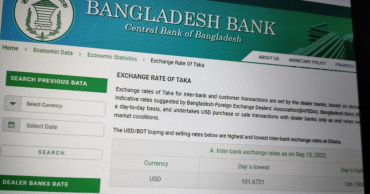
Bangladesh Bank (BB) suddenly changed the US dollar rate at the interbank exchange rate on Tuesday.
The central bank says that the selling price of the dollar in interbank transactions on Tuesday was Tk106.15. And in the interbank transaction, the purchase price of the dollar is Tk101.67.
But it is not the central bank rate, it is the dollar trading rate between the banks themselves. The price at which banks trade dollars is called the interbank rate.
Read: Uniform rate: Tk 108/dollar max for remittance, Tk 99/dollar for export income from tomorrow
Recently, the price at which the central bank used to buy and sell dollars was referred to as the interbank rate. The BB has been publishing that price on the website.
But today (Tuesday) the central bank suddenly changed the price. Last Sunday, the selling price of the dollar was shown at Tk95 on the website. Yesterday (Monday), the price of the dollar was increased by Tk1 to Tk 96.
Today (Tuesday) the selling price of the dollar is shown on BB’s website as more than Tk106. And the purchase price is showing around Tk102.
However, even today, the BB has sold $4.5 crore from forex reserves at the rate of Tk96.
Read: Illegal dollar trade: BB summons account details of 28 exchanges
The central bank officials say that the price at which banks will buy and sell dollars will be the interbank rate. That will be published on the website. But the central bank will not sell at this rate.
The BB Executive Director and Spokesperson Md Sirajul Islam told UNB, "The price of the dollar was increased to Tk 96 yesterday. Even today the central bank sold dollars at this price.”
He is not aware why the price of dollars is being shown so high on the website.
4 years ago

BB announces refinance scheme of Tk 25000 crore to boost small buisnesses
Bangladesh Bank (BB) has announced a refinancing scheme of Tk 25000 crore for cottage, micro, small and medium entrepreneurs.
Under this scheme, banks and financial institutions can disburse loans through their own branches, sub-branches, agent banking, and mobile financial services (MFS).
A BB circular in this regard was issued on Tuesday and sent to the top executives of banks and financial institutions.
Read: BB increases interest rate on borrowing from EDF
The circular stated that if it is possible to create opportunities to get money on easy terms for the entrepreneurs engaged in cottage, micro, small and medium industries or CMSME sector, it will accelerate the economic growth.
The title of the scheme is 'Refinance Scheme against Term Loan in CMSME Sector' will be supported by funds from own sources of the central bank.
The funds will be increased if necessary. Initially, the duration of the refinancing scheme will be three years.
Read FY23: Bangladesh Bank raises agro credit target to Tk30,911 crore
4 years ago

BB increases interest rate on borrowing from EDF
Bangladesh Bank (BB) has raised the interest rate on borrowing from the Export Development Fund (EDF).
The central bank on Wednesday fixed 1.0 per cent per annum to 1.5 per cent for Authorized Dealers (ADs) while the ADs will charge 3.0 per cent per annum on their USD loan disbursement to manufacturer-exporters.
The Foreign Exchange Policy Department of BB on Wednesday issued the circular and all authorized dealers in foreign exchange for immediate effect of the notification.
The size of EDF was increased to $ 7 billion from $ 6 billion to meet the growing demand among exporters in the immediate past fiscal year.
In June 2021, the EDF went up to $ 6 billion from $ 5.5 billion, while the fund rose to $ 5.5 billion from $ 5 billion in March of the year. It increased to $ 5 billion from $ 3.5 billion in April 2020.
Read: BB lets dealers to open foreign currency deposit accounts
The growing demand and low-interest rate of lending from the EDF prompted the central bank to increase the size of the fund.
Earlier on April 7, 2020, BB lowered the interest rate to 2 per cent on its EDF for the first time following a downturn in the country’s economic activities created by the Covid-19 pandemic.
Before that, the interest charge was a six-month London Interbank Offered Rate (LIBOR) plus 1.50 per cent.
Bangladesh established EDF in 1989, intended to facilitate financing in foreign currency for input procurements by manufacturer-exporters.
4 years ago

BB asks banks to keep branches open in Dhaka cattle market areas on July 8,9
Bangladesh Bank (BB) has instructed banks to keep open their branches and sub-branches in nearby areas of cattle markets in Dhaka north and south city corporations on Friday and Saturday.
The central bank set banking hours in these areas from 10.00 am to 8.00 pm on July 8 and 9 (Friday & Saturday) to facilitate the sacrificial animals’ traders.
The Banking Regulations and Policy Department (BRPD) of BB on Tuesday issued a circular in this regard and sent to the top executives of all the scheduled banks to take necessary measures.
Read: BB re-fixes mobile financial service money transaction limit
The circular stated that cattle traders are arriving in the capital from different parts of the country and banks have to arrange secured transfers of their money through banking service.
The BB also instructed banks to set bank booths at the cattle markets to secure transactions of money.
Banks are asked to maintain Covid-19 health guidelines at the bank booths as infections are increasing, the circular stated.
4 years ago

BB will announce new monetary policy on June 30
Bangladesh Bank (BB) will announce monetary policy for the new fiscal year (2022-23) on June 30 amid challenges of growing inflation rate and taka weakening against US dollar.
BB’s outgoing governor Fazle Kabir will announce the monetary policy physically through a press conference though it was announced virtually or just uploaded on the central bank website in the last two years due to the Covid-19 pandemic.
Read:More Bangladeshis are becoming rich despite pandemic and inflation: BB
Usually the BB formulates and publishes monetary policy for controlling inflation and achieving the desired GDP growth.
Monetary policy is very important in the financial management of the country. Through this, a plan is presented to increase or decrease the internal debt, money supply, internal resources, and foreign resources.
The BB has been facing several challenges this year to prepare a monetary policy as the time is very challenging for price hike of energy and essential commodities as well, said a senior official who works at the monetary policy department of BB.
Chief Economist of BB Md. Habibur Rahman told UNB that the government has set interest rates on bank loans and the exchange rate of dollars.
“There is nothing new in this year's monetary policy, but controlling the inflation rate will be given priority,” he said.
Experts said the government borrowing from banks and other domestic sources to make up the budget deficit will create a pressure on bank deposit and in the monetary policy should include measures to increase investment and employment.
4 years ago
.jpg)
Taka weakens further as BB sets new single exchange rate of USD at Tk89
The Bangladesh currency was further weakened by Tk1.10 against a US dollar as Bangladesh Bank (BB) on Sunday set the inter-bank exchange rate of the greenback Tk89.
The rate in case of the bills of collection (BC) or import was set at Tk89.15, to make the foreign exchange market stable, said the central bank announcing the depreciation for the 7th time this year.
Also read: BB to set uniform exchange rate to stabilize volatile dollar
Md. Serajul Islam, executive director and spokesperson of BB told UNB that the central bank has set a standard rate for interbank US dollar exchange, on basis of this exchange rate of other purpose will be fixed additional of Tk0.05 to Tk0.15.
The central bank set the unified dollar exchange rate on Sunday as per the meeting with Association of Bankers, Bangladesh (ABB), an association of banks’ CEOs-MDs and Bangladesh Foreign Exchange Dealers Association (BAFEDA) on Thursday, he said.
The new exchange rate will be executed from Monday (May 30), he said.
Several bankers who attended the meeting with the BB governor told the reporter that the central bank is trying to control dollar price which is actually not good for remittance and export income.
“Without acknowledging the reality, the central bank still wants to keep the dollar price below Tk90. Although in reality the dollar is being exchanged above Tk95,” the bankers said.
Earlier, BB governor Fazle Kabir assured dollar supply to the banks to meet the forex demand and bring back stability in the market.
He said a huge trade deficit has been created due to growing inflation and unstable US dollar rate.
Kabir said not only Bangladesh Bank, all government and private commercial banks have to work collectively to get relief from the situation.
Also read: Dollar rate: BB governor to hold meeting with bank MDs Thursday
In order to ease the dollar demand the central bank imposed a number of restrictions on imports including raised LC margin.
In line with the BB, the National Board of Revenue has also imposed over 30 per cent additional regulatory duty on import of luxury products.
Despite several initiatives the forex market has become volatile since April due to an increased rush for import LCs.
4 years ago
.jpg)
Bank officials can travel abroad for Hajj, treatment, foreign-funded workshop: BB
Bangladesh Bank (BB) has amended the bank officials'overseas travel restrictions a day after issuing the notification. The central bank's latest guideline in this regard has allowed bank officials’ travel abroad for Hajj-Umrah, treatment and other emergency purposes at his own cost.
Also read: BB depreciates taka by Tk 0.40 against US dollars
The BB instruction stated, "Travel ban was imposed from Bangladesh to abroad through a circular letter dated 22 May 2022, but restrictions were also imposed on travel to personal initiative also. Personal travel from Bangladesh for special needs, essential treatment, on its own funds will be out of the scope of the ban”. The Banking Regulation and Policy Department (BRPD) on Monday (May 23) issued the amendment of the notification and allows travel abroad for Hajj-Umrah, treatment and other special needs. Besides, foreign nationals working in the bank can go to their home country and officials working in the Bangladesh branch of the foreign banks can go to the head office.
Also read: BB moves to encourage greater flow of remittance to boost forex They will also be able to participate in training, meetings, seminars, workshops and study tours funded by foreign organizations. The BB has banned travel abroad for the officials of the central banks, private-state owned banks, financial institutions and leasing companies to curb the spending of forex.
4 years ago