Bangladesh
Father allegedly kills teen son, locks home from outside and flees in Joypurhat
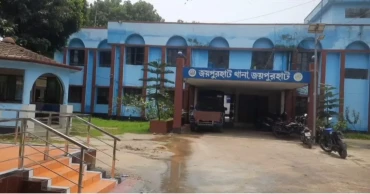
Police recovered the body of a 19-year-old male on Friday afternoon after his father allegedly strangled him to death following a dispute over a smartphone instalment payment and an ongoing family conflict in Joypurhat town. Police also detained the victim's stepmother for questioning.
The incident occurred in the Sagarpara area of the municipal town. The accused, identified as Lutfor Rahman, allegedly fled after locking the rented house from outside following the killing.
Police recovered the body of the victim, Naim Islam Yamin, 19, on Friday afternoon after being alerted by local residents. The body was sent to the Joypurhat 400-bed General Hospital morgue for an autopsy.
According to police and locals, Naim's family is originally from Nilphamari but had been living in a rented house in Sagarpara with his father and stepmother.
Naim had recently purchased a smartphone to be paid for in instalments. On July 29, an argument reportedly broke out between him and his father over payment of an upcoming instalment, during which Lutfor allegedly assaulted his son.
Police suspect that Lutfor strangled Naim sometime on Thursday night. After the alleged murder, he reportedly wrapped the body in a mattress, locked the room from outside and fled.
Md Nur-e-Alam Siddiqui, Joypurhat Sadar Police Station Officer-in-Charge (OC), said preliminary investigation suggests the victim was killed by his father following a family dispute linked to the smartphone instalment payment.
The accused remains absconding and a drive is underway to arrest him. The victim's stepmother, Banu Khatun, has been taken into police custody for questioning, while preparations are underway to file a murder case.
3 days ago
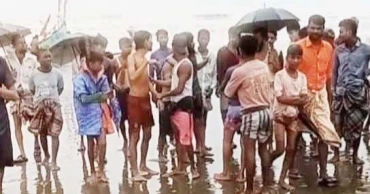
18 Rohingyas rescued after boat capsizes off Teknaf, unknown number missing
At least 18 Rohingyas were rescued alive after a boat carrying people fleeing Myanmar capsized in the sea off Teknaf while attempting to enter Bangladesh on Friday morning, with many others still reported missing.
The incident occurred around 12:00pm near the boat jetty at Poschim para of Shah Porir Dwip in Subrang union under Teknaf upazila.
The rescued Rohingyas were handed over to the Border Guard Bangladesh (BGB).
Rohingyas: US urges global partners to increase contributions
Md Ismail, Local fisherman, said they managed to rescue 18 people after the boat sank but many others remain missing. He said none of those rescued were women or children.
Lt Col Hanifur Rahman Bhuiyan, Commanding Officer of Teknaf-2 BGB Battalion, said 18 Rohingyas had been rescued following the boat capsize near Shah Porir Dwip and are now in BGB custody.
He said authorities are verifying the reasons behind their entry into Bangladesh, after which necessary legal steps will be taken.
3 days ago
Rohingyas: US urges global partners to increase contributions
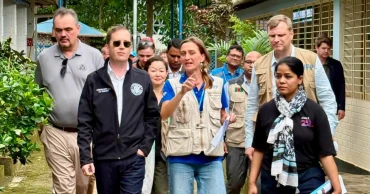
US Special Envoy for South and Central Asia Sergio Gor on Friday urged international partners to step up their support for the Rohingya camp in Cox’s Bazar, which is home to more than one million Rohingyas sheltered by Bangladesh.
"The United States has supported this camp and urges our partners around the world to increase their contributions," said Gor while visiting the Rohingya camp in Cox’s Bazar.
US Ambassador to Bangladesh Brent T Christensen, among others, was present.
Sergio Gor visits Rohingya camp in Cox's Bazar
"Today I visited Rohingya refugee communities in Cox’s Bazar with Ambassador Christensen. This is the largest refugee camp in the world, hosting over one million refugees," said the US Special Envoy.
He visited a Rohingya camp in Ukhiya of Cox's Bazar, leading a 14-member high-level delegation, reports UNB Cox’s Bazar Correspondent.
According to the Office of the Refugee Relief and Repatriation Commissioner (RRRC), the delegation arrived at Cox's Bazar Airport around 12pm and proceeded directly to the Rohingya camp in Ukhiya.
The delegation visited Camp-4, where they observed activities of the World Food Programme (WFP), including its humanitarian assistance operations for the displaced Rohingyas.
The US Special Envoy met Foreign Minister Dr Khalilur Rahman on Thursday evening and is scheduled to meet Prime Minister Tarique Rahman on Saturday.
"It was great to meet Foreign Minister Khalilur Rahman during my first visit to Bangladesh and discuss working together to strengthen the US-Bangladesh relationship. Lots of positive developments," Gor said on Thursday night.
Foreign Minister Dr Khalilur said bilateral relations between Bangladesh and the United States are moving in a very positive direction, noting that they will build on the achievements they have made so far.
"Our engagement with the US is not limited to one meeting. We remain engaged on all aspects and at all levels, and the relationship is moving forward," he told reporters at the Ministry of Foreign Affairs on Thursday night after his meeting with Gor at the State Guest House Padma.
The United States has updated its travel advisory for Bangladesh, and the improvement in the advisory "reflects growing US confidence" in Bangladesh's overall security environment and stability, Dhaka said on Thursday night.
The overall travel advisory has been lowered from Level 3 (Reconsider Travel) to Level 2 (Exercise Increased Caution), reflecting that Bangladesh is safer for travel, the Ministry of Foreign Affairs (MoFA) said.
The positive development follows the "productive" bilateral meeting held in Dhaka between Foreign Minister Dr. Khalilur Rahman and US Special Envoy for South and Central Asia Sergio Gor.
Immediately after the meeting, Gor conveyed the development to the Foreign Minister in a text message, the Ministry said.
"This evening, I informed Foreign Minister Dr. Khalilur Rahman that the State Department has taken into consideration the stable conditions on the ground and has deemed that Bangladesh is safer for travel. Accordingly, the United States' overall travel advisory has been downgraded from Level 3 to Level 2. A few areas have additional restrictions and should be avoided. Great news!" Gor said in a separate message.
Over the past six months, under the leadership of Prime Minister Tarique Rahman, the present government has achieved visible progress in strengthening law and order across the country, Dhaka said.
The decision also underscores the positive trajectory of the longstanding partnership between Bangladesh and the United States.
The government of Bangladesh views the improvement as recognition of its sustained efforts to ensure security, stability, and an enabling environment for international travel, trade, investment, and people-to-people connectivity.
3 days ago

'Strengthen breastfeeding support and health systems to give every child a healthy start in life'
Too many mothers and families around the world still lack access to services and interventions that enable and support breastfeeding.
Yet breastfeeding is one of the simplest and most powerful ways to protect a child’s health. It provides infants and young children with essential nutrition, increases immunity, helps protect against serious illness, and supports cognitive development.
UNICEF warns of growing climate threats to children worldwide
For mothers, breastfeeding brings important health benefits too, helping reduce the risk of noncommunicable diseases such as breast and ovarian cancers, and type 2 diabetes.
Encouragingly, breastfeeding rates around the world are going up. Exclusive breastfeeding in the first six months rose from around 37 per cent in 2012 to over 47 per cent today. In the past five years, the prevalence of breastfeeding up to two years of age rose from 38 per cent to 50 per cent.
These gains show that sustained investments in policies and programmes for mothers and families are working. Yet progress remains uneven, with many countries lagging behind global targets. Coverage of services supporting breastfeeding remains low, policies are inconsistently enforced, and service quality is often inadequate, especially in low-income, fragile, and humanitarian settings.
The evidence is clear: cost-effective interventions include skilled breastfeeding support in health systems, community-based counselling, maternity protection policies, and protection from the exploitative marketing of commercial milk formulas.
The returns are significant. Scaling up breastfeeding could prevent almost 400 000 child deaths and around 140 000 maternal deaths each year. Every US$ 1 invested in breastfeeding promotion generates an estimated US$ 59 in economic returns through lower health-care costs, improved cognitive development, higher educational attainment, and increased lifetime earnings.
This World Breastfeeding Week, under the theme, “Breastfeeding for a Sustainable Start in Life: Strengthen What Works,” UNICEF and WHO are calling on countries to:
strengthen health systems to provide quality breastfeeding support for mothers and newborns;
expand community-based counselling and peer programmes;
fully implement and enforce the International Code of Marketing of Breast-milk Substitutes;
invest in paid maternity leave and supportive workplace policies.
integrate breastfeeding interventions into antenatal, perinatal, and postnatal health-care services; and
sustain breastfeeding support in humanitarian and fragile contexts.
Breastfeeding is vital. By investing in proven solutions, we can give every child the best possible start in life and ensure every mother gets the care and services she needs.
3 days ago
DUTA demands withdrawal of punishment against 10 teachers
The Dhaka University Teachers’ Association (DUTA) has demanded withdrawal of punitive measures against 10 teachers, taken by the university’s last two syndicate meetings held on 22 June and 28 July.
The demand informed on Thursday thorough a notification signed by the president of the association Prof. Dr. Md. Nizamul Hoque Buiyan and the general secretary Prof. Dr. Zeenat Huda.
Alongside, the association urged to restoring the congenial environment of education through building a safe, orderly and merit-based campus.
DU suspends three teachers, relieves four others of duties
The notification mentioned that the association is strongly protesting against the recent decisions to permanent expulsion of one professor and relief of six professors from academic and administrative responsibility, taken by the syndicate meeting. DU is an autonomous institution. It’s conducted by the ‘Dhaka University Order, 1973’, not any order form the state machinery.
“According to the law, the university administration doesn’t have any authority to punish any teacher, officer and staff before the completely prove by the fact-finding committee and the tribunal,” the notification added.
The former ‘unelected administration’ of DU had followed a one-way policy by creating mob, the notification alleged. “Avoiding the Dhaka University laws and policies, 70-80 teachers have been restrained from their duties, and an initiative has been adopted to humiliate them socially by imposing various tags, which, basically, a form of mental and economical oppression.”
The notification said, university is such a place where diverse opinions, paths, philosophies and ideologies coexist. This is rare case of DU to take punitive measurements against the senior, wise and experienced teaches in the wake of changing political circumstance. Only, during the independent war of 1971, the brutal intellectual killing was taken place in DU to drain the brightest minds, as part of ethnic cleansing.
The association said that the political shifting is a normal democratic process. But, the culture of fear, panic and insecurity created in the teacher society by taking punitive actions, suppressing of dissenting opinion, compressing freedom of express, for the wake of political shifting, will be a bad instance in future.
To uphold the autonomy of Dhaka University and to ensure coexistence of teachers—regardless of political affiliation, opinion, gender, or religion, the association demanded withdrawal of these punitive actions.
Meanwhile, fresh question erupted at the campus as tenure of the Dhaka University Teachers’ Association’s running committee had ended on 31 December, 2024.
Following the boycott of the 2024 DUTA election by the BNP-aligned White Panel, the Awami League-backed Blue Panel was elected unopposed to all executive committee posts. No fresh election has been held since the July mass uprising.
According to DUTA constitution, the executive committee consists of 15 elected members. However, the association is currently being run only by its president and general secretary.
Of the 15-member executive committee, 11 members, including the vice-president, treasurer, joint secretary and other executive members, submitted their resignations to the president on 10 February 2025.
There also appears to be a discrepancy between the statements of the association’s president and general secretary regarding the issuance of Thursday’s statement. Although the statement carried the president’s name and signature, the general secretary did not obtain his full approval before releasing it.
DUTA President Prof. Dr. Md. Nizamul Hoque Buiyan said, “Usually, statements are issued by the general secretary. The digital signature is with the secretary. Whether the president’s name is included or not does not really matter. The Teachers’ Association is generally secretary-oriented. The statement was issued by the general secretary. My name is there... she contacted me once and said wanted to issue it in this way. I told her to take some time, but she went ahead and released the statement.”
He added, “the association practically has no members. Just the president and the secretary cannot constitute a teachers’ association. None of the other members are active. Out of the 15-member executive committee, 11 have resigned. One member had resigned earlier, one has passed away, and another has never been in contact with us. We have not even visited the association’s office for the last two years. This is not how a teachers’ association is supposed to function.”
Responding to the president’s remarks, General Secretary Prof. Dr. Zeenat Huda said, “I have already discussed that matter with him. I will not discuss it with you. It is an internal matter between us.”
On the issue of the committee functioning with only two office-bearers, she said, “I am accountable to the voters. We are acting in accordance with the constitution. There is nothing in the constitution that says the association cannot function with just two members. If he has said otherwise, that is his personal opinion.”
Regarding the election, Zeenat Huda said, “We have already requested an election. A letter signed by both the president and the general secretary was sent to Former VC Professor Niaz Ahmed. Why they have not arranged the election is a matter for them.”
According to Dhaka University Teachers’ Association constitution, the previous committee will carry on its work until a new committee takes over the charge of the office after fresh election.
3 days ago
DSCC administrator announces seven-day ‘crash programme’ in Kamrangirchar
Dhaka South City Corporation (DSCC) Administrator Md Abdus Salam on Friday announced a seven-day special ‘crash programme’ in Kamrangirchar to control dengue and other mosquito-borne diseases and ensure proper waste management.
He made the announcement while addressing worshippers after Friday prayers at a mosque adjacent to the Kamrangirchar Eidgah field today (Friday).
The DSCC administrator said a special crash programme will be conducted in Kamrangirchar for the next seven days to control dengue and other mosquito-borne diseases. Mosquito-control activities will be carried out every day during the programme.
“However, the City Corporation’s efforts alone are not enough. Citizens must also remain vigilant so that no stagnant water accumulates in their homes, yards or drains,” he said.
He said the Inner Circular Road project is being implemented to widen the Kamrangirchar road to eight lanes. Once implemented, the project will improve communication and transform the overall landscape of Kamrangirchar, he added.
Calling for collective efforts to protect the Adi Buriganga Channel, Salam urged residents not to dump waste and polythene into the river. He also called upon local people to play an active role in preventing encroachment on the river.
He urged people to build social resistance against drugs, extortion and land grabbing, while stressing the need to keep roads, drains and playgrounds free from encroachment and clean.
Regarding complications over the registration of the mosque, he assured that necessary measures would be taken after discussions with the relevant authorities.
He also called upon everyone to plant at least one tree to help protect the environment.
“There is no alternative to collective efforts to build a clean, green and liveable Kamrangirchar,” he said.
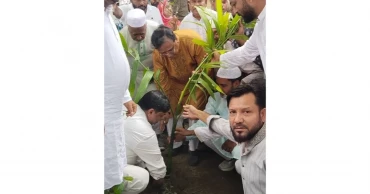
After his address, the DSCC administrator visited different areas of Kamrangirchar. Later, as part of the nationwide programme to plant 250 million trees, he planted trees at the Buriganga Public Library premises and along the bank of the Buriganga River.
Dhaka-7 lawmaker Hamidur Rahman Hamid and local leaders were present on the occasion.
3 days ago

PM inspects DNCC civic services, orders immediate corrective measures
Prime Minister Tarique Rahman on Friday carried out a firsthand inspection of waste management, drainage, greening and other civic services across the Dhaka North City Corporation (DNCC), identifying shortcomings on the ground and ordering immediate corrective measures.
During the visit, he closely observed the city corporation's cleanliness activities, tree plantation, greening initiatives, drainage system and overall urban management, said a press release issued by the PM’s Press Wing.
Tarique Rahman identified a number of problems at different locations, expressed dissatisfaction over several issues and directed the authorities concerned to take prompt and effective steps to address them.
He also gave necessary instructions to the officials responsible for improving civic services.
Before the inspection, the Prime Minister invited State Minister for Local Government, Rural Development and Co-operatives Mir Shahe Alam and DNCC Administrator Md Safiqul Islam to his residence around 3:30pm.
3 days ago
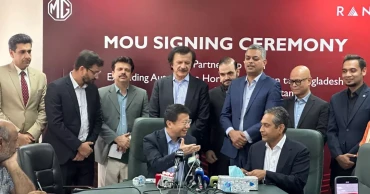
Pakistan to export automobiles to Bangladesh
Pakistan planned to export 100 vehicles to Bangladesh this year, while total exports are projected to reach 5,800 vehicles over the next four years, said the Pakistan High Commission in Dhaka on Friday.
A Memorandum of Understanding (MoU) was signed between MG JW Automobile Pakistan and Bangladesh's RANCON Group for the export of vehicles from Pakistan to Bangladesh.
Under the agreement, as informed by the Ministry of Industries and Production of Pakistan, 100 vehicles will be exported to Bangladesh during the current year, while total exports are projected to reach 5,800 vehicles over the next four years, said the High Commission.
The partnership is expected to benefit Bangladesh by expanding the range of vehicles available in the market, promoting healthy competition, and providing consumers with more choices at competitive prices.
The agreement will also contribute to closer economic cooperation between Pakistan and Bangladesh and encourage greater business-to-business collaboration.
Speaking on the occasion, Executive Director of RANCON Group, Muhammad Mostafizur Rashid Bhuiyan, said the agreement would introduce healthy competition in Bangladesh's automobile market while providing consumers with high-quality vehicles manufactured in Pakistan.
Special Assistant to the Prime Minister on Industries and Production, Haroon Akhtar Khan welcomed the agreement and expressed confidence that such partnerships would strengthen trade and economic relations between Pakistan and Bangladesh and open new avenues for cooperation between the private sectors of the two countries.
The ceremony was attended by senior officials of both companies, government representatives, and members of the business community.
3 days ago

EU provides €200 000 in response to severe monsoon in Chattogram division
The European Union (EU) is providing €200 000 in humanitarian funding to support people affected by severe monsoon rains in Cox’s Bazar, Chattogram, Bandarban, Rangamati and Khagrachhari districts.
This funding will benefit 125,000 Rohingya refugees as well as vulnerable host communities in some of the most affected areas, said the EU Embassy in Dhaka on Friday.
Death toll from floods, landslides rises to 57
This EU funding will support the Bangladesh Red Crescent Society in providing emergency shelter materials, as well as rebuilding damaged shelters.
It will also help to repair essential water and sanitation facilities, provide seeds and gardening supplies, and give cash assistance to affected families.
Women, girls and others facing heightened protection risks will receive dignity items, information and referral support.
The operation will also restore landslide protection through cash-for-work. Communities impacted by the heavy rains will receive further training to better empower them to be more prepare for floods, landslides and other emergencies infuture.
The funding is part of the EU's overall contribution to the Disaster Response Emergency Fund (DREF) of the International Federation of Red Cross and Red Crescent Societies (IFRC).
Since 5 July, intense rainfall linked to a monsoon depression triggered flooding and landslides in Chattogram Division.
As of July 13, over 1.1 million people were affected. Thirty people had died and more than 38,000 had been displaced.
The rains damaged shelters, water and sanitation facilities, access routes and other essential infrastructure in the Rohingya refugee camps and surrounding host communities.
In the camps alone, over 4,300 shelters and hundreds of water and sanitation facilities were reported damaged.
The EU and its Member States are the world's leading donors of humanitarian aid. Relief assistance is an expression of European solidarity with people in need all around the world.
3 days ago
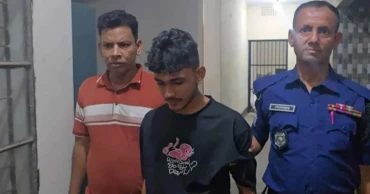
Youth in Feni held over harassing child in TikTok video
Police arrested a young man after a TikTok video showing the harassment of a six-year-old girl in Feni sparked outrage on social media.
The arrestee, identified as Mozammel Hossai Prokash, 20, is a resident of Maishail in Chandina upazila of Cumilla and currently lives with his family in a rented house near Uttar Silonia Madania Madrasa in Feni Sadar.
The two other accused were identified as Salman, 20, of Paschim Silonia, and Mahfuz, 19, of Jatrasiddhi area.
The incident took place on July 28 in Gobindapur under Feni Sadar upazila while the child was returning home from school. The video surfaced on social media on Thursday, drawing widespread criticism and prompting police action.
Police arrested the prime accused from the Lalpol area on Thursday evening.
Later that night, the victim's father filed a case under the Women and Children Repression Prevention Act with Feni Model Police Station against three youths.
According to the case statement, two of the accused allegedly blocked the child's path, held her hands, pulled her and harassed her, while another recorded the incident and later uploaded the video to TikTok.
The victim informed her father about the incident the following day. After learning that the video had gone viral, the family identified the accused with help from local residents and filed the case. The complaint said the child has been traumatised by the incident.
Feni Model Police Station Inspector (Investigation) Sajal Kanti Das said the video came to the attention of police after it spread on social media. He said Mozammel was shown arrested in the case, while efforts are underway to apprehend the remaining two accused.
3 days ago