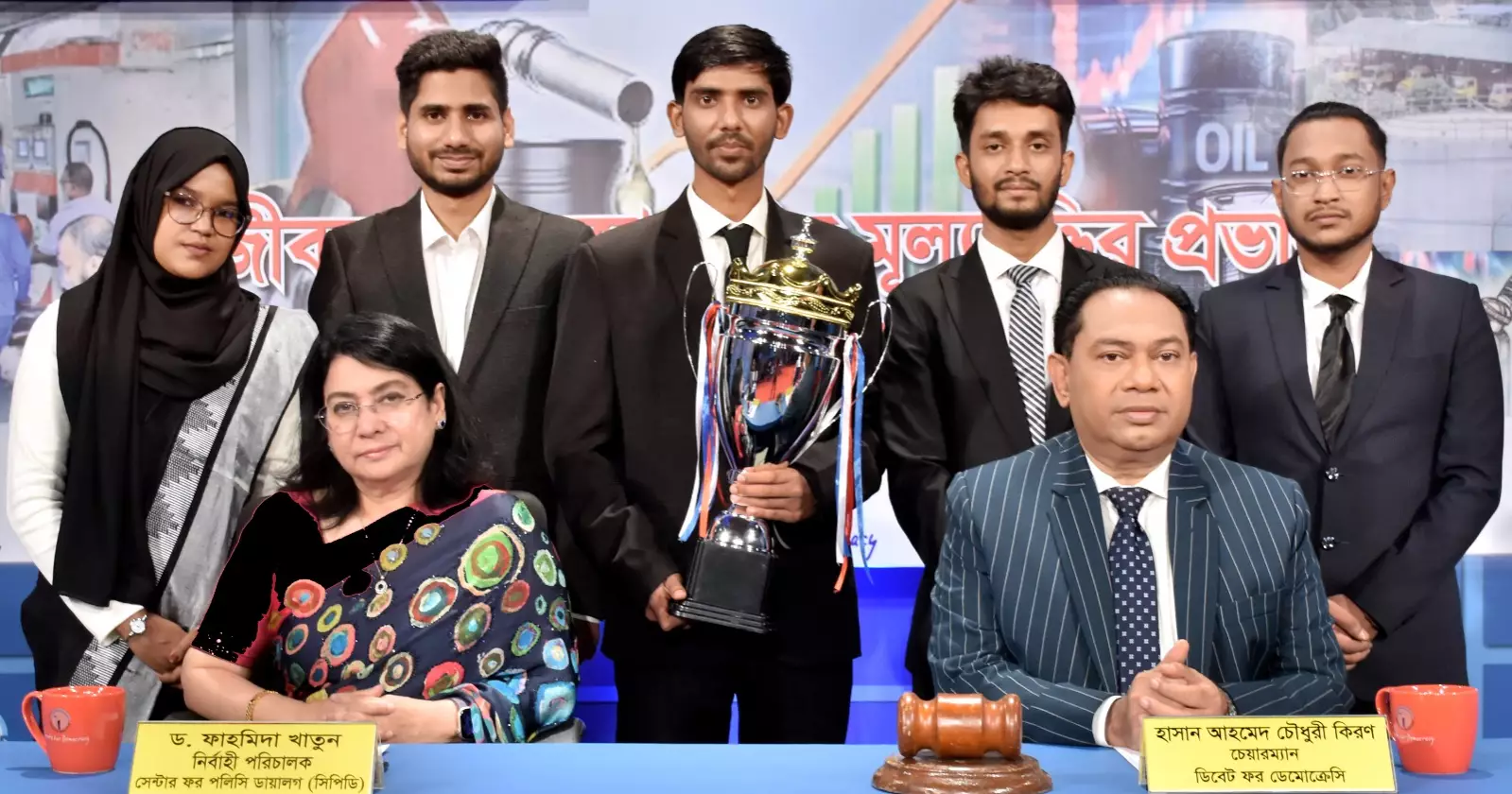
Dr. Fahmida Khatun, Executive Director of the Centre for Policy Dialogue (CPD), on Saturday warned that the government’s practice of borrowing from the central bank to meet budget deficits is ‘suicidal’ for the national economy.
Such borrowing fuels inflation and severely erodes the purchasing power of general public, she said at a shadow parliamentary debate organised by Debate for Democracy at the Bangladesh Film Development Corporation (FDC).
She urged the government to prioritise international sources instead of banking channels to mitigate deficit pressures.
Addressing the upcoming FY 2026-27 budget, Dr. Fahmida advocated for a ‘cost-effective’ budget with clear policy directions.
She called for a transition from wholesale subsidies to a target-based system, specifically prioritising sectors like agriculture, irrigation, and public transport.
"Wholesale subsidies in power and energy often benefit capable individuals who do not require them," she said suggesting that these funds be diverted to ensure food security.
The CPD chief lauded the government’s initiatives like the Family Card and Farmer’s Card under social safety net programmes but stressed the need for transparency.
"To reap the real benefits, accountability in beneficiary selection must be ensured to prevent the irregularities and corruption seen in the past," she added.
Dr. Fahmida recommended temporary waivers on VAT and taxes for imported essential goods to provide relief to citizens amidst global market volatility.
She cautioned that the impact would be limited if market management remains weak.
She also suggested adjusting domestic fuel prices in sync with the global market to ensure reductions reach consumers when international prices drop, increasing revenue through digital compliance rather than bank borrowing, boosting allocations for productive sectors and skill development programmes to address unemployment.
She also emphasised the need to enhance energy storage capacity to manage emergency situation.
Debate for Democracy Chairman Hasan Ahmed Chowdhury Kiron highlighted the severe economic challenges facing the country.
He noted that the current BNP government assumed office while grappling with the lingering impacts of the Russia-Ukraine war and the ‘economic scars’ left by the previous government.
“The government is struggling with an energy crisis, rising inflation, low investment, and a high volume of non-performing loans and foreign debt,” Kiron said.
He noted that while the government attempted to stabilise the market without raising fuel prices, it was eventually forced to adjust prices for diesel, petrol, octane, and kerosene in line with the global market.
Kiron revealed that the government incurred a loss of Tk 165 crore daily on fuel sales, totaling a loss of Tk 4,300 crore in April alone.
Without the price adjustment, the subsidy requirement would have reached Tk 12,000 crore by June, he added.
Debaters from Kabi Nazrul Government College (Government side) and Dhaka College (Opposition side) participated in the shadow parliament.
Trophies, crests, and certificates were awarded to the participants.
The panel of judges included Professor Abu Mohammad Rais, Dr. S.M. Morshed, Dr. Tajul Islam Chowdhury Tuhin, and journalists Abul Kashem and Maidur Rahman Rubel.
Kabi Nazrul Government College was declared the winner of the debate.