Bangladesh
BGB seizes Indian sarees, mobile displays worth Tk 11.5 m in Cumilla
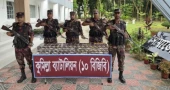
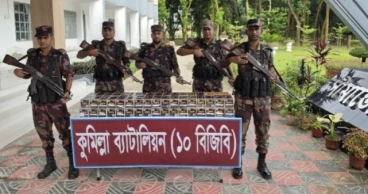
Border Guard Bangladesh (BGB) seized a large consignment of smuggled Indian sarees and mobile phone displays worth an estimated Tk 11.5 million in separate drives in Cumilla and Feni early Sunday.
According to a press release issued by Cumilla Battalion (10 BGB), the seizures were made during separate anti-smuggling operations conducted by special patrol teams of the Shiber Bazar Border Outpost (BOP) in Chauddagram upazila of Cumilla and the Gitabaria BOP in Feni Sadar upazila.
The operations were carried out around 4:30 am and 5:30 am as part of BGB's regular campaign to prevent smuggling and curb cross-border crimes.
During the drives, BGB personnel recovered a large quantity of ownerless Indian sarees from Chouara Bazar, about five kilometres inside Bangladesh from the border, and mobile phone displays from the Uttar Betiyara area, around 300 yards inside the border.
The total estimated market value of the seized goods is about Tk 11.5 million, the release said.
The confiscated items will be handed over to the customs authorities in accordance with the law.
BGB said its operations against smuggling and cross-border crimes along the frontier will continue.
1 day ago
Tension erupts between JCD and Shibir at DU over alleged homosexual incident
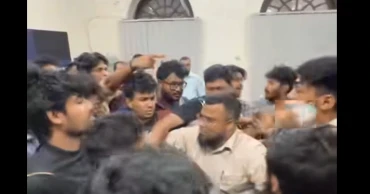
Tensions flared at Dhaka University's Dr. Muhammad Shahidullah Hall on Sunday as activists of the Jatiyatabadi Chhatra Dal (JCD) and Islami Chhatra Shibir engaged in a scuffle over the administration's handling of an alleged same-sex incident involving in the room of the hall's Assistant General Secretary (AGS), Ibrahim Khalil, also a Shibir activist.
The confrontation took place outside the provost's office during a meeting of an investigation committee formed after videos circulated on social media allegedly showing two outsiders in what was described as a "compromising situation" inside the AGS's room. Both student organizations traded accusations over the incident, while Shibir later staged a protest procession on the campus.
According to eyewitnesses, Ibrahim Khalil was summoned by the hall administration on Sunday afternoon in connection with the ongoing inquiry. At the same time, JCD leaders and activists, led by Shahidullah Hall unit Member Secretary Md. Junayed Abrar, gathered outside the provost's office, demanding the cancellation of Khalil's residential seat in the hall.
As Shibir activists present at the scene responded with counter-slogans, the situation quickly escalated, leading to a physical altercation between members of the two organizations. Both sides claimed that several of their activists sustained injuries.
Shahidullah Hall Students' Union General Secretary Towkir Hasan alleged that although the videos involving the visitors had been recorded five days earlier, no action was initially taken against those concerned. Instead, he claimed, the provost cancelled the AGS's hall seat without issuing any formal notice, allegedly under pressure from JCD.
Towkir further alleged that JCD activists entered the provost's office and attacked Shibir members who had attended the investigation committee meeting. He also criticized a reported remark by an assistant proctor describing the incident as an act committed "in the heat of the moment," saying such comments were inconsistent with the responsibilities of the university administration.
Rejecting the allegations, Shahidullah Hall JCD Convener Mosaddiq Al Haque Shanto claimed that Shibir was attempting to shield the accused AGS by spreading misinformation. He further alleged that CCTV footage from the day before the incident had been deleted, making it impossible to verify whether the AGS had been present at the scene.
Hall JCD Member Secretary Junayed Abrar also alleged that Shibir activists launched a sudden attack on JCD members when they went to the provost's office to demand cancellation of Ibrahim Khalil's seat for allegedly providing shelter to individuals involved in the incident.
Later in the evening, Shibir brought out a protest procession on the DU campus, accusing JCD activists of attacking members of the hall students' union. Addressing the rally, DU Shibir President Mohiuddin Khan alleged that JCD had repeatedly attacked the hall union leaders and urged the university administration to act more responsibly.
Dr. Md. Anwar Hossain Bhuiyan, a house tutor of Shahidullah Hall, said the scuffle occurred outside the provost's office while the investigation committee was in session. He said hall authorities later intervened and brought the situation under control. Repeated attempts to contact the hall provost for comment were unsuccessful.
University Proctor Associate Professor Israfil Ratan said a temporary tension had arisen surrounding the hall administration's investigation meeting but that the situation was now under control. He said the university's proctorial team responded promptly and an investigation into the clash was underway.
The latest unrest follows the circulation of several videos on social media on Saturday evening showing two outsiders allegedly detained in a "compromising situation" inside the Shahidullah Hall AGS's room, triggering widespread debate on campus.
1 day ago

Shama Obaed seeks enhanced global cooperation to prevent irregular migration
State Minister for Foreign Affairs Shama Obaed Islam on Sunday called for enhanced international cooperation to expand regular migration pathways and prevent irregular migration, promote ethical recruitment and strengthen the skills of prospective migrants in line with evolving international labour-market demands.
She sought IOM’s support in matching Bangladesh’s workforce, with global demand, promoting talent mobility and facilitating talent partnerships with destination countries, including in healthcare, caregiving and agriculture.
The issues were discussed when Deputy Director General (DDG) of Operations of the International Organization for Migration (IOM) Ugochi Daniels paid a courtesy call on her in Dhaka.
The IOM-DDG was accompanied by Iori Kato, Regional Director of IOM for Asia and Pacific, and Priya Marwah, Special Adviser to the IOM-DDG. Senior Officials of the Ministry were also present.
The State Minister underscored the importance of protecting the rights and welfare of migrant workers, particularly women, through awareness raising and appropriate support services.
Appreciating IOM’s assistance in evacuating and repatriating stranded Bangladeshi nationals from crisis-affected countries, Shama Obaed called for continued cooperation on safe return and sustainable reintegration, climate-related mobility, and coordinated action against human trafficking and migrant smuggling.
1 day ago

CIID foils smuggling attempt in consignment of undeclared garments
The Customs Intelligence and Investigation Directorate (CIID) has foiled an attempt to evade nearly Tk 60 lakh in customs duties and penalties by detecting a large quantity of undeclared garments in an imported consignment at Dhaka Custom House.
According to the CIID, a special team from its headquarters intercepted the consignment imported by M/S S.B Traders after receiving confidential information about possible misdeclaration.
The shipment, imported under Bill of Entry No. C-765485 dated July 30, 2026, was stopped just before clearance and subjected to a physical inspection.
During the inspection, officials found that the importer had declared 2,699 pieces of garments, while the actual quantity stood at 4,319 pieces, revealing an excess of 1,620 pieces, or 60.02 percent more than declared.
The inspection uncovered significant discrepancies across several product categories. Officials found 48 pieces of ordinary lehenga against the declared 29, 50 pieces of gorgeous lehenga instead of 13, 120 premium sarees against 112 declared, 803 super sarees instead of 112, and 900 medium sarees against the declared 179.
The CIID team also recovered 140 girls’ wear sets against 128 declared, 120 sherwanis instead of 18, and 124 T-shirts against the declared 94.
In another discrepancy, the importer declared 187 gowns, but inspectors found only 100 gowns along with an additional 87 ordinary lehengas, indicating that part of the consignment had been deliberately misdeclared.
The CIID said the operation prevented an attempt to evade customs duties and taxes amounting to Tk 31.71 lakh. Including an equivalent redemption fine, the total recoverable amount is estimated at nearly Tk 60 lakh.
A detailed report has been sent to Dhaka Custom House for necessary legal action.
The intelligence agency said it would continue surveillance and special operations against undeclared imports and customs duty evasion to safeguard government revenue and ensure transparency in import and export activities.
1 day ago
Man held for killing wife, mother-in-law in Dhaka
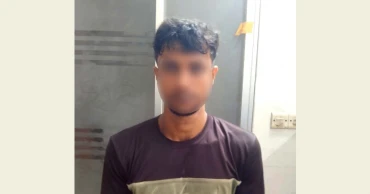
Police have arrested a man for allegedly killing his wife and mother-in-law in the capital's Kalabagan area following a family dispute.
Md. Hridoy, also known as Shipon, 30, was arrested hours after the incident, while police also recovered the sharp kitchen knife allegedly used in the killings.
The incident occurred on the fifth floor of a house on Alamin Road under Kalabagan Police Station on Sunday morning.
Quoting Kalabagan thana police, Additional Deputy Commissioner (Media) Mehedi of the DMP said Hridoy had been married to the victim for about five years and the couple had been experiencing frequent family disputes over various issues since their marriage.
At around 9:30am, he went to the house and became involved in another argument with his wife Ratri, 25.
During the altercation, he allegedly took a sharp vegetable-cutting knife from the kitchen and slit her throat.
When the victim's mother Firoza Begum, tried to save her daughter, the suspect allegedly attacked her repeatedly on the neck and shoulder with the same knife, killing her as well, the ADC media said.
The victims' brother, Yamin, witnessed the incident and informed relatives, according to Kalabagan Police Station.
Police said the suspect later attempted to flee with his one-year-old child but was detained by Kalabagan Police at around 5:00pm on Sunday.
A murder case has been filed with Kalabagan Police Station in connection with the incident.
1 day ago

Police arrest two with fake notes worth Tk 28 lakh
Police arrested two people with fake currency notes worth Tk 28 lakh in a raid in the capital’s Gulshan area on Sunday.
The arrestees are Al-Amin, 27, and Md Sohan Hossain, 26.
Niaz Mehdi, Additional Deputy Commissioner of Police of the Media and Public Relations Division of Dhaka Metropolitan Police, said that acting on a tip-off, a team of Gulshan Police learned that a group of people were staying in front of a house on Road No. 34 in Gulshan-1 area with a large amount of fake currency notes.
Later, police conducted a raid there around 4:10 pm and arrested Al-Amin and Sohan Hossain.
Fake notes worth Tk 28 lakh were recovered from their possession, he added.
Legal action is being taken against them, the police official said.
1 day ago
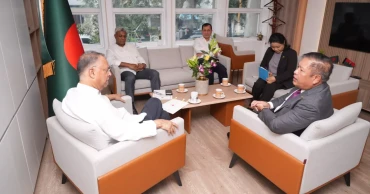
Bangladesh proposes importing gas from Myanmar via pipeline to boost energy security
Bangladesh has proposed importing natural gas from Myanmar via a cross-border pipeline to meet its growing domestic energy demand and deepen regional energy cooperation.
Minister for Power, Energy and Mineral Resources Iqbal Hasan Mahmud placed the proposal during a meeting with Myanmar Ambassador to Bangladesh U Kyaw Soe Moe at his Secretariat office on Sunday.
Highlighting the significant demand for natural gas within Bangladesh, Minister Mahmud stated that the country prioritizes enhancing energy collaboration with Myanmar as an immediate neighbor.
He expressed keen interest in retrieving and reviving the long-standing proposal to construct a gas pipeline connecting Myanmar to Chattogram.
In response, the Myanmar Ambassador welcomed Bangladesh’s proposal positively and noted that in addition to a pipeline, the feasibility of supplying gas in the form of Liquefied Natural Gas (LNG) could also be discussed in detail. The minister responded favorably to the LNG exploration suggestion.
To accelerate bilateral talks in the energy sector, Minister Mahmud proposed holding ministerial-level meetings between the two countries. He announced plans to extend a formal invitation to Myanmar’s Energy Minister to visit Bangladesh, adding that he is also prepared to travel to Myanmar if necessary.
Recalling Prime Minister Tariq Rahman’s recent official visit to China, the power and energy minister noted that a proposal was made to establish a China-Myanmar-Bangladesh Economic Corridor.
He emphasized that establishing a gas pipeline between Bangladesh and Myanmar would play a supportive role in facilitating that regional corridor.
Reiterating the government's commitment to long-term trade and energy cooperation, Minister Mahmud conveyed Prime Minister Tariq Rahman's sincere goodwill to strengthen bilateral ties under a "Neighbor First" policy, noting that numerous potential areas of cooperation remain to be explored between the two nations.
Myanmar Ambassador U Kyaw Soe Moe suggested that the proposals be thoroughly reviewed in upcoming meetings of the Bangladesh-Myanmar Joint Technical Committee.
State Minister for Power, Energy and Mineral Resources Anindya Islam Amit, Energy Secretary Mohammad Saiful Islam, and Power Secretary Mirana Mahrukh were also present during the meeting.
1 day ago
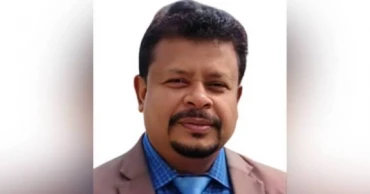
ACC secretary says corruption must be 'sent into exile' to ensure sustainable development
Newly appointed Secretary of the Anti-Corruption Commission Md Saidur Rahman Khan on Sunday said corruption must be "sent into exile" to ensure sustainable development, while pledging to restore public confidence in the anti-graft body through integrity, professionalism and dedication.
"The ACC has long faced criticism and suffered from a negative image. We want to change that perception. By overcoming the image crisis, we will work with honesty, professionalism and commitment to make the institution more people-friendly and a trusted public body," he told journalists after assuming office.
He made the remarks during a media briefing at the ACC headquarters around 3:30pm.
ACC Director General Mir Md Zainul Abedin Shibly, Deputy Director Akhtarul Islam and Assistant Director Tanzir Ahmed were also present.
Saidur Rahman said preventing corruption is one of the most important prerequisites for ensuring good governance and that the ACC must become a capable, impartial and citizen-oriented institution to play an effective role against corruption.
He said initiatives would be undertaken to ensure that people receive effective services from the ACC and that state resources are properly protected and utilised.
The newly appointed secretary said his immediate priority would be to gain a comprehensive understanding of the Commission's activities.
He said discussions would be held with officials and employees and, if necessary, a priority-based "crash programme" would be launched. He also said recommendations on institutional reforms would be reviewed and feasible measures implemented without delay.
Regarding the formation of a new Commission, Saidur Rahman said the search committee had almost completed its work and that the Commission would be finalised once the government's required procedures were completed.
He expressed hope that a full Commission would assume office very soon.
Responding to allegations that the ACC operates under the influence of the government or the ruling party, he said the Commission is an independent constitutional institution.
"The ACC will function in accordance with the law and in the interest of the people, not for any individual, government or political party," he said.
He acknowledged that people may have different assessments of the Commission's past performance, but said the new leadership's objective is to transform the ACC into an impartial, professional and credible institution.
"We have been saying from the outset that we are committed to bringing about a positive transformation in the ACC. That change will be visible, and people will see it," he added.
1 day ago
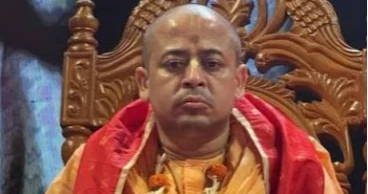
Chinmoy Krishna Das gets bail in two cases
Chinmoy Krishna Das Brahmachari, spokesperson of the Sanatani Jagaran Jote, has been granted bail by the High Court in two cases.
A High Court bench comprising Justice K M Zahid Sarwar and Justice Sheikh Abu Taher passed the order on Sunday, making the rules issued on the bail petitions absolute.
However, he will not be released from custody immediately as he is facing other cases, said Chinmoy’s lawyer Apurba Kumar Bhattacharya.
Deputy Attorney General Syeda Sazia Sharmin represented the state.
Apurba Kumar Bhattacharya said six criminal cases have been filed against his client. Of these, the trial is ongoing in the murder case over the death of lawyer Saiful Islam in Chattogram. Besides, a High Court stay order is in place on Chinmoy’s bail in the sedition case filed over the alleged desecration of the national flag.
The lawyer said the High Court granted bail in two of the remaining four cases, while hearings on bail petitions in the other two cases have been scheduled for August 16.
On November 26, 2024, a clash broke out in the Chattogram court area during Chinmoy Krishna Das’s bail hearing, leaving lawyer Saiful Islam dead. Several cases, including murder, attempted murder, assault, obstruction of government work and cocktail explosions, were filed over the incident.
Chinmoy Krishna Das was arrested in Dhaka on November 25, 2024, in a sedition case filed over the alleged desecration of the national flag.
He has remained in custody in connection with different cases since then.
1 day ago

Govt to implement July Charter, ensure trial over July killings: Mahdi Amin
Prime Minister’s Adviser Mahdi Amin on Sunday said the government is committed to implementing the July Charter and ensuring justice for the killings committed during the July mass uprising.
He made the remarks while addressing the first conference on the July Revolution, organised by the July Revolutionary Alliance (JRA) at the BIAM Foundation auditorium in the capital.
"I respect your emotions and demands. I assure you that the present government will implement the July Charter and ensure justice for the July massacre," he said.
Mahdi Amin said one of the government's key objectives is to fulfil the aspirations of the July uprising martyrs, who envisioned a Bangladesh based on equality, human dignity and social justice.
He said the martyrs had dreamed of building a truly sovereign Bangladesh where merit would be properly recognised and discrimination would have no place.
"We all have to work together to realise that ideal," he said.
The adviser said many people injured during the July uprising have yet to return to normal life.
"Some have lost their eyesight, while others have become permanently disabled. Many are still undergoing treatment," he said.
Mahdi Amin said the BNP government wants to stand beside the injured and the families of the martyrs with the highest level of sincerity, responsibility and compassion, while ensuring they continue to receive necessary long-term support.
He said after assuming office, Prime Minister Tarique Rahman has been leading efforts to build a discrimination-free, humane and democratic Bangladesh by upholding the aspirations, ideals and values of the July mass uprising.
At the same time, he acknowledged that the impact of 17 years of what he described as authoritarian rule cannot be completely eliminated within a short period.
"Even so, the government remains committed to building a just state in line with the sacrifices of the martyrs and the expectations of their families," he added.
1 day ago