Business
BanglaBiz unveiled as unified platform to ease investment in Bangladesh
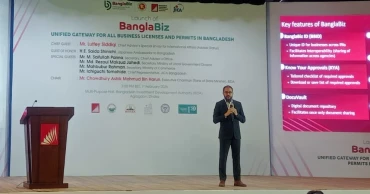
Bangladesh Investment Development Authority (BIDA) on Sunday launched BanglaBiz, a unified digital platform bringing all investment promotion agencies (IPAs) under one umbrella to facilitate domestic and foreign investments in Bangladesh.
The platform was formally unveiled at BIDA’s Multipurpose Hall in Agargaon with support from the Japan International Cooperation Agency (JICA).
Chief Adviser’s Special Envoy on International Affairs Lutfey Siddiqi and BIDA Executive Chairman Chowdhury Ashik Mahmud Bin Harun were present at the inauguration.
Speaking at the event, Lutfey Siddiqi said this platform would significantly reduce licensing complexities for businesses; through BanglaBiz, around 1.2 million instances of physical contact related to business and investment licensing could be eliminated annually.
“If the online system is strengthened, physical contacts can be reduced to zero. However, attention must be paid to avoiding server-related complications. Once full online capacity is achieved, offline licensing options will be withdrawn. This will resolve the longstanding hassle of visiting multiple offices for business licences through a single platform,” he said.
Mobile financial service transactions to be restricted for national election
Chowdhury Ashik said investors currently have to submit the same documents to multiple offices, often moving from one ministry to another for months due to paperwork-related complications. “This discourages investment in Bangladesh.”
Ashik also announced that following the launch of BanglaBiz, BIDA will introduce an NRB Desk dedicated to expatriate Bangladeshis, offering them maximum support in investing in the country.
According to BIDA, information on licences and permits is currently scattered across various government laws, policies and portals. BanglaBiz will consolidate these into a single platform, replacing nearly 60 separate government portals related to business services.
At present, obtaining approval to establish a business requires applications to four different government agencies through four separate portals.
Under BanglaBiz, this process will be completed through a single application on one portal. BIDA said the use of e-signatures will ensure that the entire process is completed without any physical contact.
BGMEA honours Hams Garments for achieving world’s highest score for green factories
BIDA has divided the rollout of BanglaBiz into three phases. From the launch phase, entrepreneurs will be able to apply through the platform and start their businesses within three days, with pilot projects initially launched in major cities.
During 2027–28, a unique business ID will be introduced for all businesses through BanglaBiz, alongside artificial intelligence-driven services. By 2029–30, the platform’s services will be expanded to the grassroots level, BIDA said.
6 months ago

Mobile financial service transactions to be restricted for national election
Bangladesh Bank is set to impose strict limits on mobile financial services (MFS) and internet banking transactions ahead of the upcoming national parliamentary elections.
Under the proposed measures, platforms such as bKash, Rocket, and Nagad will see a significant reduction in transaction limits to prevent the misuse of funds during the polls.
According to authoritative sources within the central bank, the restrictions are expected to be in effect from February 8 to February 13. The move aims to curb the illegal flow of money used to influence voters.
The Bangladesh Financial Intelligence Unit (BFIU) has submitted a proposal to the central bank following a request from the Election Commission. While the final figures are subject to minor adjustments, the current plan includes:
· Single Transaction Limit: A maximum of Tk1,000 per transaction.
· Daily Transaction Limit: A total of Tk10,000 per day.
· Frequency: A maximum of 10 transactions per day.
Currently, MFS users can send up to Tk 50,000 daily and Tk300,000 monthly. The temporary restrictions represent a drastic reduction from these standard limits.
The central bank is also considering a temporary suspension of Person-to-Person (P2P) fund transfers via banking apps and internet banking platforms. Popular services such as BRAC Bank’s ‘Astha’, City Bank’s ‘Citytouch’, Islami Bank’s ‘Cellfin’, and Dutch-Bangla Bank’s ‘NexusPay’ may be impacted.
At present, individual customers can transfer up to Tk10 lakh daily through these apps. The BFIU has proposed halting these transfers entirely during the election period to maintain financial integrity.
In addition to digital restrictions, monitoring of physical cash movement has been intensified since January 11.
Cash Transaction Reports (CTR): Banks must report any single or multiple transactions totaling Tk10 lakh or more in a single day to the BFIU.
Reporting Frequency: These reports must now be submitted on a weekly basis.
Penalties: Failure to report or providing inaccurate data will lead to punitive action under the Money Laundering Prevention Act.
When asked about these measures at a recent press conference, Bangladesh Bank Governor Dr. Ahsan H. Mansur stated that the central bank would take action once formal instructions are received from the Election Commission.
"If necessary, Bangladesh Bank will issue a circular to inform all banks, financial institutions, and MFS providers regarding the implementation of these measures," said Dr. Mansur.
Central bank officials warned that if any abnormal transaction patterns are detected in CTRs, the respective banks must take immediate action, or they will face disciplinary measures from the regulator.
6 months ago

Stocks open higher on Sunday as indices surge at DSE, CSE
Trading at the country’s stock exchanges began on a strong note on Sunday, the first trading day of the week, with key indices posting sharp gains at both the Dhaka Stock Exchange (DSE) and the Chittagong Stock Exchange (CSE).
At the opening, the DSE’s benchmark index DSEX rose by 25 points. The Shariah-based DSES advanced 8 points, while the blue-chip index DS30 gained 3 points.
Most stocks traded in the green as prices of 187 companies increased against declines in 138 companies, while shares of 63 companies remained unchanged.
During the first half of the session, shares and units worth more than Tk 300 crore were traded at the DSE.
Meanwhile, at the CSE, the overall index CASPI climbed by 100 points.
The prices of 61 companies rose, while 30 declined and 15 remained unchanged.
In the first half of trading, the CSE recorded transactions of shares and units worth around Tk 2.5 crore.
6 months ago

BGMEA honours Hams Garments for achieving world’s highest score for green factories
The Bangladesh Garments Manufacturers and Exporters Association (BGMEA) on Saturday accorded a special reception to Hams Garments Limited for becoming the world's top-rated green factory.
The ceremony, jointly organized by BGMEA and Hams Garments Limited, was held at the Nurul Quader Auditorium in the BGMEA Complex, Uttara. During the event, BGMEA Senior Vice President Inamul Haq Khan presented a special memento of honor to Engineer Shafiqur Rahman, Managing Director of Hams Garments Limited.
In his speech, Inamul Haq Khan revealed that Hams Garments Limited set a new world record by scoring 108 out of 110 in the USGBC LEED Platinum certification.
Read More: NBR links ASYCUDA World with BGMEA e-UD system to modernise bond management
"This is not just a number; it is currently the highest score achieved by any green factory in the world," said Inamul Haq Khan.
"This success has elevated the prestige of the 'Made in Bangladesh' brand to new heights and created a global benchmark for our apparel sector," he added.
While celebrating the achievement, industry leaders also discussed the practicalities of green manufacturing:
Access to Finance: BGMEA Director Faisal Samad emphasized the need to simplify the availability of the ‘Green Technology Fund’ to help more factories transition to eco-friendly operations.
Fair Pricing: Director Faruque Hassan noted that while Bangladesh continues to break its own records in LEED certification, the global market’s product pricing does not yet fully reflect the high costs and efforts of maintaining these green standards.
Read More: Uruguay could be a gateway for RMG exports to Mercosur: BGMEA
Ananta Ahmed, USGBC Consultant and Managing Director of 360 TSL, highlighted the technical milestones of the project, noting that Bangladesh is no longer just following sustainability trends but is actively setting the global pace.
The achievement further solidifies Bangladesh's position as the global leader in sustainable apparel manufacturing. Key statistics mentioned at the event include:
Total LEED-certified green factories in Bangladesh: 273
Platinum-rated factories: 115
Gold-rated factories: 139
69 out of the world’s top 100 highest-rated green factories are now located in Bangladesh.
Engr. Shafiqur Rahman, Managing Director of Hams Garments, shared the success story of his factory and expressed his gratitude to the BGMEA board. He noted that such recognition would inspire other industrial owners to take bold steps toward sustainable industrialization.
The event was attended by senior BGMEA officials, including Vice President (Finance) Mizanur Rahman, Director A.B.M. Shamsuddin, and representatives from the Institution of Textile Engineers and Technologists (ITET).
6 months ago

AI skills and digital financial literacy essential for sustainable industrial growth: Experts
Experts and industry leaders emphasized that entrepreneurs, managers, and young professionals must gain proficiency in Artificial Intelligence (AI) and digital financial literacy to ensure Bangladesh's industrial sector remains sustainable and globally competitive.
They made the remarks while speaking at a training workshop titled ‘AI for Finance and Digital Financial Literacy’ held on Saturday (January 31). The workshop was organized by the Bangladesh Chamber of Industries (BCI) in its office in Tejgaon I/A, Dhaka.
The speakers noted that AI is no longer confined to the tech sector. Instead, it is revolutionizing financial management, business operations, risk analysis, and financial inclusion in the era of the Fourth Industrial Revolution (4IR).
Anwar-ul Alam Chowdhury (Parvez), President of BCI, presided over the inaugural ceremony. He highlighted that adapting to AI is a necessity rather than an option for modern businesses.
"Financial literacy is no longer just about basic accounting; it is about secure digital transactions, data tracking, risk analysis, and the ability to make informed decisions using technology," said Anwar-ul Alam.
He added that BCI is committed to enhancing industrial capacity and preparing human resources to meet future challenges through technology adaptation.
Dr. Md. Helal Uddin, Secretary General of BCI, shared striking global statistics during the session.
He noted that currently, 63 percent of organizations worldwide have started using AI for finance. This figure is projected to rise to 84 percent within the next three years.
Preeti Chakraborty, Senior Vice President of BCI, welcomed the trainees and urged them to prepare themselves for a rapidly evolving global market.
The workshop featured two specialized technical sessions conducted by:
Md. Imdadul Islam, Senior Manager, NetCom Learning Bangladesh) and
Sanjoy Paul, head of financial literacy wing, Shimanto Bank PLC.
The first session focused on how AI ensures accuracy in financial operations through real-world examples. The second session addressed the necessity of digital financial literacy for personal use, small businesses, and large-scale corporate operations.
The event saw participation from 20 representatives across various BCI member organizations and industrial firms.
6 months ago
Dhaka Trade Fair wraps up with Tk 400cr in sales
The Dhaka International Trade Fair, the country’s flagship trade showcase, closed after a month on Saturday with sales of nearly Tk 400 crore, underscoring steady domestic demand despite pressure from inflation and a slowing economy, according to the Export Promotion Bureau.
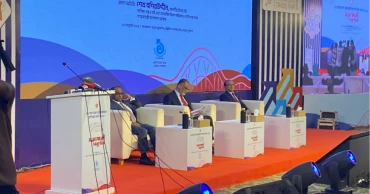
At the closing ceremony held at the Bangladesh–China Friendship Exhibition Centre in Purbachal, Narayanganj, the EPB said domestic transactions at this year’s fair amounted to Tk 393 crore—up 3.42 percent compared to 2025.
Based on data received from 329 participating local and foreign companies, the EPB reported that potential export orders secured during the fair stood at $17.98 million, equivalent to Tk 224.26 crore.
Sectors attracting export orders included diversified jute products, electrical and electronics goods, home appliances, cosmetics, hygiene products, processed food, handloom, household items, home textiles, nakshi kantha and fabrics. Export orders were received from Afghanistan, Singapore, Hong Kong, Indonesia, India, Pakistan, Malaysia and Turkey.
A total of 329 enterprises participated in the fair, including 11 companies from six countries—India, Turkey, Singapore, Indonesia, Hong Kong and Malaysia—besides Bangladesh.
Products and services on display and sale covered cottage, micro, small, medium and large industries, including garments, leather goods, jute and jute products, agricultural and agro-processed goods, furniture, electrical and electronic items, cosmetics, home décor, toys, stationery, crockery, handicrafts, plastic and melamine products, herbal and toiletry items, imitation jewellery, real estate products and services, fast food and various other services.
At the closing ceremony, awards were presented to the best pavilions, stalls and enterprises across different categories.
A total of 40 institutions were recognised based on criteria such as construction and architectural design, interior decoration, product display, customer service and satisfaction, compliance with allotment conditions, cleanliness and health standards, digital contents, contribution as exporters and manufacturers, and innovation.
To promote export diversification and enhance exporters’ capacity, eight seminars were organised as sideline events under a seminar series led by the EPB, in collaboration with the Ministry of Commerce, government trade promotion bodies (BSCIC, SME Foundation and JDPC), product-based trade associations (BPGMEA, BGAPMEA, BFPIA and BanglaCraft), and development partners including the World Bank, GIZ, FCDO and BSI.
The EPB said an Export Enclave was set up at the fair to showcase the capabilities of seven leading export sectors, keeping foreign buyers and local visitors in focus.
Facilities such as a Senior Citizen Corner, mother and child care centre, and a children’s park were arranged to make the fair more comfortable and enjoyable for visitors of all ages.
30th Dhaka International Trade Fair kicks off
Several voluntary organisations conducted health awareness campaigns during the fair. To ensure security, CCTV surveillance, deployment of law enforcement agencies and fire service units were in place.
The Directorate of National Consumers’ Rights Protection carried out regular drives throughout the month to ensure food quality and prevent consumer harassment, the EPB added.
Commerce Adviser Sk Bashir Uddin formally declared the fair closed, with Commerce Secretary Mahbubur Rahman presiding over the closing ceremony.
6 months ago

Gold sees sharpest one-day fall, down Tk15,746 per bhori
Gold prices in the Bangladesh market fell sharply again, with the price of 22-carat gold dropping by Tk15,746 per bhori (11.664 grams) in a single day, the Bangladesh Jewellers Association (Bajus) announced on Saturday.
In a morning notification, Bajus said the new price of 22-carat gold has been fixed at Tk255,617 per bhori, citing a decline in the local price of refined gold (tejabi sona).
According to the revised rates, 21-carat gold is now priced at Tk244,011 per bhori, while 18-carat gold stands at Tk209,136 per bhori. Gold made under the traditional method has been fixed at Tk171,869 per bhori.
Bajus noted that a mandatory 5 percent government VAT and a minimum 6 percent making charge set by the association must be added to the selling price. Making charges, however, may vary depending on the design and quality of jewellery.
Earlier, on January 30, Bajus reduced the price of 22-carat gold by Tk14,638 per bhori, fixing it at Tk271,363. As a result, gold prices in the local market have fallen by a total of Tk30,384 within two days.
Before the two consecutive price cuts, gold prices were raised by Tk16,213 per bhori on January 29, pushing the price of 22-carat gold to a record Tk286,001 per bhori—the highest ever in Bangladesh.
So far in 2026, gold prices have been adjusted 18 times, with prices increasing on 13 occasions and decreasing five times.
Silver prices have also been reduced. The price of 22-carat silver has been cut by Tk467 to Tk7,290 per bhori.
The price of 21-carat silver now stands at Tk6,940 per bhori after a similar reduction, while 18-carat silver has been fixed at Tk5,949 per bhori, down Tk408. Silver under the traditional method is now priced at Tk4,432 per bhori, following a Tk350 cut.
Meanwhile, global gold prices have seen a significant decline. In the spot market, gold fell by more than $434 per ounce in a day, dropping to $4,893 an ounce.
6 months ago

Gold price drops by Tk 14,638 per bhori in Bangladesh a day after record high
A day after hitting a record high, the prices of gold in Bangladesh fell sharply on Friday, with the Bangladesh Jewellers Association (BAJUS) cutting the rate by Tk 14,638 per bhori.
In a notification, BAJUS said it has fixed the price of 22-carat gold at Tk 271,363 per bhori (11.664 grams), effective immediately.
The jewellers’ body explained that the latest reduction comes following a fall in the price of pure gold (tejabi sona) in the local market.
According to the revised rates, the price of 21-carat gold has been set at Tk 258,999 per bhori, 18-carat gold at Tk 222,024 per bhori, while the price of traditional gold stands at Tk 182,833 per bhori.
Gold price skyrockets to Tk262,440 per bhori overnight in Bangladesh
In addition to the selling price, buyers will have to pay a mandatory 5 percent VAT set by the government and a minimum 6 percent making charge fixed by BAJUS. However, the making charge may vary depending on the design and quality of jewellery.
On January 29, BAJUS had raised the price of gold by Tk 16,213 per bhori, setting the rate at Tk 286,000 — the highest ever in the country’s gold market.
So far in 2026, gold prices have been adjusted 17 times, with increases on 13 occasions and decreases on four.
Alongside gold, BAJUS has also reduced silver prices. The price of 22-carat silver has been cut by Tk 816 to Tk 7,757 per bhori, marking the first reduction after four consecutive hikes.
Under the new rates, 21-carat silver will sell at Tk 7,407 per bhori, 18-carat at Tk 6,357 per bhori, while traditional silver has been fixed at Tk 4,782 per bhori.
Gold hits record high in Bangladesh as prices jump Tk 7,348 per bhori
Meanwhile, gold prices have also shown a downward trend in the global market.
In the spot market, gold was trading at around USD 5,600 per ounce on Thursday, which fell to about USD 5,100 on Friday — a decline of more than 4 percent within a day.
6 months ago

Stocks slide in early trade at DSE, CSE
Bangladesh’s stock markets posted losses in the first half of trading on Thursday, with key indices of both the Dhaka Stock Exchange (DSE) and the Chittagong Stock Exchange (CSE) moving lower.
On the last trading day of the week, the DSE’s benchmark index DSEX shed 13 points.
The Shariah-based DSES slipped by 2 points, while the blue-chip index DS30 fell 6 points.
Out of the traded issues, prices of 132 companies advanced, while 181 declined and 74 remained unchanged.
The turnover on the DSE in the first half of the session crossed Tk 270 crore.
The market also witnessed a downturn on the CSE, where the overall index CASPI dropped 23 points.
Indices extend gains despite lower turnover at Bangladesh bourses
On the port city bourse, share prices of 38 companies rose against declines in 56 companies, while 17 issues remained unchanged.
The turnover at the CSE during the first half of trading stood at over Tk 1.3 crore.
6 months ago

Amazon confirms 16,000 job cuts after internal email sent in error
US tech giant Amazon has confirmed it will lay off about 16,000 employees, hours after an internal email detailing the cuts was mistakenly sent to staff.
The email, seen by the BBC, was circulated late Tuesday and referred to job losses affecting employees in the United States, Canada and Costa Rica as part of efforts to streamline operations and strengthen the company. The message was quickly withdrawn, suggesting it had been shared accidentally.
Amazon formally announced the job reductions early Wednesday, saying the move is aimed at cutting bureaucracy and improving efficiency.
Beth Galetti, Amazon’s senior vice president of people experience and technology, said the company was not planning frequent, large-scale layoffs, referring to the 14,000 corporate job cuts announced in October. She noted that while many teams completed restructuring last year, others finalized their changes only recently.
Amazon employs about 1.5 million people worldwide, including roughly 350,000 in corporate roles. The company has not specified which divisions or countries will be most affected by the latest layoffs, reports BBC.
The accidental email, reportedly linked to an internal project codenamed “Project Dawn,” outlined Amazon’s ongoing effort to reduce management layers, increase accountability and move faster to meet customer needs. It acknowledged the difficulty of the decisions while positioning the changes as necessary for future growth.
Current and former employees said the layoffs had been anticipated for weeks, with expectations that total job cuts could reach around 30,000 through multiple rounds extending into the coming months. Affected workers were encouraged to apply for other openings within Amazon, though opportunities were limited, while severance packages were offered based on tenure.
Since founder Jeff Bezos stepped down as chief executive four years ago, his successor Andy Jassy has overseen several rounds of cost-cutting and introduced a stricter workplace culture, including a mandatory five-day office workweek. Amazon has also intensified efforts to curb expenses across its operations.
Earlier this week, the company announced plans to shut its remaining Amazon Fresh and Amazon Go grocery stores while expanding its Whole Foods Market business.
6 months ago