World
Jordan says air defenses intercept five missiles launched from Iran
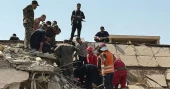
Jordanian air defenses intercepted five missiles launched from Iran early Thursday, the state-run Petra news agency reported, hours after the US military said it had carried out a major new wave of strikes against Iran.
No casualties were reported in Jordan following the missile interceptions, Petra quoted a spokesman for the Jordanian armed forces as saying.
The US Central Command said in a social media post that American forces had spent more than two hours striking “dozens” of targets linked to Iran’s Islamic Revolutionary Guard Corps.
The targets included military command centers, missile and drone facilities, and coastal surveillance and defense sites, according to the command.
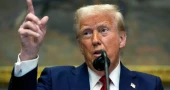
The strikes came hours after US President Donald Trump vowed to hit Iran “very hard” after Iranian forces targeted a US military base in Jordan.
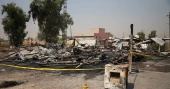
Iranian state media reported that two people were injured in attacks on Qeshm Island in the Strait of Hormuz. Explosions were also reported in Khuzestan province in southwestern Iran.
The latest escalation followed US and Saudi strikes on Iran-backed militias in neighboring Iraq on Wednesday. At least 20 fighters and six Iranian advisers were reportedly killed in those attacks.
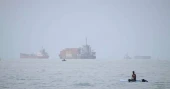
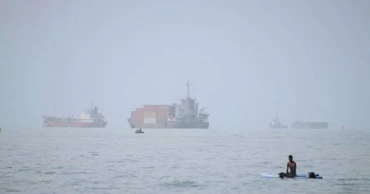
In another development, drone strikes set fire to two natural gas vessels at Egypt’s port of Damietta, British maritime security company Ambrey said.
It was not immediately known who carried out the attacks on a US-owned floating storage facility and a Greek-owned tanker. No injuries were reported.
The renewed violence on several fronts after days of relative calm raised fears that the conflict could again escalate into a full-scale war.
The developments also highlighted the challenges of ending a five-month conflict that has disrupted the global economy and become increasingly unpopular among Americans.
The continued fighting could also increase concerns that the US is using up its already limited stocks of advanced weapons needed to protect its military bases and allies.
5 days ago
US launches strikes on Iranian targets after foiling missile attack on American forces
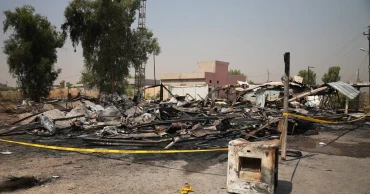
The US military said early Thursday that it had completed what it called “a heavy wave of strikes against Iran” in response to an earlier Iranian missile attack on a US base in Jordan.
US Central Command said in a social media post that over a two-hour period, US forces struck “dozens” of targets linked to Iran’s Revolutionary Guard Corps, including military command centers, missile and drone facilities, and coastal surveillance and defence sites.
The US military launched the retaliatory strikes on Iranian targets Wednesday following Tehran’s attack on American forces in Jordan. The strikes came after the US, together with Saudi Arabia, attacked Iran-backed militias in neighbouring Iraq, killing at least 20 fighters and six Iranian advisers.
The latest strikes came hours after US President Donald Trump vowed to hit Iran “very hard” after Tehran targeted a base in Jordan that hosts US troops.
Iranian state media reported that two people were injured in attacks on Qeshm Island in the Strait of Hormuz. Explosions were also reported in Khuzestan province in southwestern Iran.
Meanwhile, drone strikes set fire to two natural gas vessels at Egypt’s Damietta port, according to British maritime security firm Ambrey.
It was not immediately clear who was behind the attacks on a US-owned floating storage facility and a Greek-owned tanker. No injuries were reported.
5 days ago
US-Iran conflict enters new phase as Saudi Arabia joins strikes, diplomacy stalls
The stop-start conflict between the United States and Iran appears to have entered a new phase, with Saudi Arabia publicly joining military action against Tehran-backed proxies as diplomatic efforts to end the war once again falter amid deepening mistrust between the two longtime adversaries.
Despite several days of relative calm, both sides carried out military strikes over the past 24 hours, raising fears of a return to full-scale fighting and further regional escalation. At the same time, it remains unclear whether either Washington or Tehran has a clear strategy for ending the conflict.
While President Donald Trump and his allies have recently claimed that Iran is eager to return to negotiations, Iran's Deputy Foreign Minister said Tuesday that Tehran had made no request to resume diplomatic talks for more than two weeks.
After an attempted attack on a US base in Jordan was thwarted, Trump returned to threatening Iran on Wednesday while keeping open the possibility of further negotiations.
"They've already apologized, but, you know, we got to smack them a little bit," Trump told reporters in the Oval Office. "It's our turn, and we'll see if we get there with an agreement at some point. But we're going to hit them very hard."
Hours later, the US military said it had launched "a powerful response to yesterday's attempted Iranian attacks on U.S. forces based in the Middle East" in a social media post. It did not immediately provide details about the targets.
The latest developments reflect a pattern seen repeatedly over the past several months, with Trump alternating between saying a deal to end the war and address Iran's nuclear programme was close and issuing threats aimed at forcing Tehran to accept US demands.
The stakes are particularly high for Trump and his Republican Party as the unpopular conflict has disrupted the global economy only months before the crucial November midterm elections. Renewed fighting has also resulted in more US military casualties and raised concerns that Washington is depleting stocks of key air defence systems needed to protect its troops and allies.
Saudi Arabia enters conflict as Israel steps back
Iran said it fired ballistic missiles at Jordan's Muwaffaq Salti Air Base, a key US military facility in the region, over the past day. Trump said the missiles were intercepted.
Saudi Arabia, meanwhile, joined the United States in striking several logistics and weapons facilities used by Iranian-backed militias in Iraq.
The first publicly announced joint US-Saudi strikes came after drone attacks targeted Saudi Arabia, further complicating a conflict that now involves nearly every country in the region. A US official, speaking on condition of anonymity to discuss sensitive military operations, said the two attacks were not linked.
Saudi Defense Minister Khalid bin Salman was at the White House on Wednesday, where he separately met Trump and Vice President JD Vance, according to a person familiar with the matter who was not authorised to speak publicly.
Drone attacks also caused fires on two natural gas vessels at a port in Egypt, a close US ally and regional mediator. Egypt has so far been among the few Middle Eastern countries spared direct military action during the war.
If the attack is confirmed to have been carried out by Iran or its allies, it would represent a significant expansion of the conflict.
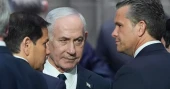
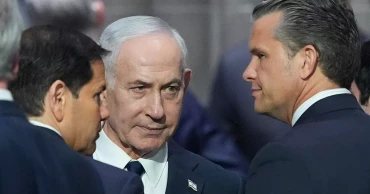
The US-Saudi strikes came hours after Israeli Prime Minister Benjamin Netanyahu left his first meeting with Trump since the two countries launched their war against Iran on Feb. 28.
An Israeli official briefed on Tuesday's White House meeting said Netanyahu assured Trump that the United States, rather than Israel, was leading the policy toward Iran. The comment appeared aimed at countering suggestions that Netanyahu was increasingly out of step with Washington over the way forward.
However, Israeli officials have privately expressed concern that Trump is seeking to keep the conflict at a low level as the midterm elections approach, according to a person familiar with internal discussions within Netanyahu's government. Both the person and the Israeli official spoke on condition of anonymity because they were not authorised to discuss the matter publicly.
The person said Israeli officials are also increasingly concerned about Trump's sensitivity to rising oil prices as the Strait of Hormuz remains effectively closed to global energy shipments. They are also worried about growing concerns within the US administration over the rapid use of critical missile interceptors.
The recent fighting with Iran has further reduced US stocks of Patriot and THAAD interceptors, which were already limited, potentially increasing risks to American troops if hostilities resume, according to an analysis released this week by the Center for Strategic and International Studies, a Washington-based think tank.
Gen Dan Caine, chairman of the Joint Chiefs of Staff, has also warned Trump that the condition of US munitions stocks could affect military operations against Iran, another US official said.
The official, who spoke on condition of anonymity to discuss sensitive conversations, said Caine delivered the message as part of his regular responsibility to provide Trump with military advice and options.
Failed diplomacy clouds prospects for US-Iran talks
The Trump administration currently appears to have no clear strategy for restarting negotiations with Iran over ending the conflict.
Although some mediators have been working to revive talks or establish conditions for their resumption, the administration is not actively pursuing negotiations at present, a senior US official said.
The official, who spoke on condition of anonymity to discuss internal deliberations, said recent developments in the region indicate that a return to direct diplomacy is not imminent.
Analysts say the uncertainty and lack of a clear strategy are rooted in deepening mistrust between Washington and Tehran, particularly after an interim ceasefire proposal agreed in mid-June collapsed in recent weeks.
Ali Vaez, Iran project director at the International Crisis Group, said senior Iranian officials had been nearly unanimous in approving the memorandum of understanding with the United States.
"But now none of them believe that Trump is a reliable negotiating partner," he said. "The problem, I think, is that Trump also has now the same impression about the Iranians."
The repeated cycle of negotiations, breakdowns and military strikes is not entirely unexpected.
US-Iran relations since the 1979 Islamic Revolution have been marked by failed negotiations, false starts and military actions that stopped short of full-scale war, although the two countries are now engaged in a much more serious conflict.
Despite its shortcomings, the 2015 nuclear agreement reached with Iran under the Obama administration was the first major agreement between the two countries since the Algiers Accords in 1981, which ended the US hostage crisis and established a framework for resolving other disputes, including the unfreezing of Iranian assets held by the United States since the Islamic Revolution.
However, both sides accused each other of violating the terms of the agreements from the outset.
Disputes over alleged violations of the Algiers Accords contributed to a period of intense hostility, including US support for Saddam Hussein's Iraq during the 1980-88 Iran-Iraq war.
Relations improved somewhat after the 2015 nuclear deal, but Trump's decision to withdraw from the agreement in 2018 during his first term, his "maximum pressure" sanctions campaign against Tehran and the US killing of Iran's top military commander Qassem Soleimani in early 2020 pushed relations to new lows.
5 days ago
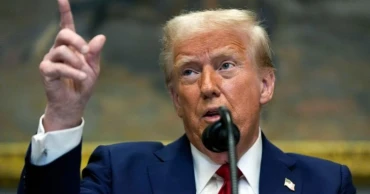
Trump threatens strikes on Iran after attacks on US forces
US President Donald Trump on Wednesday vowed a strong military response against Iran following ballistic missile attacks targeting American forces in the Middle East a day earlier.
"We'll be hitting them hard," Trump said in an interview with media. "They're going to get a beating."
Despite the warning, Trump said his administration would continue to allow Iranian officials to participate in ongoing negotiations.
Iraqi president condemns Saudi-US strikes on PMF as sovereignty violation
The US president also said he was considering issuing additional warnings to Iran-backed groups operating across the region.
Earlier, the US Central Command (CENTCOM) said US and Saudi fighter jets carried out strikes on several logistics and weapons facilities in eastern Iraq on Tuesday night. The operation came in response to more than 30 drone attacks allegedly directed by Iran's Islamic Revolutionary Guard Corps (IRGC) over the previous 72 hours.
Meanwhile, the Iraqi presidency strongly condemned the US-Saudi airstrikes targeting the country's paramilitary Popular Mobilisation Forces (PMF), describing them as "unacceptable aggression" and a "flagrant violation of Iraq's sovereignty."
5 days ago
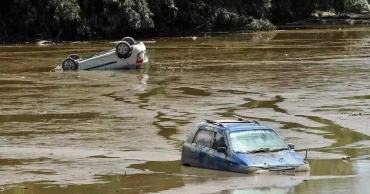
Assam floods leave 75 dead, eight missing
The death toll from the ongoing floods in India's northeastern state of Assam has increased to 75, while eight people remain missing, officials said on Wednesday.
Himanta Biswa Sarma, Assam Chief Minister, said Sivasagar district recorded the highest number of fatalities at 37, followed by Charaideo with 20 deaths and Jorhat with nine.
The floods have affected 2,185 villages in 25 districts, impacting more than 1.14 million people across the state.
Authorities have established 215 relief camps, providing shelter to 71,312 displaced people. In addition, 1,718 relief distribution centres have been opened in the flood-hit districts to support those affected.
According to Sarma, the disaster has completely destroyed 1,368 residential houses, while another 11,066 homes have sustained partial damage.
The Assam State Disaster Management Authority said more than 45,341 hectares of cropland remain under floodwaters.
5 days ago
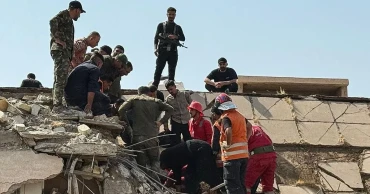
Iraqi president condemns Saudi-US strikes on PMF as sovereignty violation
Iraqi President Nizar Amedi has strongly condemned the Saudi-US strikes targeting the Popular Mobilisation Forces (PMF) in Iraq, describing the attacks as a serious breach of the country's sovereignty.
In a statement, Amedi called the deadly strikes "unacceptable" and said they constituted a "blatant violation of Iraq's sovereignty," accusing the attackers of targeting the country's official security institutions in violation of international law and the United Nations Charter.
Jordan intercepts Iranian missiles as US, Saudi forces strike militia targets in Iraq
The Iraqi president stressed that Iraq's territory must not be used as a launchpad or battlefield for attacks against neighbouring countries or as a venue for resolving regional or international conflicts.
He also called on all parties to respect Iraq's sovereignty and avoid any actions that could threaten the country's security and stability.
With inputs from Al Jazeera
5 days ago
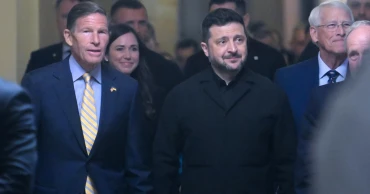
Ukraine says it strikes major Russian oil refinery after Zelenskyy-Trump talks
Ukraine said Wednesday that its forces struck one of Russia's largest oil refineries overnight, intensifying military and economic pressure on Moscow just hours after President Volodymyr Zelenskyy met US President Donald Trump in Washington.
Ukraine's General Staff said the overnight drone strike set fire to the Ryazan oil refinery, one of Russia's largest refining facilities, with an annual processing capacity of about 17 million tons of crude oil. The plant produces gasoline, diesel, aviation fuel and other petroleum products.
The refinery is located in Russia's Ryazan region, roughly 400 kilometres from the Ukrainian border.
The latest attack is part of Ukraine's sustained campaign of long-range drone and missile strikes targeting Russia's energy infrastructure. Kyiv has increasingly relied on domestically developed weapons to hit oil depots and refineries deep inside Russian territory, seeking to disrupt fuel supplies and increase economic pressure on the Kremlin.
The strike came hours after Zelenskyy's visit to Washington, where he held talks with Trump as Ukraine seeks continued US military, financial and diplomatic support in its war against Russia.
Ryazan regional governor Pavel Malkov said six people were hospitalized following the drone attack. He said debris from downed drones caused fires at several unspecified industrial facilities but did not directly confirm damage to the refinery.
In a social media post, Zelenskyy said Russia must continue to bear increasing costs for the war.
"Russia must feel that every day of this war will only come at a higher cost for it. We need to weaken the aggressor and keep up the pressure to bring an end to this war closer," he said.
Ukraine's recent long-range strikes against Russian military and energy targets have been viewed as a demonstration of its growing domestic defense capabilities. The operations have also helped strengthen support in Washington after uncertainty earlier in Trump's second term over the future of US assistance to Kyiv.
5 days ago

Australian researchers develop AI tool to predict bowel cancer relapse
Researchers have developed an artificial intelligence (AI) tool that could help identify patients at greater risk of recurrent bowel cancer, potentially enabling earlier life-saving treatment.
The AI algorithm, called SEMIL (Semantically-Enhanced Multiple Instance Learning), analyzes routine pathology slides using both images and written descriptions to assess tumor growth patterns associated with cancer recurrence, according to a statement released Wednesday by Australia's La Trobe University.
Researchers analyzed more than 1,600 pathology slides and validated the findings across 1,220 stage-two bowel cancer patients in three independent cohorts from multiple Australian institutions. Bowel cancer is the third most common cancer worldwide.
The study, published in the journal Gastroenterology, found that when AI-based assessments and pathologists' evaluations aligned, they produced the most accurate predictions of relapse risk.
Lead author Francis Magisson from La Trobe University said the technology could help identify which stage-two cancer patients are at higher risk of relapse and may need closer monitoring or additional treatment such as chemotherapy. Current Australian clinical guidelines recommend chemotherapy after surgery only for patients considered at high risk of recurrence.
The research highlighted the growing role of AI in supporting precision medicine, the researchers said, adding the tool could be "integrated into existing digital pathology workflows without requiring expensive new tests or tissue samples to provide more consistent and objective assessments of cancer pathology."
5 days ago

Japan's national population hits 42-year low
The total population of Japanese nationals in Japan fell below 120 million for the first time in 42 years to 119,736,483 as of Jan. 1 this year, government data showed Wednesday.
The figure marked a decline of 917,000 people compared to the previous year, the largest drop since comparable data became available in 1968, according to data from the Ministry of Internal Affairs and Communications.
Of Japan's 47 prefectures, Tokyo was the only one that recorded an increase of 0.09 percent in the number of Japanese nationals, data showed.
The number of foreign residents, meanwhile, increased 354,000 to a record 4,031,159. The figure is the highest since the ministry began taking count in 2013.
Japan's total population, including foreign residents, stood at 123,767,642, down by approximately 563,000 from the previous year. Population growth was reported only in Tokyo, Chiba and Osaka prefectures.
5 days ago

Russia charges Telegram founder Pavel Durov with aiding terrorism
Russia's Federal Security Service (FSB) said Wednesday it has charged Telegram founder Pavel Durov with aiding terrorism and placed him on an international wanted list, escalating Moscow's campaign to tighten control over online platforms.
The move comes as Russian authorities continue to impose restrictions on Telegram, one of the country's most widely used messaging apps, amid a broader effort to strengthen state oversight of the internet since the start of the war in Ukraine in February 2022.
In a statement, the FSB accused Telegram's management of failing to remove numerous channels, chats and bots allegedly used by Ukrainian intelligence agencies and groups designated by Russia as terrorist or extremist organizations to coordinate acts of sabotage, terrorism, cyberfraud and other attacks that resulted in casualties.
The agency also claimed Ukrainian security services had used a Telegram-based dating chatbot to recruit Russians for sabotage and terrorist activities. According to the FSB, 46 users of the chatbot, aged between 12 and 22, have been detained across Russia since July 2025 on allegations including attacks on law enforcement officers and arson.
Earlier this year, Durov disclosed that Russian authorities had opened a criminal case against him, accusing the government of manufacturing grounds to restrict Telegram in an attempt to curb privacy and freedom of expression.
If convicted, Durov could face a maximum sentence of life imprisonment under Russian law.
Telegram did not immediately comment on the latest charges. According to the company's website, Telegram is headquartered in Dubai, where Durov—who holds French and United Arab Emirates citizenship—also resides.
Under President Vladimir Putin, Russia has steadily tightened control over the internet through restrictive legislation, website bans and technological measures aimed at monitoring online traffic. Popular platforms including Facebook, Instagram and X have been blocked, YouTube has been slowed, while Signal and Viber have been banned. Access to WhatsApp and Telegram has also been restricted.
Durov previously founded the Russian social media platform VK before launching Telegram. Russia unsuccessfully attempted to block Telegram between 2018 and 2020.
Although many users continue to bypass internet restrictions through virtual private networks (VPNs), Russian authorities have also sought to block many VPN services.
At the same time, Moscow has been promoting a state-backed messaging platform known as MAX, which officials describe as an all-in-one service for messaging, government services and digital payments. Critics, however, say the platform could facilitate government surveillance, noting that it shares user data with authorities upon request and does not provide end-to-end encryption.
Durov has also faced legal scrutiny outside Russia. In 2024, he was arrested in Paris over allegations that Telegram had been used for criminal activities, including drug trafficking and the distribution of child sexual abuse material. He later said he returned to Dubai in March 2025 after spending several months in France.
Following Durov's arrest in France, the Kremlin criticized the French authorities, describing their actions as "selective" while questioning why similar action had not been taken against other technology platform operators facing comparable allegations.
5 days ago