
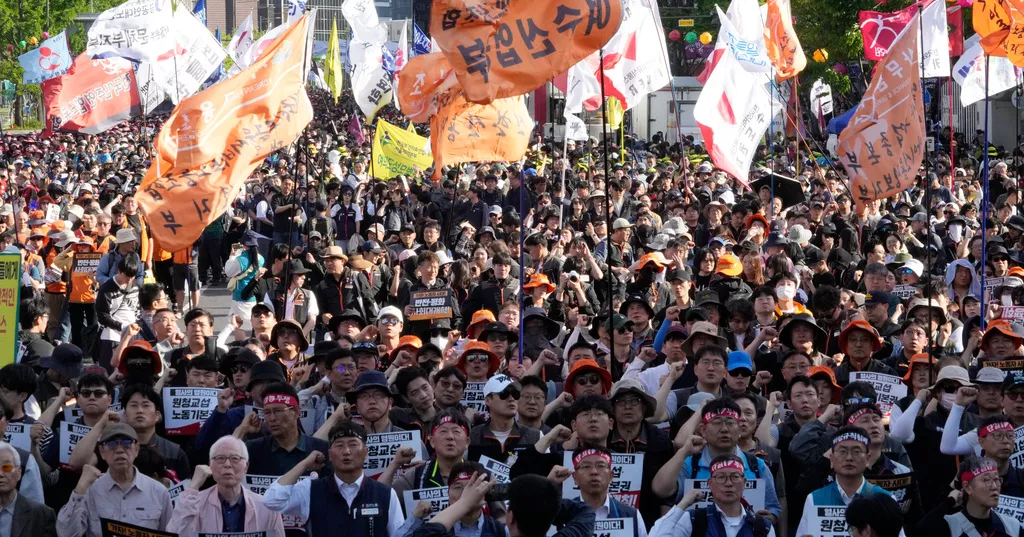
Workers and activists across the world marked May Day with rallies and protests on Friday, demanding higher wages, better working conditions and peace, as many face rising energy costs and declining purchasing power linked to the Iran war.
International Workers’ Day, observed on May 1 in many countries, traditionally sees trade unions mobilising around labour rights, wages, pensions and inequality. This year, demonstrations were held in cities ranging from Seoul, Sydney and Jakarta to European capitals and across the United States.
"Working people refuse to pay the price for Donald Trump's war in the Middle East," the European Trade Union Confederation said. "Today's rallies show working people will not stand by and see their jobs and living standards destroyed."
Rising fuel prices and inflation emerged as key concerns during the protests. In Manila, thousands marched demanding higher wages and lower taxes while criticising the United States’ role in the Iran conflict. Some protesters clashed with police near the US Embassy.
"Every Filipino worker now is aware that the situation here is deeply connected to the global crisis," said Josua Mata, leader of the SENTRO labour group.
In Indonesia, President Prabowo Subianto joined a major rally in Jakarta, where workers called for stronger government support amid rising prices and shortages of industrial raw materials.
In Pakistan, although May Day is a public holiday, many daily wage earners continued working due to financial pressures.
"How will I bring vegetables and other necessities home if I don't work?" said Mohammad Maskeen, a construction worker near Islamabad.
Inflation, driven partly by rising oil prices, has reached around 16 percent in Pakistan, according to government estimates.
Elsewhere, protests took place across Europe. In Istanbul, police detained around 15 people attempting to reach Taksim Square in defiance of a ban. In France, unions organised marches under the slogan “bread, peace and freedom,” linking domestic concerns with global conflicts.
In Italy, the government recently approved nearly 1 billion euros in job incentives aimed at boosting employment and addressing labour abuses, though opposition parties criticised the measures as ineffective.
In Portugal, labour tensions remain high over proposed changes to employment laws, with unions warning the reforms could weaken workers’ rights.
In France, May Day also sparked debate over whether more businesses should be allowed to operate on the public holiday, which is traditionally a mandatory paid day off for most workers.
"Don't touch May Day," unions said in a joint statement opposing proposed changes.
Activists in the United States also organised protests and boycotts, targeting policies of President Donald Trump. Demonstrators called for taxing the wealthy and ending strict immigration measures, with organisers urging people to observe a “no work, no school, no shopping” protest.
May Day traces its origins to the US labour movement of the 1880s, when workers campaigned for an eight-hour workday. A protest in Chicago in 1886 turned violent, leading to deaths and the execution of several labour activists, events that later inspired the global observance of International Workers’ Day.