lifestyle

Toyota RAV4 vs Hyundai Tucson: Which plug-in hybrid SUV is the better choice?
You want to cut fuel costs but are not ready to switch to a fully electric vehicle, the 2026 Hyundai Tucson Plug-in Hybrid and the 2026 Toyota RAV4 Plug-in Hybrid could be good options.
Both SUVs combine a conventional hybrid system with a rechargeable battery, allowing drivers to travel a certain distance using only electric power. Regular charging at home can help reduce petrol consumption. But which of these two popular compact SUVs offers better overall value? Edmunds tested both vehicles to find out.
Range and fuel economyThe Toyota RAV4 Plug-in Hybrid has a clear advantage in electric range and fuel efficiency.
Toyota estimates that most RAV4 Plug-in Hybrid trims can travel up to 54 miles using only electric power, while the sportier GR Sport is rated at 48 miles. In Edmunds' real-world test, however, the GR Sport managed an impressive 58 miles before the battery was depleted.
After the battery runs out, the RAV4 is estimated to deliver up to 40 mpg in combined city and highway driving, a figure that Edmunds also found realistic in its testing.
The Tucson Plug-in Hybrid trails behind, with an EPA-estimated electric range of 32 miles and fuel economy of 35 mpg after the battery is depleted. Although it performed slightly better than those estimates in Edmunds' testing, it could not match the RAV4's advantage.
Winner: Toyota RAV4 Plug-in Hybrid
Passenger comfort and cargo spaceThe two SUVs offer similar cargo capacity, although the RAV4 has a slight edge in the plug-in hybrid versions.
The RAV4 provides 33.6 cubic feet of cargo space behind the rear seats, compared with 31.9 cubic feet in the Tucson. Edmunds found both cargo areas spacious and practical, with their boxy shape making it easier to load luggage and other items.
However, the Tucson offers significantly more room for rear-seat passengers. It has 41.3 inches of rear legroom, compared with 37.8 inches in the RAV4. The difference is noticeable for adults, teenagers and families using child seats.
Edmunds' testers also found the Tucson's front seats softer and more supportive. Its ride quality over rough roads was also more comfortable than that of the RAV4.
Winner: Hyundai Tucson Plug-in Hybrid
Technology featuresBoth SUVs performed exceptionally well in Edmunds' infotainment testing, receiving scores of 9.7 out of 10 for usability and connectivity.
The RAV4 features a newer and improved infotainment system compared with other Toyota models. However, some important functions, including navigation and voice controls, depend on an internet connection and may require a paid subscription after the free trial ends.
The Tucson includes these functions directly in its system without requiring an internet connection, although its navigation search is not as capable.
Hyundai provides a standard 12.3-inch central touchscreen. Toyota offers either a 10.5-inch display on lower trims or a larger 12.9-inch screen on higher-end models.
Overall, the technology packages are closely matched.
Winner: Tie
Pricing and valueBoth SUVs start at just over $42,000, including destination charges, and their prices rise to around $50,000.
At the top end of the price range, the Tucson comes with nearly all available features. A similarly equipped RAV4 XSE requires additional options, pushing its price above $52,000.
Edmunds also rated the Tucson's interior more highly, citing better-quality materials and a more premium look and feel. Hyundai also offers stronger basic and powertrain warranty coverage than Toyota.
Winner: Hyundai Tucson Plug-in Hybrid
Style and choiceToyota offers buyers more options.
Besides the SE and XSE trims, the RAV4 Plug-in Hybrid is also available in the more adventure-focused Woodland version and the sportier GR Sport model. These choices give buyers more flexibility in terms of styling, capability and driving character.
The Tucson Plug-in Hybrid, meanwhile, is available only in SEL and Limited trims. Hyundai's more rugged-looking XRT version is not offered as a plug-in hybrid.
For buyers looking for more variety and distinctive styling, the RAV4 offers more choices.
Winner: Toyota RAV4 Plug-in Hybrid
Edmunds saysThe competition is close, with the Tucson standing out for passenger comfort, interior quality, value and warranty coverage.
However, the RAV4 Plug-in Hybrid's biggest strengths are the features that matter most to many plug-in hybrid buyers: a longer all-electric driving range and better fuel economy.
For drivers mainly focused on reducing fuel use and making the most of electric driving, Edmunds says the Toyota RAV4 Plug-in Hybrid is the better overall choice, despite the Tucson's advantages in comfort and value.
8 hours ago
'Poet of the soil' Al Mujahidi remembered at Bangla Academy seminar
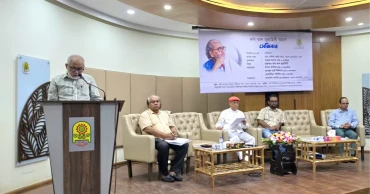
Noted poet Al Mujahidi was remembered at a seminar at the Bangla Academy on Wednesday, with speakers recalling his distinctive contribution to Bangla poetry and lifelong engagement with the soil, people and struggles of Bangladesh.
The Bangla Academy organised the seminar at 4pm at the Kobi Shamsur Rahman Seminar Room of the academy.
Bangla Academy Secretary Dr Md Selim Reza delivered the welcome address, while poet and essayist Dr Mahbub Hasan presented a paper titled ‘Mrittikar Kobi Al Mujahidi’.
National Press Club President and poet Hasan Hafiz and Dainik Jugantor Editor and poet Abdul Hai Shikder took part in the discussion. Bangla Academy Director General Professor Mohammad Azam chaired the event.
The programme began with a one-minute silence in memory of the late poet.
"Al Mujahidi is an unforgettable name in Bangla poetry. In his poems, the soil and people of this country have been illuminated with exceptional artistry," Dr Selim Reza said.
Presenting his paper, Dr Mahbub Hasan said, "One way to know Al Mujahidi is through his poetry. His inner world is reflected there, and we can experience its fragrance."
He said Al Mujahidi devoted himself to a long poetic journey through his works on Hiroshima and Nagasaki.
"It began in 1963 with ‘Kaado Hiroshima, Kaado Nagasaki’, written while he was imprisoned at Dhaka Central Jail," he said.
"From 1988 to 1999, he sharpened his pen to portray the brutality of imperialist destruction and crimes against humanity. This poetic journey proves how, with immense vitality, he used his sharp thoughts against the naked violence of human history," Dr Mahbub said.
Referring to Al Mujahidi’s widely recognised identity as the ‘poet of the soil’, Dr Mahbub said, "He created the soil in his poetry in many ways and in many forms. He felt a profound attraction towards that primordial soil from which this earth was formed, as well as towards the golden gateways of Gaur and the attics of civilisation."
"Although he sometimes spoke of living among heaps of stars, ultimately he spoke of returning to the soil," he added.
The discussants said Al Mujahidi was simultaneously a poet, translator, essayist, editor and intellectual fighter who gave Bangladesh and its people distinctive expression through his poetry.
They said he portrayed the fighting spirit and unique heritage of the people of this land throughout his literary career. As the literary editor of Dainik Ittefaq for many years, he also played a legendary role in nurturing and guiding many talented writers.
They further stated that the fearless fighter of the national liberation struggle consistently used his poetic voice to speak of peace, humanity, equality and a modernity rooted in the soil.
Poet’s daughter Paroma Al Mujahidi said, "My father always illuminated the country and its people through his poetry. Undoubtedly, his literary works will inspire the new generation in language, literature and patriotism."
Professor Mohammad Azam said, "Al Mujahidi was a unique personality in the field of poetry in Bangladesh. Alongside illuminating indigenous modernity in his poetry, he also explored foreign mythology for expressions of human fellowship."
"He left his distinctive mark through prose writings on poetry, translations of important poems from different languages into Bangla, and children’s literature," he said.
"His contribution to the history of literary magazine editing in this country can never be forgotten," Bangla Academy Director General added.
Sayera Habib, Bangla Academy Deputy Director, moderated the programme.
20 hours ago

Shilpakala Academy to host training workshop on magic, followed by evening show
Bangladesh Shilpakala Academy (BSA) is set to organise a three-day magic training workshop and a magic evening as part of its initiatives to promote and develop magic as a performing art in the country.
The training workshop, organised by the academy’s Training Department, will be held from September 3 to 5 at Rehearsal Room 105 of the National Music, Dance and Recitation Building.
Magician Shaheen Shah will serve as the chief instructor, while Abu Sadat Md Mamun will work as an instructor and Sarmin Sultana Islam will provide training on the language and presentation style of magic.
The workshop will run from 10 am to 4 pm each day and will have 30 participants.
The three-day programme will conclude with a special event titled ‘Jadusandhya’ (Magic Evening) at the National Theatre Hall on September 5 at 6:30 pm.
Nitai Roy Chowdhury, Minister for Cultural Affairs, will attend the event as the chief guest, while Bangladesh Shilpakala Academy Director General poet Sheikh Rezauddin Ahmed (Rezauddin Stalin) will be present as the special guest. Academy Secretary Mohammad Zakir Hossain will preside over the event.
Chief instructor and magician Shaheen Shah will deliver the welcome address, while Training Department Director Shaheen Dil-Riyaz will deliver the vote of thanks.
The magic performance will remain open to all.
1 day ago
As Spain bakes, centuries-old hand fans make a comeback
As Spain endures another scorching summer, an age-old accessory has returned to prominence, offering a simple and effective way to beat the heat.
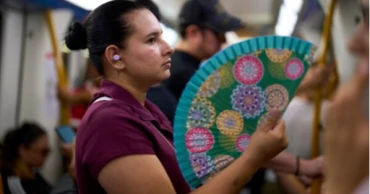
The traditional Spanish folding hand fan, known as an abanico, is once again a common sight in packed metro trains, busy squares, concerts and outdoor festivals. Compact enough to carry in a handbag, the fan opens into a half-circle and produces a refreshing breeze with a quick movement of the wrist.
With a series of heat waves sending temperatures across Western Europe soaring this summer, the humble fan has become almost indispensable. People of all ages, including an increasing number of men, are now using them to stay cool. During Madrid’s Pride celebrations in July, brightly colored rainbow fans were particularly visible among the crowds.
On a hot August day, 20-year-old Ana Feliu used a paper fan she had received at a festival in Valencia to shield herself from the sun. She said she takes it with her whenever temperatures rise.
“This one is my favorite because it’s the biggest, but I have many more,” Feliu told The Associated Press near Madrid’s Puerta del Sol. Temperatures in the Spanish capital were forecast to climb to 39 degrees Celsius (102 Fahrenheit) later that week.
Nearby, 53-year-old David González was also cooling himself with an abanico decorated in shades of pink, purple and red.
González said he initially felt somewhat awkward carrying the traditionally feminine accessory, but eventually embraced its practicality.
“At first, I felt a little self-conscious, because it’s something that’s mainly associated with women, but I have to admit it serves a purpose — and it brightens my day,” he said.
A tradition with Asian originsAlthough closely associated with Spanish culture today, the folding fan has roots far beyond Europe.
Historians believe it arrived in Europe through Portuguese maritime trade with Asia during the 15th and 16th centuries. The accessory soon found its way into European art. Spanish master Diego Velázquez depicted a woman holding what appears to be a delicate folding fan in his 17th-century painting The Lady with a Fan.
As fans became fashionable among European royalty and aristocrats, Spain developed its own manufacturing tradition. Madrid became a major production centre, while Valencia emerged as the country’s leading fan-making hub during the 18th century.
Mary Kitson, a curatorial consultant at London’s Fan Museum, said advances in printing helped make fans more affordable during that period.
The fan eventually became deeply embedded in Spanish social life. By the 19th century, women in aristocratic circles could supposedly communicate romantic interest, flirtation or disapproval through carefully choreographed movements of the fan — a practice popularly known as the “language of the fan.”
The accessory later crossed the Atlantic and became popular in Latin America. In the 19th century, flamenco performers adopted the abanico as a dramatic prop, incorporating it into dance movements influenced in part by Cuban music and dance traditions.
Over time, its role in flamenco helped establish the hand fan as one of the enduring visual symbols of Spain.
For flamenco dancer Carmen Torres, 44, the fan remains both practical and expressive.
“The fan is a perfect element because, on the one hand, it evokes the heat and humidity of Cuba — that heavy, oppressive feeling,” she said. “And at the same time, it gives us a way to bring out the seductive, coquettish quality.”
From historic stores to tourist stallsAt Casa de Diego, a traditional wood-panelled shop in Madrid, the Llerandi family has been selling abanicos for more than 150 years.
“We live from the heat,” said Javier Llerandi, whose family business has benefited from the latest bout of extreme temperatures.
The shop sells fans made in Spain, ranging from relatively simple wooden designs to elaborate, hand-painted creations made from mother-of-pearl and decorated with intricate floral motifs.
Prices start at around 30 euros ($35), while more elaborate pieces can cost between 200 and 500 euros (up to $580). The most exclusive fans can command prices of as much as 6,000 euros (nearly $7,000).
According to Llerandi, the cost reflects not only the materials but also, more importantly, the skill and time required to make each piece.
Madrid’s popularity as an international tourist destination has also brought foreign buyers into the shop. Llerandi said many customers appreciate the traditional fans as a practical alternative to battery-powered portable devices.
“Battery-run items eventually run out of power, and always at the worst possible moment,” he said with a smile. “Without a doubt, heat waves are good for this business.”
For tourists looking for a cheaper souvenir, plastic fans decorated with printed designs are widely available at kiosks across the city, often for just a few euros. Vendors say sales have been strong during this summer’s heat.
Near one of Madrid’s large bullrings, Juani Duran sells wooden fans featuring traditional floral patterns for about five euros each.
Because bullfights are held in open-air arenas and spectators traditionally dress formally for the occasion, the elegant hand fan remains a natural accessory.
“You’ll usually find a hand fan in any woman’s pocket — and in some men’s, too,” Duran said before a bullfight in late August.
She acknowledged that the inexpensive fans she sells are not particularly durable.
“They’re not the best quality,” she said, “but they’ll get you through the summer.”
1 day ago

Italy turns invasive blue crab crisis into export opportunity
Italian fishermen are trying to turn an environmental disaster into a business opportunity as they find new markets for invasive Atlantic blue crabs that have devastated clam and mussel farms in the Po River Delta.
For two years, most of the crabs caught by fishermen were incinerated because Italians showed little interest in eating the species, which is blamed for destroying large numbers of prized Manila clams.
But the strategy is now changing. Instead of destroying the crabs, fishermen are exporting them, helping some communities recover from huge financial losses caused by the invasion.
The Polesine Fishermen's Cooperative Consortium saw its revenue fall by 75% to 15 million euros ($17 million) in 2024 and 2025. Its active membership also dropped from 1,500 to 850.
“We needed to change strategy and create an opportunity from this disaster,” said Paolo Mancin, president of the cooperative.
The new approach appears to be paying off. The consortium has sold every blue crab it has caught so far this year, eliminating the need to incinerate them. It expects revenue to reach 20 million euros ($23 million) this year, with crab sales accounting for most of the income.
“Since we're going to have to live with these crabs, I hope they become an opportunity,” said fisherman Federico Zago. “I hope the market continues to grow.”
The Atlantic blue crab has been present in the Adriatic Sea since at least the 1940s, likely arriving in ships' ballast water. However, its population remained relatively limited until 2023.
Then its numbers surged dramatically. The crabs damaged fishing nets, consumed large numbers of mollusks and pushed aside the native green crab, a popular local delicacy.
Experts say climate change helped create favourable conditions for the species. Rising water temperatures supported reproduction, while drought lowered water levels in the Po River, allowing more seawater to enter freshwater areas.
The changing water conditions created an ideal environment for blue crabs, especially in lagoons and deltas where clam and mussel farms provided an abundant food supply.
Italy launched an eradication programme in 2024 and paid fishermen to catch and incinerate the crabs. Over two years, the Polesine cooperative alone collected and destroyed nearly 2.3 million kilograms of blue crabs.
But the programme had little impact because female blue crabs can produce up to 8 million eggs in a season. The government has since shelved the eradication effort.
Scientists are also testing other ways to control the population. This summer, researchers at the University of Bologna released 150,000 baby octopuses into the Adriatic Sea, hoping they would prey on the crabs.
However, experts remain doubtful that predators alone can control an animal with such a high reproductive rate.
Meanwhile, fishermen are increasingly relying on exports.
Every morning, fishermen unload large crates of live blue crabs, which are later steamed, frozen and packed for shipment to Sri Lanka. There, workers process the crab meat by hand before it is exported to other markets.
The joint venture between Sri Lankan company Taprobane Seafoods and the Scardovari consortium produces several crab products, including claw meat, mixed meat and fillets. Only a small portion is currently returning to Italy.
Still, blue crab remains far less profitable than the clam industry. Fishermen receive about 1.30 euros per kilogram for crab, compared with around 10 euros per kilogram for clams, which once generated about 90% of their income.
Efforts are also underway to persuade Italians to eat the invasive crab.
Most restaurants around Venice still avoid blue crab, partly because of the work needed to prepare it and its negative reputation.
But the Yogi restaurant and bar in Porto Tolle, near the Po Delta, has fully embraced it.
Owner and chef Stefania Marchesini, a former professional fisherwoman, now offers an all-crab menu featuring fried crab balls, creamed crab with polenta, soft-shell crab and other dishes.
“At first, the customer is very skeptical. But then the reaction is completely positive, and they want to try the entire range of products,” she said.
Marchesini is also processing blue crab for sale to other restaurants, although demand has remained limited.
Despite the resistance, she believes attitudes will gradually change.
“We are all angry because it invaded our seas,” Marchesini said. “But we also have to eat. Once people understand how it should be prepared, they will realize it is an excellent product.”
1 day ago
Kuntal Barai’s ‘Anatomy of Transit’ explores Dhaka’s movement and urban realities
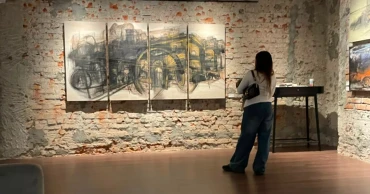
The constant movement, congestion and psychological pressures of life in Dhaka take centre stage in contemporary artist Kuntal Barai’s upcoming solo exhibition, Anatomy of Transit, opened recently at Plat-forms Gallery in Gulshan.
The exhibition, featuring paintings, drawings and mixed-media works, explores the relationship between movement, infrastructure, urban pressure and the everyday experiences of people living in the rapidly changing metropolis.
Running from August 15 to September 5, Anatomy of Transit examines how the systems and rhythms of the city shape the ways people move, wait, negotiate and survive within its increasingly dense urban environment.
At the heart of the exhibition is Dhaka itself, portrayed not simply as a physical landscape but as a living organism in constant motion.
In Barai’s visual interpretation, roads resemble arteries, intersections function like vital organs, while vehicles become symbols of an urban body that remains perpetually active yet frequently under pressure.
Traffic, crowds, buildings, roads, bridges and fragmented spaces appear throughout the works, reflecting both the physical and psychological realities of navigating one of the world's most densely populated cities.
The artist’s compositions bring together fragments of roads, vehicles, architectural structures, human figures and abstract forms, creating layered visual narratives that capture the density and fragmentation of contemporary urban life.
While rooted in observation, Barai’s works move beyond documentary representation to explore movement as both a physical and metaphorical experience.
The exhibition considers movement as a reflection of aspiration, displacement, uncertainty, routine and the constant negotiation between individual lives and collective urban existence.
“Anatomy of Transit is not only about traffic or transportation. It is about the human condition within a city that is always moving,” according to the exhibition concept.
“The exhibition asks how we navigate spaces that are constantly changing and what happens to our sense of identity, memory and belonging within that movement.”
Through the exhibition, everyday elements of urban travel take on new meanings. A road becomes more than a route, a traffic signal represents a moment of pause, a vehicle becomes a temporary space of isolation, while an intersection turns into a point where countless individual narratives meet.
The exhibition ultimately presents Dhaka as both infrastructure and lived experience, revealing the energy, contradictions, vulnerabilities and aspirations embedded within the city's constant movement.
Kuntal Barai is a contemporary artist whose practice engages with urban environments, social realities and the visual complexities of everyday life. Through painting, drawing and mixed media, he explores the relationship between people and the rapidly transforming spaces they inhabit.
Anatomy of Transit will remain open for the visitors till September 5 from 11 am to 8 pm at Plat-forms Gallery, House 12/B, 5th Floor, Road 55, Gulshan 2, Dhaka.
2 days ago

A guide to choosing chrysanthemums for a colourful fall garden
September marks the transition from summer to fall, and while many summer flowers are still blooming, gardeners are beginning to turn their attention to one of the season's most popular plants — the chrysanthemum, commonly known as the mum.
Most mums sold in ready-made containers at garden centres are traditional “cushion” mums. These compact, rounded plants are popular for their colourful flowers, but gardeners have many other varieties to choose from.
Around 40 species of wild chrysanthemums are recognised worldwide. Over the centuries, breeders have developed thousands of different varieties, making chrysanthemums one of the largest and most diverse groups of flowering plants.
The National Chrysanthemum Society classifies mums into 13 categories based on flower shape. Although some types require special care and are mainly grown for exhibitions, many attractive varieties are suitable for home gardens.
Perennial mums can return every yearMany chrysanthemums are perennials and can bloom again year after year if they are planted early enough to allow their roots to become established before winter.
Gardeners should, however, be careful when buying florist mums, often sold in foil-covered pots at supermarkets and other stores. These are usually grown as temporary fall decorations and may not survive the winter.
Checking the plant label is important to see whether a variety is suitable for the local climate and growing zone.
Perennial cushion mums are among the easiest to find. Their compact, rounded shape is covered with small, double flowers in colours ranging from white and yellow to pink, purple, red, orange, bronze and rust. They usually begin blooming in late summer or early fall and can continue flowering for four to six weeks.
Most cushion mums grow well in hardiness zones 5 to 9, while some varieties can survive in colder areas as low as zones 3 or 4.
Other varieties can add something differentDaisy chrysanthemums have flowers that resemble daisies, with a flat centre surrounded by petals. Their stems often produce several blooms in colours including white, yellow, pink, lavender, orange, bronze and even two-tone combinations.
Most varieties are suitable for zones 5 to 9, although cold-hardy types such as Mammoth can survive in zones as low as 3.
Gardeners looking for something more unusual may consider Fuji, or spider, mums. Their long, narrow, tube-shaped petals curl at the ends, giving the flowers an appearance similar to spider legs.
These mums can be harder to find and may be available mainly at specialist nurseries or through mail-order catalogues. Most are hardy to zone 5 and often begin blooming in early November, with flowers lasting between four and eight weeks.
Homecoming, also known as Football mums, are among the largest and most striking chrysanthemum varieties. They became popular during the early and mid-20th century when their large blooms were commonly used in corsages for college homecoming events.
Their flowers are large and densely packed, with petals that curve inward. These mums can be grown as perennials in zones 5 to 9 and are generally available from specialist nurseries or mail-order suppliers.
With so many shapes, colours and varieties available, chrysanthemums offer gardeners plenty of ways to brighten their fall gardens beyond the familiar cushion mum.
2 days ago
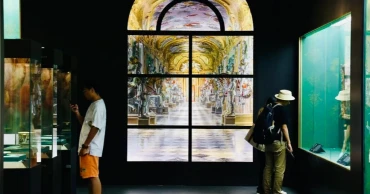
Centuries-old artefacts highlight vibrant China-Italy cultural exchanges in Tianjin
More than 150 Italian artifacts at an exhibition in Tianjin have highlighted centuries-old cultural exchanges between China and Italy, showing how Chinese silk, porcelain and decorative motifs influenced European art and tastes.
The exhibition, “Crown of Glory: 18th-Century Italian Court Treasures from the House of Savoy,” was jointly presented by the Tianjin Museum, Tianjin Digital Art Museum and Turin City Museum of Ancient Art in Palazzo Madama. It ran from Feb. 10 to Aug. 31.
Rather than focusing only on Italian royal splendor, the exhibition explored mutual influences between Chinese and European craftsmanship.
A French court gown featuring Chinese silk and embroidery reflects the popularity of “chinoiserie,” which became fashionable among European aristocrats and wealthy bourgeoisie by the mid-18th century. An ivory-colored men’s robe made with Chinese silk, weaving, block printing and hand painting also demonstrates the trend.
Chinese porcelain, silk and lacquerware became increasingly popular in Europe during the 17th and 18th centuries, influencing art, fashion and interior decoration.
3 days ago
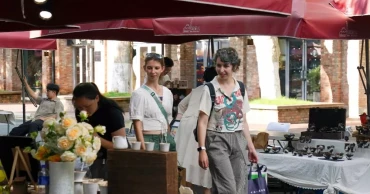
From waste to wonder: Jingdezhen recycles broken porcelain
In China’s porcelain capital Jingdezhen, discarded ceramics are being transformed into new products, reviving a centuries-old tradition of reuse while supporting greener development.
The brand XUN, meaning “recycling,” collects broken porcelain, then sorts, crushes and purifies it before reformulating and firing it into vases, planters, tableware and other products. Owner and co-partner Lan Lan said recycled pieces are safe and durable, while retaining porcelain particles that give finished products a unique look.
XUN also uses sand-mold 3D printing to make larger decorative items. Its products are displayed at the China International Import Expo and Canton Fair and sell well in Europe and the Americas.
Jingdezhen has reused ceramic waste for centuries. Broken porcelain, spent saggers and damaged kiln bricks were used to fill waterways, raise land and build walls and foundations. Ceramic waste was also placed beneath roads to help rainwater drain into underground channels.
4 days ago
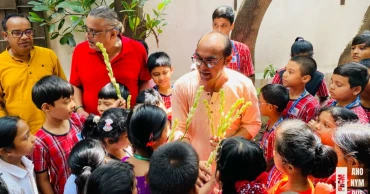
Taxila Vidyalaya celebrates children’s creativity with art festival
Taxila Vidyalaya hosted a colourful children’s art festival in the capital on Saturday, bringing together young artists in a celebration of creativity, imagination and self-expression.
The school campus came alive with the Art Festival 2026, themed “Culture Is the First Sunrise of Awakening”, organised by the social organisation 27 Dhanmondi in partnership with Tokshoshila School.
Parents, teachers and invited guests gathered at Tokshoshila School in the capital on Saturday to witness young minds at work.
Designed to nurture creativity, imagination and a love of the arts among children, the festival drew students from Grade One through Grade Ten, representing more than ten educational institutions across Dhaka.
4 days ago