special
A 20-metre road, eight months underwater: British-era tunnel leaves thousands stranded in Kushtia
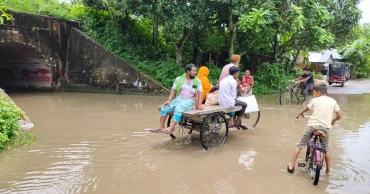
For nearly eight to ten months every year, crossing a barely 20 metres stretch of road becomes an ordeal for thousands of people in Kumarkhali upazila of Kushtia.
Submerged under knee-deep water for most of the year, the road beneath a British-era railway tunnel in Hatisako area has become a symbol of chronic neglect, disrupting daily life for nearly 100,000 residents of Koya and Nandalalpur unions.
What was once a vital transport link has gradually turned into a bottleneck, with poor drainage and unplanned land filling trapping rainwater for months at a time.
A Daily Struggle
Every monsoon, the road disappears beneath stagnant water. Schoolchildren roll up their uniforms and carry their bags over their heads. Office-goers wade through the murky water before beginning their workday. Easy-bikes and vans frequently break down midway, leaving passengers stranded.
A recent visit to the area found knee-deep water covering both approaches to the tunnel, forcing commuters to navigate the flooded road on foot or risk damaging their vehicles.
For many residents, this is not an occasional inconvenience but a reality they have endured for years.
Only Road to the Upazila
According to Koya Union Parishad Chairman Md Ali Hossain, the road serves as the only direct route to the upazila headquarters for around 70,000 people in his union.
"The water has nowhere to go because there is no drainage system," he said.
He explained that raising the road level is not a practical solution, as vehicles would then struggle to pass through the low-clearance railway tunnel.
"What was built during the British period has now become a source of suffering in modern times," he said, alleging that repeated appeals to the authorities have produced little progress.
How the Problem Began
Residents said the railway tunnel was constructed during British rule to maintain communication across the area.
For decades, rainwater naturally drained through surrounding lowlands into nearby wetlands. But over the last ten years, many of those open spaces have been filled to build houses, shops and other structures.
With the natural drainage channels blocked and no engineered drainage system in place, rainwater now accumulates around the tunnel and remains there for months.
By the time the stagnant water begins to recede, another rainy season often arrives.
Vehicles Damaged, Livelihoods Affected
The prolonged waterlogging has also taken a financial toll on transport operators.
Easy-bike driver Raja Ali said the flooded road frequently damages vehicle batteries and motors.
"The battery gets short-circuited and the motor is damaged. I spend between Tk 5,000 and Tk 7,000 every month on repairs," he said.
Many drivers avoid the route altogether, forcing passengers to walk through the flooded section or take longer alternative roads.
Students Pay the Price
For schoolchildren, the flooded road has become a barrier to education.
Umme Maria, a ninth-grade student at Alauddin Nagar Secondary School, said she used to cycle to school before the road became regularly submerged.
"One day I fell because the damaged road was hidden beneath the water. Now I walk or travel by van," she said.
Another student, seventh-grader Huzaifa Rahman, said he has no choice but to walk through the water every day.
"My books, notebooks and school uniform often get wet. Sometimes I cannot even attend classes. It is affecting my studies," he said.
4 hours ago
Sherpur’s Jhenaigati awaits lasting solution to Maharshi River erosion
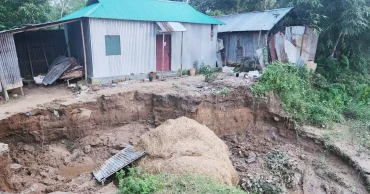
Every monsoon, residents of Jhenaigati upazila in Sherpur face renewed suffering as the Maharshi River swells due to heavy rainfall and upstream runoff from the Meghalaya hills, causing erosion and flooding in low-lying areas.
The rising waters frequently inundate Jhenaigati Bazar and surrounding areas, affecting traders and residents on both sides of the river.
Every year, houses, croplands, roads, markets and other important establishments are damaged, forcing many families to lose their homes and livelihoods.
Locals said the problem has worsened due to the river’s navigability crisis, siltation and the absence of strong and sustainable embankments.
Over the past decade, at least 500 families have lost their homes due to erosion caused by the Maharshi River.
Residents have long been demanding re-excavation of the river, construction of permanent embankments and effective water management to bring an end to their recurring sufferings.
The Maharshi River originates in the West and South Garo Hills of Meghalaya in India, enters Bangladesh through the Garokona area of Jhenaigati upazila near pillar no. 1108, and later flows into the Malijhi River at Paglarmukh.
According to the Bangladesh Water Development Board (BWDB), the river has been listed as river no. 68, with a length of around 17 kilometres and an average width of 57 metres.
According to local sources, erosion occurs at around 10 points in Nalkura and Jhenaigati Sadar unions every year during the monsoon season.
In October 2024 and September 2025, embankments on both banks of the Maharashi River collapsed due to heavy rainfall and upstream runoff, causing widespread damage in different parts of the upazila.
Houses, agricultural lands, ponds, markets and educational institutions were affected.
Following the incidents, local civil society groups and voluntary organisations organised public signature campaigns, submitted memorandums and held discussions demanding permanent and sustainable embankments on both banks of the river.
Proposed Tk 48.64cr project awaits approval
According to BWDB officials, a proposal has been prepared for repairing and rehabilitating flood-control embankments on both banks of the Maharashi River and re-excavating the river channel to address the recurring flood situation.
1 day ago
No bridges, endless sandbanks: Kushtia char residents face daily ordeal
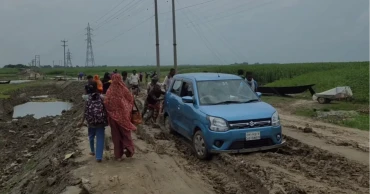
Every monsoon, the swollen Padma River once again cuts off thousands of families living in the char areas of Daulatpur upazila from the mainland, turning even the most basic needs – medical care, education and access to markets – into daily challenges.
More than five decades after Bangladesh's independence, residents of Ramkrishnopurup and Chilmary unions along the Padma's char areas say the absence of just two bridges has left nearly 1,00,000 people largely isolated despite gradual improvements in schools, electricity and other public facilities.
For years, locals have been demanding the construction of bridges at Bhagjot and Sukharghat, saying the missing links have become the biggest obstacle to the region's development.
During the rainy season, boats remain the only means of crossing the river.
In the dry months, residents travel across miles of sandy riverbeds by van, trolley, motorcycle or even horse cart before reaching paved roads on the mainland.
2 days ago
Five years on, Rangpur women’s training centre still awaits its first class
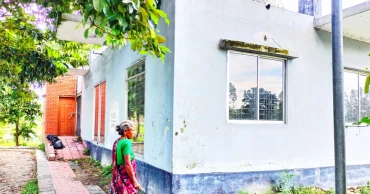
Built with the promise of empowering rural women through skills training, the Taraganj Upazila Women's Development Training Centre now stands as a deserted building—its classrooms silent, its doors broken and its future uncertain.
Five years after its construction, not a single training session has been held at the centre in Taraganj upazila of Rangpur.
Instead of becoming a place where women could learn income-generating skills, the facility has fallen into disrepair.
Local residents alleged the structure became a gathering place for drug users after dark.
During a recent visit, the building presented a picture of neglect. Large cracks have appeared in several walls, doors have been damaged, and most of the bathroom fittings have been taken.
The water tank and supply pipes are missing, while soil erosion around the structure has left parts of its foundation vulnerable.
The centre is located inside Bamandighi Eco Park of the Collectorate, beside the Rangpur-Dinajpur highway in Ikarchali Union.
According to the upazila administration, the building was constructed during the 2020-21 fiscal year at a cost of Tk 35.19 lakh under the Upazila Management and Development Project, funded by the Government of Bangladesh and the Japan International Cooperation Agency (JICA).
The project was implemented by the Upazila Parishad under the technical supervision of the Local Government Engineering Department (LGED).
The objective was to provide local women with vocational and income-generating training to improve their livelihoods.
However, despite the investment, the centre has remained locked since its completion.
Local residents say the lack of use and maintenance has encouraged theft and vandalism.
As supervision declined, government property gradually disappeared, while the surrounding area became increasingly unsafe.
Nahiduzzaman, a resident of Bamandighi Bazar, said people had expected the centre to create opportunities for women but instead watched it remain locked year after year.
"Development worth lakhs of taka was promised, but no training has ever taken place here. The building has become a symbol of wasted public money," he said.
Zemin Sheikh, who leads a local voluntary social organisation, said the project could have made a real difference to women in the area.
"Many village women could have benefited from skills training. Instead, the building has been left unused for years and is now deteriorating. It should be brought into use as soon as possible," she said.
Local media worker Rohidul Mia also criticised the situation.
"There is no justification for wasting public money like this. Not a single class was held after the building was completed, yet additional public funds have already been spent on its construction," he said.
Responding to the allegations, Taraganj Upazila Executive Officer (UNO) Monabbor Hossain acknowledged that the centre has remained unused for a long time and had suffered damage.
He said the administration plans to renovate the building and launch training programmes for women, though no timeline has yet been announced.
For now, the abandoned structure remains a stark reminder of an ambitious project that has yet to fulfil the purpose for which it was built.
3 days ago
Bangladesh's bat-making hub eyes global cricket market
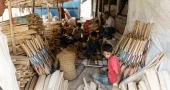
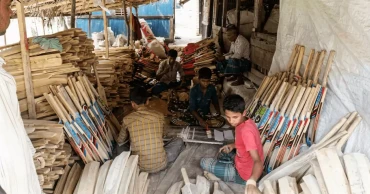
Long known for its rich tradition of woodworking, Nesarabad upazila in Bangladesh's southern Pirojpur district has quietly emerged as the country's largest producer of cricket bats, supplying equipment to players from school grounds to competitive tournaments nationwide.
Every bat shaped in the workshops of Nesarabad reflects not only the craftsmanship of local artisans but also the ambitions of an industry determined to take Bangladesh's cricket manufacturing expertise onto the international stage
Currently, the upazila produces an estimated 75 percent of all locally manufactured cricket bats in Bangladesh, making it the undisputed centre of the country's bat-making industry.
Spread across more than 65 workshops in over 15 villages, the industry produces around 3,00,000 cricket bats annually.
Bridge without approach roads leaves thousands suffering in Patuakhali for years
It has also become a major source of employment, supporting the livelihoods of more than 12,000 people directly and indirectly, according to local industry stakeholders.
Unlike internationally manufactured bats that rely on imported English willow or Kashmir willow, Nesarabad's manufacturers craft their products from locally available timber, including kadam, gaua, neem shishu, cotton tree, fig and chatim wood.
The abundance of these materials helps keep production costs low while maintaining quality that has earned the bats growing acceptance across Bangladesh.
What began three to four decades ago as a small-scale venture by a handful of local woodworkers has gradually developed into a thriving cottage industry.
Foreign mango variety 'Red Ivory' creates buzz among farmers in Chapainawabganj
Their handmade bats, once sold mainly in local markets, are now distributed to nearly every part of the country, including Dhaka, Chattogram, Rajshahi, Khulna and Sylhet.
The industry's growing reputation has also encouraged several entrepreneurs to explore export opportunities.
A limited number of locally produced bats have already been shipped to neighboring India and Nepal, offering a glimpse of the sector's international potential.
Manufacturers believe Nesarabad has the essential ingredients to compete in the global cricket equipment market. They say the region already possesses skilled craftsmen, an experienced workforce and a strong base of domestic raw materials.
However, industry insiders argue that greater institutional support is needed to unlock that potential.
Easier access to imported willow wood, advanced technical training for craftsmen and stronger export facilitation could enable local manufacturers to produce internationally competitive cricket bats for global markets.
If those challenges are addressed, they believe Pirojpur's bat-making industry could evolve from a domestic success story into an export-oriented sector, generating significant foreign exchange earnings while creating even more employment opportunities.
Floating guava market breathes new life into Pirojpur's rural economy
Contacted, Nesarabad Upazila Nirbahi Officer (UNO) Amit Datta said if local cricket bat manufacturers want to export their products abroad, the upazila administration, along with the government, will provide support through training and access to loans.
Once the industry becomes established, the government will extend full cooperation to help it grow and expand, he said.
3 days ago
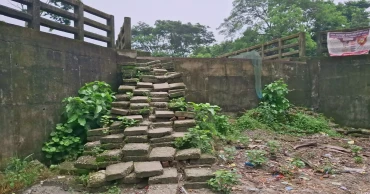
Bridge without approach roads leaves thousands suffering in Patuakhali for years
A bridge built at a cost of nearly Tk 3 crore to improve communication between two upazilas in Patuakhali has remained largely unusable for the past six years due to the absence of connecting roads, forcing thousands of residents to risk their lives every day.
The 24-metre-long reinforced-concrete girder bridge spans the Banshbaria-Bogi canal on the border between Dashmina and Bauphal upazilas.
Although the main structure was completed years ago, work on the approach roads stopped after design flaws were detected during construction.
As a result, a vital transport link has become a daily struggle for people from at least 11 villages.
During a recent visit, this correspondent found no permanent connecting roads on either side of the bridge.
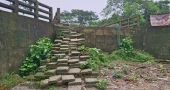
Instead, local residents have built makeshift brick steps to climb the nearly 20-foot-high bridge, while others rely on narrow bamboo walkways to cross the canal.
Women, schoolchildren, elderly people and farmers use these temporary arrangements every day despite the obvious safety risks.
According to the Local Government Engineering Department (LGED), the bridge was constructed during the 2019-20 fiscal year at an estimated cost of Tk 2,82,10, 506.
The project was implemented by M/s Abul Kalam Azad Enterprise of Patuakhali and was scheduled for completion by the end of 2020.
However, construction of the connecting roads was halted after flaws were identified in the original design.
Local resident Md Abdul Hai said the bridge had been designed without consulting local people.
"After the bridge was completed, flaws were discovered while constructing the connecting roads. Six years have passed, but no work has resumed. A bridge built with crores of taka is of no benefit to us," he said.
Another resident Mashiur Rahman Labu said thousands of people suffer every day while crossing the bridge.
"It is especially dangerous for women, children, students and elderly people. Several accidents have already happened, yet there is still no permanent solution," he said.
The unfinished project has also affected local livelihoods.
4 days ago

Bangladesh targets technology-driven economy with ambitious ICT sector reforms
Long regarded as a supporting sector rather than a primary growth engine, Bangladesh’s Information and Communication Technology (ICT) and telecommunications industry is now being positioned at the centre of the country’s economic transformation.
With the government setting a target to increase the sector’s contribution to Gross Domestic Product (GDP) from the current 1-2 percent to 10 percent within the next five years, the latest budget outlines an ambitious roadmap built around digital infrastructure, high-speed connectivity, investment-friendly policies and a unified digital public service platform.
If achieved, the target would represent one of the most significant structural shifts in Bangladesh’s economy, moving the country closer to a technology-driven growth model while creating thousands of skilled jobs and expanding exports of digital services.
To achieve the target, the government plans to develop the sector as a priority industry by expanding wireless and wireline connectivity, building digital infrastructure, producing skilled human resources, introducing a “One Citizen, One ID, One Digital Wallet” system and creating a more investment-friendly policy environment.
The government said affordable and reliable internet is essential for developing the ICT sector and transforming Bangladesh into a digital economy.
As part of a comprehensive telecommunications reform programme, it has undertaken policy initiatives to improve internet quality and bring services up to global standards.
The reform agenda includes ensuring 5G network coverage for 90 percent of the population and providing broadband internet speeds of up to 100 Mbps through coordinated efforts involving mobile network operators and fixed broadband service providers.
To improve internet access in remote and rural areas, the government has also launched initiatives to expand fibre-based connectivity, including the establishment of a National Fibre Bank.
The budget document said high-speed free internet services have already been introduced at railway stations and airports across the country.
Over the past four months, the government has added 4.1 million new 4G mobile connections and 400,000 new high-speed broadband connections, according to the document.
The government also plans to build an integrated Digital Public Infrastructure (DPI) centred on the concept of “One Citizen, One ID, One Digital Wallet”.
The initiative will enable citizens to access a wide range of public and private services through a single digital identity while facilitating secure digital financial transactions, including the payment of government allowances, fees and other charges.
According to the budget document, the unified digital identity and wallet system will eliminate complexities created by multiple identity platforms, improve interoperability among government databases and strengthen data exchange across public institutions.
The government expects the initiative to enhance transparency, accountability and efficiency in public service delivery while making services faster and easier to access.
Citing a projection by the Boston Consulting Group (BCG), the budget document said Bangladesh is expected to become the world’s ninth-largest consumer economy by 2030, making digital transformation a key component of the country’s long-term economic strategy.
The government believes sustained investment in digital infrastructure, innovation and human resource development will be crucial to unlocking the sector’s full potential.
It also expects the expansion of high-speed broadband, advanced mobile technologies, data centres and cloud infrastructure to strengthen the country’s digital ecosystem, improve public services and support businesses and entrepreneurship.
Industry experts said Bangladesh’s growing pool of young technology professionals is well positioned to meet rising global demand for software development, business process outsourcing, freelancing, artificial intelligence, cybersecurity and digital financial services.
However, they stressed that continued investment in technical education and specialised skills training will be essential to remain competitive.
The government is also focusing on developing innovation hubs, startup ecosystems and research facilities to encourage technology commercialisation, while promoting greater collaboration among academia, industry and public institutions.
The ICT sector is increasingly supporting agriculture, manufacturing, healthcare, education and financial services by improving productivity and expanding access to digital solutions. The wider adoption of e-commerce, digital payments and online public services is also expected to strengthen financial inclusion and governance.
Despite the sector’s strong prospects, experts say challenges remain, including strengthening cybersecurity, improving digital literacy, ensuring reliable internet connectivity in rural areas and maintaining a favourable regulatory environment for technology businesses.
The government documents emphasised that effective implementation of development programmes, appropriate policy measures and greater private sector participation will be critical to achieving the vision of a digitally empowered economy.
If successfully implemented, the ICT and telecommunications sector is expected to emerge as one of Bangladesh’s strongest growth pillars, generating high-quality employment, attracting foreign investment, boosting exports and significantly increasing its contribution to the national economy.
4 days ago

Sundarbans see steady rise in tiger population despite mounting challenges; World Tiger Day puts spotlight on conservation
The number of Royal Bengal Tigers in the Sundarbans in Bangladesh has increased steadily over the past decade despite continuing conservation challenges, reinforcing hopes for the species’ long-term survival.
Despite the continued threats of poaching, climate change, habitat degradation and illegal activities inside the forest, the number of tigers in the forest has shown a gradual increase over the past decade, according to the Forest Department.
World Tiger Day is being observed on Wednesday (July 29) under the theme, “Be Aware, Conserve Tigers.” In recent years, Bangladesh has moved national observances beyond Dhaka, involving communities living around the Sundarbans to strengthen public participation in tiger conservation.
Slow but steady recovery
Bangladesh began estimating tiger numbers through camera-trap surveys in 2015, replacing older pugmark-based methods.
The first survey estimated 106 tigers in the Bangladesh Sundarbans. A second survey in 2018 recorded 114 tigers, while the latest survey completed in October 2024 estimated the population at 125.
The consistent increase of roughly 10 tigers in each survey has been viewed by conservationists as evidence that protection measures are producing results, although they caution that the population remains vulnerable.
Forest officials and people who regularly work inside the Sundarbans said tiger sightings have become more frequent than in previous years.
Last Friday afternoon, a tiger was spotted roaming near the Andharmanik Ecotourism Centre.
Analysis of images captured by 20 recently-installed camera traps in the same area over one week also identified three tigers.
Officials say incidents of tigers straying into nearby villages have declined significantly, reducing human-tiger conflict. Forest workers and tourists are increasingly reporting sightings of tiger pairs, and occasionally groups of three.
Earlier this year, on January 4, Forest Department personnel rescued a female tiger from a poacher’s snare inside the Sundarbans. Estimated to be around 10 years old, the tigress remained trapped for several days and was in critical condition.
After months of treatment and rehabilitation, she was released back into the forest on July 12.
Conservation gains overshadowed by losses
While tiger numbers are rising, mortality remains a major concern.
Forest Department data show that between 2001 and 2025, 61 tigers died in the Sundarbans.
Of them, 26 were killed by criminals, 14 died after entering human settlements and being attacked by local people, 19 died of natural causes, while two died during Cyclone Sidr and other incidents.
Authorities also recovered tiger skins and skeletal remains during the same period, indicating continued illegal wildlife trafficking.
The eastern division of the Sundarbans recorded 30 tiger deaths, while the western division accounted for 31.
During the same period, tiger attacks claimed the lives of 13 people in the eastern Sundarbans.
A global bright spot
The Sundarbans’ improving tiger population stands out against the global decline of the species.
A new report from wildlife trade monitoring network TRAFFIC has warned that criminal networks involved in wildlife trafficking are adapting more quickly than conservation efforts can keep pace. It said the global wild tiger population, which stood at about 100,000 a century ago, has declined dramatically to an estimated 3,700-5,500 animals.
Three tiger subspecies—the Bali, Javan and Caspian tigers—have already become extinct.
Wild tigers now survive in only 10 countries, including Bangladesh, India, Nepal, Bhutan, Myanmar, Thailand, Malaysia, Indonesia, China and Russia.
Deforestation, poaching and illegal wildlife trade continue to threaten tiger populations worldwide.
Protection efforts intensify
Md Rezaul Karim Chowdhury, divisional forest officer (DFO) of the Sundarbans East Forest Division, said anti-poaching operations have been strengthened considerably in recent years.
Forest guards now conduct regular foot patrols, while drones are also being used during enforcement operations.
Over the past year, authorities recovered a large number of traps set for hunting tigers and deer, arrested 70 deer poachers and submitted a list of 150 suspected poachers to law enforcement agencies.
“The activities of poachers have declined because of continuous enforcement drives,” he said. “As a result, tiger movement inside the forest has increased.”
He added that no tiger has been killed in nearby villages in recent years.
Boundary fencing has also helped reduce cross-border movement, allowing tigers approaching the frontier to return safely to the forest, while the increasing deer population has improved prey availability.
Parallel search operations have also made it more difficult for poachers to lay traps.
“Tigers are now being seen on forest trails, beside ponds and canals, and sometimes even near Forest Department offices,” he said. “Tourists are also getting opportunities to see tigers during visits to the Sundarbans.”
He expressed optimism that the next tiger census would record another increase.
AZM Hasanur Rahman, DFO of the Sundarbans West Forest Division, said the department remains vigilant in protecting both tigers and other forest resources and expects the results of ongoing conservation initiatives to be reflected in future surveys.
6 days ago

Two years on, no memorial for July Uprising's first martyr Abu Sayed at BRUR
More than two years after Begum Rokeya University, Rangpur student Abu Sayed’s killing became a defining moment of the July Uprising, there is still no sign of a permanent memorial in his honour at BRUR, leaving students, family members and visitors questioning why the campus has failed to preserve the memory of its most famous student, as well as one of the movement’s most iconic figures.
Sayed, remembered for standing with his arms outstretched in front of police moments before he was shot on July 16, 2024 quota reform movement, became a symbol of resistance after images of his final moments spread across the country and beyond.
His death galvanised the student-led protests that, within 36 days, culminated in the collapse of the Awami League government, marking a turning point in Bangladesh’s political history.
Although a few plaques bearing his name can be found around the campus, there is no monument, memorial tower or museum dedicated to the university student whose death inspired a nationwide movement.
After the change in the university administration following the July Uprising, authorities announced an ambitious development plan reportedly worth Tk 1090 crore.
The project included proposals for an Abu Sayed memorial gate, a museum, a monument and commemorative street installations.
The announcements were made at a high-profile event attended by senior government advisers, University Grants Commission officials and Sayeed’s parents.
Nearly two years later, however, none of the major memorial projects are visible on the campus.
Students seek lasting recognition
Standing at the site where police allegedly opened fire on Sayed, BRUR student Shamsur Rahman Sumon said students had expected the area—declared "Shaheed Abu Sayed Square" during the movement—to become a permanent place of remembrance.
"An Abu Sayed gate was supposed to be built here, with a museum behind it. A monument was also approved for this location, but no visible work has started yet," he said.
"Two years have already passed. We want these projects to begin without further delay so that future generations can remember Abu Sayed and understand the significance of his sacrifice."
Ashikur Rahman, a student of the university's Electrical and Electronic Engineering Department, echoed the frustration.
"Abu Sayed was one of the leading figures of the July movement. It is painful that even after two years there is no proper memorial for him on his own campus. We have repeatedly heard promises, but there has been no implementation. We hope the current government will expedite the projects so that Abu Sayed's memory and the spirit of July remain alive," he said.
The absence of any institutional memorial has also surprised many visitors to the university, who question why the campus where Sayeed studied still lacks a permanent tribute to him.
Family seeks justice and remembrance
At Sayed's grave in Babanpur village under Pirganj upazila of Rangpur district, his father Maqbul Hossain said his foremost demand was the execution of the verdict in his son's murder case.
"My son was killed in front of everyone. I want the verdict to be implemented while I am still alive," he said.
He also expressed disappointment that a mosque proposed in his son's memory is yet to be built.
"I was told a mosque would be constructed in his name. Later I was informed that there was no budget. We want this to happen as soon as possible," he said.
With emotion in his voice, he also urged the government to promote industrialisation in Rangpur to create employment opportunities for local people.
Sayed's elder brother, Ramzan Ali, said the family had expected to see a memorial at the university by now.
"We hope the government will implement the projects without further delay," he said.
He also called for swift execution of the court verdict in the murder case, saying their father wanted to see justice served during his lifetime.
University cites ongoing process
Acting Registrar of Begum Rokeya University Dr Ferdous Rahman said the process of naming the university gate after Abu Sayed had been completed and only the physical work remained.
He said the proposed mega development project also included four new residential halls, one of which would be named after Abu Sayed.
According to the registrar, work on the planned memorial has been delayed because several existing structures at the designated site need to be removed before construction can begin.
For many students, the delay in establishing a permanent memorial raises broader questions about how the nation honours those whose sacrifices shape its history.
While Abu Sayed's image remains one of the most enduring symbols of the July uprising, supporters say the absence of a visible memorial at his own university stands in stark contrast to the legacy he left behind.
7 days ago
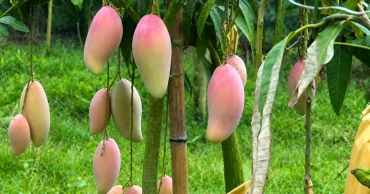
Foreign mango variety 'Red Ivory' creates buzz among farmers in Chapainawabganj
In Bangladesh’s famed mango-producing district of Chapainawabganj, a striking crimson fruit is turning heads and drawing curious visitors, offering a glimpse of how exotic varieties could diversify the country's mango industry.
Rows of 'Red Ivory' mangoes now hang in clusters from trees in a two-bigha orchard at Basantapur village in Shibganj upazila, where farmer Kabir Ali has successfully cultivated the foreign variety, attracting growers, students and fruit enthusiasts from across the district.
Known primarily as a vegetable farmer, Kabir's journey into cultivating the exotic mango began during a visit to Gaibandha, where he first encountered the Red Ivory variety. Impressed by its vibrant red colour, large size and commercial potential, he decided to bring the variety to his hometown.
Two years ago, he collected 340 saplings and established the orchard beside his home at a cost of around Tk 1,50,000.
The trees produced fruit for the first time last year, yielding about five mounds of mangoes, which he sold at Tk 5,500 per mound.
This season, however, nearly every tree has borne fruit.
Large crimson mangoes now cover the orchard, and the fruits are expected to reach the market within the next few weeks.
"Last year the harvest was small, but I received a good price.This year the trees are heavily laden with fruit. If the market price remains favourable, I hope to recover my investment and earn a profit," Kabir told UNB.
Growing curiosity
The unusual appearance of the mangoes has transformed Kabir's orchard into an attraction, with visitors arriving daily to see the rare variety firsthand.
8 days ago