special
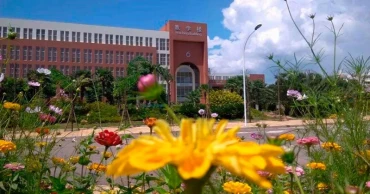
China vows hassle-free healthcare for Bangladeshi patients in Yunnan
Authorities in China’s Yunnan province have pledged full cooperation in ensuring high-quality and hassle-free healthcare services for Bangladeshi citizens seeking medical treatment in the country.
They made the assurance when a group of Bangladeshi journalists visited the First Affiliated Hospital of Kunming Medical University on Thursday and exchanged views with provincial health officials and chiefs of local public hospitals.
"Our international medical pricing is based on the principle of offering high-quality services at fair prices. Bangladeshi patients treated in our pilot hospitals have expressed high satisfaction with the services provided,” said Wang Jiankun, deputy director of the Health Commission of Yunnan Province.
He said they are making every effort to support Bangladeshi patients visiting their hospitals. “Our government and our embassy in Dhaka are in regular contact with the Bangladesh government to strengthen cooperation in the healthcare sector.”
The Chinese government invited the 23-member media delegation as part of the celebration of the 50th anniversary of the establishment of diplomatic relations between China and Bangladesh.
Chief Adviser’s deputy press secretary Abul Kalam Azad Majumder is leading the Bangladesh delegation.
Bangladeshi journalists begin four-day visit to China’s Kunming
The delegation joined a two-hour interactive session with Chinese officials, including Zeng Zhing, president of the First Affiliated Hospital of Kunming Medical University, Xie Hongbin, deputy director of the Department of Medical Administration and Han Rui, director of the International Medical Department.
During the session, Chinese officials responded to many queries regarding the language barrier, accommodation for attendants, travel expenses, access to Bangladeshi credit cards, liaison offices, follow-up treatment and billing process and the high cost of carrying the dead body back to Bangladesh.
"We are aware of the challenges faced by Bangladeshi patients and working to address these issues, ensuring a hassle-free treatment experience,” Wang Jiankun said.
The Bangladesh delegation head Azad Majumder urged the Chinese authorities to allow more Bangladeshi students to their medical universities in China so that they can support Bangladeshi patients overcome the language barrier.
“We expect the support of Chinese authorities more Bangladeshi patients will seek treatment in China,” he said.
China assures continued medical support to Bangladesh
First Affiliated Hospital of Kunming Medical University officials said 67 Bangladeshi patients took treatment for diseases such as liver cirrhosis, breast cancer in the past six months.
During a banquet hosted by the local foreign office of China in honour of the Bangladeshi delegation assured Bangladeshi patients of all possible cooperation to facilitate their visit for treatment.
The Bangladesh media delegates are expected to visit a few more hospitals in Kunming on Friday.
11 months ago
Onion vanishes: Faridpur faces price shock
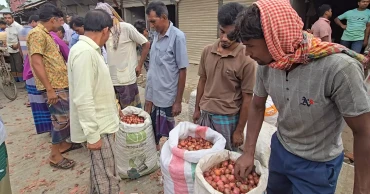
Onion prices in Faridpur have surged by Tk 1,000 per maund over the past 10 days due to reduced supply in the market, affecting retail customers.
According to Md Shaheduzzaman, Deputy Director of the Department of Agricultural Extension (DAE) in Faridpur, the district is the second-largest onion-producing region in the country.
This year, a total of 38,000 hectares of land were brought under onion cultivation, yielding 6.77 lakh metric tonnes.
Farmers, however, were frustrated as they received only Tk 1,000 to Tk 1,500 per maund during the season, while they needed Tk 2,000–2,200 per maund to break even and make a profit.
In the past 10 days, the price of onion in the wholesale market has risen from Tk 1,500 to Tk 2,500–2,600 per maund, with retail prices now ranging between Tk 70 and Tk 75 per kg.
Traders blamed the supply shortage for the price hike, noting that farmers are currently occupied with jute processing, resulting in fewer onion deliveries to the market.
Tapan Kumar, a trader from Kanaipur, said there is no onion import from abroad at the moment and the local supply is insufficient to meet demand, which is pushing prices up sharply.
Moniruzzaman, an onion trader from Boalmari upazila, said, "Farmers are busy with retting, washing and drying jute. That’s why less onion is reaching the wholesale markets."
Faridpur farmers in distress as onion prices plummet
Expressing frustration, Saifur Rahman from Saltha upazila said farmers did not get fair prices during the harvesting season and now most of the remaining stock is in the hands of large wholesalers.
"It's the wholesalers who are profiting from the current price surge. We farmers have nothing left to gain," he said.
In local markets, including Kanaipur, Saltha, Boalmari and Nagarkanda, onions are selling at Tk 60 to Tk 75 per kg depending on the variety.
11 months ago
Bangladesh well-positioned in new era of trade wars: BGMEA President Mahmud Hasan Khan
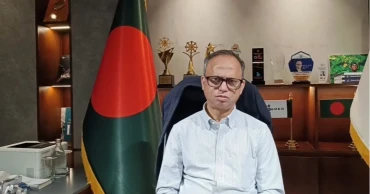
In the wake of the US decision to impose a tariff of 20% on Bangladeshi products, Mahmud Hasan Khan, the president of the Bangladesh Garment Manufacturers and Exporters Association (BGMEA), in an exclusive interview with UNB, discussed the immense opportunities for Bangladesh's apparel sector amid global trade tensions. Khan emphasized that while the current tariff war presents a favorable landscape, the country must address critical infrastructural and logistical challenges to fully capitalize on it. Bangladesh has a significant opportunity to boost its exports to the U.S. and global markets in the current climate of international tariff disputes, he said. Excerpts:
UNB: Bangladesh seems to have a new opportunity for export growth. What are your thoughts on this?
Khan: This new era of global tariff wars presents a great opportunity for Bangladesh to enhance its exports, particularly to the US and other major global markets. We are in a strong position. While major competitors like India face a 25% tariff and China a 30% tariff from the US, Bangladesh's tariff is currently at 20%. This tariff reduction will naturally divert a significant portion of global apparel business to Bangladesh. To attract buyers from China and India, however, we must ensure rapid and timely shipment of goods.
UNB: Beyond the tariff advantage, what does Bangladesh need to do to sustain this growth?
Khan: Business growth isn't solely dependent on opportunity; it requires a robust supporting infrastructure. We urgently need to improve the capacity and international-standard handling of the Chittagong port, along with streamlining customs facilities. Infrastructure development, efficient use of existing facilities, and an uninterrupted supply of gas and electricity to our factories and export sectors are absolutely crucial for us to perform well in the global trade competition. All of these supporting facilities, alongside our production capacity, are vital for us to stay ahead of our competitors.
Tariff reduction to 20% 'a relief': BGMEA President
UNB: Regarding port management, is hiring foreign companies a viable solution?
Khan: Hiring foreign companies with experienced and skilled management is a good option. However, if their charges are excessively high, it will negatively affect our business competitiveness. We need to strike a balance between efficiency and cost.
UNB: What specific initiatives are your top priorities for the BGMEA right now?
Khan: We need to focus on several key areas immediately. First and foremost is ensuring an uninterrupted supply of gas and electricity. Additionally, we need to guarantee a smooth, four-hour journey on the Dhaka-Chittagong highway. Other priorities include reducing non-performing loans in banks to bring down interest rates, rationalizing the NBR's tax structure, and maintaining a good law and order situation across the country.
UNB: You mentioned a 20% tariff for US exports. Are there any ways to reduce this further?
Khan: Yes, there is a significant opportunity for further tariff exemption. If our products use 20% or more US content—such as US cotton or other materials—exporters can receive a tariff discount on that portion. For example, if a product contains 20% US content, the effective tariff would be reduced to 16%. The more US content we use, the greater the tariff exemption becomes, potentially reaching zero tariffs on that portion.
UNB: What are the challenges in implementing this US content-based tariff exemption?
Khan: The main challenge is the lack of a certifying body. There is currently no institution established to verify the traceability of US content in a way that would be acceptable to US customs. While the price of US cotton is higher, its quality is excellent. The entire process is machine-run, making the cotton fresh, dust-free, and with very low wastage. We believe that Bangladeshi factory owners will increase their use of US cotton as buyers will push for it to get the additional tax exemptions in the US market. US cotton is completely clean, machine-fit, and will result in a 2-3% lower cost at the processing level.
Pakistan envoy meets BGMEA president, discusses trade ties
UNB: What reforms are underway within the BGMEA itself?
Khan: We have brought all BGMEA activities under an online service, allowing members to easily view and monitor all our work. A major reform has been the recent fair election for the association, where over 90% of our members participated. This was a direct result of the July uprising, and this practice of holding free and fair elections will continue so that we never return to the previous situation.
UNB: How is the BGMEA addressing the alleged misuse of 'Bonded Warehouses'?
Khan: We are committed to tackling this issue. If the NBR provides specific allegations of bonded warehouse rule violations, the BGMEA will actively assist them in taking action. However, the NBR and its intelligence units must provide us with specific information about misuse. To date, the NBR has not filed a single complaint against any of our members. In fact, BGMEA is sometimes criticized for creating barriers to importing legal goods, which is time-consuming.
UNB: You've mentioned a lot of reforms. Can all of this be accomplished in a single term?
Khan: Many reforms are required in our trade association, and it's not possible to complete all of them in a single two-year term. We have started the reform process, but I won't be able to conclude everything. The series of reforms will continue. As promised during our election campaign, we have already reduced the subscription fee by 25%. We are also working on easing the tax system, addressing SDG challenges, establishing a member welfare fund, building a hospital for our workers, amending labor laws, and bringing the BGMEA University under the association's full control. We have started this journey to strengthen the BGMEA, and future presidents will build upon this foundation.
Mahmud Hasan, seven others elected BGMEA president and VPs for 2025-27
UNB: How will the BGMEA protect its members from non-paying buyers?
Khan: We want to assure our members that we will take a firm stance against buyers who do not make timely payments. The BGMEA will create a blacklist of such buyers and inform our members to avoid doing business with them. Suppose we receive complaints from members about buyers who refuse to accept goods after shipment. In that case, we will resolve the issue through negotiation with those buyers or the ambassadors of their respective countries. The BGMEA has the authority to blacklist buyers who fail to pay manufacturers on time or refuse to receive goods after they have been shipped.
11 months ago
Feni faces flood risk again as embankment work stalls
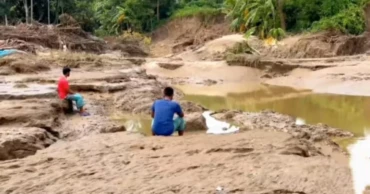
Residents of three upazilas in Feni—Fulgazi, Parshuram and Chhagalnaiya—are living in constant fear as heavy rains may trigger flood anytime and authorities have yet to repair embankments damaged in the last month’s flood.
Although floodwaters have receded breaches in 42 spots in the embankments in the Muhuri, Kohua and Silonia rivers remain unrepaired, leaving the region vulnerable.
With monsoon clouds looming and forecast of fresh flood in the region, panic grips locals who are still reeling from last year’s catastrophic floods.
Intermittent rain for the last couple of days has disrupted daily life in Feni, causing temporary waterlogging in several low-lying areas of the town.
The Bangladesh Meteorological Department has warned of continued rainfall in different parts of the country due to active monsoon conditions.
If the rains persist, water levels in the Muhuri and the Silonia rivers may rise again.
Although repair work began on July 20 it had to be suspended as river levels surged again. On July 21, strong upstream currents from India caused fresh inundation of five villages in Chitholia union through the unrepaired embankment breaches.
In response, residents and organisations have intensified their demands for sustainable flood protection.
A protest march was held on July 23 from the Feni Central Shaheed Minar to the local office of the Water Development Board (WDB) pressing for eight specific demands, including permanent embankment reconstruction.
Feni floods leave behind trail of destruction worth Tk 146.43 crore
Over the past month, various groups under the banner of ‘all walks of life’ and with support from Feni expatriates have staged human chains and protests.
Earlier, 56 voluntary organisations in Parshuram also held a human chain demanding swift embankment repair.
With rain resuming this week, concerns of renewed damage have escalated.
Locals fear that floodwaters could again breach the damaged points and flood their homes and croplands.
During the July 8 flood, breaches at 42 points submerged 137 villages in the three upazilas, affecting thousands. Crops, roads, bridges and educational institutions suffered extensive damage.
Abu Taleb Ripon, a resident of Fulgazi, said, “The embankments have not been repaired yet. If the rain continues, the area will be flooded again. People living near the broken embankments are spending their days in fear.”
Shafik Ahmed of Nish Kalikapur village in Parshuram added, “I lost everything in last year’s flood. I’m still living in a fragile bamboo house. Every night I worry about the river flooding again. The spot where embankment was damaged hasn’t been repaired yet.”
Zahirul Islam Raju from Fulgazi noted, “Last year’s flood trauma still haunts people. As soon as it starts raining, locals stay up all night, fearing another flood.”
Struggle for survival begins anew in flood-hit Feni as waters recede
Masum Chowdhury, who lost his home in West Olka village of Chitholia union on July 8, said, “Whenever I see dark clouds, my body shivers. I sit by the broken embankment, dreading the moment water might gush in again. We’ve pleaded repeatedly with the Water Development Board to build a sustainable embankment. Every night feels like a nightmare.”
Tajul Islam, proprietor of The New Trade Link, the contractor assigned to repair the embankment, said, “We had started repairing the 80-meter breach on embankment in the Muhuri River at West Olka in Parshuram. But a sudden rise in water level swept away our excavation equipment and materials. Work will resume once the water recedes.”
WDB Executive Engineer Akhtar Hossain Majumder said 15 points of the embankment in Parshuram were damaged in the July 8 flood.
“We assigned contractors for urgent repairs, but rising river levels on July 20 forced suspension of the work. Once water levels drop, repairs will resume,” he said.
11 months ago
Joyful return of Oman expat ends in heartbreak in Noakhali
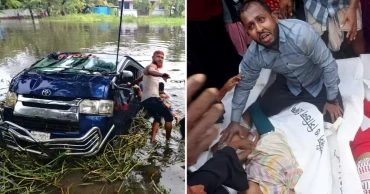
What was meant to be a joyful homecoming turned into an unimaginable tragedy for Oman expatriate Bahar Uddin, as seven members of his family, including two young children, lost their lives in a devastating road accident in Noakhali on Wednesday.
The family, residents of Choupalli village in Sadar upazila of Laxmipur, had set off in a microbus from Dhaka after receiving Bahar from Hazrat Shahjalal International Airport, where he had just returned following years of work abroad. But the celebration never came.
On their way back home in Laxmipur, the microbus veered off the road and plunged into a roadside canal, killing seven of the passengers instantly. Bahar was being accompanied by 12 family members.
The fatal accident occurred around 5:40am, when the microbus lost control and fell into the canal at Chandraganj Dakshin Bazar in Begumganj upazila of Noakhali district, said officer-in-charge (OC) of Chandraganj Highway Police Station Md Mobarak Hossain Bhuiyan.
The deceased were identified as Bahar’s mother Morshida Begum, 50, his wife Kabita, 22, his two-year-old daughter Mim Akter, maternal grandmother Faizunnessa, 60, sister-in-law Laboni Akter, 25, (wife of Bahar’s elder brother), and Laboni’s two daughters, Lamia, 8, and Reshma, 9.
Noakhali road crash leaves seven dead
11 months ago
Hidden struggles behind private university education in Bangladesh
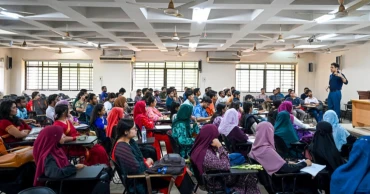
At first glance, Bangladesh’s private universities project an image of progress: sleek campuses, glossy adverts, and bold promises of ‘world-class education’. But for many middle-income families, those dreams now carry a heavy cost.
"I had to take a huge amount of loan from a bank to get my son admitted into a university in Dhaka," said Faizur Rahman, a private firm executive.
“Like me, thousands of parents are quietly bearing the burden, spending savings for a shot at higher education,” he said, adding, “Behind the air-conditioned classrooms and polished branding lies a big question -- is this model of education truly accessible?”
Completing an undergraduate degree at a private university in Bangladesh can cost a student between Tk 10 to 15 lakh, a financial burden that many middle-class families struggle to bear.
An analysis of tuition fees at several prominent private universities in Dhaka reveals that simply covering course and credit-related expenses may require a family to spend Tk 8 to 12 lakh. Depending on the subject of study, this amount may rise up to Tk 15 lakh.
For instance, a top-tier residential university located in the Bashundhara Residential Area charges between Tk 9.59 lakh and Tk 12.47 lakh for an undergraduate degree in engineering. For science-related disciplines outside engineering, the cost ranges from Tk 8.94 lakh to Tk 14.48 lakh.
Another leading private university in Merul Badda charges even more.
According to its website, students pay over Tk 8,000 per credit. When combined with admission, course, semester, and library fees, the total cost of completing a degree ranges between Tk 10 to 15 lakh.
Similar is the case with a university in Aftabnagar, where graduating in a well-regarded subject costs between Tk 7 to 9.5 lakh. For a highly demanded programme like BBA, the expense is around Tk 8.27 lakh, excluding additional miscellaneous costs.
Heavy Burden on Middle Class
In contrast, students at public universities such as Dhaka University, Jahangirnagar University, Jagannath University, Khulna University, Rajshahi University, Chittagong University and Barishal University typically spend Tk 30,000 to Tk 50,000 over the entire duration of their undergraduate studies.
This stark 16-fold difference in cost heavily impacts students and their families.
Sanwar Ahmed, an employee at a private company in Dhaka, has enrolled both his sons in private universities.
Sharing his distress, Sanwar said, “It’ll cost nearly Tk 30 lakh to complete the education of both of them. It’s impossible to afford this on a salary. That’s why I had to sell land in the village to fund their education.”
Another parent, Sabbir Hossain, who has one son and one daughter, said, “My son is still in college. I’ve admitted my daughter to an engineering programme at a private university. Each semester costs over a lakh. I’ve told my son that unless he gets into a public university, I won’t be able to fund his honours degree. I’ll find him a job instead. My monthly salary and savings are being drained for my children’s education.”
EU provides €26mn for Bangladesh education; Miller calls it key to inclusive society
Israt Jahan, a mother of two daughters, one currently studying at a leading private university, said, “My husband and I both work, yet we struggle to pay semester fees. There are also plenty of additional expenses. Even with a combined income of Tk 2 lakh per month, we often have to dip into our savings.”
Mounting Pressure on Students
To ease the financial strain on their families, many students at private universities take up part-time jobs, or work such as tutoring, freelancing, or working night shifts.
Ahmed Faisal, a pharmacy student at a private university in the capital, said, “It will cost about Tk 15 lakh to complete my degree. While my father could initially afford it, a sudden illness means he can no longer contribute as before. That’s why I’ve taken up three tutoring jobs after classes to help cover the fees. It’s not enough, but it helps a little.”
Abdullah Sadi, a BBA student at another private university, echoed the sentiment, saying, “It’s hard enough to afford the credit fees, but on top of that, the academic system in Bangladesh doesn’t allow for much flexibility to work part-time. So, many of us—including myself—work night shifts at call centres to make ends meet.”
When it comes to quality of education, several students admit that most are pursuing their degrees not for learning or skill development, but simply to obtain a certificate, essentially, paying large sums for a piece of paper.
Public Seats Limited, Private Options Costly
Each year, nearly one million students qualify for university admission after passing the Higher Secondary Certificate (HSC) exams.
According to the University Grants Commission (UGC), public universities in Bangladesh offer only around 55,000 seats. With the seats in medical and engineering institutions, the total still only reaches around 100,000.
In the 2024 HSC exams alone, 145,911 students achieved GPA-5, while over one million passed. This means more than half of the top-performing students couldn’t secure places at public universities and had no choice but to turn to expensive private ones.
The Private University Act of 2010 states that all private universities must operate as non-profit institutions. Trustees or authorities are prohibited from drawing personal financial benefits and are required to submit annual audit reports via government-approved firms.
Haileybury Bhaluka School opens a new era for British education in Bangladesh
Yet, investigations reveal that many of the 116 UGC-listed private universities fail to submit annual financial reports to the Ministry of Education.
Despite holding frequent syndicate meetings, these institutions often avoid conducting proper financial oversight. As a result, there’s little to no transparency on how students’ tuition fees are spent.
An anonymous UGC official claimed that syndicate members receive Tk 4–5 lakh for each meeting. “Trustees are living in luxury on students’ money, driving expensive cars and buying posh flats. Yet no serious investigations have been carried out. Even after repeated warnings, these universities keep getting away with it due to political and financial influence.”
When asked how such exorbitant tuition fees are determined, an administrative officer at a top-tier private university, also requesting anonymity, said, “Every decision is dictated by the Board of Trustees. Most private universities are hostage to these boards. From treasurers to department heads, all appointments are made based on trustee recommendations. These boards are more focused on business than on education.”
Rise of Corporate Education
Private universities first emerged in Bangladesh in the 1990s, following the introduction of private university policies. Many experts argue that the origin of these institutions is deeply rooted in market competition and corporate interest.
Professor Manosh Chowdhury of Jahangirnagar University’s Anthropology Department said, “At the time, neoliberalism was sweeping across the globe. Bangladesh was witnessing the rise of large corporate houses. Private universities began as part of a movement to turn education into a corporate product.”
He said, “While elite institutions like Harvard or Columbia are also private, their revenue models are very different. In Bangladesh, universities’ finances are often shrouded in secrecy—but the intent is quite evident.”
Commenting on how private universities marginalised the National University system, Professor Manosh said, “It was a business strategy. Previously, students who couldn’t secure public university seats would study at district-level colleges under the National University. Now, due to strategic marketing by private institutions, students perceive private degrees as a matter of status. This mindset is shaped by the corporate backers of these universities.”
Budgetary allocation for education and technology remains almost unchanged
Many corporate houses have used private universities to gain business advantages while presenting themselves as educational philanthropists. These institutions often serve as tools for acquiring international travel benefits, donor funding, or tax breaks—all under the guise of promoting education.
UGC Must Step Up
Education experts and rights activists insist that the UGC must take a more active role in curbing the commercialisation of education and ensuring accountability among private universities.
Rasheda K Choudhury, Executive Director of Campaign for Popular Education (CAMPE), said, “Uncontrolled commercialisation has led to the mushrooming of private universities, most of which are based in Dhaka. What passes for education in many of these institutions is little more than certificate trading.”
“These universities are becoming increasingly untouchable. There’s barely any discussion on what students are actually learning or the quality of their curriculum. It’s the UGC’s responsibility to bring them under proper regulation,” she said.
UGC member Anwar Hossain stressed the Commission’s commitment to halting the commercialisation of education and ensuring quality curricula. “Our focus is to ensure educational standards in existing institutions, while also addressing their ongoing problems,” he said.
11 months ago
A year after the Uprising, DU students enjoy improved campus life but academia still to break the mould
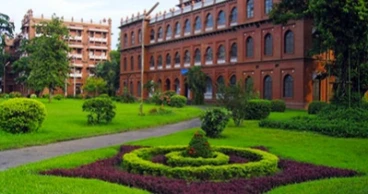
The abrupt collapse of the Awami League government on August 5, 2024 - the culmination of the July Uprising, the monumental movement that by the end had drawn in people from all walks of life, but was led by the students of Dhaka University, marking yet another glorious chapter in the 104-year history of the institution.
Prior to the Uprising, almost every aspect of campus life was influenced by the ruling party’s student wing, the Bangladesh Chhatra League. The allocation of dormitory seats was controlled by the organisation. First- and second-year students, upon entering the halls, were typically denied proper seats (allocation in rooms) and forced to stay in overcrowded ‘Gonorooms’. In contrast, Chhatra League leaders enjoyed single beds, and in many halls, some enjoyed entire rooms to themselves.
A fourth-year student of Sheikh Mujibur Rahman Hall, Muslimur Rahman, said, "It felt like we were imprisoned in a concentration camp. If somebody returned to the room a little late at night, he wouldn’t get space to sleep. Then he had to spend the whole night sitting in the reading room or sleeping in the mosque.”
In stark contrast, leaders of the Chhatra League used to live comfortably in single-occupancy seats (dorms).
“They would artificially create a seat crisis and hold general students hostage,” Muslimur continued. “Whenever they announced any political program, it had to be attended. On many occasions, they even instructed students to skip classes and join their programs.”
What if they disobeyed these instructions?
“Then the torture would begin,” said Muslimur. “At night, they would be summoned and subjected to abusive language, threats, and even physical assault. This would take place in the Guestroom.”
Dhaka University’s ‘Guestrooms’—typically a room near the hall’s entrance meant for students and visitors to sit or wait—spelt terror for students. At night, students were taken to the Chhatra League. Seniors would sit, while junior students had to stand in line. Often, seniors wielded sticks used as weapons to intimidate them. Then, they would be interrogated—why they didn’t greet their senior 'brothers', why they didn’t attend party programs, and so on. They were subjected to vulgar abuse and severe psychological harassment.
‘July Women’s Day’ celebrated at Dhaka University
A student named Pavel Ahmed shared a story. He said, “One of my friends missed the ‘Guestroom’ session for two days. As a result, a few of our immediate seniors came to our room. They verbally abused all of us. When they came to the friend who had missed the sessions, they insulted him with abusive language and even physically assaulted him over a trivial matter. Later, sensing the situation was escalating, a few others helped him leave the room safely.”
And at times, of course, things could indeed spiral out of control, as happened on the night of October 7, 2019 - with the macabre killing of Abrar Fahad, that shocked the nation. Although he was a student of BUET, the two institutions are of course closely linked, and most certainly had succumbed to the same culture as prevailed at DU under the Awami League.
The ordeal for Pavel’s friend however, was not over yet.
“Then they devised a terrifying plot,” said Pavel. "They threw away all his clothes and labeled him a drug addict, a mugger, and more. They forced all of us to memorise and testify against him—saying he was a drug addict, a mugger, a member of Shibir (student wing of the Jamaat e Islami), and so on."
Over 15 years, this dark reality had become the norm in almost every dormitory of the university, and as a matter of fact, throughout the public university system. But not anymore, thanks to the July Uprising. In a stunning portrayal of what was to come on the national stage, towards the middle of the 36-day movement, on July 17, the general student body came together in an unthinkable show of strength to expel the Chhatra League from the campus - for good, they hope.
“The expulsion of Chhatra League on July 17 dismantled the old political culture. In that sense, our movement was successful,” said Abdul Kader, one of the key coordinators of the July Uprising who now serves as the convenor of the DU branch of Bangladesh Ganatantrik Chhatra Sangsad.
Now, students say seat allocations are managed by the hall administration—there are no more ‘Guestrooms’ or ‘Gonorooms’. This alone might be enough to vindicate the Uprising, at least for the country’s student population.
Professor Abdullah-Al-Mamun, Convener of the Dhaka University Provosts Standing Committee and himself Provost of Salimullah Muslim Hall, said, “We have been able to abolish the Guestroom and Gonoroom system. The key reason behind this is a shift in political culture. Previously, the university was not seen as a center for research, but rather as a breeding ground for political power. Students were subjected to fascist repression, but now they are emerging from that. They are becoming aware of their rights. In the past, they were silenced through fear and intimidation.”
But will it last?
“There is a view that once a political regime is in power again, the ‘Guestroom’ and ‘Gonoroom’ culture might return. But as far as I can see, that will not be possible,” said Mamun. “Those who live in the halls will never accept the Guestroom-Gonoroom culture or the so-called ‘big brother’ culture. And if any political party is considering such a move, it would be a mistake.”
End of authoritarianism
A university can never meet its potential in an atmosphere of authoritarianism, such as that which prevailed at Dhaka University, and by extension most public universities, till the July Uprising. The spirit of intellectual enquiry was suppressed, and dissenting opinions were not tolerated.
Dhaka University symbolises our national identity: UGC Chairman
Md. Nizam Uddin, Vice President of the Bangladesh Jatiotabadi Chhatra Dal (BNP’s student wing), said, “I had to take both my Honours and Master’s exams under the guard of the proctorial body. Not just me—anyone involved in the anti-fascist movement faced the wrath of Chhatra League. We were attacked multiple times. Although we had the right to reside in the halls, we were not allowed to stay there. Students were living under a form of political slavery.”
Although the journey since August 5 has not been without its bottlenecks, things are now slowly changing, and mostly for the better, he says.
“Now everyone can move freely—not just at Dhaka University, but across the country. There are still limitations, but positive changes have taken place in student politics. Earlier, due to the terrorist Chhatra League, no opposition voice could even enter the campus.” said Nizam.
Miftahul Hossain Al Maruf, literature and sports secretary of DU Chhatra Shibir, came down hard on teachers who allow their partisan natures to come to the fore.
He stated, “The most shocking thing was that university teachers, renowned academics, turned into party hooligans. Based on just one message in a department group, my Zia Hall provost and Chhatra League labeled me a traitor and even a terrorist. I was handed over to the Shahbagh Police Station.”
With Hasina carrying out a political vendetta against Jamaat in the form of prosecuting their top leadership for war crimes and crimes against humanity during 1971, and her courts having stripped the party of its registration with the Election Commission, life was not easy at all for members of their student wing Shibir.
“Not only at Dhaka University but across the country, identifying as Shibir—or even suspicion of being linked to Shibir—was considered a serious crime. Abrar Fahad and Bishwajit gave their lives merely on suspicion of Shibir affiliation,” Maruf noted.
He added that now, coming out from there, students’ democratic and fundamental rights are being practiced at Dhaka University. “We want this continuity to remain. Students should not become slaves of any particular political party.”
What about academia?
As far as the academic atmosphere at the university is concerned, Dr. Rushad Faridi, Assistant Professor of Economics, believes not much has changed. He too stresses that significant changes have taken place in the dormitories, where students previously endured inhumane torture. Political cadres had taken over the residential halls, but public universities have now been freed from that grip.
“But the quality of education and research in universities hasn’t improved. The necessary steps for such changes are not being taken,” said Dr. Faridi.
Dhaka University lifts ban on Pakistani students
“Some efforts are being made to improve research standards, but they are minimal—and mostly for show,” he added. “There’s an attempt to move up in the rankings by increasing publications, but the actual quality of teaching remains the same as before.”
Abdul Kader stated that students’ opinions still tend to be ignored in the academic sphere, and crises that have long existed remain unresolved.
Kader said, “There is still no effort to ensure teachers’ accountability or prioritise student interests. As students, our rights in the academic domain are consistently overlooked. There’s a prevailing culture of arbitrariness among teachers—a kind of class-based discrimination.
“There are also political rivalries among teachers, and students often end up being the victims,” he added.
Kader may get the chance to affect some changes in this regard, with the announcement that after a six-year hiatus (that itself followed one of nearly 30 years), the Dhaka University Central Students’ Union elections will be held on September 9.
Currently serving as the DU branch convener of the Bangladesh Ganatantrik Chhatra Sangsad, effectively NCP’s student wing, he has declared himself the organisation’s candidate for the top post up for grabs in the election - the vice president. The university’s vice chancellor serves as the president.
11 months ago
Justice eludes families of July martyrs in Feni
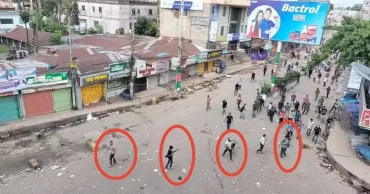
Family members of nine victims, who were killed during an anti-government protest in Mohipal area of Feni town on August 4 last year, have expressed their frustration over the tardy trial procedures and justice as a year has already elapsed since the killings.
So far, 22 cases have been filed, accusing over 6,000 people, with 2,199 people named and around 4,000 unidentified ones.
A total of 785 people have been arrested, including 155 named suspects. Of the arrestees, 11 have confessed under Section 164 in court.
The violence occurred on August 4 last year during a protest demanding the resignation of the then Prime Minister Sheikh Hasina.
Awami League and its affiliated groups allegedly attacked the protestors under the Mohipal flyover using firearms, machetes and explosives, killing nine and injuring over 150.
Hasina, Quader among 221 chargesheeted in Feni uprising murder case
Seven murder cases have been filed at Feni Model Police Station, along with 15 attempted murder cases.
Officer-in-charge Mohammad Shamsuzzaman said that among 782 named and 1,800 unnamed accused, 401 have been arrested and 75 of them are named and 326 suspected.
Victims’ families expressed frustration during a commemorative event on Tuesday at Shilpakala Academy.
They accused law enforcement of inaction, delayed chargesheet submissions and letting main perpetrators escape justice.
Expressing angry over the slowed justice process, Nesar Ahmad, father of slain Ishtiaq Ahmed Shraban, said “Many accused have fled abroad. Even those in the country roam free. Without justice, our children’s blood will be in vain. We don’t want wealth—only justice,” he said.
He added, “If there is no justice in this world, Allah will deliver it.”
The deceased also include Saeedul Islam Shahi, 19, Wakil Ahmed Shihab, 19, Zakir Hossain Shakib, 19, Mahbubul Hasan, 21, Md. Sabuj, 20, Sarwar Jahan Masud, 21, Md. Abdur Gani, 38, and Md. Abu Bakr Siddiq, 38.
Investigations reveal inconsistencies: Several people named in the murder cases weren’t even present at the protest, including teachers, lawyers, and journalists.
Victims' families claim many of the accused are unfamiliar to them and allege that some names were added or removed in exchange for bribes.
Families also claim that key leaders from the Awami League and its affiliates, identified as armed attackers, have yet to be arrested, despite being active on social media from hiding. Of the seven murder cases, only one has reached the chargesheet stage.
NCP postpones rallies in Feni, Noakhali, Lakshmipur after Milestone plane crash
Police say investigations are ongoing based on video footage, social media clips and witness accounts.
OC Shamsuzzaman said that arrested accused such as Nobi Member, Osman Gani Liton, Shafiqul Islam Samrat, and Ashiqur Rahman Ashiq have confessed to their roles.
Superintendent of Police Md. Habibur Rahman said, “Legal procedures are being followed. We are working to repatriate those who fled abroad. Digital surveillance is helping track down those still in the country. Political identity is irrelevant in these operations.”
Despite these assurances, victims' families remain skeptical, demanding swift and impartial justice for the atrocities committed during what many are calling a modern-day people's uprising in Bangladesh.
11 months ago
Govt launches Tk 1,792cr railway project to modernise tracks on key eastern routes
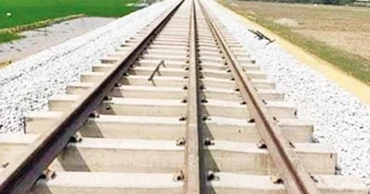
The government has taken up a Tk 1,791.66 crore development project to renovate and maintain railway tracks in the eastern zone of Bangladesh Railway in a bid to improve safety, expand capacity and enhance overall passengers and freight services.
The project, titled “Maintenance and Rehabilitation of Railway Tracks in the Eastern Region of Bangladesh Railway”, will be fully funded by the government (GoB) and implemented over four years—from July 2025 to June 2029—by Bangladesh Railway, according to a project document.
According to the document, the main objective of this development project are development and capacity enhancement of the existing rail communication up to Chittagong, Noakhali, Mymensingh and Jamuna Bridge Railways, increase the quality of services and increase the capacity of goods transportation and enhancing revenue income of the Bangladesh Railway.
The eastern zone of Bangladesh Railway comprises around 1,503.61 km of tracks with the Dhaka-Chattogram main line and the Laksam-Chandpur and Laksam-Noakhali sections serving as vital corridors for economic and social development.
Govt granting India corridor by allowing to set up railway tracks: Rizvi
In addition to connecting Dhaka with Mymensingh, Sylhet, and the Jamuna Bridge Eastern side, the eastern rail network plays a key role in regional connectivity.
The project document said that regular maintenance, such as inspections, slack removal, track alignment, and the replacement of worn-out components, is essential to ensure safe train operations.
Seasonal overhauls and periodic renewal of rails, sleepers, and ballast are also carried out, particularly during the dry season.
However, officials said long-standing manpower shortages have hindered proper implementation of these maintenance tasks.
The project is expected to boost the railway's operational capacity and service standards by facilitating major upgrades including the replacement of worn rails, sleepers, and fittings, filling ballast deficiencies, and introducing mechanised tamping and maintenance systems.
Although several new rail links have been developed in the eastern region in recent years many existing lines remain old and dilapidated.
Due to high costs, regular maintenance of these lines has not been feasible under the current revenue budget, officials said.
This has led to deteriorating track conditions prompting the need for comprehensive upgrades under a dedicated development initiative.
High demand, higher losses: Bangladesh Railway's financial strain deepens
According to the Planning Commission, the project will improve approximately 1,500 kilometers of track infrastructure on key routes linking Dhaka with Chattogram, Noakhali, Sylhet, Mymensingh, and the eastern end of the Jamuna Bridge.
Maintenance gangs are currently deployed across the eastern zone to oversee operations and ensure track security.
In critical situations, nighttime patrols are also arranged.
The project document recommends installing CCTV surveillance under the Signal and Telecom Department for enhanced security to be funded under the revenue budget.
A feasibility study conducted by the Infrastructure Investment Facilitation Company (IIFC) found the project to be both financially and economically viable.
1 year ago

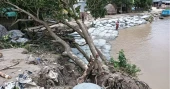
All Daulatdia ferry terminals face erosion threat as Padma swells
Riverbank erosion in the Padma has taken a serious turn with the rising water level since mid-July, putting all ferry terminals at Daulatdia under threat.
According to Bangladesh Inland Water Transport Authority (BIWTA), the three active terminals — No. 3, 4, and 7 — in Rajbari’s Goalanda upazila are now at serious risk of collapse.
Although sandbags are being dumped as part of emergency repairs the measures are insufficient given the scale of the erosion, said locals.
They said some adjoining villages including Bahir Char Sattar Member Para, Mojid Matubber Para, and Shahadat Member Para as well as markets, mosques, schools, and madrasas are also in danger.
BIWTA officials including the executive engineer of the Aricha office visited the site Saturday to assess the damage.
They reported severe erosion in a two-kilometre stretch around the terminals particularly around No. 4 and 7 terminals where ferry pontoons are becoming increasingly unstable due to soil loss.
Riverbanks residents alleged repeated delays in permanent river training.
Dharla erosion steals homes and hopes in Lalmonirhat
“Every monsoon brings the same problem, but no long-term solution,” said tea seller Shahin Sheikh. He also alleged irregularities in sandbag use.
Local residents Altaf Molla, Shahadat Pramanik, and Moyan Sardar said they do not want relief and want only effective river management.
They said they want to save their last refuge. “Many came with promises to prevent erosion but none kept their word,” said Altaf Molla.
Mohammad Salah Uddin, Assistant General Manager of BIWTC’s Daulatdia office, said, “Erosion has made the ferry terminals vulnerable. We’ve requested BIWTA to take immediate measures. Although three terminals are still operational, if erosion worsens, it may disrupt the transportation of passengers and vehicles.”
Panic grips Shariatpur residents as erosion resumes near Padma Bridge
Nepal Chandra Debnath, Executive Engineer of the BIWTA Aricha office, said, “Terminals 4 and 7 are at highest risk, and we’ve informed the authorities. As part of emergency repairs, around 700 sandbags have been dumped recently. However, no bags have been placed in the central part of the terminal yet. We can complete the remaining work if we receive the required allocation.”
1 year ago