special
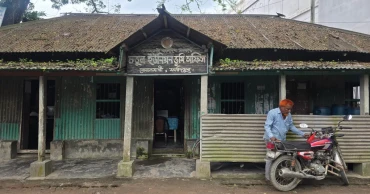
No service, 'without bribes' at Chatul land office in Faridpur
Service seekers in Chatul Union land office under Boalmari upazila of Faridpur have raised serious allegations of rampant 'bribery and harassment'.
Locals said no land-related service is delivered without paying 'extra money', forcing many to wait for days in the corridors unless 'unofficial' payments are made.
From mutation to obtaining khatians (land owners official numbers and descriptions), investigation reports, or even paying land taxes, victims allege that every step involves bribes.
Surrounding the Tahsil office, several computer shops offer online land-related services.
These shops are known to bring clients to the tahsildar (revenue collector), acting as middlemen, locals alleged.
Although the government mutation fee is officially Tk 1,170, clients are reportedly being charged between Tk 2,000 and Tk 10,000 depending on the case.
Expatriates remain a prime target of these agents.
Talking to this correspondent, several locals, including former Zila Parishad member Ahsan Habib, Niyamul Haque Faisal of Baikhir village and Milon Sheikh of Baikhir Chourasta said no files are forwarded to seniors without bribes.
Circular to be issued to take strict action against those involved in corruption in land offices
None of their mutation cases were resolved for less than Tk 4,000–5,000, they alleged.
Shamima Yasmin, an expatriate based in Italy, said she needed an urgent mutation for a piece of land in Chatul Union ahead of her July 10 flight.
“I thought the digitalisation of land services would ease the process. After submitting the online application and required documents, I approached the land office. But they wouldn’t forward the file without extra payment,” she said.
Eventually, she had to send Tk 1,000 through her brother to get the job done.
Echoing similar frustration, Ehramuzzaman, son of the late Ashrafuzzaman Saifar Miah, said, “My father passed away some time ago. I went to the Chatul Land Office for mutation of inherited property. After several visits, the tahsildar told me that unless I paid for ‘office expenses’, the file wouldn’t move. I finally paid Tk 1,000 to get it done.”
Nazmul Hossain, a Saudi expatriate, came from Chapaldanga of Gunboha Union to get a mutation done for 8 decimals of land.
“Besides, the official fee, I paid Tk 10,000 and was promised the work would be done within a week,” he said.
Chatul Union Parishad Chairman Rafiqul Islam said, "I’ve heard many complaints about the tahsildar from locals, though I haven’t personally visited the office.”
1, 333 more city and union land offices to be constructed across country: Land Minister
When asked why digitalisation has not curbed harassment and corruption, Advocate Shipra Goswami, former President of Faridpur Citizens’ Committee of Transparency International Bangladesh (TIB), said, "The central government is keen on ensuring public services through reforms, but the message hasn’t reached the grassroots effectively. Despite efforts, land service seekers continue to suffer. District and upazila administrations must show strong commitment and strict monitoring. Only then can we root out corruption from land management.”
Masud Rana, Member Secretary of the anti-discrimination student movement in Faridpur, said, “The current government is tirelessly working to ensure public services at the grassroots level. If anyone obstructs this process, we’ll launch a movement if necessary.”
Hasanuzzaman, General Secretary of Faridpur’s Committee for Preventing Corruption, added, "The movement of ‘24 was about change. Those creating obstacles must be brought under the law. Close monitoring is necessary where corruption is most likely. Local citizens must also be active in identifying corrupt officials and raising their voices.”
Abdullah Al Amin, Assistant Commissioner (Land) of Boalmari, said, "With the introduction of online services, corruption has reduced in many areas. But due to lack of awareness, many still fall into the trap of brokers and spend extra money. We urge people to come directly to the AC Land office instead of approaching middlemen.”
1 year ago
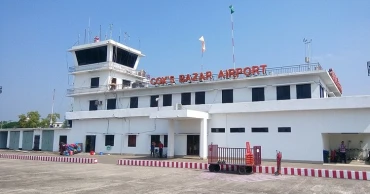
CAAB set to launch international flights from Cox’s Bazar by July end despite challenges
Undeterred by infrastructural and administrative challenges, the Civil Aviation Authority of Bangladesh (CAAB) is pressing ahead with its plan to begin overseas flights from Cox’s Bazar International Airport by the end of July.
Although nearly 40 percent of the airport’s expansion work remains incomplete and complications persist over land acquisition, eviction of thousands of residents, funding shortfalls, and a lack of clearance from the International Civil Aviation Organization (ICAO), CAAB has reportedly begun preparatory work to facilitate international operations.
According to CAAB sources, the decision to move forward was taken at a special meeting chaired by the then CAAB Chairman on April 21 this year.
Ongoing Challenges
· Construction of the airport terminal building is still nine months away from completion.
· Around 3,300 families continue to reside on airport land and have yet to be evicted.
· Acquisition of 4.64 acres of essential land remains pending.
As ICAO approval has neither been sought nor granted, launching international flights would technically breach global aviation norms.
Although an additional expenditure of nearly Tk 100 crore has been incurred, the government has yet to release the funds.
CAAB is currently lobbying top government officials to address the issue.
Infrastructural Progress
Notably, of the 1,700-foot runway extension into the sea, 1,300 feet lies over water—96 percent of this extension and 94 percent of the protective embankment have been completed.
Ctg airport flight operations halted for 2 hours after Biman glitch
Installation of the precision approach lighting system and a steel bridge is 83 percent finished, while drainage infrastructure stands at 55 percent. However, only 26 percent of the perimeter wall and patrol roads have been completed.
Upon full completion, the airport runway will expand from its existing 9,000 feet to 10,700 feet.
Future Prospects
The airport will feature a state-of-the-art Airfield Ground Lighting (AGL) system enabling safe night-time operations. Its architectural design includes illuminated pavements, flood management infrastructure, and aesthetic lighting along the seafront.
Recently transferred CAAB Chairman Air Vice Marshal M Mafidur Rahman told UNB, “We are working with determination for the country’s development. Even though some tasks are pending, we are trying to launch international flights soon. Hopefully, we will be able to do so within a short period.”
He went on to say, “Efforts to upgrade Cox’s Bazar Airport to international standards are underway. Despite some infrastructural and administrative challenges, we are working under the Prime Minister’s directive to launch international flights as soon as possible.”
Highlighting the urgency of the project, the former chairman said, “The terminal building, runway extension, security infrastructure and lighting systems are all progressing rapidly. An advanced AGL system will be installed for night operations, meeting international standards.”
Turkish Airlines flight makes emergency landing at Dhaka airport
“Over 3,000 families still need to be evicted and some crucial plots are pending acquisition. However, we are coordinating with the relevant agencies on these matters. Though project costs have risen, and Tk 100 crore remains due, the government is assisting us. We hope the funds will be released soon,” he added.
“We are committed to overcoming any challenge and turning Cox’s Bazar Airport into an international-standard facility. It will serve not only the tourism industry but also act as a key hub for regional connectivity,” he added.
Project Background
The initiative to transform Cox’s Bazar Airport into a regional hub and an alternative air connectivity centre during natural disasters was taken over a decade ago. Delays, delays in land acquisition and eviction, financial constraints, and planning inconsistencies have hampered timely execution.
Project Cost
The estimated cost of the project is Tk 1,794.31 crore, entirely financed by the Civil Aviation Authority of Bangladesh.
1 year ago
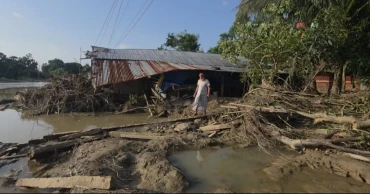
Feni floods leave behind trail of destruction worth Tk 146.43 crore
The recent flooding in Feni district has left thousands of residents reeling from devastating losses across agriculture, fisheries, and livestock sectors, with the overall damage estimated at Tk 146.43 crore, according to official sources.
Triggered by incessant rainfall and a surge of water from upstream regions, the flood submerged vast stretches of low-lying areas in Feni Sadar, Chhagalnaiya, Daganbhuiyan, Fulgazi and Parshuram upazilas, severely affecting daily life and livelihoods, they said.
Agriculture: A Battered Backbone
According to a preliminary report from the Department of Agricultural Extension (DAE), 5,564.61 hectares of cropland have been damaged. This includes 845 hectares of Aush paddy, 537 hectares of summer vegetables, 14 hectares of chilli, seven hectares of ginger, 2.5 hectares of turmeric, 0.11 hectares of tomato, 689 hectares of Aman seedbeds, and 3,470 hectares of stored ginger.
The loss has impacted an estimated 28,835 farmers, with damages amounting to Tk 38.07 crore.
Kamruzzaman Chowdhury from Darbarpur Union in Fulgazi upazila said, “My entire summer Aman seedbed on three bighas of land was ruined. Every year floods ruin our crops and plunge our families into a financial crisis.”
Mustafizur Rahman of Dhanikunda in Parshuram upazila said, “Five bighas of vegetable lands have been submerged and damaged during the flood. Within a year, we have faced massive losses once again. If this continues, we will have to starve.”
Mohammad Atik Ullah, Deputy Director of DAE, said, “There is still a lot of water in many areas. We can assess the true loss only once the water recedes. We’re working on initial calculations and will recommend compensation for affected farmers.”
‘When waters rise, our dreams drown’: Feni cries out for sustainable future
Fisheries: Livelihoods Washed Away
The fisheries sector reported a total loss of Tk 8.71 crore.
According to the District Fisheries Office, 276.20 metric tonnes of fish worth Tk 5.90 crore were washed away from 2,330 ponds, water bodies, and farms.
Besides, 128 metric tonnes of fish fry worth Tk 3.50 lakh were destroyed, while infrastructural damages amounted to Tk 42.50 lakh.
Md Alamgir, a fish farmer from Munshirhat Union, said he lost fish from three ponds totalling three bighas, resulting in a loss of Tk 2.5 lakh. “We don’t know how to recover,” he added.
Abdur Rahman from Paschim Alka village in Parshuram upazila shared a similar plight. “I lost my net-enclosed pond, with all the fish swept away. Officials did not assist us properly last year either, so it’ll be impossible to recover without help.”
District Fisheries Officer Aminul Islam said final reports are being prepared and a list will be sent to the government for compensation.
Livestock Sector Suffers Heavy Toll
Floodwaters claimed the lives of 10,600 poultry birds—1,400 in Fulgazi, 7,200 in Parshuram, and 2,000 in Chhagalnaiya. Besides, 235 ducks, three goats, one sheep and four cows were lost, according to the District Livestock Office.
Animal feed and fodder were also destroyed: seven tonnes of animal feed worth Tk 2.58 lakh, 30 metric tonnes of husk worth Tk 1.70 lakh, and 160 metric tonnes of grass worth Tk 7.65 lakh.
Kamal Hossain from Amjad Hat Union lamented, “I lost one cow—the only source of income. We are now destitute. If sustainable dams are not constructed, this crisis will never end.”
Md Hasan, owner of Bismillah Poultry in Bijoypur, said, “Years of hard work and dreams have ended in a moment, causing a loss of Tk 4.50 lakh.”
Dr Md Mozammel Haque, Feni’s Livestock Officer, said the estimated loss in this sector stands at Tk 64.89 lakh. “Compensation will be disbursed to affected and marginal farmers once officially sanctioned,” he said.
Breaches and Infrastructure Damage
Embankments along the Muhuri, Kahua and Sillonia rivers suffered 41 breaches across five upazilas. The Water Development Board estimates damages at nearly Tk 9 crore.
Assistant Engineer Abul Kashem said, “Since July 8, breaches have occurred in 41 locations along embankments, affecting five upazilas.”
Meanwhile, floodwaters damaged 126 roads covering a combined 300 kilometres in three upazilas. Feni Roads & Highways Executive Engineer Mahmud Al Faruq said the damage is valued at Tk 90 crore.
Tk 7,340 cr flood control embankment to be built in Feni: Adviser
Displacement and Ongoing Hardship
While 9,195 flood victims have left shelter homes, 365 people from 122 families are still residing in nine centres, highlighting the prolonged effects of the disaster.
This flood, though severe, follows a more devastating one in August 2024, which claimed 29 lives and affected over ten lakh people in the district. That event caused total damages of approximately Tk 2,686.205 crore—crippling roads, schools, homes, businesses and vital infrastructure.
With memories of last year’s disaster still fresh, many in Feni now wonder how many more blows their communities can endure without sustainable and long-term solutions.
1 year ago
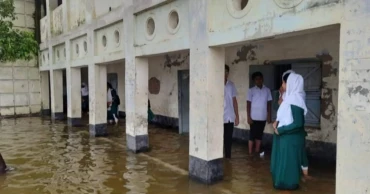
Severe waterlogging forces closure of two schools in Kushtia
Severe waterlogging in the Allardarga area of Daulatpur upazila of Kushtia district, has compelled authorities to close two schools temporarily amid rising health concerns.
Nearly 1,500 students from Allahrdarga Secondary School and the private Tressel English Version School, both situated in the affected area, face serious health risks due to prolonged water accumulation following incessant rains.
The school premises, including ground-floor classrooms of Allahrdarga Secondary School, remain submerged in stagnant water mixed with rotting garbage, emitting a strong, unbearable stench.
The foul odour has made it increasingly difficult for students to stay in classrooms, leading to serious disruptions in academic activities.
School officials have attributed the problem to the absence of a proper drainage system in the area, which has caused persistent waterlogging. Several students are reportedly suffering from skin diseases and other health complications as a result.
Chattogram’s costly failure: Waterlogging persists despite mega drainage projects
1 year ago
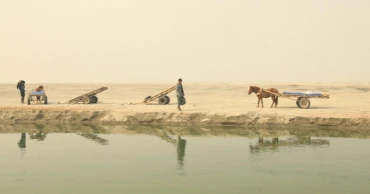
Kurigram char residents pay for power they never receive
What was supposed to be a blessing has turned into a source of frustration for hundreds of families living in remote char areas of Kurigram’s Ulipur upazila.
A solar electrification initiative, meant to bring power to homes beyond the reach of the national grid, has instead left residents disillusioned, and still in the dark.
Back in 2021, a total of 375 families from Chark Ghughurmari and Sukherbati, located in ward-8 of Saheber Alga Union, were provided with solar panels under a project reportedly managed by local public representatives and Awami League leaders and activists.
Each family was asked to pay between Tk 500 and Tk 1,000 in instalments for the installation of the solar units. But, according to the residents, the panels have remained dysfunctional from the very beginning.
Locals complain that the systems — comprising low-capacity panels, batteries and basic wiring — have either stopped working entirely or were never functional to begin with. Damaged batteries and faulty wiring are common, with many units rendered completely useless.
Dharla’s wrath leaves over 50 families homeless in Kurigram, hundreds more at risk
Residents such as Ruhul Amin, Abdur Razzak Pramanik, Abdus Sabur Pramanik and Kashem Ali said their villages still lack access to the national electricity grid.
At the time of installation, they were assured that payment could be made in instalments. But within eight to nine months, many began receiving official electricity bills from the Kurigram-Lalmonirhat Palli Bidyut Samity’s Ulipur zonal office despite the fact that the solar panels provided no power.
Repeated complaints to the relevant authorities have gone unanswered, with no maintenance or inspections carried out.
Meanwhile, bills continue to arrive.
“We can’t even light a bulb with these panels. We no longer want the solar units. If proper grid electricity is given, we are willing to pay monthly bills,” said Ruhul Amin.
Zohur Uddin, 67, said he paid Tk 500 for a 50-watt solar panel, but it failed almost immediately. “It barely lasted a day. Still, we keep receiving bills every month,” he lamented.
Lutfor Pramanik, 46, who received a 30-watt panel, said he now owes Tk 2,300 for the period between 2021 and 2025, despite never having received reliable power from the system.
Locals alleged that Palli Bidyut staff members now deliver electricity bills by hand each month at the riverbank, but no officials have visited the char to investigate or repair the malfunctioning solar systems.
When contacted, Tariqul Islam, Deputy General Manager of the Ulipur zonal office of Kurigram-Lalmonirhat Palli Bidyut Samity, acknowledged the issue.
“We are removing the panels upon request from those who no longer want them. Those who wish to keep them may do so. Had they paid bills on time, the arrears wouldn’t have accumulated. They are still liable to pay as per rule,” he said.
Zakir Hossain, Senior General Manager of the Palli Bidyut Samity, said he was unaware of the matter.
“Since you’ve raised it, I will have our Ulipur office look into the situation. If indeed the solar systems are faulty, we will consider waiving the bills based on customer applications,” he said.
1 year ago
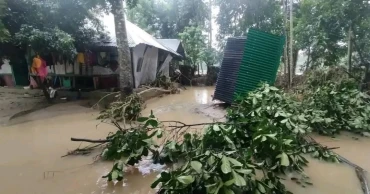
Struggle for survival begins anew in flood-hit Feni as waters recede
As floodwaters begin to recede across Feni, thousands of displaced residents are returning to their homes only to be met with devastation and despair.
The battle for survival has entered a new phase, marked by waterlogged dwellings, broken furniture, spoiled food and widespread uncertainty.
The immediate threat of floodwaters may have passed, but the scars of the deluge are evident across the district.
Many areas remain without electricity, with recovery efforts struggling to keep pace with the damage.
At least 484 people from 130 families continue to seek refuge in nine local shelters, while around 9,076 people have already left temporary accommodations to attempt rebuilding their lives in damaged homes.
Fulgazi Upazila Nirbahi Officer (UNO) Faria Islam said power restoration is still pending in several locations.
“Although water has receded, several homes remain uninhabitable. We are working in coordination with power and health departments,” she said.
Since 8 July, the rivers Muhuri, Kahuya and Silonia began swelling following continuous rain and upstream water from Tripura.
The resulting floods swept through Fulgazi, Parshuram, Chhagalnaiya and Feni Sadar upazilas.
According to the district administration, over 150,000 residents were marooned by the flooding, and more than 1,000 homes were either partially or completely destroyed.
Roads, bridges, agricultural land and educational institutions were severely affected.
In Fulgazi Bazar’s Shripur Road area, river erosion swept away at least 15 shops.
Md Abdul Alim, a local trader, lost his only means of income.
‘When waters rise, our dreams drown’: Feni cries out for sustainable future
“The river took away my shop in a single day. I ran my family with that income. Now I stand here, empty-handed, with no idea how to survive,” he said.
Residents who returned to their homes are finding conditions unlivable.
Rozina Akhter from Gojaria village said, “The water has gone, but we can’t enter our home. Mud, stench from spoiled food, and filth have made the place unlivable. The children are falling sick. Even in shelters, we are getting very little support.”
The Water Development Board (WDB) reported that embankments were breached at 36 points along the Muhuri, Kahuya, and Silonia rivers—19 in Parshuram and 17 in Fulgazi.
Earlier, the board had recorded 20 breaches within four days.
Akhtar Hossain, WDB executive engineer in Feni, said geo-bags are being used to contain breaches, but sustainable solutions are required.
“We have been trying to contain the breaches using geo-bags, but sustainable embankments and long-term river dredging plans are urgently needed,” he said.
The Department of Agricultural Extension confirmed that 5,564.61 hectares of cropland were affected.
The Fisheries Department recorded losses of Tk 8.12 crore, while the Department of Livestock reported damages amounting to Tk 64.88 lakh.
Final estimates are expected once all floodwaters have fully receded.
Md Harun, a poultry and fish farmer from Komua village, said he is facing the same nightmare again.
“Last year, the flood cost me over Tk 20 lakh. This time, chickens died, and fish enclosures were washed away again. Every year the same story—embankments break, the water comes, and we get promises. These disasters have become routine,” he said.
Tk 7,340 cr flood control embankment to be built in Feni: Adviser
Calls for temporary aid are gradually being replaced by demands for permanent solutions. Former upazila chairman Aminul Rasul Golap said people in Phulgazi are no longer seeking relief.
“They want strong embankments. Without proper river dredging, maintenance, and oversight, annual floods will continue to drown us,” he said.
Parshuram UNO Ariful Islam said relief efforts are ongoing, but resources remain limited.
“We are listing affected people and planning rehabilitation in phases,” he added.
Feni Deputy Commissioner Saiful Islam said, “We have allocated Tk 23.5 lakh for relief distribution. An additional Tk 40 lakh has been sought from the Disaster Management Ministry for dry food, cattle feed, and baby food. The army is assisting with relief efforts. The situation is gradually improving, and support for affected families will continue.”
In August last year, Feni experienced one of the worst floods in its history.
The disaster claimed 29 lives and affected more than 10 lakh people.
Feni’s low-lying areas disappear under rising waters leaving no land in sight
Total damages were estimated at Tk 2,686.20 crore, impacting homes, roads, schools, transport, and businesses across the district.
1 year ago
Faridpur-Barishal Highway in peril: A lifeline crumbles under monsoon pressure
For thousands of people who travel the Faridpur-Barishal Highway every day, the road has long been a lifeline, linking communities, supporting local trade and making travel easier across southern Bangladesh.
But over the past week, relentless monsoon rainfall has turned a critical 30-kilometre stretch from Faridpur town to the Bhanga intersection into a hazardous, crater-ridden obstacle course.
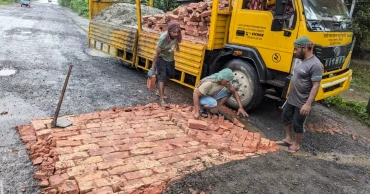
The scene is now one of disruption and distress. Bitumen and carpeting have given way in numerous areas and gaping potholes — some as deep as five inches — have transformed the highway into a patchwork of treacherous puddles and jagged edges.
For passengers, transport workers and traders, the once-routine journey has become an ordeal often ending in injury or delays.
“Accidents are becoming more frequent. It’s difficult to keep balance, especially on a motorbike,” said a local commuter, navigating cautiously through the rain-drenched road near Bakhunda.
In a bid to salvage the situation, the Faridpur Roads and Highways Department (RHD) has initiated emergency repairs.
Surma riverbank erosion threatens lifeline in Sunamganj
Using bricks and basic materials, teams are working on the worst-hit sections, including Pukhuria, Bhuban Dayar, Danggi Bridge and Talma Mor, to patch over the damage temporarily.
Executive Engineer Khalid Saifullah Sardar and his team have been at the forefront of these efforts. Despite continuous rain hampering progress, they remain visible on the ground, overseeing repair operations.
“This is only a temporary solution,” Engineer Saifullah told UNB, adding, “Proper repair work can’t begin until the rain stops and land acquisition issues are resolved.”
Behind the scenes, a more ambitious plan is waiting in the wings. In late May, the government awarded a formal tender to Arabail Company for a full-scale renovation of the damaged highway. An amount of Tk 49 crore has already been allocated for immediate improvements.
Besides, a far-reaching plan to widen the highway into four lanes has been approved, with Tk 500 crore previously sanctioned for land acquisition. But progress remains stalled.
“We can’t begin full-scale work until the district administration hands over the acquired land. That’s why there has been no major development in the Faridpur section for a long time,” Saifullah said.
Until then, the weight of the monsoon continues to bear down on the road, and on the people who depend on it.
At least 10 districts rely on this crucial artery, and the deterioration is not just a matter of inconvenience; it is disrupting livelihoods and mobility.
Bangladesh’s Trains: Lifeline for millions, yet stuck by challenges
While the RHD has pledged to continue temporary repairs to keep the highway functional, frustration grows among road users. Many are asking why such an important route was left vulnerable in the first place.
For now, drivers inch forward, dodging potholes and praying for clear skies and swift action to restore a road that connects more than just places, but also the daily lives of countless citizens.
1 year ago

Justice for all: Bold drive to ensure access for the marginalised in Bangladesh
Although Bangladesh’s constitution promises equal protection under the law, the real experience of many tells a different story as people face multiple barriers that prevent them from accessing the justice system.
Aiming to make the judicial services more extensive, accessible and effective for people particularly for marginalised groups, including women, the poor and children, the government has taken a project titled ‘Access to Justice for Women: Strengthening Community Dispute Resolution and Improving Case Management’.
It will be implemented by the Law Ministry involving Tk 186.4962 crore.
The project will be implemented in Barishal, Dhaka, Cumilla, Narsingdi, Khulna, Rangpur and Moulvibazar districts by March 2027, according to the project document.
Of the total amount of money, Tk 180.3082 crore will be provided by the German government as project grant while Tk 6.1880 crore will come from the national exchequer.
The main project objectives are to enhance the capacity of justice service providers, especially legal service providers and community-based organisations, and to enhance cooperation and coordination among relevant stakeholders in government, judicial and non-governmental voluntary development institutions.
It will also implement necessary legal and procedural reforms related to evidence-based case management and alternative dispute resolution.
The activities under the project involves organising seminars, workshops, and stakeholder meetings, conducting study tours, publishing legal aid materials, strengthening access to legal aid services and developing gender-sensitive conflict resolution policies and implementing evidence-based case management systems.
According to the project document, the Ministry of Law, Justice and Parliamentary Affairs is always striving to ensure an efficient and effective justice system.
For this reason, the ministry is taking various measures to ensure justice along with legal assistance to the people by formulating necessary laws, policies, rules, strategy papers, circulars, etc.
Judicial Service Commission presents 2023 Annual Report to President Shahabuddin
To this end, the project has been proposed with the aim of contributing effectively to the protection of the constitutional rights of the citizens of the state, especially the marginalised and helpless people, including women, by playing a role in adopting new reform methods, it said.
Despite legal reforms and various initiatives, women, children and marginalised communities in Bangladesh continue to face significant hurdles in accessing justice.
Structural barriers, social stigma, financial constraints and lengthy legal procedures often discourage vulnerable groups from seeking justice.
For many women, particularly in rural areas, navigating the judicial system remains a daunting task due to limited awareness of legal rights and fear of social backlash.
Victims of gender-based violence frequently encounter further victimisation during the legal process.
In many cases, police are reluctant to record complaints, while survivors face pressure from families or communities to withdraw cases or settle disputes informally, often at the cost of justice.
For children, the situation is equally complex.
Although child-friendly justice mechanisms exist in law, in practice, children involved in legal proceedings—whether as victims, witnesses, or accused—are often subjected to trauma due to lack of proper support systems, inadequate legal representation, and exposure to intimidating courtroom environments.
Marginalised communities, including ethnic minorities, the poor, and people with disabilities, struggle with additional obstacles such as discrimination, language barriers and lack of access to legal aid.
Many cannot afford the high costs of legal counsel or endure the prolonged nature of case resolutions.
Besides, case backlogs in courts remain a persistent problem, leading to years of delay in delivering justice.
This not only erodes trust in the legal system but also leaves victims without closure or remedy.
Legal experts and rights activists have long called for reforms that prioritise gender sensitivity, community-based dispute resolution, and the expansion of legal aid to ensure that justice is not a privilege, but a guaranteed right for all.
1 year ago
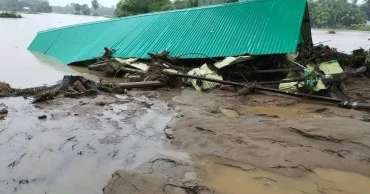
‘When waters rise, our dreams drown’: Feni cries out for sustainable future
As the monsoon set in, the people of Feni were once again devastated by flooding, a recurring tragedy that left behind deep and unhealed scars.
As the destruction recurs, one question continues to echo: will a sustainable embankment ever be built? Will the people of Feni ever be spared the horrors of recurring floods?
On Saturday, Faruk-e-Azam, Adviser to the Ministry of Disaster Management and Relief, visited the flood-hit areas in Feni.
Local residents seized the opportunity to press their demand for durable embankments. In response, the adviser mentioned that a project worth Tk 7,340 crore has been proposed for embankment construction in Feni.
Rushing waters from upstream India broke through embankments in the Parshuram and Fulgazi areas, submerging low-lying villages in Chhagalnaiya and Feni Sadar upazilas.
As of Friday, embankments in 23 spots have collapsed, flooding 112 villages and affecting around 34,600 people.
Thousands in border-adjacent Fulgazi, Parshuram, Chhagalnaiya and parts of Feni Sadar are enduring significant hardship. Roads have gone under water, halting all vehicular movement.
Power cuts and lack of mobile network connectivity have further complicated the situation for flood-affected families.
Tk 7,340 cr flood control embankment to be built in Feni: Adviser
As the floodwaters begin to recede, the extent of the damage is becoming clear. In Parshuram, about 50 homes have collapsed.
“Just a year after the last flood, we’re submerged again,” lamented elderly Razia Begum of Uttar Sripur in Fulgazi, as she stood waterlogged in her home.
She went on to say, “Everything is ruined. Floods in July and August have become a norm for this region. Sometimes I feel like being born here was a mistake.”
Razia is not alone. Each year, residents of northern upazilas like Fulgazi, Parshuram and Chhagalnaiya suffer the same fate.
This time, three consecutive days of heavy rainfall combined with upstream water from India have broken 23 embankment points along the Muhuri, Kahua and Silonia rivers. With water engulfing new areas every hour, life in these regions remains paralysed.
Ali Azam, a resident of Uttar Sripur in Fulgazi, described the ferocity of the current, saying, “Water is pouring through the breached embankments with strong currents. New areas are flooding by the hour. Just like last year, we are again struggling with power outages and mobile network failures. Regardless of which political party is in power, our fate never seems to change.”
Feni flood situation getting better after pause in rainfall
1 year ago

Reforms, higher incentives push Bangladesh’s remittances to record $30.32 bln
Bangladesh recorded an all-time high of US$30.32 billion in remittance inflows in the 2024–25 fiscal year, reflecting a 26.8% year-on-year jump, due to some government measures including higher cash incentives, streamlined regulations, and efforts to boost formal transfer channels.
According to the Finance Division’s medium-term macroeconomic policy statement, the unprecedented rise in remittance inflows—peaking at US$3.29 billion in March 2025—was largely driven by policy interventions such as an enhanced 2.5 percent cash incentive, simplified regulatory processes, and formal recognition of remitters’ contributions.
The government has also taken visible steps to improve the experience of overseas workers, it said.
In November 2024, it inaugurated the ‘Probashi Lounge’ at Hazrat Shahjalal International Airport, offering modern facilities including comfortable waiting areas, subsidized food, prayer rooms, and baby care services.
These initiatives aim to foster a sense of respect and privilege for expatriate workers who are a critical part of the national economy.
“Finally, following the introduction of the crawling peg exchange rate regime, the gap between the official exchange rate and the curb market rate has significantly narrowed and exchange rate remained stable, resulting in a more remittance inflows over the past several months,” the document claimed.
Remittance hits record $30.32 billion in FY2024-25
The Bureau of Manpower, Employment and Training (BMET) and the Ministry of Expatriates' Welfare and Overseas Employment (MoEWOE) played a crucial role in promoting overseas employment for skilled Bangladeshi workers.
Progress has already been made through initiatives like Skills For Employment Investment Program (SEIP) and Skills for Industry Competitiveness and Innovation Program( SICIP), while the government continues to focus on creating new employment opportunities and improving labour market conditions.
Expatriates sent a record US$30.32 billion in remittances in the just-concluded 2024-25 fiscal year, marking a 26.8 percent year-on-year increase from the US$23.9 billion received in FY2023-24 and it was the highest annual remittance inflow in the country’s history.
In June 2025 alone, the remittance inflow stood at US$2.81 billion, an 11 percent rise compared to US$2.53 billion in June 2024.
The highest single-month remittance in FY2024-25 was recorded in March, when inflows surged past the US$3 billion mark, driven by Eid-ul-Fitr-related transfers.
This not only marked the peak for the fiscal year but also set a new monthly record for Bangladesh.
Banking sector insiders attributed the surge to a growing preference among expatriates for using formal banking channels over informal ones such as hundi.
They believe the positive trend will help ease pressure on the country’s foreign exchange reserves and support import payments.
Jianul Islam, a Bangladeshi expatriate living in middle eastern country, said, “The expatriates are now feeling comparatively comfortable to send their money in the country due to some steps of the interim government.”
“The process has been eased and we feel encouraged to send our money to our nearest ones through proper channel,” he told UNB over telephone.
He also said that if the process remains easy and the exchange rates remains lucrative there is no reason to send money through illegal channel.
Bangladesh received $2.7 billion remittances in 29 days of June
But, he said that as the previous nexus of Hundi traders are absent till now after the change of Awami League government, the remitters are sending money through proper channel having no other option.
He added, “If remitters feel they are respected and provided better services—especially at airports—they will no doubt send more money through proper channels. The government should maintain this stance.”
The inward remittance flow throughout the FY2024–25 showed a steady upward trend, with monthly figures as follows: US$1.91 billion in July, US$2.22 billion in August, US$2.40 billion in September, US$2.39 billion in October, US$2.20 billion in November, US$2.64 billion in December, US$2.19 billion in January, US$2.53 billion in February, US$3.29 billion in March—the highest monthly inflow on record—followed by US$2.75 billion in April, US$2.97 billion in May, and US$2.81 billion in June.
1 year ago