Education
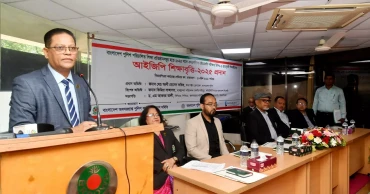
IGP urges students to enhance national prestige through merit, intellect
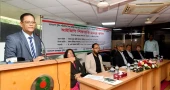
Inspector General of Police (IGP) Md Ali Hossain Fakir on Saturday has called on students to contribute to raising Bangladesh’s global image through merit, intellectual development and positive thinking.
He made the remarks while speaking as the chief guest at the “IGP Scholarship-2025” distribution ceremony held at the Bangladesh Retired Police Officers Welfare Association complex seminar hall in Rajarbagh, Dhaka.
The event was organised by the Bangladesh Retired Police Officers Welfare Association, with its president (retired Additional IGP) Dr M Akbar Ali in the chair.
IGP urges honesty, professionalism to earn public trust
Addressing the scholarship recipients, the IGP said students should work for the welfare of the country and its people alongside their studies. He stressed the importance of learning laws and developing a mindset of obeying them, adding that students should always maintain positive thinking and prioritise social welfare over personal interests.
He also said that members of the Bangladesh Police will not be spared if found involved in crimes, adding that legal action will be taken against them. “Bangladesh Police will stand as back up,” he said.
The IGP further stated that every district police station has been declared a “zero complaint” station.
Dr Akbar Ali, in his presidential remarks, said police members must maintain good behaviour with the public.
Students from different police educational institutions also shared their views on “What kind of police we want”, calling for a friendly and people-oriented police force that balances law enforcement with humane treatment.
A total of 400 students who achieved GPA-5 in SSC and HSC examinations in 2025 received the IGP Scholarship funded by CSR contributions of Community Bank Bangladesh PLC. Of them, 100 students from Dhaka-based institutions received scholarships directly at the event, while the remaining 300 will receive theirs through respective district police superintendents.
Community Bank Bangladesh PLC Managing Director (CC) Kimia Saadat attended as special guest.
Among others, association vice-presidents, retired police officials, teachers and students from police-run educational institutions were present.
3 months ago
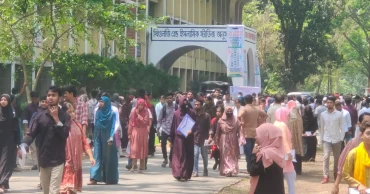
GST ‘A’ unit admission test held at IU
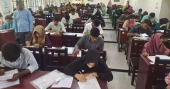
The ‘A’ Unit admission test under the General Science and Technology (GST) cluster system for the 2025–26 academic session was held at Islamic University (IU) on Friday.
A total of 166,162 applicants competed for 7,880 seats under the ‘A’ Unit this year. Of them, 11,186 candidates were scheduled to sit for the exam at the IU centre.
The one-hour examination was conducted from 11:00 am to 12:00 pm in 195 rooms across nine buildings on the campus.
GST ‘B’ unit admission test held at Islamic University; attendance 82.45pc
IU Vice-Chancellor Prof Dr Nakib Muhammad Nasrullah visited several examination halls to monitor the process. He was accompanied by Pro-Vice-Chancellor Prof Dr M Yeakub Ali, Treasurer Prof Dr Jahangir Alam and ‘A’ Unit admission test coordinator Prof Dr Asaduzzaman.
The university authorities took comprehensive measures to ensure a smooth and disciplined environment, including a four-tier security arrangement.
Law enforcement agencies, including police, RAB and Ansar personnel, were deployed on the campus under the supervision of the proctorial body. Adequate monitoring was maintained to prevent any untoward incidents.
Members of BNCC and Rover Scouts provided assistance to the candidates throughout the examination.
To facilitate candidates and their guardians, the administration set up information and health booths on the campus. A dedicated guardians’ corner was also arranged for their convenience.
Student organisations operated service booths near the main gate, while medical teams and ambulances were kept ready to respond to emergencies.
3 months ago
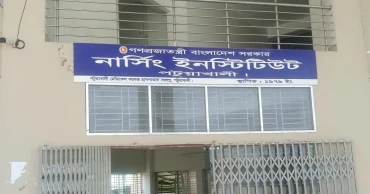
Patuakhali Nursing Institute ‘overcharging’ students for admission
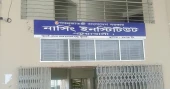
The Patuakhali Government Nursing Institute has allegedly been overcharging students during admission, with complaints centring on instructor Mahmuda Sultana Sheuly.
Students and guardians alleged that although the government-fixed admission fee is Tk 9,400, each student was charged Tk 11,400.
So far, 85 students have reportedly been overcharged, while 13 more have yet to complete admission, with the deadline set to end on Sunday.
The admission seekers said an additional Tk 2,000 was collected from each student, but receipts were issued for Tk 10,400, raising questions over the handling of the remaining amount and triggering concern among students and parents.
They called for a prompt investigation and appropriate action in this regard.
When asked about the allegations, instructor Sheuly said additional costs were involved and the charges were collected following previous practice.
“The decision was not mine alone. If it is proven illegal, the extra money will be refunded,” she said.
Patuakhali Medical College Hospital Superintendent Dilruba Yasmin said there is no scope for collecting fees beyond the government-fixed amount.
“If anyone has taken extra money, they will have to bear responsibility,” she said.
3 months ago
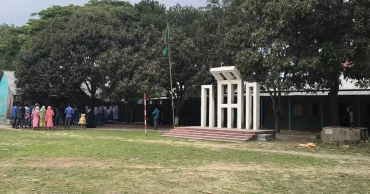
Where map fades, a school keeps dreams alive
Cut off from the mainland by the relentless erosion of the Brahmaputra River, Karai Barishal Char in Chilmari upazila in the district is a place where survival itself is a daily struggle. Yet amid poverty, isolation and uncertainty, a small school stands as a symbol of hope, defying all odds.
Karai Barishal Junior Secondary School, founded in 2003, serves around 152 students – more than half of them girls – drawn from several remote chars, including Majhabari, Bailamandiarkhata, Char Shakahati and Dhusmara. For many, reaching school means long journeys by boat and on foot, often through dangerous conditions.
“We struggle every day just to attend classes,” said one student preparing for the Secondary School Certificate (SSC) examination, beginning on April 21. “During the monsoon, the suffering turns unbearable. Still, we continue because our teachers encourage us.”
3 months ago
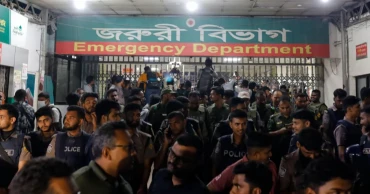
DMCH emergency services remain suspended for hours after clash
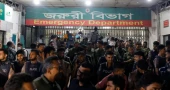
Emergency services at Dhaka Medical College Hospital (DMCH) remained suspended for several hours on Wednesday following a clash between Dhaka University students and interns at the hospital.
According to witnesses, the clash erupted around 5:30pm.
DU sources said Mahadi Hasan Sani, a student of the Department of Botany, went to the hospital with illness in the afternoon when the attending doctor prescribed a medication, asking him to purchase it from outside.
Sani alleged that after visiting several nearby pharmacies and failing to find the medicine, he returned to the doctor and requested an alternative prescription.
At that point, the doctor allegedly reacted angrily and assaulted him physically, he said.
When several of his classmates went to rescue him around 5:30pm, they were also reportedly beaten.
As news of the incident spread around, students from various residential halls of DU gathered in front of the hospital, creating further tension.
The main entrance of the emergency department was closed, with students of DMCH and doctors staying inside, while DU students remained outside chanting slogans. Police took position between the two groups.
A Dhaka Medical College student alleged the DU students created a mob against the doctors, leaving four interns injured.
Later, emergency services at the country’s premier hospital resumed around 9:00pm following a meeting between the authorities of the DMCH and DU, though the DMCH main gate was closed till filing of this report around 10:00pm.
The general secretary of Intern Doctors’ Association of DMCH Nabil Bin Kashem warned that they will go for a strike suspending emergency services if visible steps are not seen within 24 hours.
Meanwhile, a six-member probe committee, headed by a Dhaka University dean, has been formed to investigate the incident.
The committee has been asked to submit its report by July 11, DMCH Director Brigadier General Md. Asaduzzaman said after a meeting at the hospital around 10:05 pm on Wednesday.
3 months ago
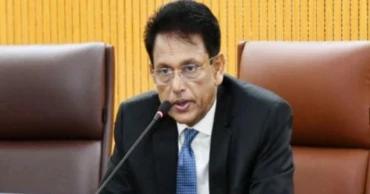
Selected city schools to see blended learning method: Milon
Education Minister ANM Ehsanul Hoque Milon on Wednesday said the government is considering launching a pilot hybrid education system – combining online and offline classes – in selected Dhaka schools, citing the global energy crisis, chronic traffic congestion, and the growing need for technology-driven learning.
"Not all schools at once, only those with the capacity will be considered for a pilot project," he said while addressing a seminar titled 'Continuing Education and Saving Electricity Amid the Global Energy Crisis' at the International Mother Language Institute in Dhaka as the chief guest.
Urban areas to see blended learning to save power: Milon
Under the proposed model, students will attend classes in person on some days of the week and online on others.
Milon said this will reduce student commutes, ease traffic pressure, and cut fuel consumption while keeping learners on track with their regular curricula.
He drew parallels with historical turning points, noting that wars, technological shift, and social transformation have consistently opened new opportunities. "Similarly, the current energy crisis, traffic gridlock, and global competition demand a fresh reimagining of Bangladesh's education system."
The minister emphasised that the future of education will be technology-driven and largely paperless. "From parliament to classrooms, digital systems will expand. Students must be prepared for that reality."
On the implementation side, he stressed that teacher training and monitoring would be critical to ensuring the effectiveness of online sessions and maintaining student engagement.
Touching on broader energy-saving efforts, Milon noted the government has already introduced measures such as setting air conditioning temperature limits and adjusting office hours, while also pushing for greater use of solar power and electric transport.
The government will take decisions in phases and implement them through pilot initiatives to prepare the next generation for global competition, he said.
State Minister for Primary and Mass Education Bobby Hajjaj, present at the event as a special guest, expressed hope that the ongoing crisis could be overcome through collective cooperation.
3 months ago

Students, NU authorities blame each other over Gazipur campus clashes
Several students were injured on Monday reportedly after clashes broke out between protesting students and security personnel at the National University campus in Gazipur, amid a dispute over the grace mark policy.
Witnesses said third-year degree students had been staging a peaceful sit-in at the university gate, demanding a second phase of grace marks and access to their examination records.
According to the protesting students, tensions escalated when the vice-chancellor came out to speak with them.
They alleged that university security staff and officials then charged at the demonstrators with sticks, leaving several injured.
However, the university authorities presented a different account.
In a press release, acting director of public relations Mostafizur Rahman said the protesting students attacked the vice-chancellor’s car and physically assaulted him.
The statement quoted Vice-Chancellor Professor Dr Amanullah as saying that the university is discouraging the practice of auto pass and excessive grace marks in order to maintain academic standards in the future.
3 months ago
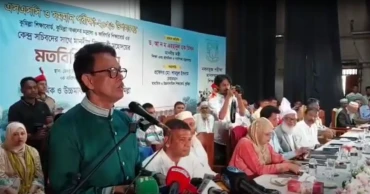
Urban areas to see blended learning to save power: Milon
Education Minister Dr ANM Ehsanul Hoque Milon on Saturday said classes in urban areas will be conducted through a blended system – both offline and online – to help conserve electricity amid the war-induced global crisis.
“We will run classes in urban areas in both offline and online modes to save power,” he said while speaking at a view-exchange meeting with centre secretaries of the Cumilla Secondary and Higher Secondary Education Board, as well as technical and madrasah boards of the region, at the Cumilla Shilpakala Academy.
The minister said a meeting with guardians will be held on Sunday to finalise the plan and gather feedback.
Highlighting the broader shift in the education system, he said the sector is moving towards a “penless and paperless” model, adding that the government aims to advance in line with modern information technology.
Addressing the issue of exam malpractice, Milon said adopting unfair means has existed since 1972, but stressed that it will be strictly prevented this time. “We stopped it in 2001-2006, and we will not allow it again,” he said, urging teachers to play a proactive role in eliminating it completely.
Cumilla Education Board Chairman Md Shamsul Islam delivered the welcome speech at the event.
MPs Manirul Haque Chowdhury, Md Mobasher Alam Bhuiyan, Md Abul Kalam, Md Jashim Uddin and MA Mannan, along with Technical Education Board Chairman Ruhul Amin, Madrasah Education Board Chairman Miah Md Nurul Haque, Deputy Commissioner of the district Reza Hasan and Superintendent of Police Md Anisuzzaman, among others, were present.
3 months ago
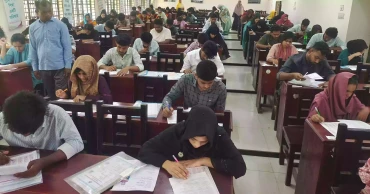
GST ‘B’ unit admission test held at Islamic University; attendance 82.45pc
The ‘B’ Unit (Humanities) admission test under the General Science and Technology (GST) cluster system for the 2025–26 academic session was held on Friday.
The one-hour examination took place from 11:00 am to 12:00 pm at 21 centres across the country.
A total of 93,102 candidates applied for the ‘B’ Unit, of whom 76,762 appeared in the test, marking an attendance rate of 82.45 percent.
Islamic University (IU) Acting Registrar Prof Dr Manjurul Haque, also secretary of the admission test core committee, confirmed the information on Friday afternoon.
The GST cluster includes 20 general, science and technology universities across the country. These are Islamic University, Mawlana Bhashani Science and Technology University, Patuakhali Science and Technology University, Noakhali Science and Technology University, Jatiya Kabi Kazi Nazrul Islam University, Jashore University of Science and Technology, Pabna University of Science and Technology, Begum Rokeya University, Gopalganj Science and Technology University, University of Barishal, Rangamati Science and Technology University, Rabindra University, University of Frontier Technology, Netrokona University, Jamalpur Science and Technology University, Chandpur Science and Technology University, Kishoreganj University, Sunamganj Science and Technology University, Pirojpur Science and Technology University and Naogaon University.
4 months ago
DVM students at PSTU continue boycott demanding degree restoration
Students enrolled in the Doctor of Veterinary Medicine (DVM) discipline at Patuakhali Science and Technology University (PSTU) continued boycotting classes and examinations on Thurday, demanding the reinstatement of the DVM degree.
The students first announced a suspension of all classes and exams on March 4, organizing protest marches and other activities to press their demand. On Thursday, DVM faculty members held discussions with the students, but failing to reach a satisfactory solution, the students decided to maintain their movement.
Earlier, on February 26, DVM students submitted a memorandum to the university’s Vice-Chancellor requesting the reinstatement of their DVM degree. The petition stated that the students were previously enrolled as regular DVM students, but following a decision by the university’s 54th (emergency) Academic Council on September 3, 2025, the DVM and Animal Husbandry degrees were annulled and merged under the BSc in Veterinary Science and Animal Husbandry program.
Subsequently, the students filed a writ petition (No. 17318/2025) in the High Court, which declared the separate annulment of the DVM and BSc (Hons) degrees unlawful and ordered that the programs be run independently in parallel.
The university appealed, but on March 11, the Chamber Court overturned the stay granted on March 5, allowing students to continue classes in their respective degrees.
Following the court verdict, students renewed their demand for the full restoration of the DVM degree under the previous curriculum. However, due to the lack of effective action from the university administration, DVM students have been compelled to continue boycotting classes and examinations.
One student said, Our demand is clear — we want our previous DVM curriculum reinstated. Unfortunately, the university administration has repeatedly delayed action under various pretexts, diverting our legitimate demand. We are given verbal assurances that have no practical basis.
The student added, We make it clear that until the university issues an official notification restoring the DVM degree, we will continue our movement to safeguard students’ rights. If our demand is not met, we may take stronger measures. We believe in peaceful and legitimate protest, but we are ready to escalate if necessary.
Repeated attempts to reach the university Vice-Chancellor, Professor Dr. Kazi Rafiqul Islam, by phone were unsuccessful.
4 months ago