Asia
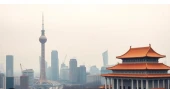
Chinese SOEs report 1.9 pc profit growth in first four months
Chinese state-owned enterprises (SOEs) and state-controlled enterprises reported combined profits of more than 1.37 trillion yuan (about 202 billion U.S. dollars) in the first four months of 2026, representing year-on-year growth of 1.9 percent, latest government data showed Friday.
During this period, Chinese SOEs' total operating revenue came in at roughly 26.27 trillion yuan, down 0.5 percent, according to data released by the Ministry of Finance.
The SOEs' debt-to-asset ratio stood at 65.5 percent at the end of April, the data revealed.
This year's government work report released in March states that the country will formulate and implement plans for further deepening SOE and state-capital reform to refine the layout of the state-owned sector and adjust its structure.
During an inspection tour last month to Qingdao, east China's Shandong Province, Chinese Vice Premier Zhang Guoqing underscored the need to unswervingly deepen the reform of SOEs to ensure that SOEs strengthen, optimize and expand their businesses.
He urged SOEs to enhance their role as major innovators and focus on tackling scientific and technological challenges in line with national strategic needs, in order to better support the development of the innovation ecosystem in the country.
13 minutes ago
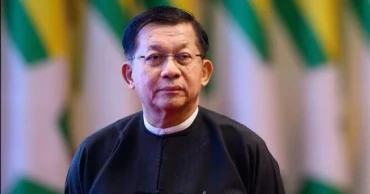
Myanmar president to lead delegation on official visit to India
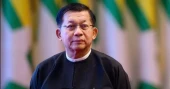
President of the Republic of the Union of Myanmar, Min Aung Hlaing, will pay an official visit to India from May 30 to June 3 at the invitation of Indian Prime Minister Narendra Modi.
He will be accompanied by a high-level delegation comprising several Cabinet Ministers, senior officials and business leaders.
This will be the first visit of President Min Aung Hlaing to India in his current capacity, said the Indian Ministry of External Affairs on Thursday.
He was scheduled to visit India to participate in the International Big Cat Alliance Summit on 1 June (since deferred).
Myanmar lies at the confluence of India’s Neighborhood First, Act East and MAHASAGAR policies.
The official visit of President Min Aung Hlaing to India is expected to further strengthen and deepen the multi-faceted relations between the two countries.
During his visit to New Delhi, President Min Aung Hlaing will hold discussions with Prime Minister Narendra Modi on June 1 on further strengthening the historical and civilisational ties between the two countries. He will also participate in a business forum.
As part of the visit, President Min Aung Hlaing will also travel to Bodh Gaya on 30 May 2026 and to Mumbai on June 2 for business and industry interactions and site visits.
22 hours ago
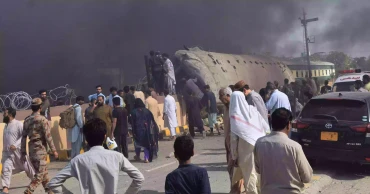
Suicide bombing in Pakistan kills at least 23
QUETTA, Pakistan (AP/UNB) — A suicide bomber detonated an explosives-laden vehicle near a railway track as a passenger train passed through the southwestern Pakistani city of Quetta on Sunday, killing at least 23 people and wounding over 70 others, officials said.
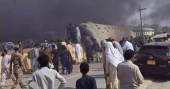
The force of the explosion caused two of the train cars to overturn and catch fire, sending thick black smoke into the air, according to footage shared online.
The attack happened in an area where security forces are usually stationed, badly damaging several nearby buildings and smashing more than a dozen vehicles parked along the road, according to witnesses and images circulating on social media.
Doctors at local hospitals said they had received the wounded, with 20 in critical condition. Three security officials told The Associated Press the bodies were transported to hospitals following the attack. The officials spoke on condition of anonymity to be able to speak to the media.
The outlawed Baloch Liberation Army, or BLA, which demands independence from Pakistan’s central government, has claimed responsibility for the attack in a statement sent to reporters. The militant group said it targeted a train carrying security personnel.
Quetta is the capital of insurgency-hit Balochistan province. The oil- and mineral-rich region has long been the scene of a low-level insurgency. The insurgents have frequently targeted security forces, government installations and civilians in the province and elsewhere in the country.
“We strongly condemn the targeting of innocent civilians and are deeply saddened by the loss of precious human lives. Terrorist elements deserve no leniency,” said Shahid Rind, Balochistan provincial government spokesman.
He said following the explosion, a medical emergency was declared at hospitals in Quetta, and an investigation has been launched.
Prime Minister Shehbaz Sharif strongly condemned the attack, calling it a “cowardly act of terrorism" in a post on X and offering condolences to the families of the victims.
Balochistan Chief Minister Sarfraz Bugti strongly condemned the attack in Quetta, saying the militants targeted “innocent civilians, including women and children,” vowing to “hunt (them down)” in a post on X.
Bugti and the federal government in Islamabad often use the phrase “Fitna al-Hindustan” to refer to the BLA, which they allege is backed by India. New Delhi denies the allegation.
Pakistan’s President Asif Ali Zardari denounced the bombing, saying militants and their backers sought to undermine Pakistan’s role in regional and international peace efforts.
The attack came a day after Pakistan said the United States and Iran were close to reaching a memorandum of understanding to end the war in the Middle East that began on Feb. 28 after the U.S. and Israel attacked the Islamic Republic, upending global travel and spiking oil prices. U.S. President Donald Trump had said a deal related to the conflict had been “largely negotiated” following calls with regional allies, including Pakistan.
Zardari promised in a statement that his country “will defeat terrorists, their facilitators, financiers and those providing them safe havens.”
Pakistan and India have long had strained relations and have fought two of their three wars over Kashmir, which is claimed by both in its entirety.
Although Pakistani authorities say they have quelled the insurgency, violence in Baluchistan has persisted.
At least 26 people, including soldiers, were killed in 2024 when a suicide bomber attacked a train station in Balochistan.
5 days ago
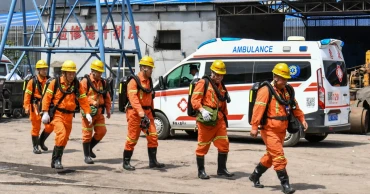
China's major coal mining disasters this century
A gas explosion at a coal mine in China’s northern province of Shanxi, the country's main coal mining province, killed at least 82 people, local officials said Saturday.
The cause of the explosion, which took place on Friday evening at the Liushenyu coal mine in the city of Changzhi, is under investigation.
With a size larger than Greece and a population of around 34 million, the province’s hundreds of thousands of miners dug 1.3 billion tons (1.17 billion metric tons) of coal last year — nearly a third of China’s total.
Mining disasters are common in China, where rapid industrialization came with intense resource exploitation, poor working conditions and a weak regulatory framework.
Mine owners and local officials are frequently blamed for putting profits ahead of safety. Underground explosions often are blamed on lack of ventilation equipment to clear gas that seeps from the coal bed. In the past two decades, the Chinese government has been making efforts to reduce mining deaths, by improving safety and closing some smaller mines.
Here are some major incidents:
2023: 53 people were killed after a collapse at an open-pit mine in northern China’s Inner Mongolia region.
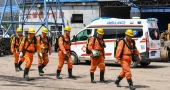
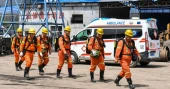
2009: 108 miners died as a result of a gas explosion at the state-run Xinxing mine in Heilongjiang province near the border with Russia. State broadcaster CCTV displayed a diagram showing the miners trapped about a third of a mile underground. Footage showed one entrance was blocked and rescuers in orange suits with breathing equipment attempting to enter through another.
2005: 171 people died in a blast at the Dongfeng coal mine in Qitaihe in Heilongjiang province.
2005: 214 miners were killed following a gas explosion at the Sunjiawan coal mine in the Liaoning province in China’s northeast.
2004: 166 died in a gas explosion at the Chenjiashan coal mine in the Shaanxi province, in China's northwest.
2004: 148 people were killed in a gas explosion at the Daping coal mine in China's inland Henan province.
2000: 162 people died after an explosion at the Muchonggou coal mine in the mountainous Guizhou province in China's southwest.
5 days ago
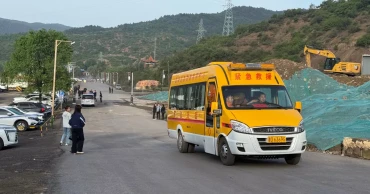
82 killed in China’s deadliest coal mine blast in years
A gas explosion at a coal mine in China’s northern Shanxi province killed at least 82 people, local officials said Saturday, in what was the country’s deadliest mining accident in recent years.
The official Xinhua News Agency said the accident at Changzhi city’s Liushenyu coal mine happened on Friday evening.
At a news conference late Saturday, local authorities said 82 were dead and that more than 120 people were hospitalized. Two were still missing. The death toll was a revised, lower number from earlier reports by state broadcaster CCTV that said 90 had died.
The scene at the coal mine was “chaotic” in the immediate aftermath of the accident, they said, and figures provided at the time were initial and not definite.
The explosion was under investigation, local officials said, adding there were “serious violations” of the law by the mine’s operator. They did not elaborate on any specific violations.
Earlier on Saturday, Xinhua reported that rescue work was pressing on a day after the accident, with hundreds of rescuers and medical personnel sent to the site. Among the injured, many were hurt by toxic gas, according to CCTV.
Chinese President Xi Jinping has called for an all-out effort to rescue the missing, Xinhua reported. Xi also called for a “thorough investigation" and accountability "in accordance with the law.”
Xinhua later reported that those responsible for the company involved in the mine accident have been "placed under control,” citing the local emergency management bureau.
An investigation team sent by China’s powerful State Council, equivalent to the country’s Cabinet, would be conducting a “rigorous and uncompromising” probe into the deadly explosion, a separate Xinhua report said following Xi’s remarks.
Wang Yong, one of the hospitalized miners, told CCTV in a video interview that he smelled sulfur “like firecrackers” and saw smoke.
“I told people to run,” he said. “As I ran, I saw people being choked by the smoke. And then I blacked out.”
The state broadcaster also reported that blueprints provided by the coal mine did not match the actual layout, hampering rescue efforts.
The coal mine, operated by the Shanxi Tongzhou Coal & Coke Group with an annual production capacity of 1.2 million tons, was placed on a national list of disaster-prone coal mines by China’s National Mine Safety Administration in 2024 for having “high gas content.”
Shanxi province is known as China’s main coal mining province. With a size larger than Greece and a population of around 34 million, the province's hundreds of thousands of miners dug 1.3 billion tons of coal last year, almost a third of China’s total.
In China, coal remains a key energy source due to its lower cost and high availability, even as the country accelerates its transition toward green energy. Mining disasters have been common although authorities had implemented measures to improve safety over the past years.
In February 2023, 53 people were killed after a collapse at an open-pit mine in northern China’s Inner Mongolia region. In November 2009, an explosion at a mine in northeastern China’s Heilongjiang province killed 108, according to state media.
5 days ago
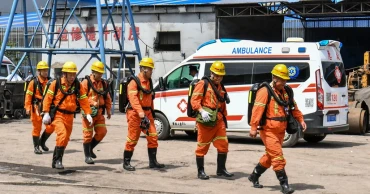
Coal mine gas explosion in China kills 90, rescue efforts continue
A gas explosion at a coal mine in China’s northern Shanxi province has killed at least 90 people, state media reported Saturday.
The accident took place on Friday evening at the Liushenyu coal mine in Changzhi city, according to the official Xinhua News Agency. About 247 workers were on duty at the time of the blast.
Xinhua initially reported early Saturday that eight people had died and 38 others were trapped underground. By Saturday afternoon, nine workers were still reported missing as rescue operations continued.
The cause of the explosion is under investigation, while emergency teams are pressing ahead with rescue work, Xinhua said. State broadcaster CCTV reported that many of the injured suffered from exposure to toxic gas.
Chinese President Xi Jinping has called for maximum efforts to rescue the missing and to determine the cause of the disaster, while ensuring those responsible are held accountable, according to Xinhua.
Shanxi province, China’s major coal-producing region, is larger than Greece and home to around 34 million people. Its vast mining industry produces hundreds of millions of tons of coal each year, accounting for nearly a third of the country’s total output.
6 days ago
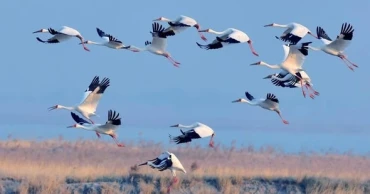
Beijing ranks among world’s megacities with high biodiversity
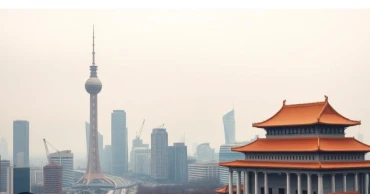
Beijing is now home to more than 7,000 recorded species, ranking its biodiversity among the highest of the world’s major megacities, the city’s ecology and environment bureau said Thursday.
The bureau added that Beijing’s ecological environment has continued to improve steadily during the 2021–2025 period under the 14th Five-Year Plan. A total of 151 types of natural and semi-natural ecosystems and 7,121 species were documented through citywide surveys, demonstrating remarkable outcomes in biodiversity conservation and placing Beijing at the forefront of global megacities in this regard.
By international standards, a city recording 3,000 to 5,000 species is considered to have a high level of biodiversity, while more than 5,000 represents an extremely high level.
Over the past five years, Beijing has continuously advanced biodiversity conservation. The city has enforced a regulation on ecological protection and green development of Beijing's ecological conservation areas and issued its first medium- and long-term plan for biodiversity conservation. A joint meeting system has also been established to facilitate cross-department coordination on key tasks.
The city has designated ecological conservation redlines covering 27.5 percent of its land area and protected natural areas covering about 19 percent, providing effective spatial safeguards for biodiversity.
In urban areas, over 700 nature zones, including biodiversity demonstration zones and ecological conservation communities, have been created to expand habitats and breeding spaces for flora and fauna. Regular inspections of ecological issues are carried out within protected natural areas and ecological redlines, ensuring that identified problems are promptly addressed.
In terms of species and genetic resource conservation, Beijing has strengthened its conservation system centered on botanical gardens, zoos and wildlife rescue centers. The China National Botanical Garden has collected and preserved over 18,000 plant species, while technical systems for the assessment, preservation, breeding and utilization of more than 20 nationally protected wild plant species have been established.
Meanwhile, pilot surveys on traditional knowledge related to biological genetic resources have been conducted in Beijing's Fangshan and Huairou districts, documenting over 700 items of traditional knowledge of biodiversity.
Cao Zhiping, an official at the bureau, said that Beijing's efforts in biodiversity conservation as a megacity have gained international recognition. During the 16th meeting of the Conference of the Parties to the UN Convention on Biological Diversity, Beijing was named a "Biodiversity Charming City," presenting to the international community a model for harmonious coexistence between megacities and biodiversity.
7 days ago

Why is India’s Gen Z rallying behind the ‘Cockroach Janta Party’?
A satirical online political movement dubbed the “Cockroach Janta Party” has gained massive traction across India after controversial remarks by the country’s chief justice comparing some unemployed young people and activists to cockroaches.
The controversy erupted on Friday when Chief Justice Surya Kant, during a Supreme Court hearing, referred to “parasites” attacking the system and remarked that some unemployed youths become activists or social media commentators and begin criticizing institutions.
“There are youngsters like cockroaches, who don’t get any employment or have any place in the profession. Some of them become media, some of them become social media, RTI activists and other activists, and they start attacking everyone,” he said.
The comments triggered widespread criticism, particularly among India’s Gen Z population, many of whom face rising unemployment, inflation and growing social tensions.
Although Justice Kant later clarified that his remarks were aimed at individuals obtaining fraudulent degrees rather than the country’s youth, the explanation did little to quell the backlash online.
Capitalising on the outrage, Abhijeet Dipke, a 30-year-old public relations graduate, posted a tongue-in-cheek message on social media asking what would happen if all “cockroaches” united.
The joke quickly evolved into the “Cockroach Janta Party” — a parody of Prime Minister Narendra Modi’s ruling Bharatiya Janata Party (BJP).
Within days, the movement attracted millions of followers on social media and hundreds of thousands of membership applications.
The party describes itself as “a political front of the youth, by the youth, for the youth” and uses humour and satire to highlight issues such as unemployment, political accountability, media independence and concerns over democratic institutions.
Supporters say the movement reflects growing frustration among young Indians struggling with limited job opportunities despite the country’s economic growth. Official data show graduate unemployment remains significantly higher than the national average, reports Al Jazeera.
Former civil servant Ashish Joshi, who joined the movement, said many Indians feel increasingly hesitant to express dissent and view the satirical campaign as a rare outlet for public frustration.
Prominent lawyer and activist Prashant Bhushan also criticised the chief justice’s remarks, arguing they reflected broader prejudice against young people and activists. He said the popularity of the movement demonstrates a growing demand for accountability and public debate.
Dipke said the party’s branding and manifesto were created within 24 hours using artificial intelligence tools, turning what began as an online joke into a nationwide conversation about youth discontent and political expression.
8 days ago
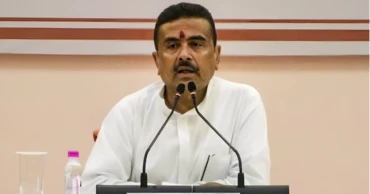
West Bengal transfers land to BSF; Suvendu launches ‘detect, delete, deport’ drive against infiltration
West Bengal Chief Minister Suvendu Adhikari on Wednesday announced a dual initiative aimed at strengthening border security, including the handover of a 27-km land corridor to BSF for pending fencing work and the rollout of a wider “detect, delete and deport” strategy ‘to tackle illegal infiltration’.
Speaking at a press conference at Nabanna in the presence of senior Border Security Force (BSF )officials, Adhikari said the land transfer process would be completed within two weeks, reports PTI.
BSF to gain complete authority over border fencing land in 45 days, says Suvendu at first Cabinet meeting
He described the move as the first step toward developing broader border security infrastructure along the India-Bangladesh border.
During the briefing, he also unveiled a new mechanism under which suspected infiltrators detained by police would be directly transferred to the BSF.
He said individuals belonging to communities outside the ambit of the Citizenship (Amendment) Act (CAA) would be subject to detention and deportation under a system that takes effect immediately.
8 days ago
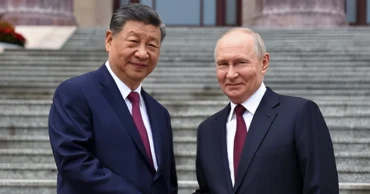
Putin and Xi hail their friendship and growing energy trade
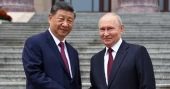
Chinese President Xi Jinping and Russian President Vladimir Putin on Wednesday reaffirmed their close strategic partnership and expanding energy cooperation during talks in Beijing, held days after US President Donald Trump’s visit to China.
The two leaders oversaw the signing of over 40 cooperation agreements covering trade, technology and media exchanges, while also agreeing to extend a friendship treaty originally signed in 2001. Xi described bilateral ties as reaching “the highest level in history.”
Xi wants ‘closer, stronger strategic coordination’ between China and Russia
Putin highlighted energy cooperation as the main driver of economic relations, noting Russia’s continued role as a reliable energy supplier amid the Middle East crisis and China’s position as a major consumer. Xi called for a “complete cessation of hostilities” in the Middle East, saying an early end to the conflict would help stabilize global energy supplies and trade.
China became Russia’s top trading partner after Moscow’s invasion of Ukraine in 2022. Bilateral trade reached about $228 billion in 2025, according to Xinhua. Russian officials said oil exports to China rose 35 percent in the first quarter of 2026.
The two leaders also projected a united stance on global affairs, criticizing unilateralism and emphasizing closer foreign policy coordination. Both praised their personal friendship, with Xi calling Putin his “longtime friend” and Putin referring to Xi as “my dear friend.”
8 days ago