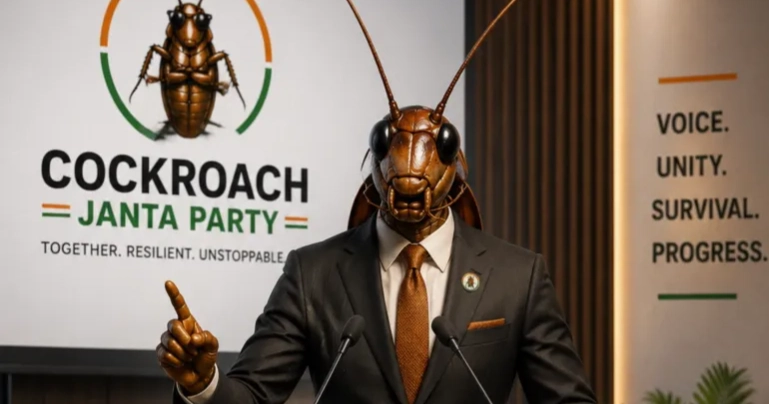
A satirical online political movement dubbed the “Cockroach Janta Party” has gained massive traction across India after controversial remarks by the country’s chief justice comparing some unemployed young people and activists to cockroaches.
The controversy erupted on Friday when Chief Justice Surya Kant, during a Supreme Court hearing, referred to “parasites” attacking the system and remarked that some unemployed youths become activists or social media commentators and begin criticizing institutions.
“There are youngsters like cockroaches, who don’t get any employment or have any place in the profession. Some of them become media, some of them become social media, RTI activists and other activists, and they start attacking everyone,” he said.
The comments triggered widespread criticism, particularly among India’s Gen Z population, many of whom face rising unemployment, inflation and growing social tensions.
Although Justice Kant later clarified that his remarks were aimed at individuals obtaining fraudulent degrees rather than the country’s youth, the explanation did little to quell the backlash online.
Capitalising on the outrage, Abhijeet Dipke, a 30-year-old public relations graduate, posted a tongue-in-cheek message on social media asking what would happen if all “cockroaches” united.
The joke quickly evolved into the “Cockroach Janta Party” — a parody of Prime Minister Narendra Modi’s ruling Bharatiya Janata Party (BJP).
Within days, the movement attracted millions of followers on social media and hundreds of thousands of membership applications.
The party describes itself as “a political front of the youth, by the youth, for the youth” and uses humour and satire to highlight issues such as unemployment, political accountability, media independence and concerns over democratic institutions.
Supporters say the movement reflects growing frustration among young Indians struggling with limited job opportunities despite the country’s economic growth. Official data show graduate unemployment remains significantly higher than the national average, reports Al Jazeera.
Former civil servant Ashish Joshi, who joined the movement, said many Indians feel increasingly hesitant to express dissent and view the satirical campaign as a rare outlet for public frustration.
Prominent lawyer and activist Prashant Bhushan also criticised the chief justice’s remarks, arguing they reflected broader prejudice against young people and activists. He said the popularity of the movement demonstrates a growing demand for accountability and public debate.
Dipke said the party’s branding and manifesto were created within 24 hours using artificial intelligence tools, turning what began as an online joke into a nationwide conversation about youth discontent and political expression.