Asia
Xi-Trump summit focuses on trade, Taiwan and global tensions
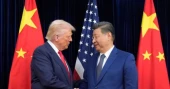
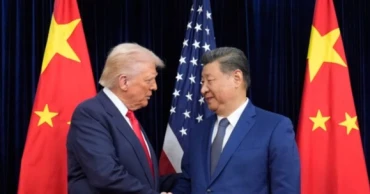
Chinese President Xi Jinping and US President Donald Trump began high-stakes talks in Beijing on Thursday, with both sides aiming to maintain stability in bilateral relations during the two-day summit.
According to the White House and Chinese state media, the two leaders held a closed-door meeting lasting about two hours on Thursday morning. Trump is scheduled to depart Beijing shortly after midday Friday following another private session with Xi. However, no major breakthroughs are anticipated on contentious issues including the Iran conflict, trade disputes, technology restrictions and Taiwan.
Trump is seeking to prioritise trade discussions, including expanding Chinese purchases of US agricultural goods and commercial aircraft. He also hopes to establish a mechanism to manage disagreements and avoid another trade war similar to the one triggered by US tariff increases last year.
During the meeting, Xi warned that the Taiwan issue remains highly sensitive in China-US ties. According to China’s state-run Xinhua News Agency, Xi told Trump that proper handling of Taiwan would help maintain overall stability in relations, while mishandling the issue could lead to confrontation and seriously damage bilateral ties.
The Trump administration approved an $11 billion arms package for Taiwan in December, although deliveries have yet to begin. Beijing considers the self-governed island part of its territory.
Speaking to CNBC, US Treasury Secretary Scott Bessent declined to detail Washington’s response to China’s concerns over US arms sales to Taiwan, saying Trump would address the matter publicly later Thursday or Friday. He added that the president fully understands the issue and would respond firmly.
Meanwhile, US Secretary of State Marco Rubio said Trump raised concerns about Iran during talks with Xi but did not seek China’s assistance.
In an interview with NBC News, Rubio said both countries agreed Iran should not obtain nuclear weapons. He also noted that Chinese officials expressed opposition to militarisation of the Strait of Hormuz and rejected the idea of imposing tolls there.
Global financial markets reacted cautiously to the summit developments. Wall Street futures pointed higher on Thursday following record highs reached by the S&P 500 and Nasdaq a day earlier.
Oil prices remained largely unchanged amid continued uncertainty surrounding the Iran conflict and the future of the Strait of Hormuz, a key global shipping route. The White House later said Trump and Xi had discussed strengthening economic cooperation and agreed the strategic waterway should remain open.
2 months ago
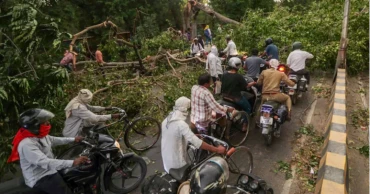
100 killed as storms and heavy rain batter Uttar Pradesh
At least 100 people were killed after powerful storms and heavy rain swept across India’s northern state of Uttar Pradesh, causing widespread damage to homes, roads and power lines, officials said.
The worst-hit district was Prayagraj, where 21 people died. Another 18 deaths were reported in Bhadohi, 15 in Mirzapur and 10 in Fatehpur.
Six people each were killed in Unnao and Badaun, while four deaths each were reported in Pratapgarh and Bareilly. Two people each died in Sitapur, Raebareli, Chandauli, Kanpur Dehat, Hardoi and Sambhal.
Single deaths were reported in Kaushambi, Shahjahanpur, Sonbhadra and Lakhimpur.
The weather changed suddenly on Tuesday evening, with dust storms and strong winds hitting large parts of the state.
Trees and electricity poles were uprooted, roads were blocked and several vehicles were crushed by falling trees. Many houses were also damaged.
Rescue teams worked to pull trapped people from collapsed structures.
One widely shared video from Bamiyana village in Bareilly showed strong winds lifting a man along with a tin shed and throwing him into a nearby field.
The injured man, identified as Nanhe Miyan, suffered fractures to his hands and legs. He said he had been holding onto a rope when the gusts swept him and the metal sheet into the air.
Uttar Pradesh Chief Minister Yogi Adityanath expressed sorrow over the deaths and directed officials to provide financial assistance to affected families within 24 hours.
The state Relief Commissioner’s office said district authorities had been instructed to quickly verify the deaths, injuries and property damage and ensure prompt support for victims.
Source: NDTV
2 months ago
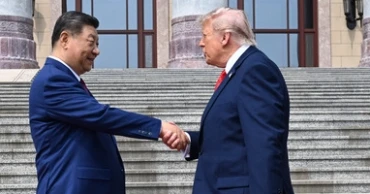
Trump and Xi may meet twice more later this year
US President Donald Trump and Chinese President Xi Jinping could meet at least two more times later this year at major international summits.
The two leaders are expected to attend the APEC Leaders' Informal Meeting in Shenzhen, China, in November and the G20 Summit in Miami in December.
“The two heads of state agreed to support each other in successfully hosting this year’s APEC Leaders’ Informal Meeting and the G20 Summit,” the Chinese Foreign Ministry said in a readout of Thursday’s meeting between the two leaders.
If Trump attends the APEC summit in Shenzhen, it would mark an unusual second visit to China within the same year by a sitting US president.
Whether the two leaders meet again later this year is likely to depend on the outcome of their current talks in Beijing and the broader trajectory of US-China relations. #From Al Jazeera
2 months ago
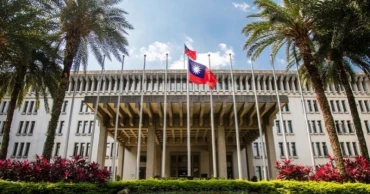
Taiwan says China is ‘sole risk’ to regional peace and stability
Taiwan said China is the “sole risk” to peace and stability in the region after Chinese President Xi Jinping warned US President Donald Trump that the Taiwan issue could lead to conflict.
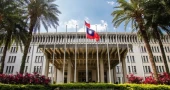
In a statement on Thursday, Taiwan’s Foreign Ministry said, “The Beijing authorities are currently the sole risk to regional peace and stability.”
The ministry pointed to China’s “military harassment” and grey-zone activities in and around Taiwan as evidence of the threat.
It also said, “Beijing has no right to make any claims on behalf of Taiwan internationally.” #From Al Jazeera
2 months ago

Storm kills at least 89 in India’s Uttar Pradesh
At least 89 people were killed and 53 others injured after a powerful storm accompanied by heavy rain, dust and strong winds swept across several districts of India’s Uttar Pradesh on Wednesday evening, officials said.
The storm uprooted trees, damaged houses and disrupted electricity, communication and transport networks in many areas. Authorities continued rescue, relief and restoration work on Thursday.
According to official figures, the death toll rose sharply overnight from 27 to 89.
The highest number of fatalities was reported in Prayagraj, where 21 people were killed. Sant Ravidas Nagar recorded 14 deaths, followed by Fatehpur with 11 and Mirzapur with 10.
Six people died in Unnao and five in Badaun. Four deaths each were reported in Bareilly and Pratapgarh. Hardoi, Kanpur Dehat, Sonbhadra and Sambhal reported two deaths each, while three people died in Sitapur.
One death each was reported in Basti, Rae Bareli and Shahjahanpur.
In Prayagraj, officials said seven people died in Handia, four in Phulpur, three in Soraon and two in Meja.
Strong winds uprooted large trees and blocked roads across the district, disrupting traffic. Electricity supply was also cut in several areas.
Municipal teams were deployed to remove fallen trees from roads, including Patthar Girjaghar, Ashok Nagar, Kachahari Road and Mahatma Gandhi Marg.
The storm also caused damage in the Triveni Sangam area, where huts used by pilgrimage priests were blown away.
Officials said tin sheds and solar panels were torn off by the strong winds, while collapsing walls crushed cars and motorcycles in several places.
The weather changed suddenly around 5 pm on Wednesday, bringing dark clouds and dust storms that turned daytime into near darkness.
In one of the deadliest incidents, four people, including a woman and her three daughters, were killed in Khargasenpur village in Sant Ravidas Nagar after a tree fell on their house.
Additional District Magistrate Kunwar Virendra Kumar Maurya said rescue and restoration efforts were hampered by disruptions to mobile phone networks.
He said district officials and police teams were conducting inspections and relief work across affected areas.
In Badaun, five people were killed in separate incidents.
Two girls, aged 10 and 9, died in Siddhpur Kaitholi village when a mud wall collapsed on them as they sheltered from the storm. Two women were seriously injured in the same incident.
In another incident, a 40-year-old woman died after a tree fell on a tubewell room where several people had taken shelter.
A truck driver was killed when a eucalyptus tree fell on his vehicle, while another young man died after a tree struck him while he was carrying food to his father.
Officials said the death toll could rise further as damage assessments continue and rescue teams remain deployed in the worst-hit districts. #From India Today
2 months ago
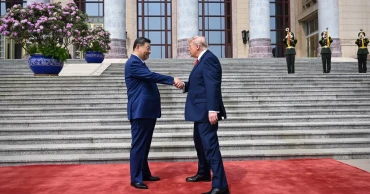
Trump tells Xi: ‘We’re going to have a fantastic future together’
US President Donald Trump praised Chinese President Xi Jinping as a “great leader” and said the United States and China would have “a fantastic future together” as the two leaders opened a high-stakes summit in Beijing on Thursday.
The two presidents are holding a two-day summit focused on issues including the Iran war, trade, technology and Taiwan, although few major breakthroughs are expected.
In his opening remarks before bilateral talks, Trump said it was an “honour” to meet Xi and described him as his “friend.”
“We've gotten along. When there were difficulties, we worked it out. I would call you and you would call me. People don't know, whenever we had a problem we worked it out very quickly,” he said.
“You're a great leader, sometimes people don't like me saying it, but I say it anyway, because it's true...It's an honour to be with you; it's an honour to be your friend... We're going to have a fantastic future together.”
Trump said he had brought the “best [business leaders] in the world” with him to China.
“Only the top people here today to pay respects to you,” he said.
The US delegation includes leading executives such as Jensen Huang and Elon Musk.
Trump said some people had described the meeting as “the biggest summit ever” and added that he was looking forward “very much” to the discussions.
The US president made only a brief reference to past tensions in relations, including trade disputes, US support for Taiwan and concerns over the flow of precursor chemicals used to make fentanyl. He did not mention differences over the Iran war.
In his remarks, Xi called for “cooperation” rather than “confrontation” between the world’s two largest economies.
“The whole world is watching our meeting. Currently, a transformation not seen in a century is accelerating across the globe, and the international situation is fluid and turbulent. The world has come to a new crossroads,” Xi said.
Raising broader questions about the future of bilateral ties, Xi said: “Can China and the United States overcome the Thucydides trap and create a new paradigm of major country relations? Can we meet global challenges together and provide more stability for the world? Can we, in the interests of the well-being of our two peoples and the future of humanity, build a brighter future together for our bilateral relations?”
“These are the questions vital to history, to the world, and to the people. They are the questions of our times that you and I need to answer as leaders of major countries,” he added.
Xi is also expected to raise Washington’s decision to approve an $11 billion arms package for Taiwan, which Beijing considers part of its territory.
Stability in US-China relations is seen as the main objective of the summit. Trump is scheduled to leave Beijing on Friday after a final private meeting with Xi.
#Via NDTV
2 months ago
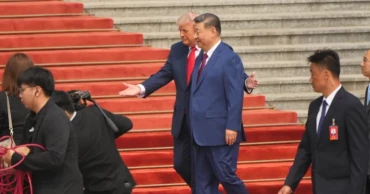
Trump seeks Chinese support for possible Iran deal
US President Donald Trump is seeking China’s support for a possible diplomatic agreement with Iran as disruptions in the Strait of Hormuz continue to affect global trade and industry.
Trump has suggested that Chinese President Xi Jinping has a strong interest in helping to resolve the crisis, as the partial reopening of the Strait of Hormuz has not fully restored shipping and the situation continues to affect Chinese industry.
Although China has been less affected because of its strategic oil reserves, Beijing does not want the disruption to continue.
There have been suggestions that China could act as a guarantor in a possible agreement by taking custody of Iran’s enriched uranium or securing Iranian commitments on nuclear weapons for a specified period.
However, China has traditionally avoided direct involvement in overseas conflicts. Beijing may also see some advantage in allowing Trump to deal with domestic political pressure and the economic impact of the crisis in the United States.
China is considered to have significant leverage with Tehran. Iranian Foreign Minister Abbas Araghchi visited Beijing last week for talks.
Trump also has leverage in his dealings with China. He has paused a $14 billion US arms package for Taiwan and could scale it back further if he believes Beijing is helping to secure an agreement with Iran.
No immediate breakthrough is expected during Trump’s visit.
Trump’s primary goal is to leave Beijing with an economic success, although a diplomatic breakthrough on Iran would also be a significant outcome. China may play an important role in achieving that objective. #From Al Jazeera
2 months ago
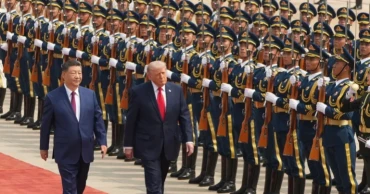
Trump begins high-profile China visit, but major outcomes remain uncertain
President Donald Trump on Thursday began a closely watched summit with Chinese President Xi Jinping in Beijing, with both sides putting on a grand display of ceremony, although significant progress on key issues such as trade, Taiwan and Iran appears unlikely.
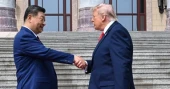
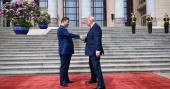
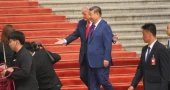
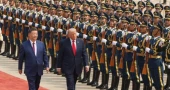
Trump arrived in Beijing on Wednesday night and was formally welcomed by Xi at the Great Hall of the People on Thursday morning. The two leaders shook hands and exchanged brief remarks before posing for photographs in the imposing state building near Tiananmen Square.
Schoolchildren waving Chinese and American flags performed a colorful welcome ceremony, chanting greetings in Mandarin.
During the three-day visit, Trump and Xi are scheduled to hold bilateral talks, visit the historic Temple of Heaven and attend a state banquet.
The White House said Trump expects to secure tangible results, including possible Chinese commitments to purchase more American soybeans, beef and aircraft. The two sides are also discussing the creation of a joint trade board to resolve commercial disputes.
However, no specific agreements have been announced, and analysts say major breakthroughs are unlikely.
The visit comes at a time when the United States is dealing with growing tensions in the Middle East. The ongoing conflict involving Iran and the effective closure of the Strait of Hormuz have pushed up global oil and gas prices, raising concerns about economic fallout.
China, the largest buyer of Iranian oil, is expected to face pressure from Washington to use its influence to persuade Tehran to reduce tensions in the Persian Gulf.
US Secretary of State Marco Rubio said Trump will urge Beijing to play a more active role, arguing that prolonged instability is hurting global economies and reducing demand for Chinese exports.
Despite this, experts say China is unlikely to make major concessions on Iran, while Beijing is expected to press Trump to ease US support for Taiwan.
Taiwan is expected to be one of the most sensitive issues during the talks. China strongly opposes US arms sales to the self-governing island, which Beijing claims as part of its territory.
The Trump administration has approved an $11 billion weapons package for Taiwan, although deliveries have not yet begun.
Trade will also be a major focus. Trump is seeking greater access for US companies to the Chinese market and wants to extend an agreement allowing China to continue exporting rare earth minerals to the United States.
The US delegation includes senior officials such as Rubio, Treasury Secretary Scott Bessent and Defense Secretary Pete Hegseth, along with several prominent business leaders including Elon Musk and Jensen Huang.
Trump is also expected to discuss a proposal for the United States, China and Russia to negotiate limits on their nuclear arsenals, although Beijing has previously expressed skepticism about such an agreement.
2 months ago
US companies expand investments in China, citing long-term growth potential
Several American companies are expanding their operations in China, highlighting continued confidence in the country’s large consumer market, strong manufacturing base and long-term business opportunities.
Essential oils company doTERRA announced in March that it will build new manufacturing facilities in Shanghai. The project will add to the company’s existing China headquarters and research and development centre in the city.
The new facilities are expected to improve supply chain efficiency and help the company create a fully integrated operation covering research, production and sales.
Owen Messick, president of doTERRA China, said the investment reflects the company’s confidence in China and will help combine its innovation capabilities with the country’s well-developed manufacturing ecosystem.
doTERRA will also take part in the China International Import Expo for the ninth year in a row. The company’s booth space has grown from 9 square metres at the first expo in 2018 to 300 square metres this year.
The company is among several major US firms, including Tesla, Apple, Eli Lilly and Company and ExxonMobil, that continue to expand in China.
Fashion brand Coach, owned by Tapestry, Inc., recently opened a new store in Chongqing as part of efforts to strengthen its presence in central and western China. Tapestry now operates more than 350 stores in over 90 Chinese cities.
Coach has also partnered with Donghua University to host a youth exhibition on sustainable fashion in Shanghai to support local design talent.
Liliana Lucioni, president of Coach China, said China remains one of the company’s most important markets and continues to offer significant long-term potential. She said the company plans to expand its retail network and deepen cooperation with local creative communities.
According to a March report by the American Chamber of Commerce in South China, 95 percent of surveyed companies said they would continue operating in China, while 45 percent named the country as their top investment priority, up six percentage points from last year.
Eric Zheng, president of the American Chamber of Commerce in Shanghai, said Chinese authorities remain supportive of foreign investment and that many US firms are committed to growing their presence in the country.
He said businesses hope to see more government measures to boost domestic demand, noting that China remains an important supply base with a highly competitive manufacturing network.
China continues to attract foreign investors due to its large market, expanding innovation capacity and ongoing economic opening.
Official data showed that more than 70,000 foreign-invested enterprises were established in China last year, an increase of 19.1 percent from the previous year.
Yan Bing of Nankai University said foreign companies are increasingly investing in China not only for market access but also to benefit from the country’s growing innovation ecosystem.
2 months ago

China’s tariff cuts boost African imports through Hunan
China’s expanded zero-tariff policy for African goods is helping businesses in central Hunan Province cut costs and increase imports from Africa, opening a new trade route through the inland province.
The new policy allows goods from all 53 African countries that have diplomatic relations with China to enter the Chinese market duty-free. China is the first major economy to offer such broad unilateral tariff-free access to all its African diplomatic partners.
One of the first companies to benefit was Hunan Express Wisdom Information Technology Co., Ltd., which imported more than 6,000 bottles of South African wine through Changsha Huanghua International Airport on May 1.
The shipment saved the company 21,000 yuan (about $3,000) in import duties.
Chairman Zhang Xin said South African wine had previously faced a 14 percent tariff. With the duty now reduced to zero, the company expects to save around 5 million yuan annually.
Officials say the policy is lowering import costs and attracting more African products, including agricultural goods, raw materials and consumer items, to Hunan for processing and redistribution.
Hunan has become a key hub for China-Africa trade, supported by the China-Africa Economic and Trade Expo and a pilot zone for deeper economic cooperation.
Trade between Hunan and Africa has been growing by an average of 15 percent annually, reaching 58 billion yuan and ranking the province first among central and western Chinese provinces in trade with Africa.
In 2025, Hunan’s imports from Africa rose 27.2 percent year-on-year to 30.92 billion yuan.
In the first four months of 2026, total trade between Hunan and Africa reached 18.16 billion yuan, up 8.8 percent from a year earlier, while imports jumped 29.4 percent to 10.41 billion yuan.
Major suppliers include Kenya, South Africa, Nigeria, Morocco and Tunisia.
Changsha Customs said the removal of tariffs on industrial components and raw materials will help local manufacturers reduce costs and diversify supply chains.
The lower tariffs are also expected to benefit products such as flowers, fruit, coffee, cocoa and shea butter.
During the recent May Day holiday, an African goods market in Changsha attracted nearly 89,000 visitors over six days, offering products from more than a dozen African countries at lower prices.
Hunan Yufei Industry Investment Co., Ltd. said its “Quality African Products” brand now includes more than 400 items from 13 African countries.
Local coffee chain Coffee Z also plans to expand direct imports from Ethiopia and Kenya.
Founder Jing Jianhua said the company aims to bring more affordable, high-quality African coffee to consumers across China by taking advantage of the zero-tariff policy.
2 months ago