Others
US says Israel and Lebanon sign framework agreement in ‘first step’ toward peace
The United States on Friday announced a framework agreement between Israel and Lebanon, described as an initial step toward peace after months of conflict involving Israel and the Lebanese armed group Hezbollah.
US Secretary of State Marco Rubio joined the Israeli and Lebanese ambassadors to Washington in unveiling the deal, which the State Department said aims to create a pathway toward ending hostilities and addressing long-standing tensions along the border.
The agreement does not include Hezbollah, which has opposed the process. A senior Hezbollah figure in Lebanon warned that the deal could trigger internal conflict.
According to the State Department, the framework outlines steps toward dismantling Hezbollah’s military capability and enables Lebanon to regain territory taken by Israeli forces during the fighting. Washington will also establish a “Military Coordination Group for Lebanon” to support implementation and has pledged $100 million in humanitarian aid.
“For Lebanon, this framework provides a genuine pathway out of a long crisis,” the State Department said. “For Israel, it creates a verifiable path to removing the persistent threat on its northern border.”
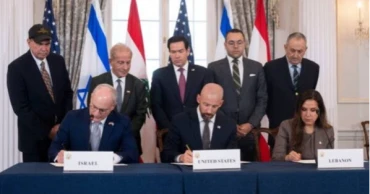
The agreement was formally signed in Washington by Israeli Ambassador Yechiel Leiter and Lebanese Ambassador Nada Hamadeh Moawad in the presence of Rubio.
Leiter said the ultimate goal is lasting peace between the two countries, expressing hope for normalised relations in the future.
“We want to embrace Lebanon,” he said, adding that both sides should eventually be able to travel freely between Tel Aviv and Beirut. However, he stressed that progress depends on the disarmament and dismantling of Hezbollah, as well as support for the Lebanese army.
Moawad described the framework as an important initial step toward restoring Lebanon’s sovereignty and territorial integrity, ending hostilities permanently, and enabling displaced civilians to return home.
The latest conflict erupted after Hezbollah launched rockets into Israel following joint US-Israeli strikes on Iran on February 28. Israel later expanded its military operations into Lebanon, intensifying the conflict.
Since March, more than 4,000 people have been killed in Lebanon due to Israeli strikes, while at least 37 Israeli soldiers have died in fighting in Lebanon and northern Israel.
Lebanon has prioritised Israeli withdrawal from its southern territory in negotiations, while Israel has focused on disarming Hezbollah, which is backed by Iran.
The talks between Israel and Lebanon are separate from a US-Iran interim agreement reached last week aimed at ending fighting in Iran and addressing concerns over Tehran’s nuclear programme. That deal set a 60-day negotiation window on key issues.
Hezbollah, however, was not part of the Israel-Lebanon talks and has long rejected any plan requiring its full disarmament. The group insists previous agreements only require it to disarm south of the Litani River near the Israeli border.
Hezbollah official Hassan Fadlallah reiterated the group’s rejection of direct negotiations with Israel, saying it would not give up its weapons. He warned that enforcing the agreement could lead to civil conflict, and accused the process of undermining broader diplomatic efforts.
Lebanese Prime Minister Nawaf Salam said the framework seeks to secure Israeli withdrawal from all Lebanese territory, restore state authority, and enable citizens to return to their homes. President Joseph Aoun also noted discussions on “pilot zones” where Lebanese forces would assume control as Israeli troops withdraw.
An Israeli official, speaking anonymously, said negotiations also cover Israeli redeployment after southern Lebanon is cleared of Hezbollah infrastructure and the group is disarmed.
Israeli Prime Minister Benjamin Netanyahu called the agreement a “major achievement,” saying Israel would maintain a security zone in southern Lebanon until Hezbollah is disarmed and no longer poses a threat.
He added that Israel is coordinating with the Lebanese army to prepare for future control of areas being vacated, while maintaining strategic positions outside the range of anti-tank missiles.
1 month ago
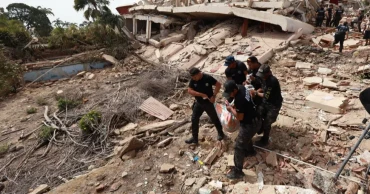
Desperation mounts in Venezuela as the earthquake death toll rises to 1,430
Tensions flared Saturday as desperation grew among anguished residents of the Venezuelan state of La Guaira, where rescuers and civilians searched for earthquake survivors amid a sharply rising death toll.
Venezuela’s government said the number of people killed rose to 1,430 Saturday morning and families reported at least 68,900 people missing, three days after the one-two punch of 7.2 and 7.5 magnitude earthquakes that devastated the South American nation.
Venezuelans looking for loved ones and neighbors used shovels, heavy equipment, ropes and bare hands atop mounds of toppled concrete throughout La Guaira, one of the country’s hardest-hit states.
Most of those digging were civilians who took search efforts into their own hands, and tensions peaked over inadequate response from the Venezuelan government, whose soldiers, firefighters, police and military cadets were evidently underprepared to respond to the tragedy.
Frustration was only amplified by state efforts to project the image of a robust state response.
“There’s a pile of bodies over there from last night. Newborn babies. Look what time it is, and they still haven’t come to recover them. At 8 p.m. there were people alive down there, and they haven’t bothered to rescue them. We’ve located several bodies, and they haven’t helped us recover them either,” said Mileidy Romero, who was among those searching the rubble in the seaside town of Caraballeada. “What are they waiting for?”
Aid agencies consider the first 48 to 72 hours as crucial for retrieving people alive, though that can be extended if they have access to food and water.
However, a growing number of international rescue teams were joining the effort to save lives nearly 72 hours after the quake.
Acting President Delcy Rodríguez said on state television Saturday that more than 14,000 members of the military and police are patrolling the area, where access is now blocked and special permits are required to enter. More rescue teams sent by governments across the world arrived in Venezuela on Saturday.
Simón Bolívar International Airport, which serves Venezuela’s capital, Caracas, was badly damaged in the quake. One runway was operational on Saturday as U.S. teams worked to repair the crucial throughway, said Jeremy Lewin, a senior State Department official in charge of foreign assistance told reporters.
Anxious families wait to see if relatives survived
In the state of La Guaira, just north of Caracas, Nazareth Jiménez sobbed into a loved one’s shoulder on Friday as she watched neighbors use hammers and power tools to try to cut through slabs of concrete in a building reduced to a mountain of debris. She was wracked with anxiety as she waited to see if her siblings, nephews, nieces and friends would emerge alive.
“My God, how are we going to get them out of there?” Jiménez murmured.
“We’re making a call for help to the government and countries across the world,” she said, pleading for machinery capable of moving collapsed structures. “There are still people alive in there.”
Government forces distributed food and water to survivors in La Guaira, and Rodríguez said her government was mounting a full response during these “critical hours for rescuing people alive.”
The disaster poses a huge challenge for Rodríguez, the former vice president who took office in January after the capture and removal of then-President Nicolás Maduro by the United States. Venezuela has been facing economic disarray for more than a decade, and many people reject the legitimacy of the political movement Rodríguez represents.
The number of dead was expected to climb, and people reported tens of thousands of missing on independent digital databases. Those figures likely included people who have been incommunicado due to the lack of cellphone signals, and some reports may be duplicated.
The number of injured stood at more than 3,300 as of midday Friday, and authorities said they rescued 243.
Search teams and foreign aid from Mexico, the U.S., Brazil, El Salvador, France, El Salvador and more continued to arrive to Venezuela Saturday morning to bolster recovery efforts.
Lewin, the State Department official, said the U.S. military would help coordinate flights to bring in search and rescue workers, mobile hospitals and supplies. He said two 80-person search teams were at work and a U.S. Navy transport ship was docked off the coast of Venezuela ready to receive airlifted survivors in need of medical attention. Lewin said it is a “race against the clock” to find people injured in the quakes.
“People are trapped under rubble, and the priority is to get the search and rescue teams and the medical professionals and others to them as quickly as possible to save lives,” he said.
Millions of people reeling
The International Organization for Migration said up to 6.76 million people could be affected, some 2 million of them in Caracas alone. The destruction was amplified by the quick succession of shallow quakes, experts said.
Loyce Pace, the International Red Cross’ regional director for the Americas, said “people are still terrified to reenter what were their homes.”
Omar Reyes said around 20 family members died.
“I’ve been left alone in this life,” Reyes said, walking through the rubble where two of his children were buried.
In the city of Maiquetia, people lined up outside stores and pharmacies that served them one by one behind closed doors. At one point a woman in a crowd threw herself to the ground to protect a package of diapers with her body, desperate to keep it.
Traffic and throngs of motorcyclists at times disrupted search efforts. Mexican soldiers and volunteers repeatedly asked for silence to try to hear signs of life under the rubble, but bikers — civilian and uniformed — continued to honk horns and rev engines to the first responders’ frustration.
Some people began to carry off basic goods such as toilet paper and food from stores in Catia La Mar, adjacent to the country’s main airport. Others swarmed a civilian pickup truck that was giving out bread and water, until a soldier intervened. The parking lot of a pharmacy turned into a makeshift shelter with tarps, hammocks and tents.
A few miles (kilometers) away, Yuleidy Cadenas, 28, stood across the street from a collapsed public housing building, hoping her son, mother and brother would be pulled out alive.
She fled barefoot from another building as it collapsed Wednesday and found her mother’s 12-floor apartment tower had pancaked.
“I got on top of the rubble and told them to yell back, and nobody did, not my brother, nor my son or my mother,” Cadenas said.
1 month ago
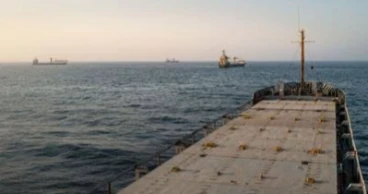
US launches strikes on Iran following drone attack on cargo ship
The United States carried out military strikes against Iran on Friday after a drone attack targeted a cargo vessel in the Strait of Hormuz the previous day. The incident marks the biggest challenge so far to a temporary agreement reached just a week earlier, under which both nations had agreed to work toward ending months of conflict and reopening the strategically important waterway.
President Donald Trump said the drone attack breached the ceasefire agreement. Before the operation, he hinted at a possible response by telling reporters, “You’ll find out.”
According to U.S. Central Command, the strikes targeted Iranian missile and drone facilities, along with coastal radar installations.
Speaking at the White House before the operation, Trump criticized Iran for launching "four shots" the day before. When questioned about why military action was being taken despite ongoing diplomatic talks with Tehran, he replied that Iran was “a little bit different” before ending the news conference.
Earlier on Friday, Ebrahim Azizi, chairman of Iran’s parliamentary national security commission, defended Iran’s actions in a social media post. He emphasized that Iran governs the Strait of Hormuz and urged others to “respect the rules,” arguing that Iran’s actions represented “ceasefire management,” not a violation of the truce.
Vice President JD Vance later urged Iran to resolve disputes through dialogue, saying the country should “pick up the phone.” However, he warned that any acts of violence would receive a forceful response.
A U.S. official, speaking anonymously to The Associated Press, said the military operation concluded roughly an hour after Central Command announced the strikes.
The latest escalation followed Thursday’s attack on a container ship near Oman. The United Kingdom Maritime Trade Operations (UKMTO) reported that the vessel was struck by a projectile, although no injuries were reported. The incident occurred shortly after Iran warned ships against using certain routes through the strait.
The attack comes as Washington and Tehran continue negotiations aimed at securing a lasting peace agreement. Despite the interim accord, Iran has continued to assert control over the Strait of Hormuz, a critical global shipping route.
The cargo ship was attacked while a United Nations maritime agency was relocating stranded vessels through an alternative route close to Oman’s coastline instead of the central section of the strait. Following the incident, the International Maritime Organization suspended the evacuation effort, saying operations would not resume until the safety of remaining ships could be guaranteed.
According to IMO Secretary-General Arsenio Dominguez, approximately 115 vessels have successfully exited the strait in recent days, while about 500 remain in the area.
The alternative shipping corridor was expected to ease pressure on global trade and reduce Iran’s leverage in ongoing negotiations with the United States.
The two countries are still discussing the final terms of a broader agreement, including safe passage through the Strait of Hormuz and the future of Iran’s highly enriched uranium stockpile. Under the interim agreement, both sides have 60 days to reach a comprehensive deal.
Shipping Industry Faces Fresh UncertaintyThe drone strike has raised new concerns within the shipping industry after signs of improving commercial activity in the Gulf.
Marine intelligence company Windward said the incident represented the first major setback to growing confidence in the Strait of Hormuz. Although shipping has continued—with 43 vessel transits recorded after the attack—the company noted that the pace of recovery has slowed.
Before the attack, 78 ships passed through the strait on Wednesday, the highest daily figure since the conflict began, though still below the prewar average of more than 130 vessels.
According to Lloyd’s List Intelligence, at least two oil tankers changed course while attempting to use the U.N.-supported route near Oman after Iran insisted that ships follow Tehran-approved navigation paths. Despite the disruption, more than two dozen vessels were still using the southern route on Friday.
Israel and Lebanon Move Toward PeaceSeparately, Israel and Lebanon announced a new framework agreement on Friday that officials described as an important step toward peace after months of hostilities involving Israeli forces and the Lebanese militant group Hezbollah.
Lebanon’s ambassador to the United States, Nada Hamadeh, said the agreement aims to help displaced citizens return home while promoting peace, security, and prosperity across Lebanon.
Israeli Prime Minister Benjamin Netanyahu welcomed the development, calling it a major achievement. He said Israeli forces would continue to remain in the security zone in southern Lebanon until Hezbollah is fully disarmed and no longer poses a threat to Israel.
1 month ago

King Charles to stay at Clarence House after Buckingham Palace renovation
King Charles III will continue living at Clarence House even after the multi-year refurbishment of Buckingham Palace is completed, as the royal household plans to open more of the historic palace to the public.
Royal officials said the king and Queen Camilla will continue to use Buckingham Palace for official duties, with the building remaining the monarchy's main ceremonial and administrative headquarters. However, the royal couple will not move into the palace and will instead remain at nearby Clarence House throughout Charles' reign.
James Chalmers, the senior royal official overseeing the king's finances, described Buckingham Palace as the monarchy's headquarters and one of Britain's most important historic buildings.
The announcement was made on Thursday during a briefing on royal finances, where Charles became the first British monarch to publicly disclose the amount of tax he paid. According to palace officials, the king paid £12.9 million (about $16.1 million) in income and capital gains tax during the 2024-25 financial year, compared with £11.7 million the previous year.
The update comes as the royal family seeks to shift public attention from renewed scrutiny over the links between convicted sex offender Jeffrey Epstein and Prince Andrew, now known as Andrew Mountbatten-Windsor. The controversy has overshadowed Charles' efforts to modernize the monarchy and demonstrate that the centuries-old institution can adapt to changing times.
Built in the 1820s, Buckingham Palace has served as the London residence of every British monarch since Queen Victoria. The 775-room palace houses royal offices, hosts state banquets for visiting world leaders and remains the focal point of major royal celebrations and national events.
The palace has undergone a 10-year, £369 million (about $487 million) renovation project since 2017 to replace outdated plumbing, electrical wiring and heating systems, ensuring the building remains fit for use for decades to come. The refurbishment is expected to be completed next year.
Keeping the king and queen at Clarence House will allow Buckingham Palace to welcome more visitors, host additional public events and expand tours of the landmark. The palace currently attracts around 700,000 visitors each year.
1 month ago
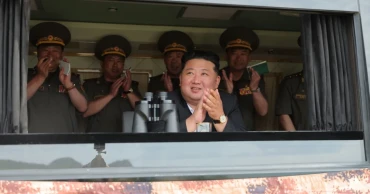
North Korea's Kim calls for stronger offensive military
North Korean leader Kim Jong Un has called for strengthening the military's "deadly and destructive offensive posture" after overseeing a series of major weapons tests, state media reported Friday. The announcement came as South Korea unveiled plans to significantly expand its drone warfare capabilities.
The latest developments reflect continued tensions on the Korean Peninsula, where Kim has been pushing to enhance both North Korea's nuclear and conventional military strength while rejecting efforts to resume talks with South Korea and the United States.
According to the official Korean Central News Agency (KCNA), Kim observed weapons tests on Thursday that assessed the performance of a special mission warhead for a tactical ballistic missile, an upgraded multiple rocket launcher and extended-range artillery shells fired from a self-propelled howitzer.
KCNA said Kim described the test results as proof of North Korea's technological advances in improving its military firepower along the southern border. The report suggested the tested weapons are intended to target locations in South Korea, including US military bases stationed there.
1 month ago

NATO deputy commander hopes Turkey summit will boost defense spending and alliance unity
NATO's deputy supreme allied commander in Europe has expressed hope that next month's summit in Turkey will encourage member states to increase defense spending, reaffirm support for Ukraine and demonstrate the alliance's unity despite growing challenges.
Air Chief Marshal John Stringer shared his expectations in an interview with The Associated Press in London, less than two weeks before the NATO summit in Ankara on July 7-8. The meeting is expected to test the unity of the 77-year-old military alliance at a time of increasing political uncertainty.
The alliance has faced fresh questions after US President Donald Trump sent mixed messages about America's military presence in Europe and repeatedly threatened to withdraw from NATO. His calls to annex Greenland and his friendly remarks about Russian President Vladimir Putin have also unsettled many European leaders.
Adding to the uncertainty, US Defense Secretary Pete Hegseth last week criticized NATO allies for not allowing their military bases to be used in strikes against Iran. He also announced a six-month review of US troop deployments across Europe.
In the United Kingdom, which traditionally provides NATO's deputy supreme allied commander, recent resignations of government ministers highlighted concerns over defense spending plans that critics say are not enough to ensure the country's security.
Stringer said NATO summits are important political events that showcase the alliance's solidarity. While acknowledging that disagreements are inevitable in an organization that has expanded over several decades, he stressed the importance of maintaining unity.
"Are we in one of those moments at the moment? Yes, we are," Stringer said during a military conference in London, where AP also spoke with other senior European military officials about their expectations and concerns ahead of the summit.
1 month ago
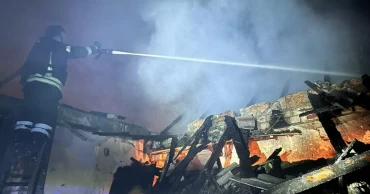
Ukraine launches one of its biggest drone attacks on Russia
Ukraine launched one of its largest drone attacks on Russia overnight, with Russian authorities claiming their air defenses shot down 660 drones across 12 regions, the Russia-controlled Crimean Peninsula, the Black Sea and the Sea of Azov on Friday.
The attack appeared to be one of the biggest drone offensives by Ukraine since Russia launched its full-scale invasion more than four years ago. Russia previously reported intercepting 556 Ukrainian drones in its largest recorded attack on May 17 this year.
Ukraine has increasingly used long-range drones to hit targets far inside Russian territory, including oil and energy facilities, in an effort to weaken Russia's military operations. Western officials and analysts say the strikes have disrupted fuel supplies and military logistics, putting additional pressure on Russian President Vladimir Putin.
Russian authorities released few details about the overnight attack. The Russian Defense Ministry did not say which sites were targeted or whether any major damage was caused.
Meanwhile, Ukraine's Security Service (SBU) said its drones struck Russian navy vessels and air defense radar systems in Kerch, a key port city in Crimea.
According to the agency, the targets included the reconnaissance and mine-laying ships Volga and Vyatka, as well as the cargo-passenger ferry Petropavlovsk. The SBU claimed the strikes triggered a large fire, although the claim could not be independently verified.
The latest drone offensive came hours after Ukrainian President Volodymyr Zelenskyy said on X that he had ordered a "40-day influence operation," which is believed to involve stepping up attacks to pressure Russia into ending the war after months of stalled US-led peace efforts.
Recent successful drone strikes, including attacks on targets in Moscow and St. Petersburg, have boosted morale in Ukraine.
Zelenskyy also said he secured fresh promises of military support from leaders at the recent G7 summit, including US President Donald Trump. He said the additional assistance would strengthen Ukraine's efforts to push Russia toward peace negotiations.
A NATO summit scheduled for next month is also expected to discuss further military support for Ukraine.
1 month ago

China defends patrols near Taiwan after European countries voice concern
China on Thursday defended its recent coast guard patrols in waters east of Taiwan, a day after Britain, France and Germany expressed concern over what they called new Chinese activities in the area.
The three European countries said the actions could threaten regional stability, freedom of navigation and the safety of international shipping. In response, China said its patrols were aimed at maintaining maritime order and stability in the region.
Chinese Foreign Ministry spokesperson Guo Jiakun told a regular briefing that the patrols were carried out after Japan and the Philippines announced plans to discuss maritime boundary issues in waters that Beijing claims as its own.
According to Guo, the patrols were a necessary response to what China sees as attempts by Japan and the Philippines to interfere in maritime boundary matters and undermine China's maritime rights and interests.
In a joint statement, the unofficial embassies of Britain, France and Germany in Taiwan said China's activities posed risks to regional security and international shipping routes. Taiwan's Central News Agency also reported that the United States had raised concerns over the developments.
Earlier this month, Taiwan accused Chinese coast guard vessels of harassing commercial ships near the island by asking them to disclose their planned routes.
The waters east of Taiwan are a major shipping corridor used for transporting oil, gas and goods between the Middle East, Europe and East Asia. Taiwan governs itself independently, but China considers the island part of its territory and claims authority over the surrounding waters.
Guo maintained that the coast guard operations were lawful and represented China's legitimate exercise of jurisdiction.
Tensions between Beijing and Tokyo have risen in recent months. Relations became more strained after Japanese Prime Minister Sanae Takaichi suggested last year that Japan's military could become involved if China took military action against Taiwan.
Taiwan remains one of the most sensitive issues in China-US relations. The United States is Taiwan's main arms supplier and has repeatedly voiced support for the island's self-defense capabilities.
This week, China sent its newest and most powerful aircraft carrier through the Taiwan Strait shortly after Taiwan launched a five-day military exercise aimed at preparing for a possible Chinese attack.
1 month ago

Paris court set for key climate change verdict
A Paris court is expected to deliver a landmark ruling on Thursday in a climate change lawsuit that could require French energy giant TotalEnergies to significantly cut its oil and gas production.
The case, filed by several environmental groups along with the city of Paris, argues that the company is failing to comply with a 2017 French law requiring large corporations to identify and prevent human rights violations and environmental harm linked to their activities.
The lawsuit marks the first time France's "corporate duty of vigilance" law has been used in a climate change case.
Environmental organisations including Notre Affaire à Tous, Sherpa, France Nature Environnement and ZEA launched the legal action in 2020.
The groups argue that TotalEnergies is among the world's largest historical contributors to greenhouse gas emissions. They are seeking a court order requiring the company to cut oil production by 37 percent and gas production by 25 percent by 2030, while also stopping all new fossil fuel projects.
The ruling comes as much of Europe faces an intense heatwave, with record temperatures recorded in France this week.
Extreme heat has also affected countries including the United Kingdom and Spain, where authorities issued the highest-level weather alerts, warning millions of people about dangerous conditions.
The heat has disrupted daily life across Europe. Tourist attractions such as the Eiffel Tower and the Louvre Museum have reduced visiting hours, while school activities and transport services have faced disruptions in several countries.
Scientists say human-driven climate change is increasing the frequency and severity of extreme weather events. The UN's climate agency has warned that the coming years are likely to bring even more record-breaking temperatures.
According to the Copernicus Climate Change Service, Europe is warming faster than any other continent, with temperatures rising at roughly twice the global average rate since the 1980s.
Earlier this month, the Europe office of the World Health Organization said more than 200,000 people across Europe had died from heat-related causes over the past four years, with many of those deaths considered preventable.
The Paris ruling is expected to add to a growing number of significant climate-related court decisions around the world.
Last year, the International Court of Justice said countries could breach international law if they fail to take adequate action against climate change. In 2024, the European Court of Human Rights ruled that governments must do more to protect people from climate-related risks.
In 2019, the Supreme Court of the Netherlands delivered a landmark victory for climate activists by ruling that protection from the harmful effects of climate change is a human right and that governments have a responsibility to safeguard their citizens.
1 month ago
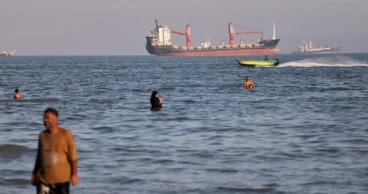
Oil tanker passes through Strait of Hormuz as Iran warns ships over new route
A Liberian-flagged oil tanker successfully sailed through the Strait of Hormuz on Thursday despite fresh warnings from Iran’s paramilitary Revolutionary Guard against vessels using a newly designated shipping route near Oman’s coastline.
The passage of the Stoic Warrior comes amid growing tensions between Iran and the United States over the implementation of a recently signed interim agreement aimed at bringing a permanent end to the Iran war.
Under the memorandum of understanding reached last week, Washington and Tehran have agreed to a 60-day period to resolve key issues, including maritime security and the future of Iran’s stockpile of highly enriched uranium. While negotiations continue behind closed doors, officials from both sides have also been publicly debating aspects of the deal, raising concerns about the stability of the fragile ceasefire.
The situation has been further complicated by renewed violence in Lebanon. On Wednesday, an Israeli airstrike killed two people in southern Lebanon, according to the country’s state-run news agency. The strike marked Israel’s first attack on Lebanon since the latest ceasefire took effect on Saturday.
The Stoic Warrior departed early Thursday and followed a route close to the coasts of the United Arab Emirates and Oman before rounding Oman’s Musandam Peninsula. The route was developed by Oman in coordination with the International Maritime Organization (IMO), the UN agency responsible for maritime safety.
The new route lies south of the long-established Traffic Separation Scheme, the main shipping lane through the Strait of Hormuz that handles roughly one-fifth of global oil and natural gas shipments.
The alternative path has gained attention after reports that naval mines may have been placed in parts of the strait during the conflict that began on Feb. 28 with US and Israeli strikes on Iran. The Revolutionary Guard has previously claimed responsibility for mining the waterway, prompting safety concerns for commercial shipping.
Responding to the new route, the Guard’s naval arm issued a warning on Thursday through Iran’s state-run IRNA news agency.
“A few hours ago, without notice or coordination with the Islamic Republic of Iran, some authorities announced a new route for ship traffic in the Strait of Hormuz, which is unacceptable and completely dangerous,” the statement said.
“It is hereby notified to all that the only authorized route for passing through the Strait of Hormuz is the one declared by the Islamic Republic of Iran,” it added, warning that vessels operating outside those routes would be violating regulations.
The statement further cautioned that “violators will be dealt with,” though it did not specify what actions might be taken.
Despite the warning, there were no immediate reports of disruptions or incidents as the Stoic Warrior completed its transit. Ship-tracking data showed several vessels following the same route.
Meanwhile, senior Emirati diplomat Anwar Gargash criticized any attempt by Iran to restrict navigation or impose fees on ships using the strategic waterway.
Writing on X, Gargash said new geopolitical realities could not be forced upon Gulf Arab states and warned that such moves could fuel future tensions and instability in the region.
At the same time, Lebanon remains a key point of contention in wider regional negotiations.
Israel’s military said Thursday that one reservist soldier was killed and another wounded in southern Lebanon, where Israeli forces continue to hold positions. Since the latest conflict began, at least 37 Israeli soldiers and one civilian defense contractor have been killed, along with two civilians in northern Israel.
Lebanese authorities say more than 4,000 people have been killed in Israeli attacks since the latest Israel-Hezbollah conflict erupted in March, shortly after the Iran war began.
Iran has maintained that a lasting agreement with the United States will require an end to hostilities in Lebanon and a withdrawal of Israeli forces from occupied areas. Israel, however, argues that it must retain freedom of action against Hezbollah as international pressure over its military operations continues to grow.
1 month ago