others
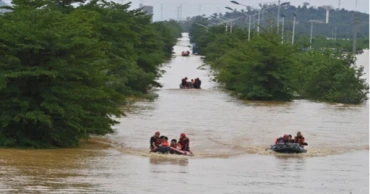
Floods in southern China kill 39 as another typhoon heads toward east coast
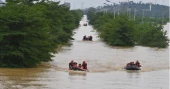
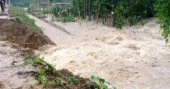
Flooding caused by days of heavy rain in southern China has killed at least 39 people, authorities said Thursday, as another powerful storm approaches the country's eastern coast and Taiwan.
Most of the deaths occurred in Hengzhou, where part of a reservoir dam collapsed, sending floodwaters into nearby communities and killing 26 people, said Ding Wei, vice mayor of Nanning, which oversees the area. Nine people are still missing across the Guangxi region.
Tropical Storm Maysak brought record rainfall to Guangxi from Saturday, causing reservoirs to overflow, flooding homes and leaving many people stranded for days. Authorities had earlier reported six deaths on Tuesday, but the toll has since risen sharply.
Meanwhile, Typhoon Bavi is moving northwest across the sea and is expected to pass near remote Japanese islands before moving north of Taiwan and making landfall in China's Fujian or Zhejiang province on Saturday.
Fishing boats crowded ports in northern Taiwan on Thursday as residents prepared for heavy rain and strong winds.
Although Bavi weakened from a super typhoon on Thursday, Taiwan's Central Weather Administration said it was still packing maximum sustained winds of 184 kilometres (114 miles) per hour.
In the Philippines, classes were suspended in several cities and towns, while ships were barred from leaving northern ports as the storm passed east of Luzon.
In flood-hit Guangxi, military rescue teams completed the evacuation of more than 10,000 students and teachers trapped in several schools in Guigang city, about 60 kilometres northeast of Hengzhou.
Footage aired by state broadcaster CCTV showed students wearing orange life jackets boarding rescue boats as floodwaters surrounded school buildings.
The flooding also affected wildlife and domestic animals.
A zoo in Guigang reported that more than 100 animals, including two zebras, four porcupines and dozens of tropical birds, were missing after the flood.
In Hengzhou, authorities warned residents about snakes believed to have escaped from a farm. They stocked up on anti-venom and issued safety advice on snake bites.
An animal shelter in Binyang County, around 75 kilometres northwest of Hengzhou, worked to rescue about 200 cats and dozens of dogs. Shelter workers carried dogs through deep floodwater while cats climbed onto roof beams to escape the rising water.
Authorities said drones and around 5,700 boats have been used in large-scale rescue efforts to deliver drinking water and other emergency supplies and evacuate stranded residents. Around 130,000 people have been moved to safer places.
Ding said floodwaters are gradually receding, but more rain is forecast in some areas over the next two days.
Cleanup crews have been deployed to remove mud and debris and disinfect affected towns in Hengzhou. Road repairs are continuing, while electricity has already been restored to more than 60,000 households.
China's National Meteorological Center said parts of Guangxi received between 10 and 40 centimetres (4 to 16 inches) of rain over the past several days, with some of the worst-hit areas recording more than 90 centimetres (35 inches).
Severe weather also struck central China's Hubei province earlier this week, where thunderstorms and tornadoes killed 11 people and left many others homeless.
Elsewhere in Asia, landslides triggered by monsoon rains have killed at least 13 Rohingya refugees in camps in Bangladesh this week, with authorities continuing efforts to move vulnerable families to safer locations.
25 days ago
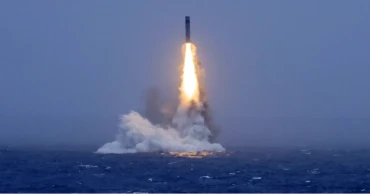
China's ballistic missile launch seen as signal to US, say experts
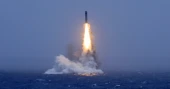
China's recent launch of a ballistic missile into the South Pacific was widely seen by security experts as a clear message to the United States, highlighting Beijing's growing nuclear capabilities despite criticism from countries in the Pacific region.
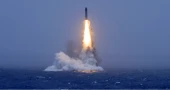
The missile, launched on Monday from a nuclear-powered submarine, marked one of the few public tests of a nuclear-capable weapons system by China. It came two years after a similar launch over international waters in the Pacific.
While several Pacific island nations criticised the test, saying the region should not become a stage for rivalry between major powers, analysts said the main audience for the launch was Washington.
"The key message is that the People's Liberation Army is becoming a stronger military force with a powerful strategic nuclear capability," said Tong Zhao, a senior fellow with the Nuclear Policy Program at the Carnegie Endowment for International Peace.
The launch showcased the sea-based part of China's nuclear triad — its ability to launch nuclear weapons from land, sea and air. It also demonstrated what military experts call a "second-strike capability," meaning China could still retaliate with nuclear weapons even if it were attacked first.
Dominic Meagher, a research fellow at Australia's Crawford School of Public Policy, said the submarine launch showed that China's nuclear forces could respond from anywhere, making them harder to eliminate in a first strike.
China described the launch as part of its annual military exercises, leading experts to believe similar tests could become more common.
"I see this as part of a broader strategy rather than a one-time event," said K. Tristan Tang, a nonresident fellow at the National Bureau of Asian Research.
The missile test comes as China continues expanding its fleet of nuclear-powered submarines. According to the International Institute for Strategic Studies, China has built these submarines at a faster pace than the United States over the past five years.
Pacific nations raise concerns
The launch drew criticism from Pacific countries because the missile landed in waters covered by the South Pacific Nuclear Free Zone, created under the 1986 Treaty of Rarotonga.
The region has a painful history of nuclear testing. The United States, Britain and France carried out nuclear tests in the Pacific during the last century, leaving lasting environmental damage and health problems, including cancers and birth defects that some island communities say continue to affect generations.
Meagher said those experiences led to international agreements aimed at preventing future nuclear testing in the region.
Solomon Islands Prime Minister Matthew Wale criticised China's action, saying while China is an important partner, "this is not something a friend does" and is not good for the region.
Although the United States still conducts missile tests in the Pacific, Meagher noted that they avoid the treaty-protected nuclear-free zone.
Regional powers question lack of notice
Australia and New Zealand said they received very little advance warning about the launch, while Japan criticised China for not being transparent.
Australia and New Zealand have become increasingly concerned about China's growing influence in the Pacific, where Beijing has strengthened ties with several island nations through security and development agreements.
Australian Prime Minister Anthony Albanese, speaking during a visit to the Solomon Islands on Tuesday, described the launch as "a provocative act" that could increase tensions in the region.
"The fact that this test took place with very little notice is a real concern," he said.
China defended the launch, saying it had informed relevant countries in advance and that the exercise was conducted openly and transparently.
Experts noted that while the Hague Code of Conduct encourages countries to provide at least 24 hours' notice before ballistic missile launches, the code is voluntary and China is not a member.
Uncertainty over missile type
Questions also remain over exactly which missile was launched.
Taiwan's National Security Council said it was likely a JL-2 submarine-launched ballistic missile fired from waters off Guangdong province in southern China.
However, Chinese state media quoted military experts as saying the launch probably involved the newer JL-3 missile, which has a much longer range and is capable of reaching targets across the Pacific.
Analysts say that as China expands its military power, it is likely to face greater international scrutiny over its weapons development and military activities.
25 days ago
Ukrainian drones hit Russian oil facilities, ignite tankers in Sea of Azov
Ukrainian drones struck several Russian oil facilities on Thursday, setting off fires at fuel storage sites and igniting two oil tankers in the Sea of Azov, a day after US President Donald Trump said Ukraine would receive a license to manufacture Patriot air defense systems.
Ukraine has increasingly targeted Russian oil refineries, fuel depots and other energy infrastructure, contributing to fuel shortages and rationing in several Russian regions. Reports said long queues have formed at gas stations as drivers wait to refill their vehicles.
In western Russia, a Ukrainian drone attack sparked a fire at an oil depot in the city of Tver, according to acting regional Governor Vitaly Korolyov.
Another strike hit the southern Stavropol region, where Governor Vladimir Vladimirov said oil storage tanks caught fire in Vyazniki. Authorities evacuated residents from several nearby apartment buildings as the blaze spread.
In the Sea of Azov, Ukrainian drones set two oil tankers on fire, Rostov Governor Yuri Slusar said. He added that one vessel was still burning while the crews of both ships had been safely evacuated.
The attack was the latest in a series of Ukrainian strikes on oil tankers in the area, aimed at disrupting fuel supplies to Russian-occupied Crimea.
Russia's Defense Ministry said its air defense systems shot down 73 Ukrainian drones between late Wednesday and early Thursday.
Meanwhile, Ukraine's Air Force said Russia launched 94 long-range attack drones and two ballistic missiles overnight. It said Ukrainian forces intercepted or jammed 72 drones, but 19 drones and both missiles hit targets, causing damage at 13 locations.
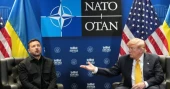
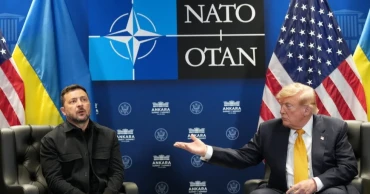
The attacks came a day after Trump met Ukrainian President Volodymyr Zelenskyy on the sidelines of the NATO summit in Turkey.
Following the meeting, Trump said the United States would grant Ukraine a license to manufacture Patriot air defense systems, a long-sought capability that Kyiv hopes will strengthen its defenses against Russian missile attacks.
The meeting marked a sharp contrast to their tense encounter at the White House in February 2025. This time, Trump praised Zelenskyy for his efforts to seek an end to the war, saying the Ukrainian leader had "done an amazing job" and had "been very effective."
25 days ago
Trump declares US-Iran ceasefire “over” after new strikes
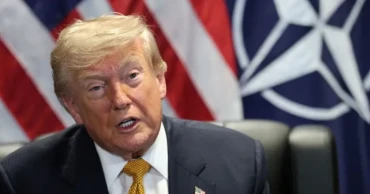
US President Donald Trump said the ceasefire between the United States and Iran is effectively “over” following a fresh exchange of military strikes.
Speaking at a NATO summit, he dismissed any further engagement with Iran, calling its leaders "sick people" and saying, "As far as I'm concerned, it's over."
While he acknowledged that negotiators could continue discussions, he argued that such efforts would likely be futile.
The latest escalation began after the United States launched strikes on more than 80 Iranian-linked targets in response to attacks on three oil tankers in the Strait of Hormuz.
Although Iran has not officially claimed responsibility for the tanker attacks, it later announced strikes on US military facilities in Bahrain and Kuwait in retaliation.
NATO Secretary General Mark Rutte defended the US military action, describing it as necessary and accusing Iran of violating the ceasefire.
Meanwhile, Iranian Parliament Speaker Mohammad Bagher Ghalibaf rejected that claim, arguing that it was the United States that broke the truce.
The renewed conflict comes despite a 14-page memorandum of understanding signed by Tehran and Washington last month, which was intended to strengthen the ceasefire and bring the conflict to an end across all fronts.
26 days ago
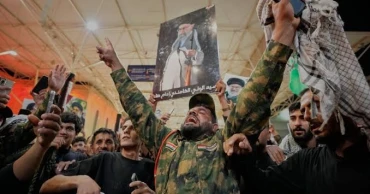
US strikes Iran after revoking oil license; Tehran retaliates with attacks on Bahrain, Kuwait
The United States launched airstrikes on Iranian targets early Wednesday, hours after revoking a license that had allowed the sale of Iranian oil under an interim agreement, prompting Iran to retaliate by targeting US military facilities in Bahrain and Kuwait.
US President Donald Trump later declared the interim agreement with Tehran effectively finished, although he said diplomatic talks could continue.
"I think it's over," Trump said when asked about the status of the agreement, adding that negotiations could proceed but expressing little confidence in their success.
The renewed hostilities raised fears of a broader regional conflict and sent global oil prices sharply higher.
The latest escalation also threatened shipping through the Strait of Hormuz, a vital waterway for global energy supplies.
The exchange of attacks came during the multi-day funeral ceremonies for Iran's Supreme Leader Ayatollah Ali Khamenei, who was killed on Feb. 28 during the opening phase of the conflict. While negotiations on reopening the Strait of Hormuz and Iran's nuclear programme had been expected after his burial, the latest military actions cast uncertainty over those plans.
Iranian Parliament Speaker Mohammad Bagher Qalibaf said Tehran would not bow to pressure.
"The era of bullying and extortion is over," he wrote on X.
The US military's Central Command said the strikes targeted Iranian air defence systems, radar installations and more than 60 fast boats operated by the Islamic Revolutionary Guard Corps, saying the operation was intended to impose costs for attacks on commercial shipping in international waters.
The military added that the operation had concluded but warned that Washington remained prepared to respond if Iran failed to honour any future agreements.
Iranian state media reported explosions in several areas, including Bandar Mahshahr, where a Revolutionary Guard member was killed, and Bushehr, home to Iran's nuclear power facilities.
Shortly afterward, Bahrain and Kuwait activated missile alerts. Iran's Revolutionary Guard confirmed it had launched attacks against US military installations in both countries.
The strikes resembled a previous cycle of confrontation last month, when Iranian attacks on commercial shipping prompted US retaliation and Iranian missile attacks on Bahrain and Kuwait.
The United Arab Emirates condemned Iran's attacks, with senior diplomat Anwar Gargash saying they demonstrated Tehran's unwillingness to pursue de-escalation.
Earlier Wednesday, Washington cancelled the license that had temporarily allowed Iran to openly export oil under the interim agreement, restoring restrictions on Iranian crude sales.
The move followed attacks on commercial vessels in the Strait of Hormuz. One tanker carrying Qatari natural gas caught fire after being struck off the coast of Oman, according to the United Kingdom Maritime Trade Operations centre.
Iranian state television said the vessel had ignored warnings before being attacked but stopped short of claiming responsibility.
Qatar condemned the incident, calling it an unacceptable attack on international navigation and global energy security, and said Iran bore legal responsibility.
Two other commercial ships sustained minor damage but continued their voyages without casualties.
Under the interim agreement, Iran and the United States had agreed to allow ships to transit the Strait of Hormuz freely for 60 days. Tehran, however, has insisted that it should regulate vessel routes and eventually impose transit fees, a proposal rejected by Washington and Gulf Arab states.
Meanwhile, funeral ceremonies for Khamenei continued in Iraq's holy city of Najaf, attended by Iranian President Masoud Pezeshkian and senior Iraqi officials, before additional services scheduled in Karbala.
Khamenei's son and successor, Supreme Leader Ayatollah Mojtaba Khamenei, has not appeared publicly during the ceremonies and is believed to be in hiding after reportedly being injured in the airstrike that killed his father.
Khamenei's body is expected to be buried on Thursday at the Imam Reza shrine in Mashhad, his birthplace.
26 days ago

Russian attacks kill 3 in Ukraine as Kyiv hit for second straight night
Russian overnight attacks killed three people across Ukraine, including one in Kyiv, as the capital came under bombardment for the second consecutive night, Ukrainian officials said on Wednesday.
Powerful explosions rocked Kyiv shortly after midnight, with air raid sirens sounding only afterwards, an unusual sequence that reduced the time available for residents to seek shelter.
In the northeastern city of Kharkiv, two people were killed and 20 others injured in a series of Russian strikes, Mayor Ihor Terekhov said.
According to Ukraine's Air Force, Russia launched 169 long-range attack drones and seven missiles, including five ballistic missiles, overnight. Ukrainian air defenses intercepted or electronically jammed 139 drones, while two anti-radar missiles failed to reach their targets. However, all five ballistic missiles and 20 drones struck targets at 15 locations, highlighting the sustained pressure on Ukraine's air defense systems.
Russia's Defense Ministry said its forces targeted military-industrial facilities in Kyiv, claiming to have struck a plant producing components for Flamingo cruise missiles and a facility assembling medium- and long-range drones.
Meanwhile, the ministry said Russian air defenses intercepted 415 Ukrainian drones between late Tuesday and early Wednesday.
In Russia, Saratov Governor Roman Busargin said a Ukrainian drone strike killed one person, injured several others and damaged industrial facilities.
Nizhnekamsk Mayor Radmir Belyayev said Ukrainian drones also hit industrial sites in the city, injuring several people, though he did not identify the affected facilities.
Rostov Governor Yuri Slyusar said Ukrainian drones damaged two empty oil tankers in Taganrog Bay, injuring two crew members. One vessel's crew had to be evacuated, but no oil spill occurred as both tankers were travelling empty to the port of Rostov-on-Don.
In Kyiv, city military administration chief Tymur Tkachenko said a woman was killed and two others injured in the Russian strikes.
Ukraine's State Emergency Service said the attacks damaged administrative buildings, warehouses, a garage complex and several city trams in the capital.
In the southeastern Zaporizhzhia region, Russian guided bomb attacks injured an elderly man and a woman, regional governor Ivan Fedorov said.
26 days ago
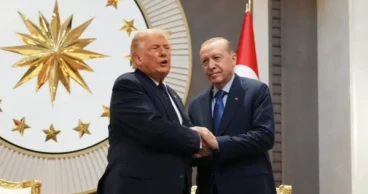
NATO launches major defence initiatives as Trump visits Ankara
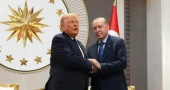
US President Donald Trump said on Tuesday that Washington will lift sanctions imposed on Turkey over its purchase of Russia's S-400 missile defence system, a move that could help Ankara rejoin the F-35 fighter jet programme.
Speaking after talks with Turkish President Recep Tayyip Erdogan in Ankara during the NATO summit, Trump said Cabinet officials were working on removing the sanctions under the Countering America's Adversaries Through Sanctions Act. He also said selling F-35 jets to Turkey was "certainly something we will consider." Turkey was removed from the programme in 2019 after buying the Russian system.
NATO chief faces fresh test as Trump demands allies' loyalty ahead of Turkey summit
Trump and Erdogan highlighted their close relationship, with Trump praising Turkey's support for the US, particularly during the Iran conflict. He said he attended the NATO summit partly because of his ties with Erdogan.
27 days ago
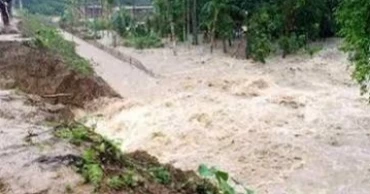
Erratic monsoon, rising temperatures heighten flash flood risk across Hindu Kush Himalaya
As deadly floods and cloudburst-triggered disasters continue to hit parts of Pakistan, Nepal and India, scientists warn that communities across the Hindu Kush Himalaya (HKH) face an increasingly dangerous pattern this season: longer dry spells punctuated by sudden bursts of intense rainfall capable of triggering flash floods, landslides and glacier-related hazards.
The Hindu Kush Himalaya (HKH) region stretches 3,500km across Asia, spanning eight countries - Afghanistan, Bangladesh, Bhutan, China, India, Myanmar, Nepal, and Pakistan.
The warning follows recent cloudburst-induced flooding in Pakistan's Gilgit-Baltistan and flooding triggered by intense rainfalls in Arunachal Pradesh, India, even as the Hindu Kush Himalaya (HKH) Monsoon Outlook 2026 projecting below-normal seasonal rainfall across much of the region.
"The biggest misunderstanding is that less seasonal rainfall means lower flood risk," said Saswata Sanyal, Disaster Risk Reduction Specialist at ICIMOD, on Tuesday. "Seasonal forecasts describes average conditions over several months, not what happens in a single valley. Under El Niño, long dry spells can be interrupted by intense local storms that triggers devastating flash floods and landslides."
The contradiction lies at the heart of this year’s monsoon. While El Niño is expected to suppress seasonal rainfall across much of South Asia, short-lived weather systems can temporarily override that pattern, producing intense localised rainfalls capable of causing severe flooding, according to ICIMOD.
The result is a monsoon that is becoming more uneven and difficult to predict, with prolonged dry conditions increasing pressure on agriculture and water supplies while isolated extreme rainfall events continue to threaten lives and infrastructure.
Above-normal temperatures are expected to further increase risks in glacier-fed river basins across the Indus, Ganga and Brahmaputra.
Warmer conditions accelerate glacier and snowmelt, adding more water to rivers already swollen by intense rainfall while also destabilising mountain slopes and moraine-dammed lakes.
"The recent flooding in Pakistan's Thore Valley demonstrates that hazards in the HKH are no longer occurring in isolation," said Manish Shrestha, Hydrologist at ICIMOD. "Heavy rainfall, glacier melt, unstable slopes and fast-rising rivers can interact to create cascading disasters. Preparedness must reflect these compound risks rather than treating each hazard separately."
Scientists say governments should prepare simultaneously for drought, heat stress, flash floods, landslides and glacier-related hazards rather than viewing them as separate scenarios.
Particular attention is needed for settlements along riverbanks, steep mountain slopes and rapidly expanding urban areas across Nepal, northern and north-eastern India, Pakistan and other vulnerable mountain regions, where fragile geology, rising temperatures and expanding infrastructure continue to increase exposure.
With weeks of the monsoon still ahead, experts say the greatest danger is assuming that fewer rainy days mean fewer disasters. This year's monsoon demands preparedness for drought and floods at the same time.
27 days ago
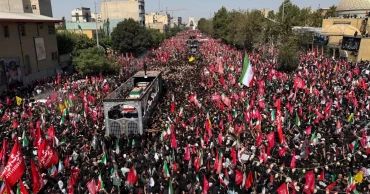
Tanker hit by projectile in Strait of Hormuz as Iran holds funeral for Khamenei
A tanker caught fire early Tuesday after being hit by a projectile while sailing through the Strait of Hormuz off the coast of Oman, according to the British military, in the latest attack on commercial shipping in the strategic waterway.
The incident took place in the narrow entrance to the Persian Gulf, a key global shipping route through which about one-fifth of the world's traded oil and natural gas has traditionally passed during peacetime.
Iranian state television reported that the liquefied natural gas tanker was attacked after it ignored warnings from Iranian authorities, but it stopped short of officially claiming responsibility.
Iran has repeatedly said that only shipping routes approved by Tehran are safe for vessels using the strait. The country has also been suspected of carrying out previous attacks on ships that used an alternative route closer to Oman's coastline.
The latest incident comes as the United States is seeking to continue negotiations with Iran aimed at fully reopening the Strait of Hormuz, curbing Tehran's disputed nuclear programme and securing a lasting end to the war that began on Feb. 28. However, earlier attacks in the waterway have triggered U.S. retaliatory strikes, followed by Iranian attacks on Gulf Arab states, raising fears of wider regional conflict.
The United Kingdom Maritime Trade Operations (UKMTO) said the tanker was struck near Limah, Oman, while heading south through the strait toward the Gulf of Oman. According to the agency, the projectile hit the vessel's port side.
UKMTO said there was no environmental damage from the attack and that authorities were investigating the incident.
Iranian state television, citing unnamed sources, suggested that Iran was behind the strike on what it described as a tanker carrying natural gas from Qatar. However, the Iranian government has not officially claimed responsibility.
Last Thursday, Iran's joint military command warned that all oil tankers passing through the Strait of Hormuz must use routes approved by Tehran. It also cautioned that any interference by U.S. forces in the waterway would face a "rapid and decisive reaction."
Speaking at the White House on Monday, U.S. President Donald Trump warned Iran to reach an agreement with Washington.
"We'd rather make a deal because I don't want to affect 91 million people," Trump said. "We can knock down their bridges in one hour. We can knock out their energy supply."
Under an interim agreement, Iran and the United States had agreed to allow ships to pass through the strait without fees for 60 days. However, Tehran later insisted it should control shipping routes and eventually collect transit fees, challenging long-standing international practice.
The United States and several Gulf Arab countries have rejected Iran's proposal to charge vessels for using the strait. Earlier efforts by Oman and a United Nations agency to establish an alternative route near Oman's coast also triggered attacks across the Middle East, underscoring tensions in the region.
According to shipping data firm Kpler, at least 108 vessels passed through the Strait of Hormuz over the weekend using different routes.
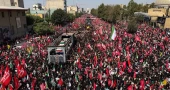
Meanwhile, hundreds of thousands of mourners gathered Tuesday near the Jamkaran Mosque south of Qom for funeral ceremonies for Iran's Supreme Leader Ayatollah Ali Khamenei, according to live footage broadcast by Iranian state television.
The mosque holds special religious significance for Shiite Muslims, who believe it was once visited by Muhammad al-Mahdi, the 12th and last Shiite imam, who disappeared in the ninth century and is expected to return one day to establish justice.
Images of Khamenei and his son, Iran's new Supreme Leader Ayatollah Mojtaba Khamenei, were displayed on banners carried by mourners. Mojtaba Khamenei has not appeared publicly during the multi-day funeral ceremonies and is believed to be in hiding after reportedly being wounded in the airstrike that killed his father.
Before the April ceasefire, Israel targeted several senior Iranian leaders during the conflict, in some cases reportedly using their public appearances to identify their locations. Israel has also threatened to target Mojtaba Khamenei.
Iranian authorities have closed roads, restricted airspace and suspended normal daily activities during the mourning period, which began on Saturday and will continue until Thursday. Ayatollah Ali Khamenei, who died at the age of 86, will be buried at the Imam Reza shrine in his birthplace of Mashhad.
27 days ago
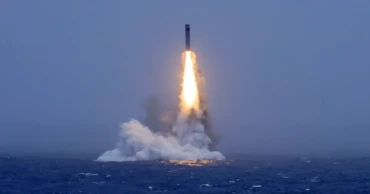
China's submarine missile test raises regional concerns over growing military tensions
China's navy launched a long-range ballistic missile from a nuclear-powered submarine into the Pacific Ocean on Monday, a rare test that has sparked concern among the United States and several countries across Asia and the Pacific over Beijing's growing military capabilities.
Military experts say the test highlights China's improving ability to strengthen its nuclear deterrence strategy. It was the second time in recent years that China has fired a ballistic missile into international waters.
Although Beijing informed some countries before the launch, several governments said the notice was too short. Analysts also warned that the test could further increase tensions as military competition continues to grow across the region.
China confirmed the launch only after it had taken place. In a brief statement, state-run Xinhua News Agency said the missile was fired into the Pacific Ocean as part of routine annual military training. It said the launch complied with international law and was not aimed at any country or target.
China did not identify the missile, but said it carried a dummy warhead rather than a nuclear one. While launches into international waters are uncommon, the United States has also conducted similar missile tests.
On Tuesday, Xinhua released a photograph of the missile but provided no further details.
Defence experts believe it was likely either a JL-2 or JL-3 submarine-launched ballistic missile, although available images are not clear enough to confirm the model.
China's state-owned Global Times reported that the missile was "most likely" a JL-3, which has a range of more than 10,000 kilometres (6,200 miles). The JL-2 has a shorter range.
New Zealand said the missile landed in treaty waters within the South Pacific Nuclear Free Zone, arguing that the launch went against the spirit of the agreement.
The nuclear-free zone was created under the 1986 Treaty of Rarotonga, which bans nuclear weapons across the region. China joined the treaty's protocols in 1987, promising not to test or threaten to use nuclear weapons against countries covered by the agreement.
Australia, Japan and several Pacific nations voiced concern over the launch.
China urged other countries not to "overinterpret" the test, but experts said the concerns were understandable because Beijing provided limited information about the launch.
Drew Thompson, a senior fellow at the S. Rajaratnam School of International Studies in Singapore, said China's military expansion has not been matched by greater transparency, creating uncertainty about its intentions.
Australian Prime Minister Anthony Albanese said China had failed to give enough advance notice.
"There is no doubt that this is a provocative act by China which does destabilize the region," Albanese told reporters Tuesday while visiting Honiara in the Solomon Islands.
He said the launch involved a nuclear-capable intercontinental ballistic missile fired from a nuclear-powered submarine, adding that the world needs fewer nuclear weapons, not more.
New Zealand Foreign Minister Winston Peters also described the launch as "unwelcome and concerning."
Solomon Islands Prime Minister Matthew Wale said China remained an important friend but added that missile tests were not welcome in the Pacific.
"We don't want anybody testing their ICBMs in the Pacific Islands region. Be our friend, but don't threaten us," Wale told reporters.
The test comes as China continues to expand and modernize its military under President Xi Jinping.
China already has the world's largest standing army and the biggest navy by fleet size. Although its nuclear arsenal remains smaller than those of the United States and Russia, Beijing has been increasing its stockpile of nuclear warheads while developing longer-range missiles and more advanced drones.
China's official defence budget is expected to reach about $270 billion in 2026 after annual increases of around 7% over the past four years. Independent analysts believe actual military spending may be significantly higher. The Stockholm International Peace Research Institute estimated China's military expenditure at $313.7 billion in 2024.
Much of the region's security concerns are linked to Taiwan, the self-governed island that China claims as its own and has not ruled out taking by force. Beijing regularly sends warships and military aircraft near Taiwan, describing the missions as military exercises.
China's military buildup has prompted neighbouring countries to strengthen their own defences. Japan is moving away from its long-standing policy of limiting defence spending to 1% of GDP and plans to raise it to 2%. The Philippines has also expanded defence cooperation with the United States by allowing access to four additional military bases.
Emma Chanlett-Avery, director of Political-Security Affairs at the Asia Society Policy Institute, said the missile launch is likely to further strain already tense relations between China and Japan.
She noted that tensions have increased since Japanese Prime Minister Sanae Takaichi suggested last year that Japan could become involved in a conflict over Taiwan, prompting China to tighten export controls on Japan and accuse Tokyo of embracing "a new era of militarism."
27 days ago