foreign-affairs
British High Commission celebrates Bangladesh's next generation of Chevening, Commonwealth scholars
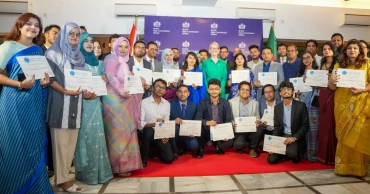
The British High Commission in Dhaka has hosted a pre-departure reception to celebrate this year’s Chevening and Commonwealth scholars preparing to begin their postgraduate studies in the United Kingdom.
Held at the British High Commissioner's residence on Tuesday evening, the event brought together the departing scholars, distinguished alumni, the Bangladesh Association of Commonwealth Scholars and Fellows, the Chevening Alumni Association of Bangladesh, and partners supporting UK scholarships.
British Fintech ‘VALT’ launches operations in Bangladesh
The reception provided an opportunity for scholars to connect with alumni and fellow award recipients before embarking on their academic journeys in the UK.
Through the UK government-funded Chevening and Commonwealth scholarship programmes, the scholars will pursue postgraduate studies at world-class UK universities and join global networks of future leaders, innovators, and changemakers, said a media release on Wednesday.
British High Commissioner to Bangladesh Sarah Cooke congratulated the Chevening and Commonwealth scholars from Bangladesh who are about to begin this exciting new chapter in the United Kingdom.
She said these scholarships reflect the strong partnership between Bangladesh and the UK and their shared commitment to education, leadership and opportunity. “I look forward to seeing the positive impact you will make in your communities and professions.”
This year also marks a significant milestone for Chevening in Bangladesh, with HSBC joining as a Chevening partner for the first time and sponsoring one Bangladeshi Chevening Scholar.
The Chevening Scholarship is the UK Government's international scholarship programme, funded by the Foreign, Commonwealth and Development Office (FCDO) and partner organisations.
The Commonwealth Scholarship programme is funded by the UK Government through the Commonwealth Scholarships Commission and supports postgraduate study and sustainable development across the Commonwealth.
18 hours ago
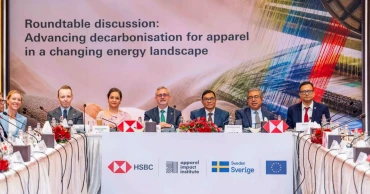
Access to clean energy to become increasingly important for Bangladesh: Michael Miller
Ambassador and Head of Delegation of the European Union (EU) to Bangladesh Michael Miller on Wednesday said access to clean energy will become increasingly important for the competitiveness of Bangladesh’s garment industry as European markets and global value chains transition towards a low-carbon future.
“There is an opportunity to combine manufacturing strength with cleaner production that we encourage you to grasp with both hands, to place this country at the forefront of sustainable sourcing,” he said while speaking at a roundtable in Dhaka.
HSBC Bangladesh, the Apparel Impact Institute (Aii), the Embassy of Sweden in Bangladesh and the Delegation of the European Union to Bangladesh convened a high-level roundtable bringing together international and national stakeholders from the government, global apparel brands, manufacturers, financial institutions, development partners and industry associations to discuss how Bangladesh can accelerate access to reliable, competitive and clean energy for its apparel industry.
The roundtable, titled “Advancing Decarbonisation for Apparel in a Changing Energy Landscape”, focused on the growing urgency to accelerate Bangladesh’s clean energy transition as global apparel supply chains move towards decarbonisation and markets, including the European Union, introduce increasingly ambitious sustainability and environmental requirements.
18 hours ago
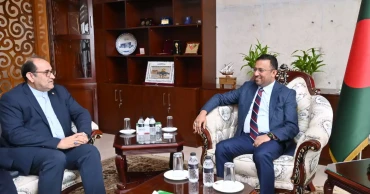
Hormuz Strait’s reopening doesn’t depend on one party; multiple actors involved: Dhaka
State Minister for Foreign Affairs Humaiun Kobir on Wednesday said keeping the Strait of Hormuz open does not depend on just one single party, stressing that there are a range of complex issues involved and multiple actors are engaged in the conflict.
“Look, keeping the Strait of Hormuz open does not depend on the decision of any single party. There are a range of complex issues involved, and multiple parties are directly or indirectly engaged in the conflict in the region. So, it is not a matter of isolating one party and depending on that one party to decide whether the strait will remain open or closed. That is not the case,” he told reporters at the Ministry of Foreign Affairs.
The State Minister said Bangladesh has reiterated its call for de-escalation of the conflict in the Middle East and sought a solution to the problem through dialogue under a de-escalation framework.
Kobir expressed Bangladesh’s hope for an early end to tensions in the region and lasting peace and stability in the interest of the people of the region and beyond.
He also highlighted the longstanding historical ties between Bangladesh and Iran, saying people-to-people exchanges and bilateral relations between Dhaka and Tehran date back to the period following Bangladesh’s independence. The two sides also exchanged views on cultural cooperation, he said.
Iran conveyed to Bangladesh that there is “no problem and difficulty” from Iran’s side regarding the shipment of LNG, gas and fuel to Bangladesh, while blaming the US for creating difficulties surrounding energy supplies.
“From the side of Iran, there is no problem and difficulty for shipment of your LNG, gas and fuel,” Ambassador of Iran to Bangladesh Dr Jalil Rahimi Jahanabadi told reporters at the Ministry of Foreign Affairs while responding to questions from journalists.
Earlier, he paid a courtesy call on State Minister-1 for Foreign Affairs Humaiun Kobir. During the meeting, they discussed issues of mutual interest.
The Iranian envoy identified what he described as two major realities behind the continuation of the difficulties - the impact of US attacks and the continuation of what he called the American blockade against Iran.
“From the side of Iran, there’s no problem. The problem is caused by Americans,” the Ambassador said.
Bangladesh stressed that the safety and wellbeing of some 8 million Bangladeshis living and working across the region remain a top priority.
The State Minister discussed recent developments and the ongoing conflict in the Middle East, along with the safety of Bangladeshi nationals and the movement of Bangladesh-bound cargo.
“We have reiterated our call for de-escalation. This has always been our consistent diplomatic position - to seek de-escalation of the conflict,” Kobir said.
He said Bangladesh has urged all sides to engage in dialogue, resolve their differences through diplomatic means and work toward a permanent and peaceful resolution.
“As you know, we have a large diaspora in the Middle East - approximately 8 million people of Bangladeshi origin working throughout the region. Their well-being and safety are of paramount importance to us,” he said.
Kobir said Bangladesh would continue to work with countries in the region on issues affecting its relations with the Middle East, particularly the safety of Bangladeshi citizens.
He expressed gratitude to Iran for helping Bangladesh evacuate some of its citizens who had been stranded in Tehran.
“On behalf of the Prime Minister (Tarique Rahman), I expressed our gratitude to them and appreciated their supportive initiatives,” the State Minister said.
The meeting also covered Bangladesh’s security cooperation and defence-related engagements in the Middle East, including its long-standing maritime cooperation with Saudi Arabia in addressing security challenges posed by the Houthis.
“This cooperation is vital because the Kingdom of Saudi Arabia is the custodian of the two holy mosques. Iran understands our position clearly in this regard,” Kobir said.
He, however, made Bangladesh’s position regarding the conflict with Iran clear.
“Our position is clear: we do not support, participate in, or call for any aggression or attacks against Iran,” he said.
“Our role is strictly limited to supporting Saudi Arabia in addressing the security challenges posed by the Houthis,” Kobir added.
The State Minister said Bangladesh also requested that its stranded cargo containers be given priority once a peaceful resolution is reached and the situation surrounding the Strait of Hormuz is de-escalated.
Asked about the movement of Bangladeshi ships and energy vessels affected by the disruption, Kobir said the situation was affecting vessels from many countries, not Bangladesh alone.
“It is not just Bangladesh; vessels from many nations across the world are currently affected,” he said.
“However, regarding Bangladesh's specific interests, we conveyed that as soon as the Strait of Hormuz reopens, our shipments and containers should be facilitated and prioritized as early as possible,” Kobir said.
20 hours ago
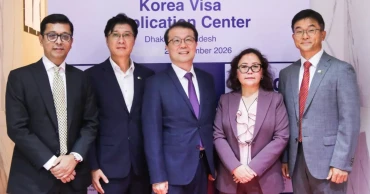
VFS Global launches South Korea visa services in Bangladesh
VFS Global, the global leader in trusted technology services, empowering secure mobility for governments and citizens, has announced the launch of South Korea visa services in Bangladesh through a state-of-the-art Korea Visa Application Centre in Dhaka, providing an enhanced visa application experience for Korean visa applicants in the country.
The inaugural ceremony of the new Korea Visa Application Centre was held on Wednesday.
Kim Ji-joon, Ambassador of the Republic of Korea to Bangladesh and Yummi Talwar, Chief Operating Officer - South Asia, VFS Global, and other dignitaries from the Embassy of the Republic of Korea.
Visa applicants across Bangladesh will now be able to submit their applications at the new Korea Visa Application Centre in Dhaka by booking a prior appointment online.
Yummi Talwar said the launch of our Korea Visa Application Centre marks a significant step in improving the visa application submission experience for travellers across Bangladesh.
"This spacious, modern, and centrally located facility offers a comfortable and convenient application environment, supported by well-trained customer service representatives who will assist applicants at every step of their journey.”
VFS Global has been a trusted partner for the Government of the Republic of Korea for visa processing services since 2011, said a media release.
The company offers visa services on behalf of the Republic of Korea across 5 countries through a network of 7 dedicated visa application centres globally.
VFS Global’s role in the visa application process is limited to front-end administrative tasks only, which include collecting visa application forms, required documentation as per the checklist, and returning the passports to applicants after the decision is made.
VFS Global has no role in the decision-making process of granting or refusing a visa.
Decision making on the granting or refusal of visa is the sole prerogative and sole responsibility of the concerned Embassy.
Applicants have been encouraged to obtain the latest information on visa requirements, fees, appointment booking, and available services only through the official website of the Embassy of the Republic of Korea and the official VFS Global website.
21 hours ago
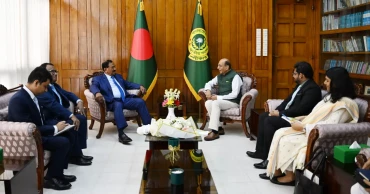
“PM Tarique intelligent, pro-people person; we should leave it to him,” says Trivedi on possible visit
Indian High Commissioner to Bangladesh Dinesh Trivedi on Wednesday described Prime Minister Tarique Rahman as a very “intelligent” and “pro-people” person and expressed optimism about something positive in terms of strengthening relations between the two countries.
“This is left to the Prime Minister’s prerogative. The Prime Minister of Bangladesh is a very intelligent person. He is pro-people. I think we should leave it to the Prime Minister,” he told reporters when asked about the Prime Minister’s possible visit to India.
The High Commissioner, who paid separate courtesy calls on Speaker Maj (Retd) Hafiz Uddin Ahmad, Bir Bikram, and Deputy Speaker Barrister Kayser Kamal at the Bangladesh Jatiya Sangsad, said he had no doubt about the intention behind the agenda of whatever is to be done in terms of friendship.
“The intention from both sides is people-oriented. When there is a people-oriented approach, things will happen,” he said while speaking at the Jatiya Sangsad Bhaban.
Asked about the renewed discussion on the possible visit by the Prime Minister, the High Commissioner said there is no end to discussion in a democracy.
“If discussion ends, that is not democracy. It is like a running river, like the Ganga and Padma. It keeps on running; there is no stagnation. Dialogue is like the flow of a river and the flow of an ocean. They will never stop. Now, I am sanguine. I am confident. It is the process of democracy. The process will continue,” he said.
Strengthening People-to-People Ties
The High Commissioner underlined that engagement between the two parliaments is vital to strengthening people-to-people ties between the two sovereign and democratic countries of Bangladesh and India.
The discussions included opportunities for forming Parliamentary Friendship Groups, mutual visits by parliamentary delegations under the guidance of both the Speakers, cooperation between parliamentary committees and the digitisation of parliamentary records.
21 hours ago
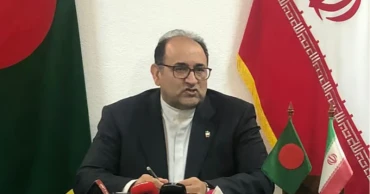
“No problem and difficulty” from Iran’s side in energy shipments to Bangladesh: Envoy
Iran on Wednesday conveyed to Bangladesh that there is “no problem and difficulty” from Iran’s side regarding the shipment of LNG, gas and fuel to Bangladesh, while blaming the US for creating difficulties surrounding energy supplies.
“From the side of Iran, there is no problem and difficulty for shipment of your LNG, gas and fuel,” Ambassador of Iran to Bangladesh Dr. Jalil Rahimi Jahanabadi told reporters at the Ministry of Foreign Affairs while responding to questions from journalists.
He identified what he described as two major realities behind the continuation of the difficulties - the impact of US attacks and the continuation of what he called the American blockade against Iran.
“From the side of Iran, there’s no problem. The problem is caused by Americans,” the Ambassador said.
Earlier, he paid a courtesy call on State Minister-1 for Foreign Affairs Humaiun Kobir. During the meeting, they discussed issues of mutual interest.
The State Minister expressed Bangladesh’s hope for an early end to tensions in the region and for lasting peace and stability, in the interest of the people of the region and beyond, said the Ministry of Foreign Affairs.
U.S. forces struck Iranian rocket launchers on the Strait of Hormuz in their first military action in a month on Sunday, breaking a lull in fighting during an intermittent war that has lasted more than six months, reports AP.
Vowing to retaliate for what it called a deadly attack, Iran later said it had launched missiles at U.S. sites in Jordan.
The Iranian Ambassador also alleged that Iranian civilians have been killed in US attacks and urged people around the world to remain aware of what he described as the killing of Iranian people by the United States.
Referring to an attack on a wedding ceremony the previous night, he alleged that more than 70 people were wounded, including women and children.
“Many children and women were injured,” he said.
The Iranian envoy also said Iran had communicated to officials at Bangladesh’s Ministry of Foreign Affairs that Tehran had no objection to the continuation of energy shipments to Bangladesh.
He said that from Iran’s side, people are allowed to carry out activities and that there is no restriction from Tehran’s end, while again stressing that the difficulties are being created by the United States.
22 hours ago
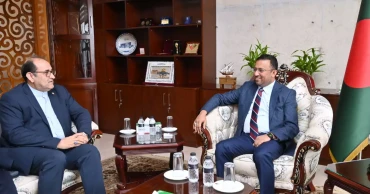
Dhaka’s “Mecca Pact” decision does not concern Tehran: Iranian Ambassador
Iran on Wednesday said it does not view the "Mecca Pact" involving Saudi Arabia, Türkiye and Pakistan something against Tehran and Bangladesh’s decision does not create concerns for them.
"We don't regard Mecca Peace Pact against Iran. Their (Bangladesh) decision does not make us concerned," Ambassador of Iran to Bangladesh Dr. Jalil Rahimi Jahanabadi told reporters after his courtesy meeting with State Minister for Foreign Affairs Humaiun Kobir.
On Bangladesh’s foreign policy, the Ambassador said Dhaka’s balanced approach to international relations was well understood by Tehran.
“When it comes to the foreign policy of your government, we are well aware that your government is enjoying a very balanced foreign policy,” he said.
The envoy said Bangladesh’s decisions regarding its international and security relations would not create concern for Iran.
The Ambassador said Iran values its relations with Bangladesh and is interested in further expanding cooperation in political, trade and cultural fields.
The State Minister expressed Bangladesh’s hope for an early end to tensions in the region and for lasting peace and stability, in the interest of the people of the region and beyond.
Iran believes recent regional security arrangements demonstrate that countries are increasingly seeking to rely on themselves rather than the United States for their security.
“Peace Pact is good evidence that regional countries and members are trying to stand on their own feet for providing their security. It proves that they no longer want to rely on America for their security,” the Ambassador said.
Dhaka seeks stronger global parliamentary advocacy for early Rohingya repatriation
Referring to the recent developments in regional security, the Iranian envoy said the experience of the recent war has made it clear that the presence of US military bases in regional countries could not necessarily guarantee their security.
The Ambassador said regional countries should increasingly take responsibility for their own security rather than depending on external powers.
“Regional countries should rely on themselves for their security,” he said, adding that efforts to establish regional security mechanisms reflected a desire for greater strategic independence.
Asked about security arrangements involving countries in the region, including Pakistan and Saudi Arabia, the Ambassador said Iran does not view such developments as a threat to its relations with neighboring and regional countries.
He said Iran maintained its position that regional countries should be able to cooperate on security without creating confrontation with others.
On Sunday, State Minister for Foreign Affairs Humaiun Kobir said Bangladesh sees no risk in joining the Mecca Defence Pact and that it would not restrict Bangladesh’s engagement with other partners.
“This is a unique pact, presenting new opportunities,” he told reporters after Saudi Ambassador to Bangladesh Dr Abdullah Zafer bin Abiyah called on him.
He also said “Mecca is in the heart of Bangladesh” while explaining Dhaka’s positive attitude towards the initiative.
The Mecca Joint Defence Agreement, or the “Mecca Pact,” was officially signed on August 7, 2026, with Saudi Arabia, Pakistan and Türkiye being its partners so far.
State Minister for Foreign Affairs Shama Obaed Islam on Tuesday said Bangladesh is assessing the situation regarding the "Mecca Pact" involving Saudi Arabia, Türkiye and Pakistan before deciding whether to join the alliance if invited.
“We are assessing the situation regarding participation in the Mecca Pact. Bangladesh’s interests will be considered first before joining the alliance,” she told reporters at the Ministry of Foreign Affairs.
Bangladesh has not yet received any formal invitation to join the pact.
She said Bangladesh’s national interest would be the foremost consideration in taking any decision regarding participation in the pact.
Bangladesh has viewed the pact positively and is interested in the initiative.
1 day ago
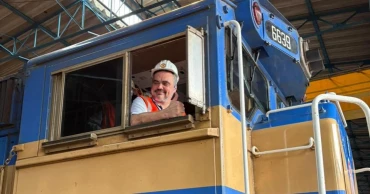
US Ambassador highlights American engineering in Bangladesh's Railway connectivity
US Ambassador to Bangladesh Brent T. Christensen has visited Bangladesh Railway's Central Locomotive Workshop in Parbatipur, where Bangladeshi technicians maintain American-made locomotives supporting passenger and freight transportation across the country.
The visit highlighted the practical and enduring value of expanded trade and commercial cooperation between the United States and Bangladesh, said US Embassy Dhaka Spokesperson Poornima Rai on Tuesday.
1 day ago
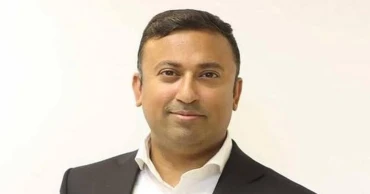
Decision to cancel AL-related programme in Delhi a ‘positive’ step: Humaiun Kobir
Bangladesh on Tuesday described India’s decision to cancel the Europe–Asia Relations programme, scheduled for August 29 and reportedly set to be attended by several Awami League (now under a ban on its activities) leaders, as a “positive, good and expected initiative”.
Bangladesh also said a possible visit by Prime Minister Tarique Rahman to India would depend on a conducive environment and the availability of the two prime ministers.
“The incident you described is a positive thing. Good initiative… expected initiative. We will not give space in Dhaka to any terrorist fleeing from India. Similarly, we don’t expect any terrorist fleeing from Bangladesh to get space in Delhi or anywhere in India,” State Minister for Foreign Affairs Humaiun Kobir told reporters at the Ministry of Foreign Affairs.
The Foreign Correspondents’ Club of South Asia (FCC South Asia), the Hand in Hand Foundation and their organising partners had regretted the cancellation of the programme, according to a media release.
“Due to unexplained interventions by Delhi Police against the programme, the FCC South Asia has been unable to host the scheduled function,” the organisers said.
Asked whether discussions on the proposed visit had stalled and whether the recent incident had revived them, Kobir said, “If we had agreed on a date and it was then held up, I would have said the process had stalled. But no date was agreed upon. Discussions were ongoing.”
Meanwhile, Indian High Commissioner to Bangladesh Dinesh Trivedi said Bangladesh and India need to move forward while keeping in mind the challenges faced by both countries, warning that remaining stuck in the past could affect development and people-to-people ties.
“We have to appreciate Bangladesh's democratic challenges, and Bangladesh also has to appreciate India's challenges. Keeping these challenges in mind, we have to move forward,” he told reporters, stressing the need for both sides to understand and appreciate each other’s democratic challenges.
He also stressed the need for both countries to understand each other’s challenges. “As neighbours, we are equal. Nobody is big, nobody is small,” he added.
The High Commissioner said the past cannot be forgotten, but there is no scope for getting stuck in it.
“If we get stuck in the past, development works will not happen,” he said.
Trivedi made the remarks while speaking to reporters after a courtesy meeting with Local Government, Rural Development and Cooperatives Minister Dr Abdul Moyeen Khan at the Secretariat. State Minister for Foreign Affairs Mir Shahe Alam also attended the meeting.
The High Commissioner also conveyed his greetings on the occasion of the 48th Founding Day of the BNP.
“It’s a Founding Day (of BNP), very important day. I congratulated him, his party and all,” he said.
1 day ago
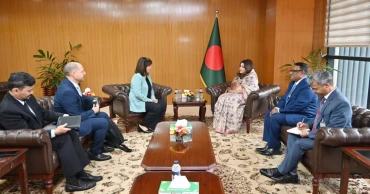
Dhaka seeks stronger global parliamentary advocacy for early Rohingya repatriation
Referring to the “untenable situation” arising from the Rohingya crisis, State Minister for Foreign Affairs Shama Obaed Islam on Tuesday called for stronger global parliamentary advocacy to sustain international attention and ensure the early repatriation of the forcibly displaced Rohingyas to Myanmar.
She made the call when Secretary General of the Inter Parliamentary Union (IPU) Anda Filip met her at her office at the Ministry of Foreign Affairs.
The IPU Secretary General welcomed the initiatives undertaken by the present government to strengthen democratic institutions, said the Ministry of Foreign Affairs.
She reaffirmed her commitment to deepening cooperation between Bangladesh and the IPU through parliamentary exchanges, experience sharing and capacity building to further advance democratic practices.
The State Minister welcomed Filip and congratulated her on becoming the first woman Secretary General of the IPU in its 13-decade history.
She appreciated the IPU’s longstanding role in promoting parliamentary democracy, peace, human rights and inter-parliamentary cooperation.
The State Minister briefed her on the government’s efforts to restore democracy and democratic institutions, reaffirming its commitment to inclusive governance and accountability.
She also discussed the growing challenges of digital harassment, misinformation and disinformation, particularly against women and girls and called for stronger parliamentary cooperation to promote digital safety.
1 day ago