
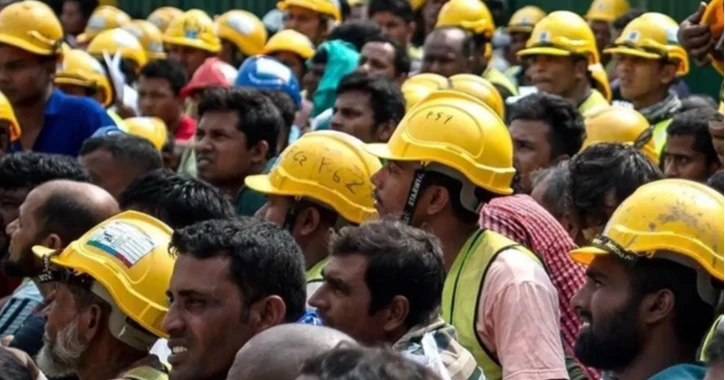
Over 1.14 crore (11.4 million) workers were sent to 12 Middle East countries over the past 22 years, according to the statistics placed by Expatriates’ Welfare and Overseas Employment Minister Ariful Haque Chowdhury in Parliament on Monday.
State Minister Md Nurul Hoque on behalf of the minister shared the statistics in the House, while replying to a starred question from ruling party lawmaker Md Mosharraf Hossain (Bogura-4) during the question-and-answer session.
Earlier, the parliamentary session resumed at 3:00pm on Monday with Deputy Speaker Kayser Kamal in the chair.
Parliament sees debate over July Charter, constitutional reform
As per the statistics, the total number of workers sent to 12 Middle East countries is 1,14,07,661 during the period from 2004 to April 08, 2026.
Of them, the highest 53,33,223 workers were sent to Saudi Arabia, while 21,92,956 to the United Arab Emirates (UAE), 16,52,489 to Oman, 10,05,936 to Qatar, 4,01,942 to Kuwait, 3,09,233 to Bahrain, 2,45,208 to Jordan, 1,76,392 to Lebanon, 85,176 to Iraq, 4,040 to Yaman, 879 to Syria and 186 to Iran.
In reply to another starred question from treasury bench member Nasir Uddin Ahmed (Maulvibazar-1), the minister said now more than 1.30 crore Bangladeshis are working in 176 countries throughout the world.
“The current government is committed to ensuring the dignity, rights and welfare of the Bangladeshis abroad,” he said.
Some countries have been identified as alternative labour markets amid Middle East situation, he said.
Responding to a question from opposition lawmaker Md Abdul Aleem (Bagerhat-4), the minister said several countries have been identified as alternative labour markets considering the recent overall situation in the Middle East.
"Considering the recent overall situation in the Middle East, countries such as Malaysia, Singapore, Japan, South Korea, Thailand, Russia, South Africa, Brazil, Portugal, Cyprus, Fiji, Serbia, Italy, Romania, etc. have been identified as alternative labour markets," he said.
Answering another question from opposition MP Mohammed Kamal Hossain (Dhaka-5), the minister said the government has incorporated plans for the development of the overseas employment sector in its election manifesto and has taken initiatives to explore new labour markets and reopen closed ones under a 180-day action plan.
“The government is already working to explore alternative labour markets in the wake of the recent unrest in the Middle East,” he said.
The government’s 180-day action plan includes initiatives to explore labour markets, open closed labor markets, he said, citing different steps taken to increase overseas employment.
As per of the steps, he said, Bangladeshi workers are currently being sent to countries including Cambodia, Seychelles, Serbia, Fiji, Romania, Macedonia, Mauritius, Mongolia and Russia, while diplomatic efforts are ongoing to reopen labour markets in Malaysia, Oman, the UAE and Bahrain.
The minister also said Bangladesh has signed MoUs or agreements with 18 countries to facilitate overseas employment, while initiatives have been taken to sign MoUs, Memorandum of Cooperation (MOC) or agreements with four countries under the 180-day plan.
He noted that Malaysia remains the second-largest labour market after Saudi Arabia and expressed optimism that the market will reopen soon following recent high-level discussions.
Ariful Haque further said the government is working to extend visas of Bangladeshi workers in conflict-affected Middle Eastern countries through diplomatic efforts.
He added that under BMET, 104 Technical Training Centres (TTCs) and six Institutes of Marine Technology (IMT) are providing training in 55 trades to develop skilled manpower.
Initiatives have also been taken to recruit native instructors for languages including Japanese, Korean, English, Chinese, Arabic, Italian and German to help workers overcome language barriers abroad for the possible overseas jobseekers, he said.
In reply to a scripted question from NCP lawmaker Abdul Hannan Masud (Noakhali-6), the Minister said a total of 11,32,519 workers including 62,352 women went abroad for employment in 2025.