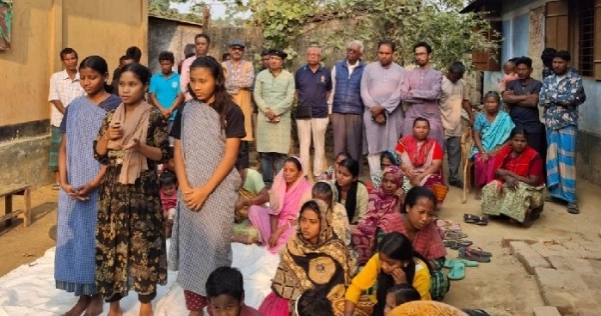
Sixteen indigenous Garo families in the Khadimnagar area of Sylhet are living in fear after receiving eviction threats from a local housing company, despite having resided in the area for generations.
The families, whose ancestors settled in the Fissari Chorarpara of Kallolgram Union around 60–70 years ago, include nearly 80 people across three generations living in 25.7 decimals of land in makeshift and semi-permanent homes.
They pay holding taxes to the Union Parishad, and adult members have national ID cards with local addresses. Yet, recent threats to remove them from the land have caused panic, particularly among women and children.
A civic representative team from Sylhet visited the area on Friday afternoon to assess the situation and show support for the Garo families. During the visit, residents expressed concerns that while the government promised permanent relocation for the community, a powerful local group is pushing for immediate eviction, which the team called a violation of human rights.
The team also observed that industrial waste from the nearby BSCIC Industrial Estate has severely polluted the Fissari canal. Efforts to fill and alter the canal’s natural flow threaten the survival of the Garo families, as blocked waterways and filthy water could make living conditions unbearable.
Dr. Mostafa Shahjaman Chowdhury Bahar, coordinator of the Sylhet branch of Dhriti Raksha (Dhora) and head of the visiting team, said, The Garo community is peaceful and law-abiding. Generations have lived here, building their homes. From a humanitarian perspective, children, women, and the elderly must not be forcibly evicted.
The civic team included indigenous researcher Prof. Mohammad Zahirul Haque, civic activist Abdul Karim Kim, environmental activist Father Joseph Gomez, Supreme Court lawyer Advocate Golam Sobhan Chowdhury, journalists Shakil Zaman and Abdur Rahman Hira, and theater artist Nahid Parvez Babu, among others.
The team expressed hope that the government and local authorities will act with humanitarian consideration to ensure the future of the Garo families remains secure and dignified.