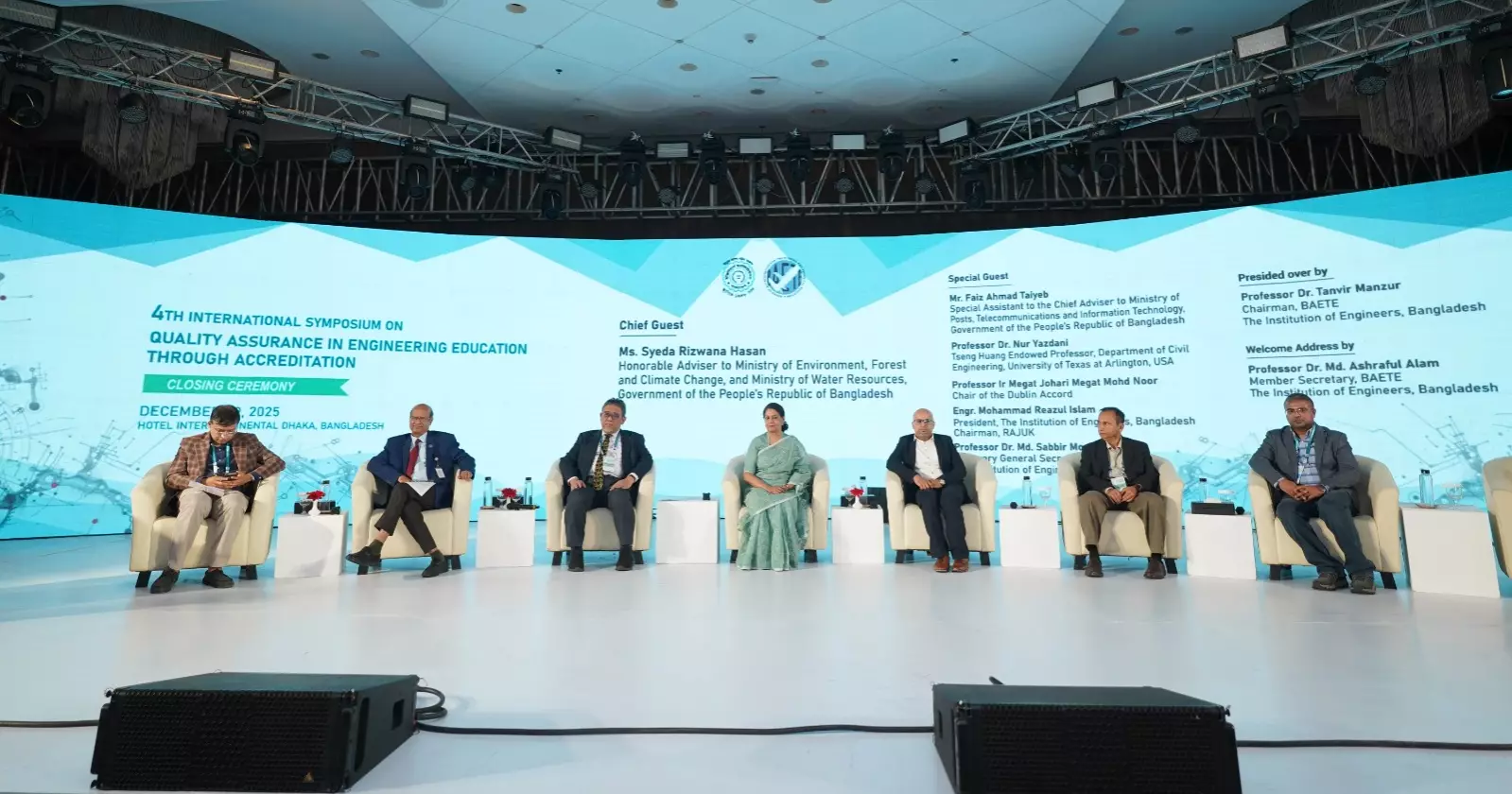
The two-day “4th International Symposium on Quality Assurance in Engineering Education,” aimed at strengthening engineering education standards and aligning local accreditation systems with global benchmarks concluded on Tuesday.
The closing session was held at the Grand Ballroom of Hotel InterContinental Dhaka.
Jointly organised by the Board of Accreditation for Engineering and Technical Education (BAETE) and the Institution of Engineers, Bangladesh (IEB), the symposium brought together policymakers, international experts, academics and professionals from home and abroad.
The second day opened with a keynote by Prof. Dr. Noor Yazdani, who presented a comparative overview of ABET and BAETE accreditation frameworks. He underscored the need for a robust quality assurance mechanism to ensure globally competitive engineering education.
Prof. Dr. Anisul Haque highlighted how outcome-based evaluation can support sustainable development and foster entrepreneurship while Prof. Dr. Md Ashraful Alam stressed integrating sustainability principles into engineering curricula.
Dr. Pru Howard and Dr. Rob Jarman jointly emphasized embedding social and technological perspectives in engineering education while Dr. Baishakhi Bose discussed challenges and opportunities in outcome-based education for the next generation of faculty members.
On other hand,Prof. Dr. Swakkhar Shatabda and Dr. Sadid Muneer underscored the importance of adaptability, critical thinking and lifelong learning for students amid rapid technological change while Prof. Dr. Salekul Islam called for enhanced capacity-building initiatives for engineering educators.
Speaking at the closing session, ICT Affairs Special Assistant Foyez Ahmed Tayyeb said Bangladesh still has significant scope for improvement in higher education.
“Our universities have expanded in number, but quality has not progressed at the same pace,” he said. “International engagements like this symposium will help us elevate engineering education. We must ensure quality learning and invest more in producing skilled graduates.”
Environment Adviser Syeda Rizwana Hasan said many river-management projects under the Water Development Board have historically harmed rivers, an issue she has long raised.
“Now within government, I also see sincere efforts by many officials to protect public resources—though opportunities remain to do better,” she noted. “Dhaka has a detailed area plan (DAP) for liveability, yet it remains one of the least liveable cities. Engineers must embrace deeper social and environmental responsibilities; engineering alone cannot solve every problem.”
BAETE Chairman Prof. Dr. Tanvir Manzur, who presided over the event, said the symposium aimed to harmonize Bangladesh’s engineering education with global standards and develop a sustainable quality assurance framework.
“The two-day dialogue has given us a clear direction—strengthening accreditation, enhancing teacher competencies and guiding institutions toward international benchmarks,” he said.
At the end of the event, organisers announced a strategic action plan focusing on expanding accreditation capacity, improving faculty training, strengthening university–industry collaboration and boosting international partnerships.
They expressed hope that the outcomes will reinforce Bangladesh’s global standing in engineering education and pave the way for ensuring higher-quality education for future generations.