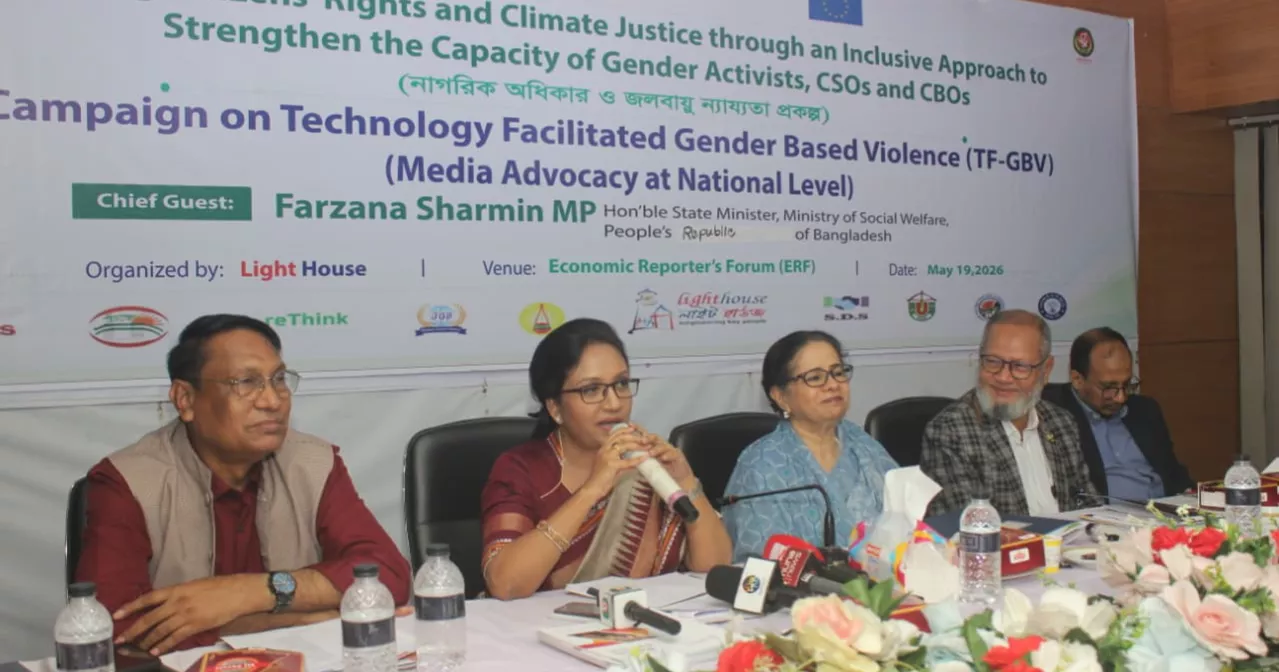
Speakers at a national seminar on Tuesday revealed that 63.51 percent of women in Bangladesh have suffered from online harassment or technology-facilitated gender-based violence (TF-GBV) at some point in their lives.
The event titled "Media Advocacy at the National Level to Prevent Technology-Facilitated Gender-Based Violence" was held at the Economic Reporters’ Forum (ERF) auditorium in the capital, drawing a diverse group of government officials, development activists, civil society representatives, and media professionals.
Organised by the human rights and development organisation 'Light House' under the Civic Engagement Fund (CEF) programme, the initiative is funded by Switzerland, Canada, and the European Union, and managed by the GFA Consulting Group.
State Minister for Social Welfare Farzana Sharmin attended the event as the chief guest, with Shah Mohammad Mahbub, Director General (Additional Secretary) of the Department of Social Services, in the chair.
Deepening Digital Vulnerabilities
Presenting the concept paper, organisers revealed that despite digital technology expanding socioeconomic horizons for women in education, online entrepreneurship, and freelancing, its misuse has birthed a dangerous dimension of gender-based crime.
Recent studies indicate that 80.35 percent of online female victims faced obscene and sexually suggestive comments, 53.28 percent were targeted with unsolicited sexual propositions or explicit images, and 17.47 percent were harassed via fake social media profiles.
More alarmingly, an overwhelming 85 percent of victims choose not to lodge formal complaints due to social stigma, fear, or lack of institutional trust, presenting a major barrier to justice.
Data from the Police Cyber Support for Women (PCSW) units, analysed by the ICT research body 'VOICE', showed that 9,117 cyber harassment complaints were registered in 2024 alone. Platforms like Facebook, TikTok, and YouTube have become primary channels for circulating hate speech, deep fakes, doxing (leaking private information), and revenge pornography. A historical trend analysis shows cyber harassment among female internet users shot up from 73 percent in 2017 to 80 percent by 2021.
Real-World Harm and Targeted Attacks
The seminar highlighted that the impact of virtual abuse is not confined to online alone. Approximately 65 percent of victims suffer from severe mental stress, anxiety, or depression, while 42.79 percent face discouragement from expressing their views on social platforms. In many cases, online vitriol translates into offline physical violence.
Publicly visible women, including female journalists, human rights defenders, and political activists, face disproportionately higher risks. An analysis of 64 specific TF-GBV incidents during 2024-25 revealed that 17 high-profile women were deliberately targeted to suppress and discourage female political participation.
Furthermore, technology-facilitated intimate partner violence – involving surveillance, blackmail, and the unauthorised distribution of intimate media – is rising sharply.
Bangladesh Perspective & Strategic Response
From a broader Bangladeshi standpoint, cybercrime experts emphasise that the enactment of successive digital laws has often prioritised state security over citizen-centric safety. The lack of grassroots digital literacy means millions of rural women and girls adopt smartphones without understanding privacy settings or two-factor authentication, making them soft targets for cyber-extortionists.
Addressing the session, Dr Mohammed Jakaria, Director General of the NGO Affairs Bureau at the Prime Minister's Office, and Shaila Sharmin Zaman, Director General of the Department of Women Affairs, called for policy-level synchronisation to make cybercrime reporting friendlier and less re-traumatising for victims.
Former caretaker government Adviser and Executive Director of the Campaign for Popular Education (CAMPE) Rasheda K Choudhury underscored that the country's mainstream media must adopt gender-sensitive reporting guidelines to ensure the privacy of victims is strictly protected.
The seminar concluded with a call to action for a coordinated framework involving government agencies, civil society organisations (CSOs), media houses, and tech platforms to build a safe online ecosystem, upgrade digital security laws, and advance digital literacy among women and youth.
The event was attended by 90 participants, including government officials, gender activists, and 40 senior journalists from television and print media outlets.