
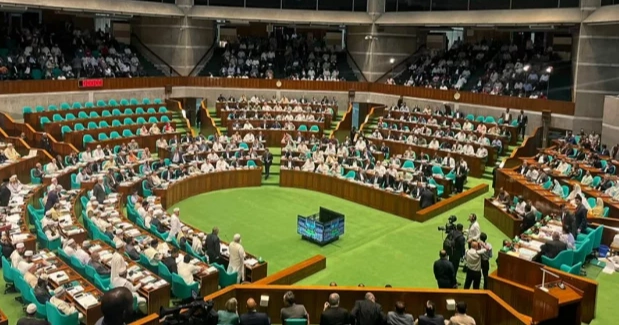
A new bill titled the Supreme Court Secretariat (Repeal) Bill, 2026 was placed in the Jatiya Sangsad on Thursday, seeking to abolish the recently established independent secretariat for the country’s apex court.
The bill, moved by Law, Justice and Parliamentary Affairs Minister Md Asaduzzaman, aims to repeal the Supreme Court Secretariat Ordinance, 2025 and the Supreme Court Secretariat (Amendment) Ordinance, 2026, promulgated by the immediate past interim government.
According to the objectives and reasons stated in the bill, the government believes that further consultation and scrutiny with stakeholders are required regarding the necessity and structure of a separate Supreme Court Secretariat.
While the previous ordinances were initially promulgated to ensure the independence of the judiciary, the government now seeks to re-evaluate the legal provisions to avoid administrative complexities.
The proposed law includes several clauses to manage the transition. Upon the commencement of this act, the Supreme Court Secretariat will stand abolished, and all posts specifically created for it will be scrapped. All budgets, projects, and programmes previously under the secretariat will be transferred to the Law and Justice Division.
Despite the repeal, the organisational structure, vehicles, and office equipment used for the Registrar, Administrative Tribunals, and subordinate courts will remain intact but will fall under the jurisdiction of the Law and Justice Division.
Judicial officers who were serving in the secretariat will see their service terms revert to the laws that governed them prior to the 2025 ordinance.
The bill clarifies that all actions taken and measures adopted under the now-repealed ordinances will be given legal protection to ensure that administrative work completed during the secretariat's existence remains valid.
When the Law Minister tabled the Supreme Court Secretariat (Repeal) Bill in Parliament on Thursday, opposition MP Muhammad Nazibur Rahman strongly objected, calling it a “direct interference” in judicial independence.
“This bill is a naked attempt to control the judiciary. There is an effort to use the lower courts in a fascist manner,” he said.
Claiming that the judiciary is currently functioning independently, he alleged that some judges have recently been issued show-cause notices for taking positions in favour of judicial autonomy. He also warned that past practices of influencing judicial postings and transfers – such as punitive transfers to remote areas like Khagrachhari – could return.
Referring to a High Court verdict, the Jamaat lawmaker argued that changes to Article 116 of the 1972 Constitution had already been deemed unconstitutional.
“Article 116 was automatically restored, and an ordinance was issued accordingly. The current Law Minister was also there at the time. How can he now bring a bill to repeal it?” he questioned.
Nazibur Rahman proposed that the bill be sent for public opinion and further scrutiny instead of being passed immediately, maintaining that the repeal move itself is unconstitutional.
He also noted that the BNP had not dissented from the proposal to establish a separate Supreme Court Secretariat in the July National Charter. “Why is the repeal bill being brought now? The people are being misled,” he added.
In reply, Law Minister Asaduzzaman said only the Supreme Court has the authority to declare a law unconstitutional, but it cannot direct Parliament to enact legislation, referring to the landmark Masdar Hossain case.
He maintained that the independence of the Bangladesh Supreme Court is constitutionally protected, including matters relating to the appointment, posting and transfer of judges.
Describing the apex court as “one of the finest in the world,” the minister rejected allegations of executive interference, asserting that the government has not taken disciplinary action against judges despite having the authority.
He also criticised certain practices by members of the judiciary, saying judges are not permitted to engage with coaching centres or publicly position themselves as constitutional commentators.
The minister reiterated that the government remains committed to ensuring judicial independence while reviewing the legal framework through broader consultation.
Following the debate, the opposition’s objection was rejected by voice vote, and the bill was passed.