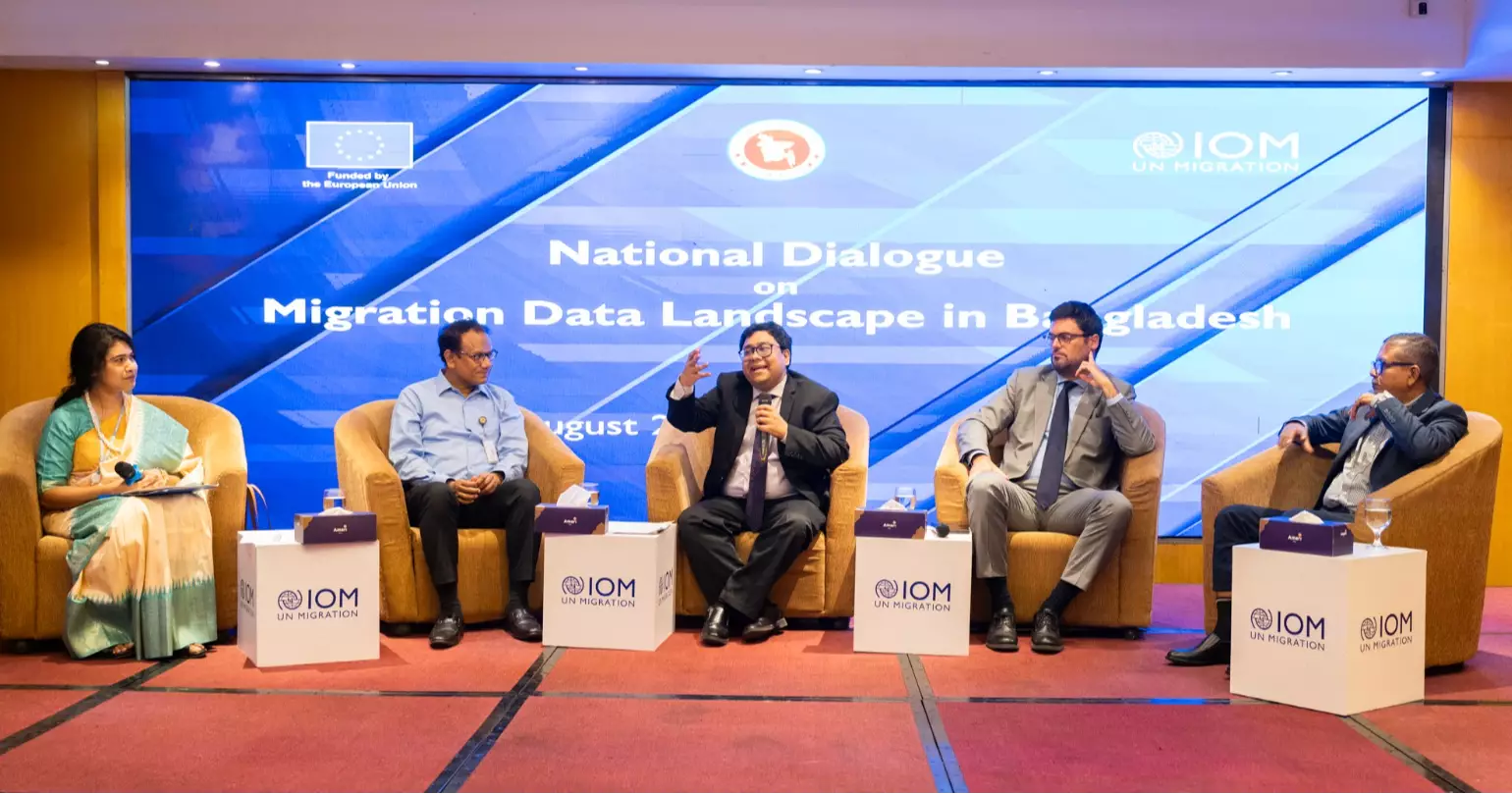
Chief of Mission of IOM Bangladesh Lance Bonneau has said accurate and timely migration data is central to effective and humane migration governance and critical in informing policy development to address Bangladesh’s diverse mobility trends, spanning labour migration, climate-induced displacement and return migration.
Bonneau made the remarks while speaking at a national dialogue held recently.
Acting Head of Cooperation and Counsellor, Delegation of the European Union to Bangladesh Jurate Smalskyte Merville reaffirmed the EU’s commitment to investing in stronger migration data systems, noting the importance of robust evidence across the entire migration cycle.
Director General of BBS Mohammed Mizanur Rahman echoed this sentiment reiterating the BBS’s dedication to fostering a comprehensive data ecosystem to guide national planning processes.
He underscored ongoing collaboration with UN partners, including IOM, to refine methodologies for data collection and survey activities.
Underscoring the United Nations’ long-standing partnership with the government of Bangladesh, Rana Flowers, UN Resident Coordinator (a.i.) in Bangladesh, stressed that reliable data and evidence are key to advancing effective migration governance.
The International Organization for Migration (IOM), with support from the European Union (EU) and in close coordination with the Bangladesh Bureau of Statistics (BBS), convened the national dialogue on the migration data landscape, said IOM in a media release on Thursday.
The event brought together senior representatives from the Government of Bangladesh, development partners, UN agencies, and civil society to strengthen collective efforts towards a responsive and integrated migration data system.
The dialogue underscored the vital role of accurate, timely and disaggregated migration data in shaping evidence-based policymaking.
Participants highlighted that stronger data systems are essential to ensure interventions are inclusive, effective and aligned with national development priorities as well as international commitments, including the Global Compact for Safe, Orderly and Regular Migration (GCM) and the Sustainable Development Goals (SDGs).
Two high-level panel discussions formed the centerpiece of the dialogue.
The first explored established and emerging data sources on migration, mobility, and displacement, focusing on ways to strengthen cooperation and modernize data systems for policymaking.
The second addressed gaps in data on irregular migration, trafficking, and smuggling, emphasising the need for stronger evidence to guide protection measures and inform strategic responses.
Key speakers included senior officials from the Ministry of Home Affairs, Ministry of Foreign Affairs, Bureau of Manpower Employment and Training (BMET), Department of Disaster Management, and the Bangladesh Bureau of Statistics (BBS), alongside experts from UN agencies, the European Union and diplomatic missions.
Dr Kazi Shahjahan, Joint Secretary, UN Wing, Economic Relations Division and Md Toufiq-ur-Rahman, Director General, Multilateral Economic Affairs Wing, Ministry of Foreign also spoke at the event.