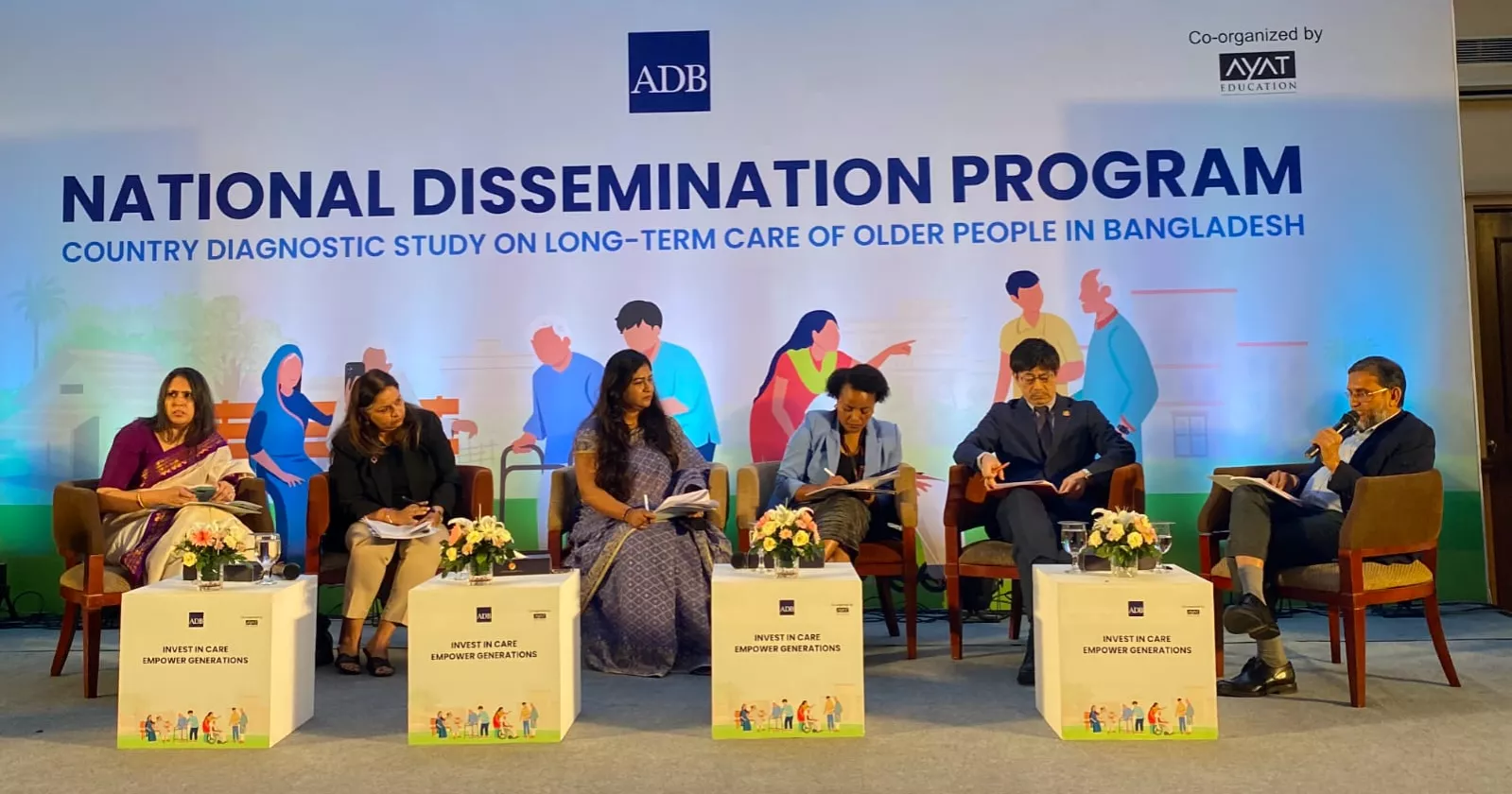
With Bangladesh’s population ageing rapidly, policymakers, development partners, and civil society representatives have come together to chart a roadmap for a sustainable long-term care (LTC) system for older persons.
The initiative was highlighted at a high-level seminar in Dhaka on Tuesday, marking the launch of the country’s first Country Diagnostic Study (CDS) on Long-Term Care for Older People, jointly conducted by the Asian Development Bank (ADB) and the AYAT Education Foundation.
The study offers evidence-based recommendations to develop a gender-responsive, affordable, and people-centred care system for Bangladesh’s elderly population, says a press release.
Dr Mohammad Abu Yusuf, Secretary of the Social Welfare Ministry, reaffirmed the government’s commitment to policy reform, noting that long-term care is becoming an integral part of the national social protection framework.
“Public–private collaboration will be key to implementing a national framework that works,” he said, adding that raising awareness and changing social attitudes are crucial.
He further observed that while overall life expectancy has improved, healthy life expectancy is declining, calling for innovative funding and health models to address the challenge.
ADB Deputy Country Director Akira Matsunaga said Bangladesh stands at a demographic crossroads. “Building a resilient and inclusive long-term care system will not only support ageing populations but also create new opportunities in the care economy,” he noted.
The CDS projects that Bangladesh’s population aged 60 and above will increase from 13% in 2020 to over 30% by 2050. It warns that traditional informal caregiving, mostly provided by unpaid female family members, will not be sufficient to meet growing demand.
Tahsin Aman, Chairperson of AYAT Education Foundation, described the effort as a “defining moment,” stressing that investing in long-term care is both a moral duty and an economic opportunity.
Presenting the study’s key findings, ADB’s Principal Social Development Officer (Gender) Nasheeba Selim and National Aged Care Consultant Imran Chowdhury highlighted policy priorities such as a National Long-Term Care Policy and Strategy, workforce development, integrated health and social care systems, and innovative financing mechanisms to ensure accessibility and sustainability.
Panelists also called for contributory social insurance schemes, public–private partnerships, and integration of LTC within existing social protection systems.
The study recommends aligning the proposed National Long-Term Care Policy and Strategy with Bangladesh’s Eighth Five-Year Plan, National Policy on Older Persons, and National Women Development Policy.
As Bangladesh experiences a major demographic shift, experts stressed that now is the time to act. With the right vision, investment, and coordination, the country can build a system that safeguards the elderly, empowers women, and promotes an inclusive future.