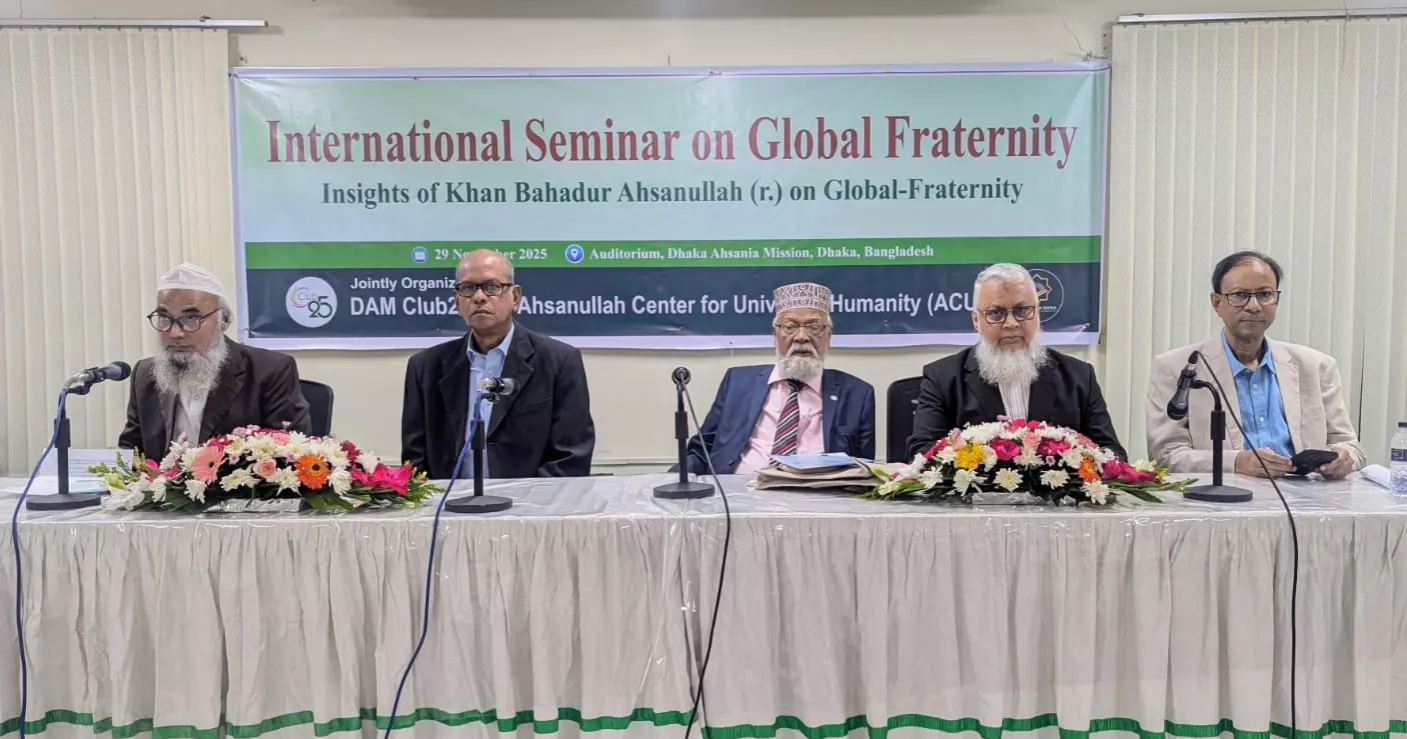
Practicing the philosophy of universal brotherhood espoused by eminent educator and reformer Hazrat Khan Bahadur Ahsanullah (R.) is essential for establishing social unity and humanity, speakers said at an international seminar in the capital on Saturday.
The seminar, titled“Global Fraternity,” was held at the auditorium of Dhaka Ahsania Mission’s headquarters in Dhanmondi and focused on Ahsanullah’s lifelong vision of universal brotherhood. The event was jointly organized by DAM Club 25 and the Ahsanullah Center for Universal Humanity.
Presided over by Prof Dr. Golam Rahman, President of Dhaka Ahsania Mission, the event featured Prof Dr. Kazi Din Mohammad Khasru, Vice-Chancellor of Prime University, as the chief guest, says a press release.
In his speech, Prof Khasru said the seminar centered on the life and philosophy of Ahsanullah (R.), whose legacy continues to inspire efforts toward peace and unity. He noted that Ahsanullah’s writings, teachings, and humanitarian initiatives motivated people to reject hatred, eliminate discrimination, and embrace a humane identity that transcends all boundaries.
Other speakers included Dr. Kazi Ehsanur Rahman, Adviser to DAM Club25; Khandaker Sakhawat Ali, Visiting Research Fellow at BRAC University’s Institute of Governance and Development; Dr. Noor Ul Zaman Rafiq, Director of Research Administration and Engagement at the Pakistan Institute of Living and Learning; and Akmal Ali, Founder and President of the United Nations Association of Fiji.
Iqbal Masud, Chief Executive Officer of the Ahsanullah Centre for Universal Humanity, delivered the vote of thanks.
Speakers highlighted that Ahsanullah (R.) believed the joy of serving others surpasses the joy of receiving service — a principle deeply rooted in Sufism and consistent with the compassion-based teachings of the Qur’an. His lifelong dedication to human welfare, commitment to unity, and efforts to spread messages of love, purity, and peace were noted as enduring reflections of this philosophy.
Humanitarian professionals, social thinkers, development practitioners, and social workers from various countries joined the seminar online. English was used as the primary language to accommodate international participants. The programme also featured open discussions, a question–answer session, and opportunities for global attendees to share their views.
The seminar underscored Ahsanullah’s concept of global fraternity through the lens of human values and Sufi thought. It highlighted how Ahsania Mission, established in 1935 under his guidance, was founded to promote social and spiritual development. Speakers also emphasized the importance of global brotherhood for fostering universal peace and harmony.