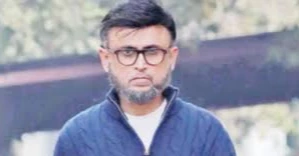
The death of eminent writer, researcher and intellectual Badruddin Umar has sparked deep grief in Bangladesh’s cultural and academic spheres, with tributes recalling on social media about his uncompromising voice, historic works and fearless analyses.
Cultural Affairs Adviser Mostofa Sarwar Farooki shared a tribute post on Facebook, writing that Umar went beyond “the factory of one-sided history” to portray Bangladesh’s critical turning points, adding his impartial analyses were unique though institutions sidelined him for questioning “fabricated Awami narratives.”
“His historical discussions and impartial political analyses were unique. Yet, unfortunately, our institutions not only failed to celebrate him but even barred his books from public libraries because he challenged the fabricated narratives of the Awami regime,” Farooki wrote.
Farooki recalled how, as a state functionary, the Interim Government decided to award Umar the Ekushey Padak despite knowing Umar would not accept it. “Because Umar Bhai didn’t need the award – the award needed him, and the state needed to celebrate him; and that is why we ensured his books reached all libraries. His thoughts and analyses remain a great source of strength for us,” he added.
Bangla Academy, through an official statement of its Director General Prof Mohammad Azam, described Umar as a distinguished historian, researcher and intellectual, noting his works on the Language Movement and politics will continue to enrich the nation. “He devoted his life to the intellectual and political struggle for working people, while his edited journal 'Sanskriti' remains significant in our literary history,” the Director General stated.
Ekushey Padak-winning eminent photographer Nasir Ali Mamun mourned Umar as “a legend gone," writing: “We will not find him again even if we cry for him.” He also shared Umar’s last published article in Daily Jaijaidin on August 22, where Umar wrote about Mamun’s currently ongoing exhibition on legendary artist SM Sultan at Bengal Gallery.
Prominent economist and writer Anu Muhammad paid tribute calling him his teacher, comrade, and a lifelong revolutionary, expressing deep respect and love. He wrote Umar’s revolutionary spirit will remain a source of strength for those fighting for justice and emancipation.
Renowned academic and writer Azfar Hussain remembered Umar as one of the country’s foremost Marxist theorists and uncompromising intellectuals, saying his life was “an epic journey against all forms of power and oppression.” He noted Umar’s rejection of awards including the Ekushey Padak and Bangla Academy Award, his solidarity with Palestine, and his sharp analysis of the 2024 mass uprising as testaments to his unmatched integrity.
Press Institute Bangladesh Director General Faruk Wasif said Umar, a lifelong communist, remained upright against oppression even in his nineties. “He was the first scholar to acknowledge the July 2024 uprising as an unprecedented mass movement in the subcontinent,” he wrote, calling Umar a voice that stood tall from Partition to the struggles of independent Bangladesh.