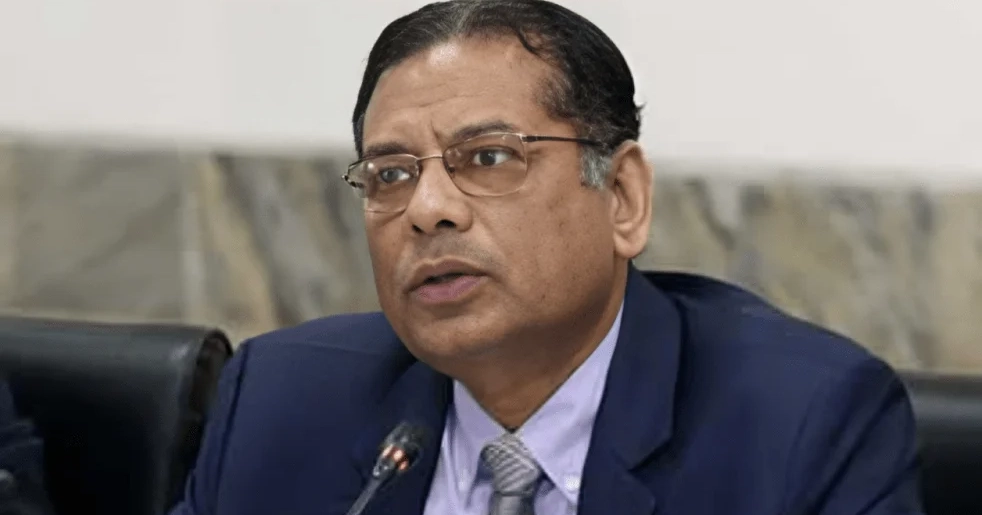
Distinguished Fellow of the Centre for Policy Dialogue (CPD) Prof Mustafizur Rahman on Monday said Bangladesh must urgently strengthen revenue mobilisation, improve governance and address deep-rooted structural challenges to ensure inclusive growth and avoid the risk of falling into a debt trap.
He also warned that the country is gradually moving towards a ‘dangerous and obligatory dependency’, largely due to its persistently low revenue-to-GDP ratio.
Mustafizur Rahman said this while speaking at the seminar on the publications ‘Bangladesh State of the Economy 2025’ and ‘Sustainable Development Goals: Bangladesh Progress Report 2025’ at the NEC Conference Room, Bangladesh Planning Commission.
He said Bangladesh’s revenue-GDP ratio has fallen to 7.7 percent this year, compared to around 8 percent in the previous year and significantly lower than the 10.9 percent recorded in 2015.
“The NBR’s 10-year plan aims to take this ratio to only 10.5 percent by 2035. If we had 10.9 percent in 2015, could we not have been more ambitious after ten more years?” he asked.
Referring to former finance minister AMA Muhith’s 2016 budget speech, he said the government pays VAT at four lakh points, while it receives VAT from only 24,000 points.
“This means the gap between what people pay and what the government collects is huge. This is not a 7.7 percent issue. It points directly to corruption. How are we addressing it?” Mustafizur Rahman questioned.
He said digitisation and technology-based reforms could close many loopholes, but stronger integration between income and expenditure data is essential.
“Unless we tag income with expenditure, we cannot shut these leakages. Our NID system is strong. If expenditure is linked to NID, we would immediately know whether someone declaring an income of Tk 10 lakh is buying a Mercedes-Benz worth Tk 10 crore,” he said.
CPD calls for scrapping ‘Upper House’ plan, warns of deeper parliamentary chaos
Mustafizur Rahman cautioned that without decisive action, Bangladesh could face a serious debt-servicing burden.
“We may enter a debt trap, which will not be good for the country. Already in the revenue budget, after paying salaries and pensions, the second-largest expenditure used to be agriculture and education. Now it is interest payment,” he said.
The CPD Distinguished Fellow praised the publications for honestly presenting existing challenges rather than masking them, and for providing a forward-looking perspective.
Linking the SDG ambition of ‘leave no one behind’ with the economic assessment, he said that while macroeconomic stability has begun to improve, many ‘subterranean challenges’ remain.
“If we analyse the economy through two reference points — the state in which the interim government assumed responsibility in July–August, and the aspirations of the student-led movement — we see that stability has come, but at a cost. This is reflected in the banking sector as well,” the CPD Distinguished Fellow said.
Mustafizur Rahman said although the Bangladesh Bank governor is undertaking various reforms, high policy and interest rates have increased the cost of capital.
“High interest rates raise business costs, but logistics and other costs also account for around 12 percent for entrepreneurs. Without addressing corruption and institutional weaknesses, the cost of doing business will remain high,” he said.
This, he added, has created a ‘vicious cycle’—high interest rates raise business costs, discouraging investment, which in turn affects employment and hampers inclusive development. Income inequality indicators reflect this trend.
“The bottom 40 percent holds 12 percent of income, while the top 10 percent holds 41 percent. If we had updated the Gini coefficient, it would likely show further deterioration,” The CPD Distinguished Fellow said.
Though inflation has eased to 8.2 percent, he said workers whose wages rise by about 5 percent annually continue to experience erosion in purchasing power. The wage share in GDP is also declining, worsening distributional inequality.
He stressed that ahead of LDC graduation, Bangladesh must urgently improve governance and competitiveness to offset the withdrawal of preferential market access, including the 12 percent GSP benefit in the EU. Export growth has slowed to 2.2 percent between July and October, compared with robust growth in the previous year.
Good election needed for boosting investment: CPD's Mustafizur Rahman
One positive sign, he noted, was a strong rise in LC openings for capital machinery—over 25 percent in the first three months of the fiscal year—reflecting early optimism among entrepreneurs about political stability and a new government.
However, Bangladesh remains far behind on SDG targets related to education and skills, Prof Mustafizur Rahman said.
Mathematics and Bangla performance indicators in the report show a “worrying situation”, while no significant improvement has been made in technical and vocational education, he added.
“If we are to shift from a low-skill, cost-based competitiveness model to a skill- and productivity-based one, we must produce skilled workers and mid-level professionals,” he said.
He also flagged serious weaknesses in the health sector, where allocation remains below 1 percent of GDP and utilisation is the lowest among major sectors. “Allocative priorities, utilisation and efficiency — in all three, there are embedded problems,” he said.
Prof Mustafizur Rahman said the success of ongoing reforms will largely depend on the commitment and capacity of the incoming government, and whether governance issues are addressed decisively.