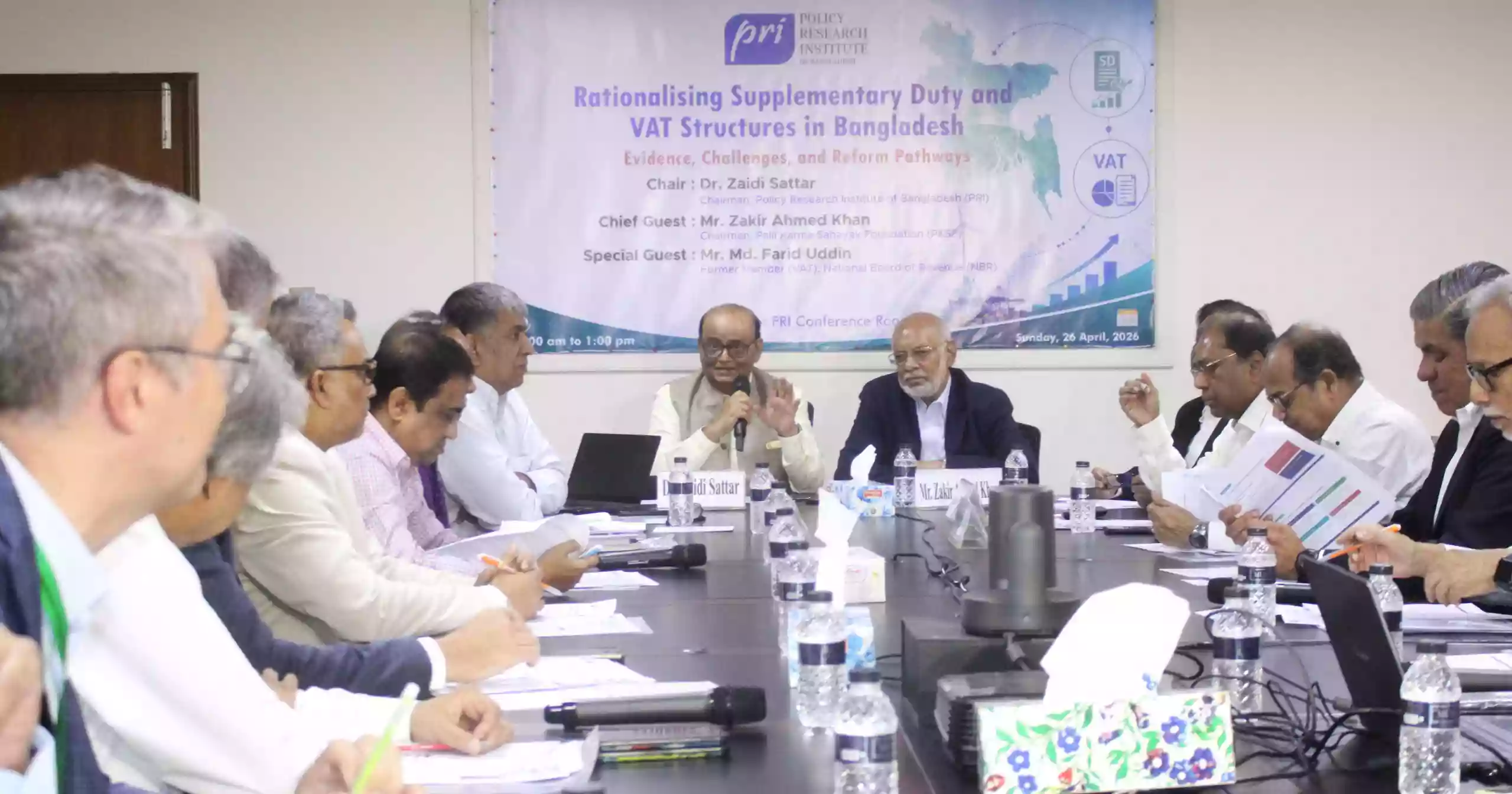
Bangladesh's tax revenue growth has collapsed from 21 percent to a mere 2.2 percent in fiscal year 2025, with actual collections running some 20 percent below revised budget targets, speakers warned at a policy dialogue organised by the Policy Research Institute of Bangladesh (PRI) on Sunday.
The dialogue, titled “Rationalizing Supplementary Duty and VAT in Bangladesh: Evidence, Challenges, and Reform Pathways,” brought together policymakers, economists, industry leaders and development partners to deliberate on structural weaknesses in the country's tax architecture.
Zakir Ahmed Khan, Chairman of Palli Karma Sahayak Foundation (PKSF) and Chief Guest at the event, said the most critical institutional reform on the table is the separation of tax policy from tax administration, the long-debated bifurcation of the National Board of Revenue (NBR).
“Tax policy should sit in a dedicated unit with research capability and broad inter-agency coordination. Implementation should remain with NBR, but with a greatly strengthened enforcement capacity,” he said, adding that the deficit in reform is one of political will, not analytical insight.
He cautioned that the current fiscal year already carries a revenue shortfall of approximately Tk 100 billion, leaving a narrow window before the next budget cycle.
Enforcing existing taxes rather than introducing new ones, remains the most accessible lever for revenue improvement, he argued, noting that a significant volume of transactions, even within organised firms, continues to be settled in cash and goes unreported.
Zakir also called for moving beyond annual, sector-level budget consultations toward frequent, targeted engagement meetings to properly assess the cross-sectoral spillover effects of any tax policy change.
Special guest Fariduddin Ahmed, Member, NBR, painted a stark picture of institutional decay within NBR, saying the board operates almost entirely on manual systems across its customs, VAT and income tax divisions, a consequence not of officer incompetence but of deliberate inaction by successive finance ministers.
He noted that NBR's published annual reports are severely behind schedule, with the last available report covering 2023, the 2024 edition still in draft, and work on the 2025 report yet to begin.
Farid also raised concerns about the integrity of customs revenue figures, saying officers routinely inflate declared prices to meet administratively imposed targets, generating an estimated Tk 15,000 crore annually in what amounts to arbitrary assessments rather than legitimate taxation.
The current tariff structure, he said, encompasses 113 different rates, with supplementary duties ranging from 5 to 500 percent.
He, too, pressed for immediate NBR bifurcation, arguing that separating policy from administration would unlock the full range of reforms currently stalled within the system.
Panelist Zakir Hossain, Senior Journalist, flagged that the tax-to-GDP ratio has fallen for three consecutive years and dropped below 7 percent in the last fiscal year, among the lowest in the region.
He projected that the full-year revenue gap for FY2025 would be the largest ever recorded, with the shortfall in the first nine months alone standing at approximately Tk 1 lakh crore.
Zakir criticised NBR's practice of releasing only aggregate monthly revenue figures without any sector-specific breakdown, rendering independent scrutiny of tax policy claims impossible.
He called on NBR to publish granular, sector-level data regularly so that media, researchers and industry could engage in evidence-based policy debate.
Daniel Alvarez Estrada, Senior Public Sector Management Specialist at the World Bank, endorsed the reform direction, urging that each tax instrument be deployed for its intended purpose, VAT for broad-based revenue, income and property taxes for equity, excise duties for correcting harmful externalities, and trade taxes for targeted industrial protection.
He described Bangladesh's current system as ad hoc, with all instruments conflated into generic revenue top-up tools rather than calibrated policy levers.
On sugar taxation specifically, he said fiscal measures alone are insufficient and must be embedded within a coordinated public health strategy spanning the ministries of finance and health alongside NBR.
Panelist Shamsul Huq Zahid, Editor, Financial Express, pointed to the imposition of 30–40 percent regulatory duties on imported sugar as a case study in policy distortion, arguing the levies exist primarily to shield loss-making state-owned enterprises rather than serve any revenue or public health objective.
He noted that Bangladesh was a pioneer in introducing VAT in South Asia in 1991, yet the country now lags India, Nepal and others in VAT productivity, a reflection, he said, of institutional stagnation. “A World Bank-financed VAT modernisation project was partially implemented before unspent funds were returned, pointing to entrenched implementation failure within NBR.”
Ahmet Zahit Erdem, Finance Head of 3J Coca-Cola Beverages, the Turkish-owned entity that acquired Coca-Cola Bangladesh two years ago said the company's total tax incidence (TTI) has surged from around 43 percent at the time of acquisition to approximately 54 percent, a level he described as among the highest in the sector globally.
The sharp escalation, he said, was driven by a fivefold increase in minimum tax within a single year (from 0.6 to 3 percent), a rise in supplementary duty from 25 to 30 percent, and a hike in import duty on concentrate from 10 to 15 percent, none of which had been factored into the investment thesis.
Erdem urged authorities to redirect focus from raising rates on fully compliant multinational operators toward expanding the tax base and drawing non-compliant businesses into the formal tax net.
The dialogue was chaired by Dr Zaidi Sattar, Chairman of PRI.