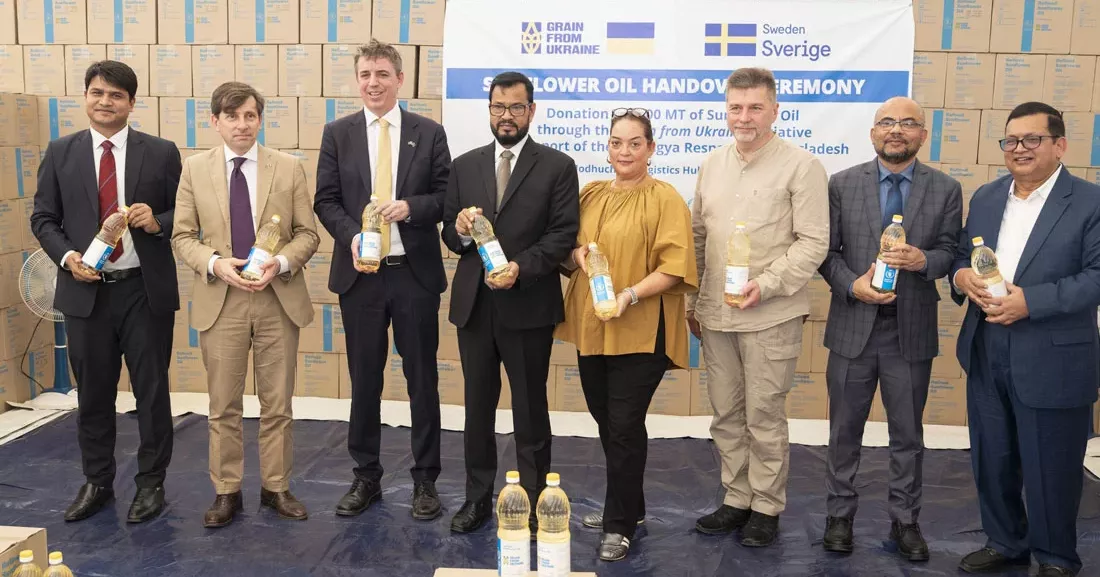
Bangladesh, Sweden and Ukraine have joined hands through the Grain from Ukraine initiative, aimed at strengthening food assistance for Rohingya families in Cox’s Bazar.
At a ceremony at World Food Programme's Modhurchara Logistics Hub in Ukhiya upazila, Cox’s Bazar, on Wednesday, 3,000 metric tonnes of sunflower oil were handed over under the initiative for the Rohingya response led by the Government with the support of WFP and other humanitarian partners.
The Grain from Ukraine (GfU) initiative is a humanitarian food programme launched by the Government of Ukraine in 2022, with the goal of making Ukrainian food commodities available for WFP’s crisis responses with international support, said a press release on Friday.
The sunflower oil for the Rohingya was produced in Ukraine, with procurement and transportation costs – amounting to USD 7 million – covered by the Government of Sweden.
The event was attended by Md. Mostafizur Rahman, Secretary of the Ministry of Disaster Management and Relief, Mohammed Mizanur Rahman, Refugee Relief and Repatriation Commissioner (RRRC); AK.M. Mohiuddin Kayes, Director, South Asia Wing, Ministry of Foreign Affairs , Dr. Oleksandr Polishchuk, Ambassador of Ukraine; Nicolas Weeks, Ambassador of Sweden; and Simone Parchment, WFP Bangladesh Country Director, ad interim; along with Jean-Marc Séré-Charlet, Ambassador of France, whose government also funds the Initiative.
“I express my sincere appreciation to Sweden and Ukraine for this critical contribution,” said Md. Mostafizur Rahman.
“Your support is deeply meaningful for the Rohingya response. It will significantly strengthen food assistance for the Rohingya populationand reflects a partnership built on humanity, compassion, and shared global responsibility,” he said.
“This event underscores a shared humanitarian conviction – one that unites Ukraine, Sweden, France, WFP and the Government of Bangladesh in supporting communities who have endured immense hardship,” Mohammed Mizanur Rahman.
“Today’s donation is not only a timely humanitarian gesture but also a genuine express of friendship and solidarity towards the Rohingya,” said A.K.M. Mohiuddin Kayes, Director,South Asia Wing, MoFA.
Following the ceremony, delegates visited a WFP food distribution outlet, where the sunflower oil and other commodities are distributed through WFP’s e-voucher system. With a full monthly entitlement of USD 12 per person, families can choose their preferred items at any of the 19 e- voucher outlets in the camps.
In addition to staple foods, they can also access fresh food,including seasonal vegetables, fish and poultry sourced from the local markets, including those supplied by smallholder farmers in host communities in Cox’s Bazar.
“I thank Sweden and other partners for supporting the Grain from Ukraine initiative and
express my admiration to the Government of Bangladesh for its leadership in addressing the
humanitarian needs of the Rohingya community,” said Dr Oleksandr Polishchuk, Ambassador of Ukraine.
“I also commend WFP and all humanitarian actors for their critical work. The food assistance we saw is an exemplary programme that meets not only basic needs but also respects dignity.”
"Together, we must keep the world’s attention on the Rohingya crisis and ensure continued support.” said Nicolas Weeks, Ambassador of Sweden.
“This partnership demonstrates that solidarity is not an idea – it is action. Through that action, the Grain from Ukraine initiative strengthens food security for Rohingya refugees, supports Ukrainian farmers whose livelihoods are under threat, and helps stabilize global food supply chains.”
“The unwavering commitments of Ukraine to humanitarian needs around the world, along with Sweden’s generous support, is a powerful testament to global solidarity,” said Simone Parchment, WFP Bangladesh Country Director, ad interim. “Let this contribution inspire others to step forward – because together, we can turn challenges into opportunities and bring hope to vulnerable communities in the Rohingya camps and beyond.”
Swedish-funded Ukrainian sunflower oil reaches Rohingyas in Cox’s Bazar
In its ninth year, the Rohingya response faces severe challenges, including a sharp decline in funding.
To meet the basic needs of nearly 1.2 million people in 2026, WFP’s Rohingya operation faces a USD 172 million funding gap for its lifesaving food and nutrition assistance.