
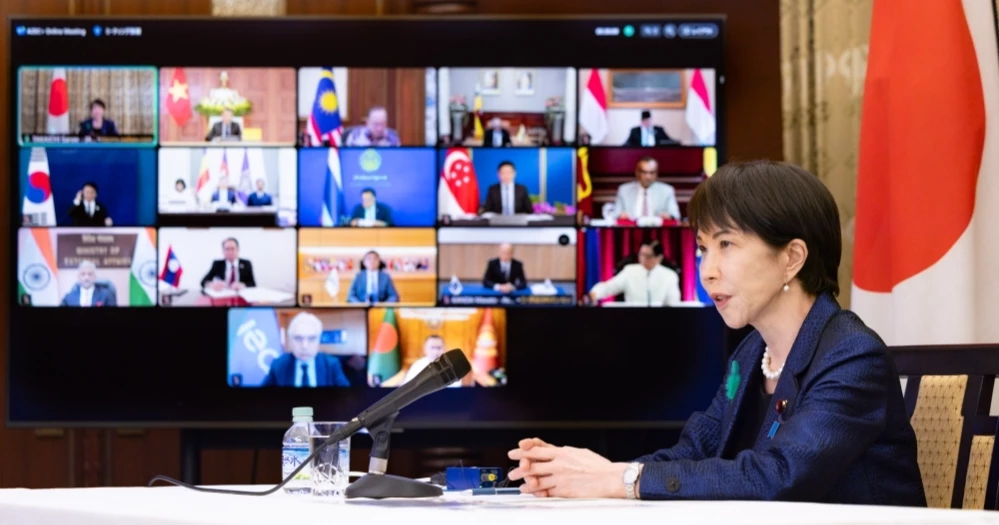
Bangladesh on Wednesday welcomed a Japan-led initiative to deal with energy issues in an efficient way in the Asian region, noting that all countries need to come together as no country can solve it alone.
“We need to come together to build a cooperation framework that will support all of us in this crisis, in particular in Asia,” Prime Minister’s Foreign Affairs Adviser Humaiun Kobir told reporters at the Ministry of Foreign Affairs.
Prime Minister Tarique Rahman joined the online meeting at the invitation of Japanese Prime Minister Takaichi Sanae.
Japan announces $10bln fund to help Southeast Asia tackle oil price spike
The Japanese Prime Minister announced the launch of “Partnership on Wide Energy and Resources Resilience (POWERR Asia),” a new cooperation framework consisting of both emergency responses and structural ones with mid-to-long-term perspectives.
The leaders of the participating countries said they will collaborate to address the current challenges together.
Adviser Kobir said the Prime Minister was invited as an important partner, noting that the Prime Minister holds one of the largest democratic mandates in the world.
He said the meeting mainly discussed the current energy crisis and concerns. “We cannot solve the issues of this crisis alone. So, we need all of us in the Asia Pacific to come together and find ways.”
AZEC partner countries are Australia, Brunei, Cambodia, Indonesia, Laos, Malaysia, the Philippines, Singapore, Thailand, Vietnam, Republic of Korea, India, Bangladesh, Sri Lanka, Timor-Leste, International Energy Agency (IEA), Asian Development Bank (ADB), and the Economic Research Institute for ASEAN and East Asia (ERIA).
The online meeting was attended by leaders of the Asian region, including partners of the Asia Zero-Emission Community (AZEC).
Bangladesh is seeking to mobilise US$2 billion from development partners to meet our immediate energy needs and safeguard our economic stability and has urged the international community to respond swiftly and positively to this call.
At the meeting, participants acknowledged that Asia is the most affected region by disruption in the supply of energy resources via the Strait of Hormuz, and concurred on the importance of ensuring safe passage through the Strait, according to the Ministry of Foreign Affairs of Japan.
Given that Asian economies are deeply interconnected via supply chains, they concurred on the importance of joint efforts by Asian countries.
Participating countries welcomed “Partnership on Wide Energy and Resources Resilience (POWERR Asia)”at the meeting to further strengthen regional supply resilience in energy and resources.
AZEC partners confirmed the importance of evolving the existing AZEC by incorporating the perspective of economic and energy resilience.
This framework (POWERR Asia) aims to cooperate in emergency responses through financing the procurement of crude oil, petroleum products, and maintaining supply chains in Asia, and addressing structural responses such as establishing stockpiling and release systems, as well as the construction and utilisation of storage tanks to expand the number of days of crude oil reserves within the region, securing critical minerals and diversifying energy resources such as biofuels, and promoting industrial advancement through energy-saving initiatives.
The support involves financial cooperation of approximately 10 billion dollars which is equivalent to roughly one year's worth of crude oil imports for ASEAN if converted to crude oil and petroleum product procurement by Asian countries.
At the outset, Prime Minister Takaichi said the countries most affected by disruptions in the supply of energy and resources passing through the Strait of Hormuz are those in Asia and it is necessary for Asian countries to work together in responding to this shared challenge because these impacts extend to all countries closely connected through supply chains.
Ferdinand R. Marcos, Jr., President of the Republic of the Philippines; Anwar bin Ibrahim, Prime Minister of Malaysia; Lawrence Wong, Prime Minister and Minister for Finance of the Republic of Singapore; Anutin Charnvirakul, Prime Minister and Minister of Interior of the Kingdom of Thailand; Le Minh Hung, Prime Minister of the Socialist Republic of Viet Nam; Dr. José Ramos-Horta, President of the Democratic Republic of Timor-Leste; and Dr. Kim Min-seok, Prime Minister of the Republic of Korea, also expressed their appreciation for holding this meeting.
These initiatives support the stability of Asian countries and contribute to strengthening Japan, including through the procurement of medical supplies from Asia to Japan.
Additionally, it embodies the realisation of the evolution of the Free and Open Indo-Pacific (FOIP) advocated by the Prime Minister Takaichi administration.
Besides, this initiative will serve as an opportunity to further develop the Asia Zero Emission Community (AZEC), which aims to simultaneously achieve energy security, economic growth, and decarbonization, by incorporating perspectives on economic and energy resilience.