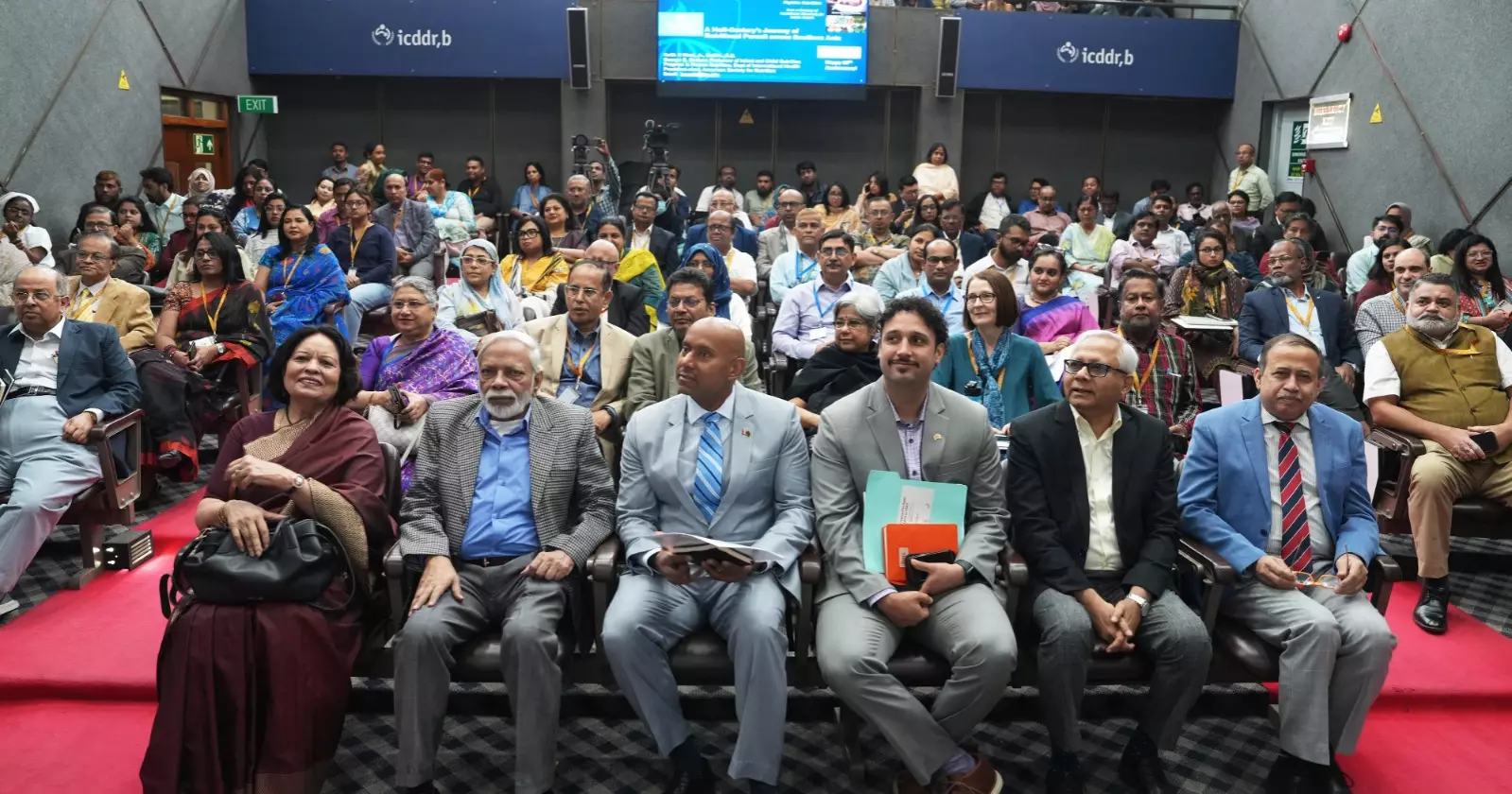
High Commissioner of Canada to Bangladesh Ajit Singh on Thursday said innovations originating in Bangladesh in the healthcare sector continue to transform lives worldwide.
“Public health challenges are transnational. What happens here in Bangladesh matters in Canada and everywhere,” he said at a seminar at International Centre for Diarrhoeal Disease Research, Bangladesh (Icddr,b)’s auditorium in Dhaka.
Internationally renowned nutrition scientist Professor Keith West from the Johns Hopkins Bloomberg School of Public Health, USA attended the seminar titled “A Half-Century's Journey of Nutritional Pursuit across Southern Asia”
The event was organised to mark the Icddr,b day to celebrate its 65th anniversary.
Singh highlighted icddr,b’s long-standing commitment to high-impact, low-cost health solutions, citing its pioneering work on cholera, malnutrition, maternal and infant mortality, gender-based violence, and other pressing public health challenges.
Singh also lauded icddr,b’s large-scale provision of free healthcare services to hundreds of thousands of low-income and vulnerable people each year.
Referring to the decades-long partnership between Canada and icddr,b, the High Commissioner mentioned collaborations with several Canadian institutions, including SickKids Hospital, the University of Toronto, the University of Alberta, the University of Saskatchewan, and the University of Calgary.
He noted that Canada is currently providing 15 million US dollars in core funding over five years, along with 24 million US dollars for expanding sexual and reproductive health research, particularly aimed at improving health services for women and girls in marginalized communities.
He added that icddr,b’s findings continue to shape global health responses, just as its earlier breakthroughs—such as oral rehydration therapy—transformed child survival worldwide.
The High Commissioner urged icddr,b scientists to continue driving innovation and strengthening international collaboration so that their research can have an even greater impact both in Bangladesh and globally.
Professor Keith P. West said early nutritional support may play a decisive role in improving pregnancy outcomes in settings where micronutrient deficiencies remain widespread.
Drawing on a career that began in Bangladesh during the 1974 famine, he reflected on five decades of research across Bangladesh, Nepal and Indonesia that has shaped global understanding of micronutrient deficiencies, maternal nutrition and child survival.
Professor West shared evidence from landmark trials in Bangladesh, including findings from the JiVitA studies and emphasised that improving women’s nutrition before conception is essential for healthier pregnancies and stronger infant outcomes.
Drawing on emerging evidence from the JiVitA trial in Bangladesh, Professor West noted that women who begin multiple micronutrient supplementation before conceiving experience about a 30 percent reduction in early pregnancy loss compared with those who start supplementation only after pregnancy begins.
Professor West reflected on five decades of nutritional research across Bangladesh, Nepal, and Indonesia, highlighting key discoveries, challenges, and lessons that may guide researchers at different stages of their careers.
Executive Director of Icddr,b Dr Tahmeed Ahmed delivered the welcome address, while Dr. Thaddaeus David May, Senior Director of the Nutrition Research Division, offered the closing remarks.