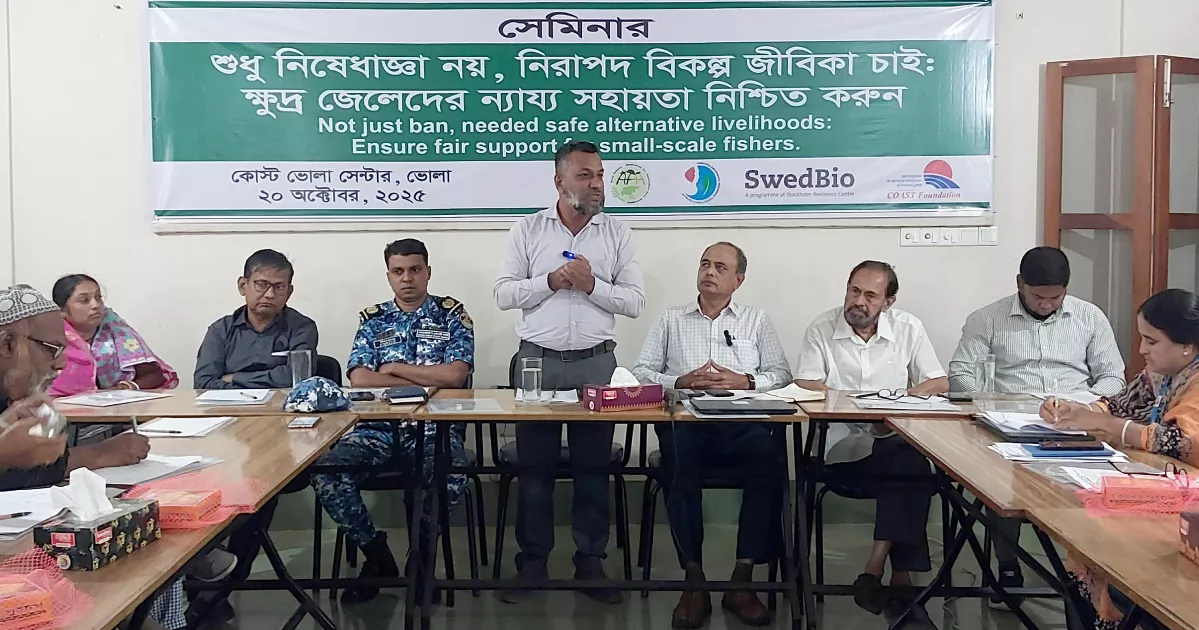
Speakers at a seminar in Bhola today urged the government to ensure secure and sustainable livelihoods for small-scale fishers beyond temporary support, to protect the endangered Hilsa fish and safeguard the future of coastal communities.
The seminar, titled “Sustainable Livelihood and Skill Development are the Keys to Secure Small-scale Fishers Beyond Temporary Support,” was organized by COAST Foundation at its Bhola Center.
Sanat Kumar Bhowmik, Deputy Executive Director of COAST Foundation, moderated the event, which was presided over by Mobasshir Ullah Chowdhury, Member, General Council of the Foundation. Md. Iqbal Hossain, District Fisheries Officer, Bhola, attended as the chief guest.
Speakers said fishers face severe livelihood crises during the annual fishing bans imposed to conserve Hilsa, as 60% of registered fishers remain income-less for 2–3 months.
They said the current support of 40 kg rice per family is inadequate and often delayed, forcing many into debt. They called for the expansion of skill-based income-generating programs, timely delivery of government support, and direct cash transfers.
Participants recommended the introduction of modern fishing techniques and technologies to enhance efficiency and safety.
They also emphasized support for fish processing, storage facilities, and training centers, along with ensuring 100% family planning coverage for fisher households.
Mst. Rashida Begum, Assistant Director, COAST Foundation, presented a keynote where she noted that short-term support can ease hunger but cannot bring long-term change. She called for institutionalized skill development to ensure dignified livelihoods.
Sanat Kumar Bhowmik highlighted that Hilsa production is declining by 4.5–5% annually due to migratory disruptions caused by emerging sandbars.
He stressed the need for immediate government intervention and suggested alternative livelihoods like goat rearing, aquaculture, and vegetable cultivation for fisher families, especially women and youth.
Women fisher representatives Rima Begum and Aklima Begum stated that government support often does not reach the genuine fishers. They said women’s participation in income-generating activities increases compliance with fishing bans.
Fisher leader Bashir Majhi alleged that many non-fishers hold fisher cards, while real fishers remain excluded from support programs.
Journalist Neyamat Ullah emphasized the need for locally adapted, safe alternative livelihoods, while journalist Nazrul Haque Anu said fishers’ human rights are violated when they are arrested for fishing beyond demarcated river zones.
Chief Guest Md. Iqbal Hossain said that fish diversity has drastically declined, with only 25–26 species remaining in rivers and seas.
He mentioned that the government is distributing legal nets, VGF rice, and livestock for alternative income.
Chair Mobasshir Ullah Chowdhury called for the removal of non-fishers from the database and the introduction of accessible loan facilities, saying many fishers are trapped in informal debt cycles and are unable to sell their catch freely.