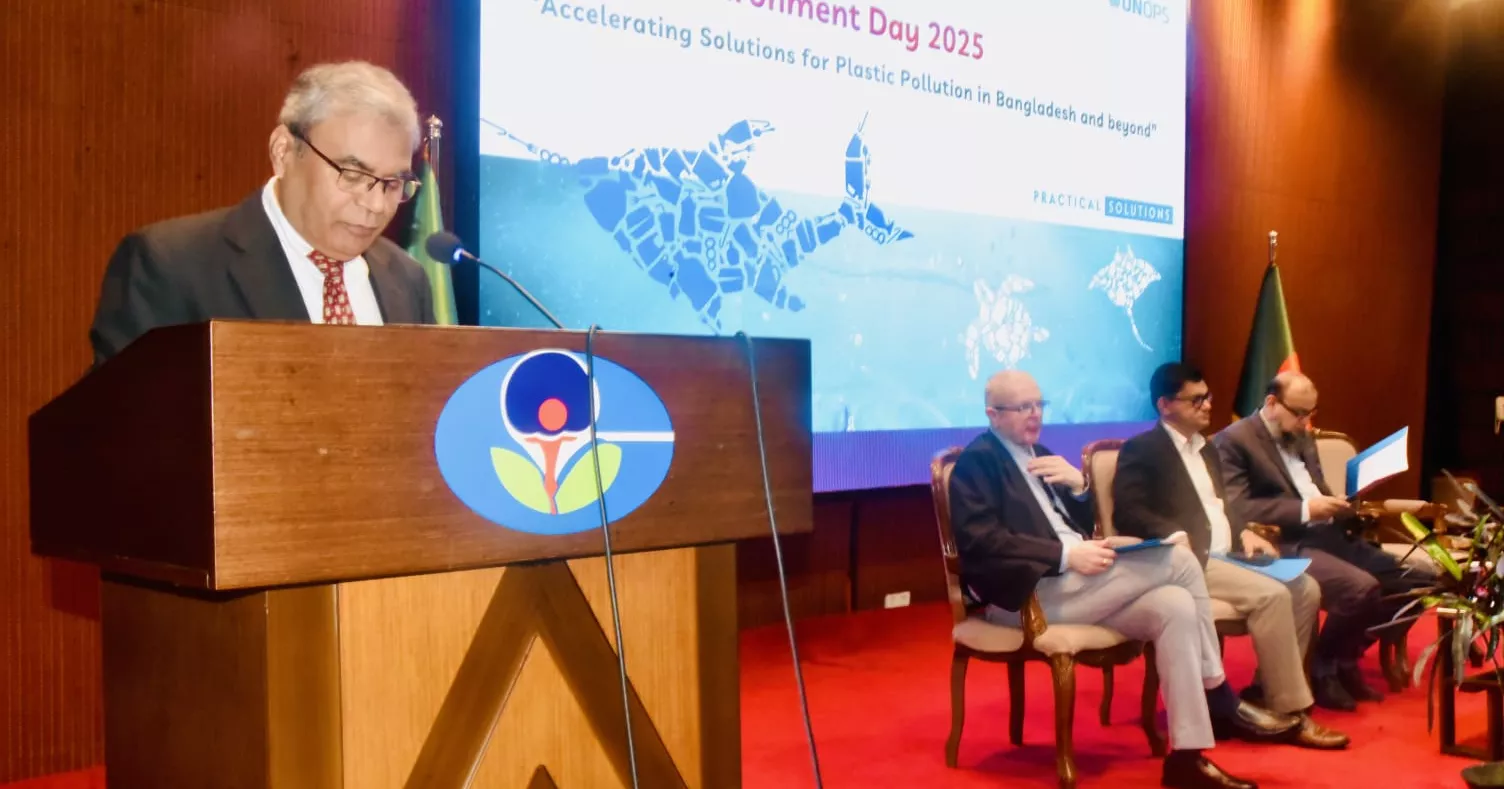
Bay of Bengal Initiative for Multi-Sectoral Technical and Economic Cooperation (Bimstec) Secretary-General Indra Mani Pandey on Thursday said plastic pollution is a shared global and regional threat, demanding shared solutions.
“BIMSTEC stands ready to deepen regional cooperation to achieve a plastic-smart Bay of Bengal region,” he said while speaking at a dialogue that brought together brought together government leaders, private sector champions, youth activists, innovators and international stakeholders to accelerate solutions for sustainable plastic management.
In a decisive move to confront the escalating plastic pollution crisis, the Department of Environment (DoE) of Bangladesh, in partnership with United Nations Office for Project Services (UNOPS) and Bimstec, hosted the seminar titled “Accelerating Solutions for Plastic Pollution in Bangladesh”.
The event, held at the Department of Environment's Conference Room in Dhaka, was aligned with the 2025 World Environment Day theme.
Country Manager of UNOPS for Bangladesh and Bhutan Sudhir Muralidharan inaugurated the session. Secretary of the Ministry of Industries Md Obaidur Rahman also spoke at the seminar chaired by Director General of the Department of Environment Dr Md Kamruzzaman.
“Plastic pollution is not just an environmental issue - it is an infrastructure and behavioral challenge that demands bold, collective action. UNOPS is committed to supporting Bangladesh through scalable solutions and regional partnerships to turn ambitious targets into measurable impact,” said Sudhir Muralidharan.
As plastic pollution continues to threaten ecosystems, economies, and public health, Bangladesh’s leadership, coupled with regional synergy through UN and Bimstec, signals a new era of coordinated, future-focused environmental governance.
With over 87,000 tons of plastic waste entering Bangladesh’s marine ecosystems annually, the country faces an urgent imperative to reimagine its waste management trajectory, according to the UNOPS.
The discussion reinforced Bangladesh’s commitment to its National Action Plan for Sustainable Plastic Management (2020–2030), which aims to reduce plastic waste by 30%, recycle 50%, and eliminate 90% of targeted single-use plastics by 2026.
The speakers explored innovative financing mechanisms and behavioral change strategies. Insights were shared on national policy implementation and petrochemical industry innovation and media as a catalyst for public awareness on plastic pollution.
Among the anticipated outcomes are a Joint Communiqué, and the identification of pilot initiatives to accelerate cross-border collaboration on marine plastic pollution.
The event also aims to foster public-private partnerships, catalyze green financing, and promote technological innovation to enable a circular economy.
“We must embed sustainability into every level of industrial development. This seminar is an important step toward aligning environmental responsibility with industrial transformation,” said Obaidur Rahman.
Kamruzzaman said the Department of Environment is committed to operationalising their plastic action plan through innovation, accountability, and inclusive collaboration across sectors and borders.