
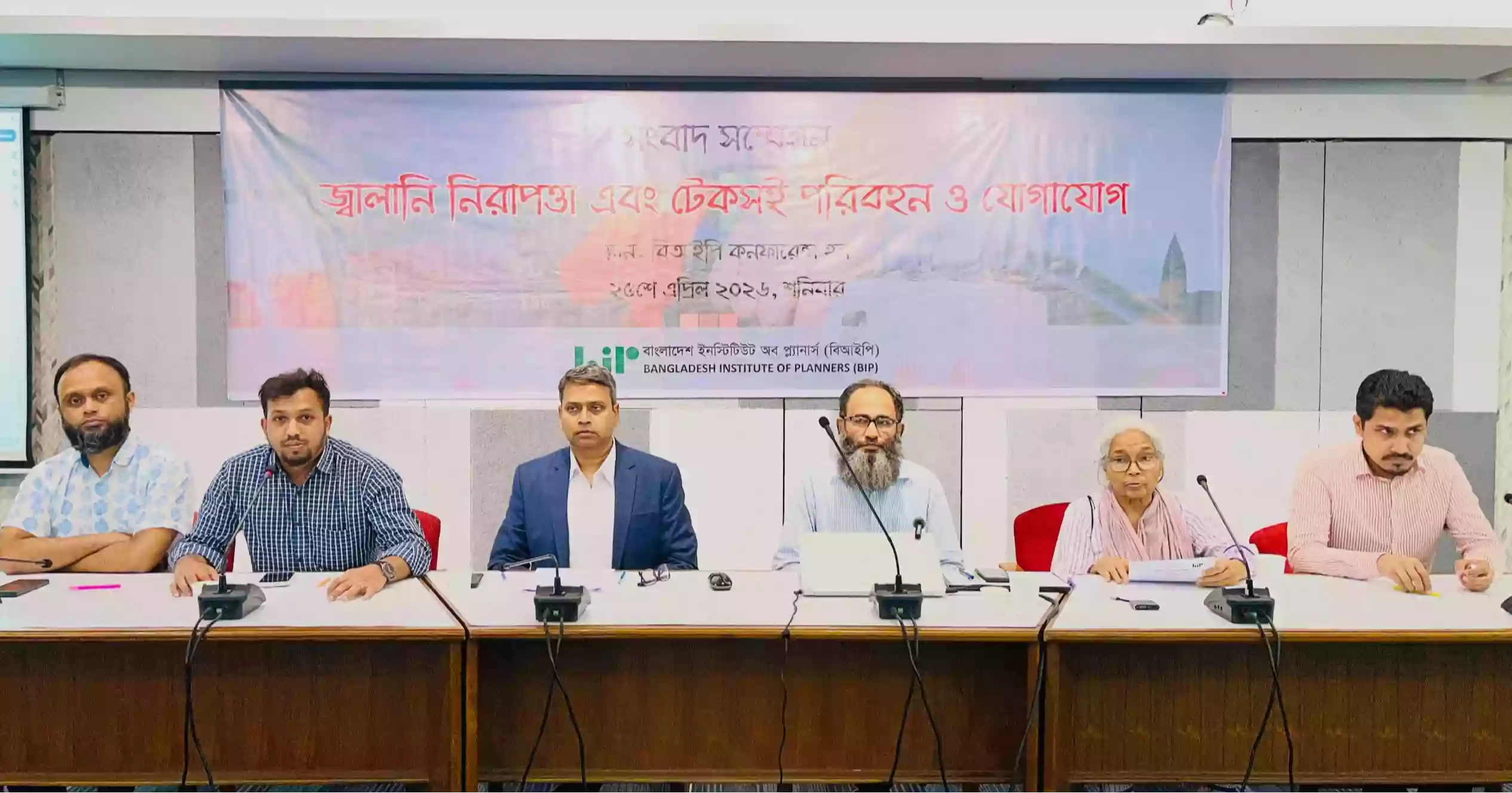
Bangladesh Institute of Planners (BIP) on Saturday urged authorities to prioritise public transport, rail and waterways over fossil fuel dependent private vehicles, stressing that such a shift is essential to ensure energy security and build a sustainable transport and communication system in the country.
The call came at a press conference titled “Energy Security and Sustainable Transport and Communication,” held at the BIP conference hall in the capital.
The event was chaired by BIP President Dr Muhammad Ariful Islam, while the keynote paper was presented by the institute’s General Secretary Prof Md Musleh Uddin Hasan, with Joint Secretary Kazi Salman Hossain moderating the session.
Presenting the keynote, Prof Hasan said ensuring energy security requires reducing reliance on fossil fuel–based private transport and giving priority to mass transit, rail and water transport.
He noted that the power sector accounts for the largest share of national carbon emissions, followed by the transport sector, underscoring the urgency of reforming transport planning.
Highlighting the environmental cost of motorisation, he said the amount of metal used to manufacture a single motor vehicle could produce around 150 bicycles, demonstrating the efficiency and sustainability of non-motorised transport.
Hasan stressed equitable distribution of energy use in the transport sector and proposed urgent introduction of Bus Rapid Transit (BRT), implementation of bicycle-sharing schemes and formation of a national urban transport fund.
He also emphasised the need to control the growing use of motorcycles and private cars, and called for infrastructure development and policy reforms to support walking, non-motorised transport and electric buses.
BIP President Arif said the institute has long been advocating environment-friendly, sustainable and public transport oriented mobility systems, but road-based transport including private vehicles and motorcycles has increased significantly in recent years. “As a result, the country’s transport system has become increasingly dependent on fossil fuels and imported energy.”
To strengthen energy security and achieve self-reliance, Arif urged faster adoption of renewable energy projects such as solar power, hydropower and waste-to-energy initiatives, along with local-level implementation.
He also called for an integrated transport system combining road, rail and waterways, and ensuring pedestrian- and bicycle-friendly environments.
Arif welcomed the formation of a 10-member special parliamentary committee to address the ongoing energy crisis and said BIP is ready to provide technical support to the committee. “Ensuring energy security will require firm steps toward sustainable transport, efficient communication and integrated spatial planning.”
Speaking at the event, senior planner and fellow member Syeda Monira Akhter Khatun recalled that Dhaka Integrated Transport Study (DITS) in 1992 had provided important directions for the capital’s future transport structure.
“But those recommendations were not aligned with the Dhaka Structure Plan of the 1990s. As a result, the country’s transport and communication system becomes unstable whenever global oil shocks occur,” she said.
BIP also placed a set of short- and medium-term recommendations, including strict measures to curb motorcycle growth, regulation of battery-operated three-wheelers, rapid introduction of electric buses, and major initiatives to promote cycling and bus use.
The institute proposed launching bicycle-sharing schemes in 90 wards of Dhaka North and South city corporations with around 100,000 bicycles, expanding the scheme to other cities within a year, and forming a national urban transport fund to support mass transit through public investment and subsidies.
Among other recommendations, BIP called for reducing taxes on buses, minibuses and public transport equipment, increasing taxes on private cars and motorcycles, introducing water taxi services in cities, boosting rail and waterway freight transport, and developing a national multimodal transport plan.
It also suggested preparing mobility management and accessibility improvement plans for cities, formulating non-motorised transport and pedestrian policies, ensuring transit-oriented development around MRT and BRT stations, expanding sidewalks, and redesigning roads to allocate more space for pedestrians, bicycles and public transport.
Additionally, the institute proposed introducing bus-based official commuting for the prime minister, cabinet members and senior government officials to promote public transport use.