
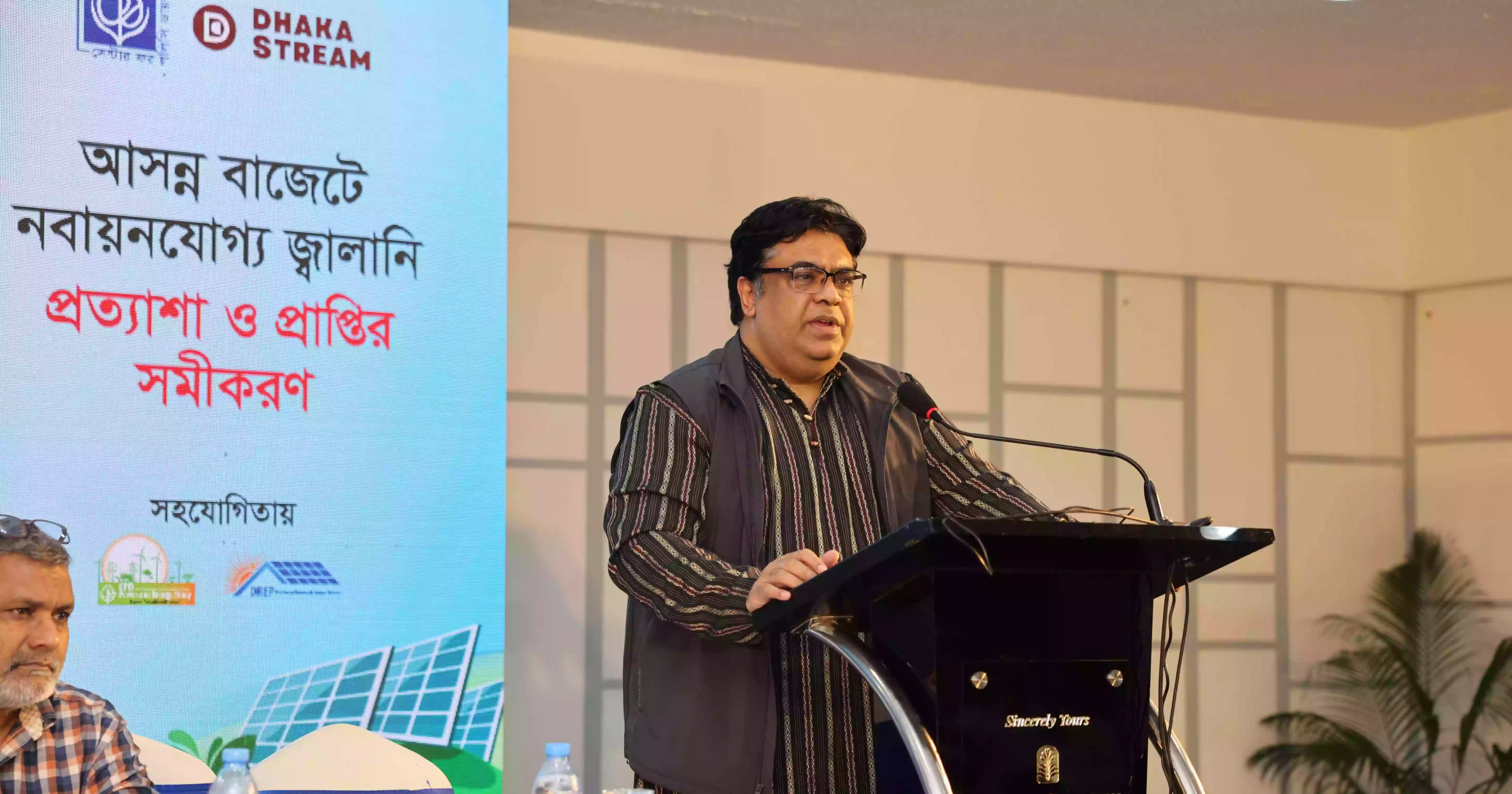
Prime Minister's Adviser on Telecom and ICT Rehan Asif Asad on Sunday stressed the need for a balanced long-term energy strategy for Bangladesh, warning that expanding renewable energy must not come at the cost of agricultural land.
“Renewable energy (RE) is crucial for Bangladesh's future. Our agriculture is also important. We cannot expand renewable energy by sacrificing arable land,” the adviser said at a seminar titled “Renewable Energy in the Upcoming Budget: Expectations and Realities,” organised by the Centre for Policy Dialogue (CPD) at a city hotel.
Asad, who holds degrees in electrical and nuclear engineering from the Massachusetts Institute of Technology (MIT), said energy is one of the key drivers of national development and that sustainable economic growth depends heavily on proper planning and predictability in the sector.
Citing an example from Rajshahi, he said solar panels placed directly on farmland had negatively affected crop output, prompting authorities to relocate them to rooftops of irrigation pumps, an arrangement that proved more effective. “Agriculture is the backbone of our economy. We cannot promote renewable energy by damaging farmland and putting food production at risk.”
The adviser highlighted nuclear power as one of the most reliable electricity sources and noted that fresh nuclear fuel has already begun arriving at the Rooppur plant.
He cautioned, however, that large-scale nuclear projects require seven to ten years from construction to power generation and demand careful long-term planning.
He also pointed to significant advances in nuclear technology over the past two decades, particularly the development of small modular reactors capable of generating between 55 MW and 500 MW, which he said could be well-suited to countries like Bangladesh.
On energy storage, Asad said the government is reviewing possible reductions in taxes and VAT on lithium-ion batteries to make the technology more affordable.
The CPD study presented at the same event had earlier flagged that lithium-ion batteries currently face a total tax incidence of 61.80 percent in Bangladesh, the highest among key renewable energy components.
Regarding electric vehicles, he said the global automotive industry views EVs as the future but cautioned that Bangladesh must first assess the impact of mass EV adoption on the national grid. “Without strengthening charging networks and grid capacity, importing more EVs could create new challenges.”
The adviser acknowledged that discussions are ongoing on whether tax exemptions and incentives should be extended to the renewable energy sector, but said every such decision must be made carefully given the country's limited fiscal space.
He noted that Bangladesh's tax-to-GDP ratio stands at approximately 6.5 percent, among the lowest in the world, compared to 11 to 14 percent in neighbouring Southeast Asian countries. “Every decision regarding tax exemptions, VAT reductions or incentives must be made cautiously to ensure maximum national benefit within limited fiscal capacity.”
Asad expressed hope that some of the recommendations discussed at the event would find reflection in the upcoming national budget. “The government is working toward a holistic approach covering renewable energy, electric vehicles, battery storage technology and overall electricity demand management.”
The CPD seminar was moderated by Research Director Khondaker Golam Moazzem. A study titled “Renewable Energy in the National Budget 2026-27: Overshadowed by Fossil Fuels?” was presented by Programme Associate Md. Khalid Mahmud. Prime Minister's Adviser on Finance and Planning Rashed Al Mahmud Titumir attended as chief guest.