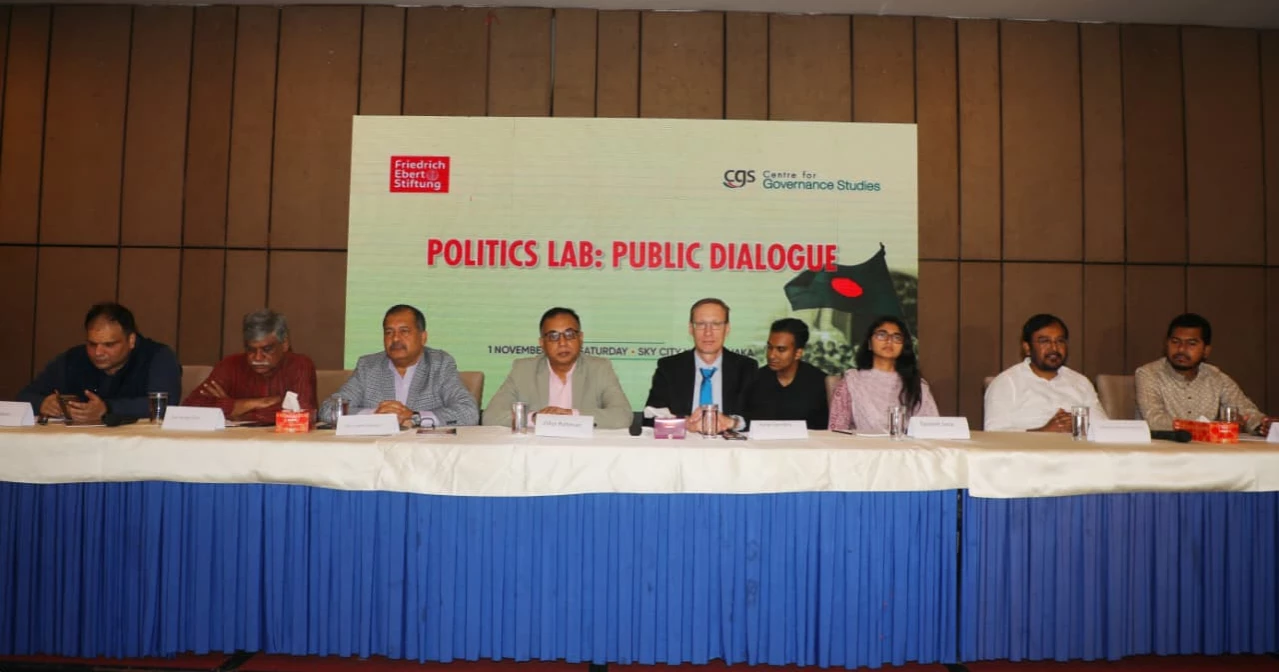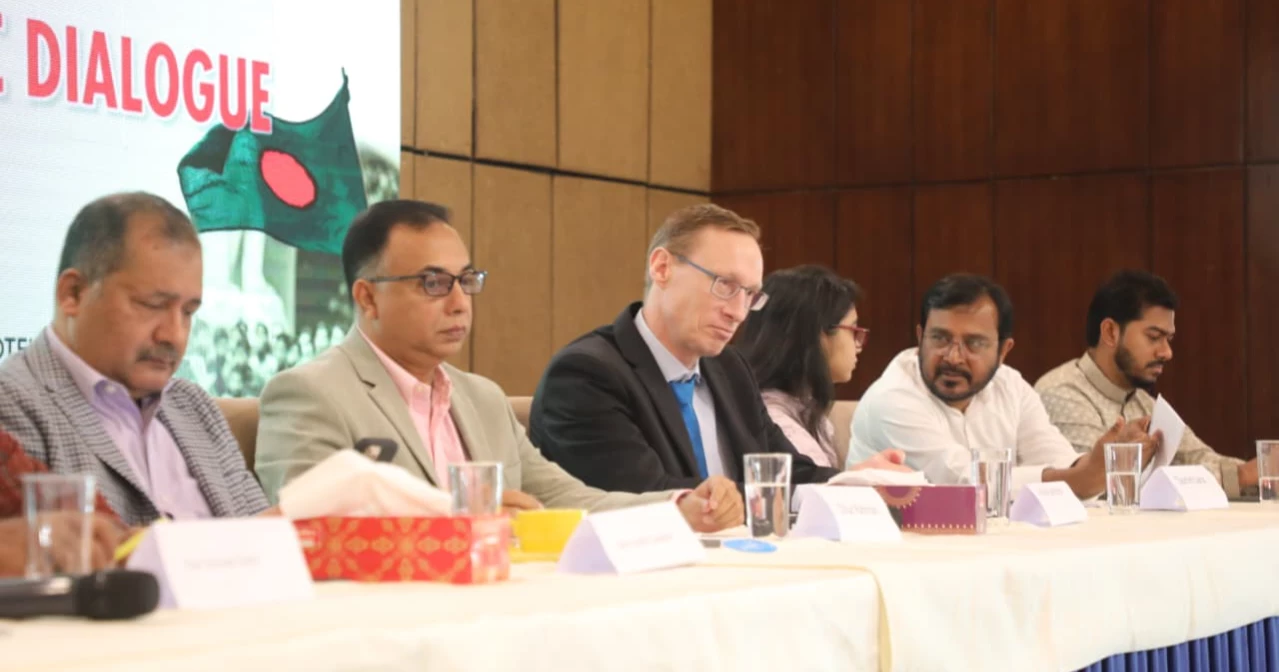
With the aim of strengthening ideology-based dialogue and democratic practices among young politicians, the Centre for Governance Studies (CGS), in collaboration with the Friedrich-Ebert-Stiftung (FES), hosted a public dialogue bringing together political leaders.
CGS President Zillur Rahman moderated the event, held at a city hotel on Saturday.
Advisor to the Chairperson of the Bangladesh Nationalist Party (BNP) Zahir Uddin Swapan, Chairman of Amar Bangladesh Party (AB Party) Mujibur Rahman Manju, Resident Representative of FES Bangladesh Felix Gradés, President of Gono Adhikar Parishad Nurul Haque Nur, President of the Communist Party of Bangladesh (CPB) Kazi Sajjad Zahir Chandan, Senior Joint Member Secretary of the National Citizen Party (NCP) Tasnim Jara, and Executive Director of the Centre for Governance Studies Parvez Karim Abbasi took part as discussants.
The public dialogue was also attended by representatives from various student organisations across the country.
Zillur Rahman expressed hope that the young participants would use the knowledge and experience gained through the ‘Politics Lab’ to help build a healthy political culture in the future.
He noted that although Bangladesh follows the Commonwealth parliamentary system, there is no architectural structure in the world comparable to the country’s National Parliament Building.
Felix Gradés said FES has a long history of sharing political knowledge. “Across the world, we are witnessing movements led by Generation Z — from Sri Lanka to Madagascar — following the overthrow of governments.
“This reflects deep-rooted issues that must be addressed through dialogue with political forces and by advancing democratically. Elections alone cannot uphold democracy. Strengthening civil society, empowering youth, and supporting research can pave the way towards good governance. Hopefully, the young politicians have learned from the Politics Lab and will contribute positively to society,” he added.
Zahir Uddin Swapan said the distinction between reform, revolution and anarchy is still unclear to many. “Reform means repair — but how far should it go? And where lies the line between revolution and anarchy? It is understandable when young politicians are confused about these concepts, but when experienced leaders consciously ignore this ambiguity, it becomes a matter of serious concern.”
He added that even if the work of the National Consensus Commission is completed quickly, the process of reaching consensus does not end there.