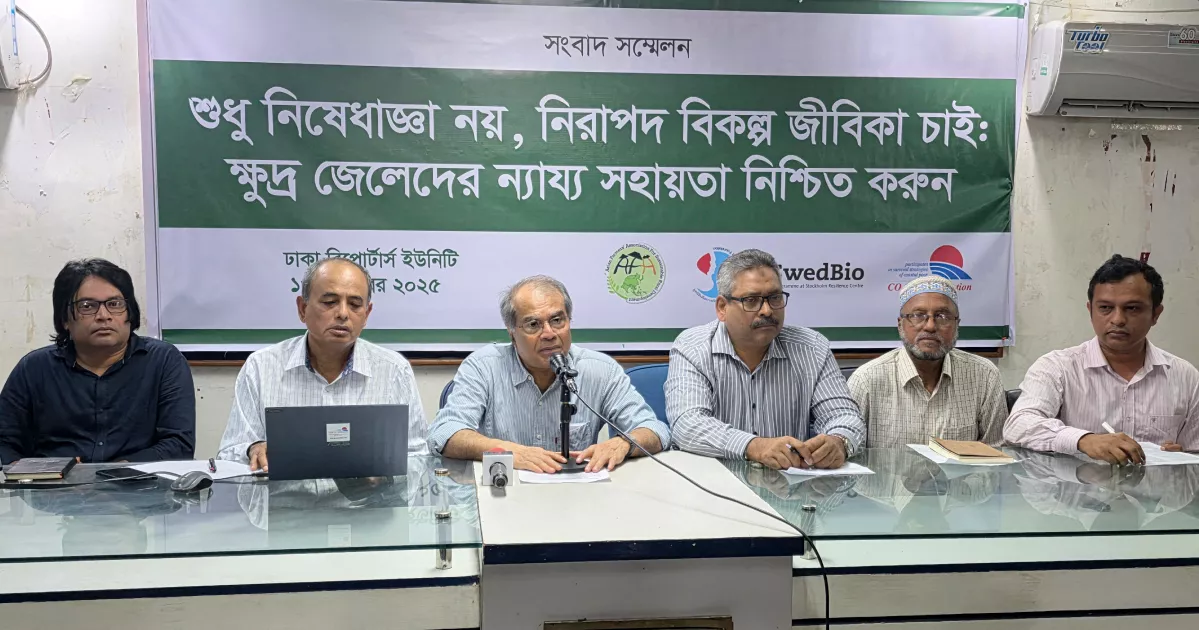
Civil society representatives on Sunday demanded timely and equitable support for small-scale fishing communities during the fishing ban, calling for alternative livelihoods and stronger government assistance to prevent hunger and economic hardship.
They made the demand at a national press conference titled *“Not Just Imposing Fishing Ban, We Demand Safe Alternative Livelihoods to Ensure Equitable Support for Small-scale Fishers” organized by COAST Foundation at Dhaka Reporters Unity in the capital .
Speakers at the event expressed concern over declining Hilsa catch, delayed relief distribution, climate-induced disasters, limited income alternatives, and rising informal debt that force many fishers into illegal fishing or debt bondage.
Moderating the programme, M Rezaul Karim Chowdhury, Executive Director of COAST Foundation and Chief Convenor of BDCSO Process, said, “Fishing bans are essential for Hilsa regeneration, but they cannot mean hunger. The government must provide 40 kg of rice and BDT 8,000 to each registered fishing family before the ban starts.”
He also stressed the need for vocational training and income-generating activities (IGA) for youth and women in fishing communities. Highlighting the plight of Manta fishers—who live on small boats in canals or small rivers—he urged the government to issue them fisher cards and exempt them from the ban.
Presenting the keynote, Sanat Kumar Bhowmik, Deputy Executive Director of COAST Foundation, said 56% of small-scale fishers remain excluded from government assistance, while 83% receive support only after the ban ends. He added that 87% lack access to IGAs (Income Generating Activities) or skill-building, and 70% are trapped in exploitative informal loans.
He noted a rise of 30–40% in domestic violence among fishing families during the ban period due to increased financial pressure.
He also called for strict actions against illegal fishing nets and factories producing them.
Mustafa Kamal Akanda, Director (Admin), COAST Foundation, urged for initiatives like livestock rearing, aquaculture, and women-led small businesses along the fish processing chain.
He also stressed updating the national fishers’ database and introducing accessible credit and grants.
Khandoker Faruque Ahmed, Executive Director of Trinamool Unnayan Sangstha, said, “Food security and livelihood protection must be institutionalised alongside conservation efforts. Justice for fishers is key to sustainability.”
Md Abul Hasan, Head of Climate Change and Resilience at COAST Foundation, linked Hilsa depletion to destructive fishing practices, unplanned dredging, and power plant expansion.
He called for a dedicated development fund for alternative livelihoods.
Md Zahidul Islam, Head of MEAL and Social Development, COAST Foundation, cited a 3.4% decline in Hilsa catch over the past five years and emphasised the importance of engaging women and youth in IGAs. He also suggested reclassifying Hilsa as an inland fish under WTO guidelines to shield it from marine subsidy restrictions.
Speakers jointly urged the government to ensure timely food and cash support, inclusive IGA opportunities, low-interest credit, and transparent inclusion of all marginalised fishing communities in national programmes.