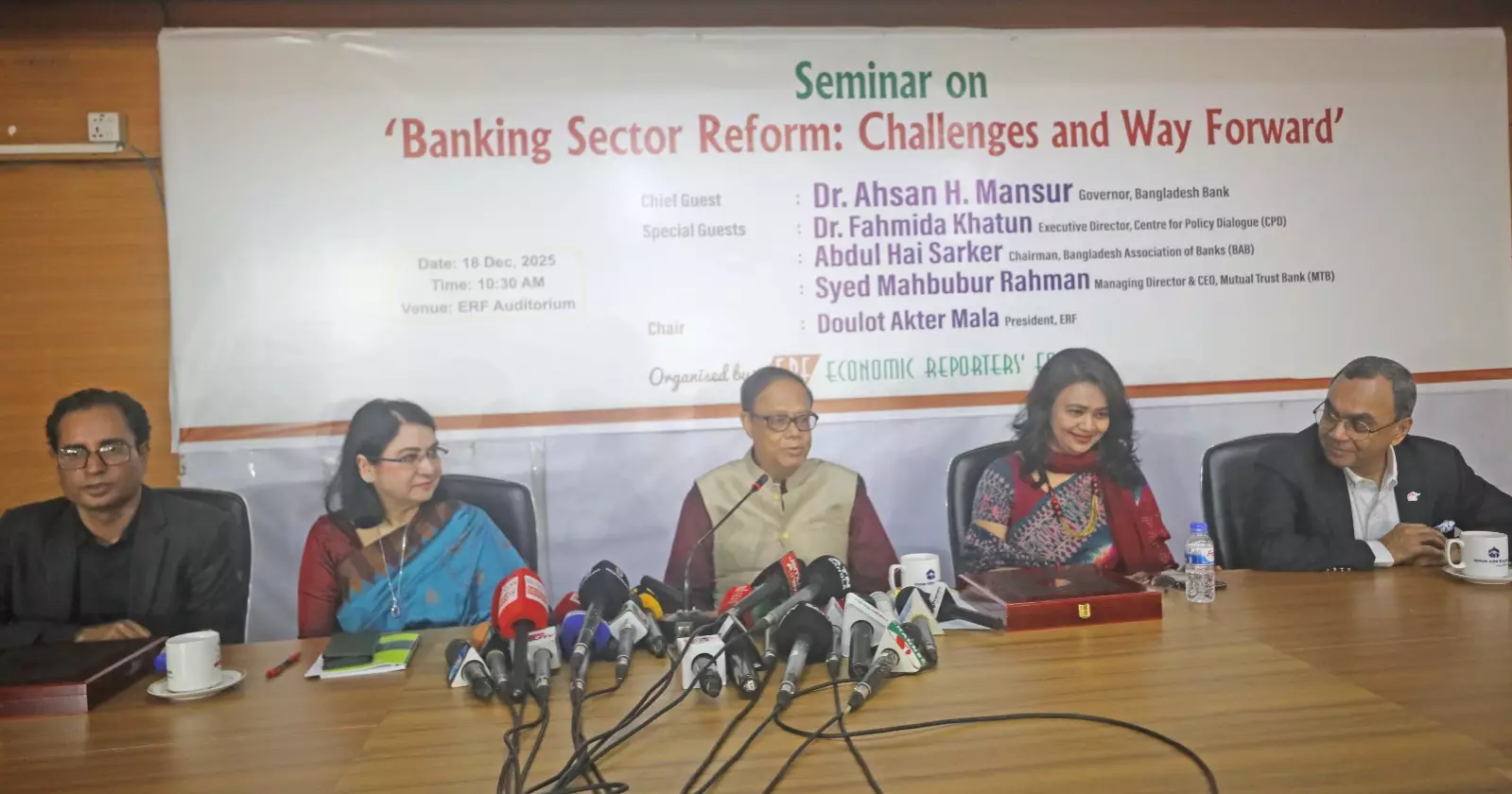
Amid lingering public unease over the health of Bangladesh’s banking system, Bangladesh Bank Governor Dr Ahsan H Mansur has acknowledged that confidence has yet to be fully restored, though efforts by the central bank have prevented a deeper erosion of trust.
“But the government has been largely successful in bringing stability to the country’s overall economy,” he said while addressing a seminar titled ‘Banking Sector Reform: Challenges and Way Forward’, organised by the Economic Reporters' Forum (ERF) at its office in Purana Paltan, Dhaka.
Governor Mansur highlighted a robust recovery in foreign exchange reserves, stressing that the country should build its reserves through its own economic strength rather than relying on external loans.
Foreign exchange reserves increased by more than $8 billion last year and have already grown by a further $1.5 billion to $2 billion this year, he said.
Regarding market intervention, the Governor said the central bank has purchased more than $2.5 billion from the open market and will continue to do so as needed. The target is to raise reserves to $34–$35 billion by the end of this year.
“Our policy is that we must increase our reserves ourselves. It is neither possible nor appropriate to build reserves by borrowing from the IMF or the World Bank. We will take money from our own economy,” he said.
Dr Mansur also spoke about transparency in reporting non-performing loans (NPLs), which have recently been reported at 36 percent. While some advised against publishing such a high figure, he said the central bank remains committed to presenting the true state of the economy.
He expressed optimism that NPLs would decline slightly by the end of December, admitting that although governance in the banking sector has shown marginal improvement, it continues to pose a significant challenge.
Providing updates on major banks, the Governor said Sommilito Islami Bank is now in a stable position, with final preparations nearly complete and signage expected to be changed within a day or two.
He also said Islami Bank Bangladesh PLC has stabilised after receiving Tk10,000 crore in liquidity support from the central bank and is now successfully mobilising deposits without further assistance.
Speaking at the event, Dr Fahmida Khatun, Executive Director of the Centre for Policy Dialogue (CPD), said visible reforms are currently concentrated in the financial and banking sectors.
Bringing back laundered funds may take 4–5 years: BB governor
“NPLs have jumped from 11–12 percent in mid-2024 to 36 percent now. This accounts for nearly 80 percent of the total budget,” she said, adding that political connections often outweighed professionalism in loan distribution.
Syed Mahbubur Rahman, Managing Director and CEO of Mutual Trust Bank (MTB), also shared his views on the way forward for the sector.
ERF President Doulot Akter Mala presided over the seminar, while General Secretary Abul Kashem moderated it.