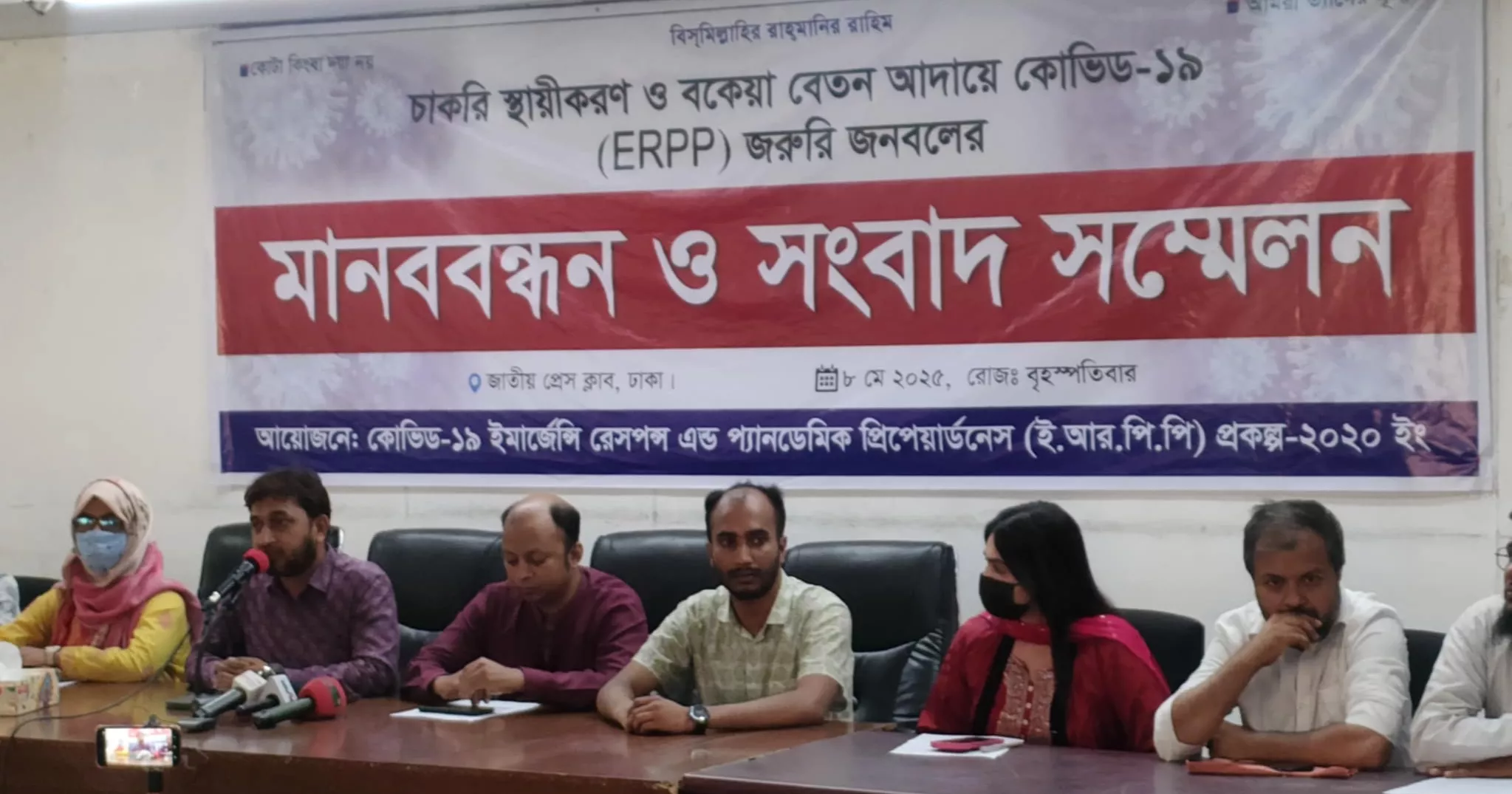
Covid-19 Emergency Response and Pandemic Preparedness (ERPP) Project staff have demanded their job be made permanent and early payment of their dues.
They made the demand at a press conference organised at the National Press Club on Thursday.
The speakers said that 1,004 people working under the Covid-19 ERPP Project to control the coronavirus are living a subhuman life as they have not received their salaries for the past 4 months.
On April 28, the Health Services Division of the Ministry of Health and Family Welfare issued a letter to the Directorate General of Health Services to send the attendance sheets of those working from January 1 to March 30 through the heads of their respective institutions in order to pay the salaries.
Later, on January 4, the Planning and Research Office of the Directorate General of Health Services, through the project director, sought the attendance information of the staff from January to March.
Being informed, all staff under ERPP submitted the attendance information for three months (January to March) to the Directorate General of Health Services and the project office through their respective heads of institutions.
But on May 5, the Project Implementation Branch-1 of the Ministry of Health and Family Welfare informed them that they are considered absent from January 1 and they will not be entitled to any salary.
Despite being regularly present at work and sending the attendance information for three months , 1004 skilled manpower of the ERPP project are left disoriented by such a decision of the Ministry of Health and Family Welfare.'
The speakers said, considering the overall aspect, we call upon the authorities concerned to take necessary measures to pay the due salaries of 1,004 personnel of the COVID-19 ERPP project.
They also urged to extend the contracts, for the smooth operation of the PCR Lab, Modern Microbiology Lab, ICU and Epidemiological Unit services established under the project.
Since 2020, under the ERPP project, they have been playing a leading role in combating the coronavirus.