Local and national organizations, along with humanitarian actors, have reiterated that repatriation remains the only sustainable solution to the protracted Rohingya crisis, urging a clear roadmap on the eighth anniversary of the mass influx.
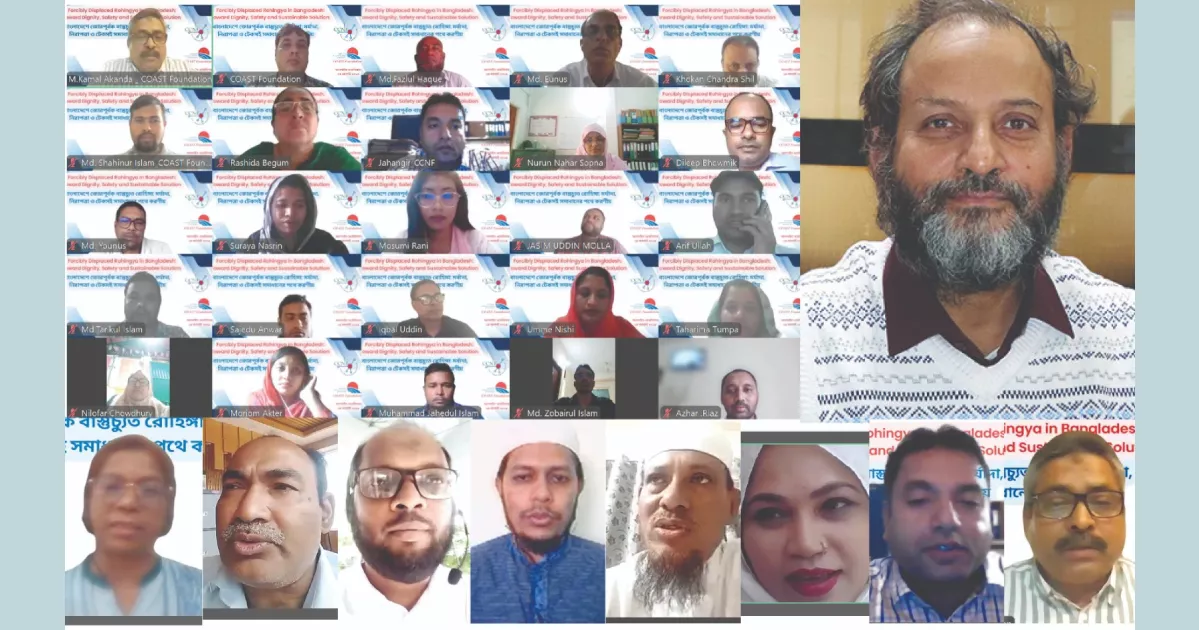
They made the call at a webinar titled “Forcibly Displaced Rohingya in Bangladesh: Steps towards Dignity, Safety and Sustainable Solutions”, organized by COAST Foundation and CCNF on Sunday. The session was jointly conducted by Mustafa Kamal Akand, Director of COAST Foundation, and Jahangir Alam, Member Secretary of CCNF.
Speakers included Gawhar Nayeem Wara of Disaster Forum, Noor Ahmad Anwari, Chairman of Whykong Union Parishad, Advocate Saki A Kawsar, Mojaffar Ahamed of Palongkhali Union, journalist Imam Khair, Save the Cox’s Bazar Chairman Tauhid Belal, Mohammad Helal Uddin of AGRAJATRA, and representatives Amir Hossen and Sukarna Abdullah from the NGO Platform.
Presenting the keynote, Md. Shahinur Islam, Assistant Director–Humanitarian Response, highlighted that around 1,148,529 Rohingya refugees remain entirely dependent on humanitarian aid, which has been shrinking due to recent funding cuts. He stressed the need to hold the Myanmar military accountable for genocide and crimes against humanity.
Gawhar Nayeem Wara said Rohingyas must be recognized as refugees, adding that education is their fundamental right. He also called for the use of local products and resources in humanitarian response, alongside a concrete roadmap for future action.
Advocate Saki A Kawsar alleged that Rohingyas are linked with Yaba trade, rape, and human trafficking cases in Cox’s Bazar, contributing to a backlog of cases. She suggested setting up a separate court for Rohingya-related cases.
Union Parishad Chairman Noor Ahmad Anwari said 25 percent of aid funds were supposed to be allocated for host communities, but that has not been implemented effectively. He warned that law and order in Cox’s Bazar has worsened due to the Rohingya presence, stressing that repatriation is the only long-term solution.
Mojaffar Ahamed noted that children born during the 2017 influx now have greater needs for food, shelter, and education. He cautioned that reducing assistance to Rohingyas will increase pressure on host communities.
Imam Khair urged the next elected government to address the issue decisively, while Abdur Rahman Hashemy said locals can no longer bear the burden of hosting even a single additional Rohingya.
Tauhid Belal identified drinking water as the biggest problem in Ukhia and Teknaf, demanding a master plan to address it. Mohammad Helal Uddin pointed to deteriorating camp security and the activities of armed groups, suggesting that third-country resettlement should also be considered.
Amir Hossain of the NGO Platform called for sustained humanitarian support while stressing peaceful coexistence, climate change adaptation, and skills development for locals. Sukarna Abdullah emphasized food security, permanent solutions, and regional-level advocacy, particularly through ASEAN.
Speakers unanimously agreed that without a clear repatriation roadmap, the crisis would continue to deepen, with devastating impacts on both Rohingya refugees and host communities.