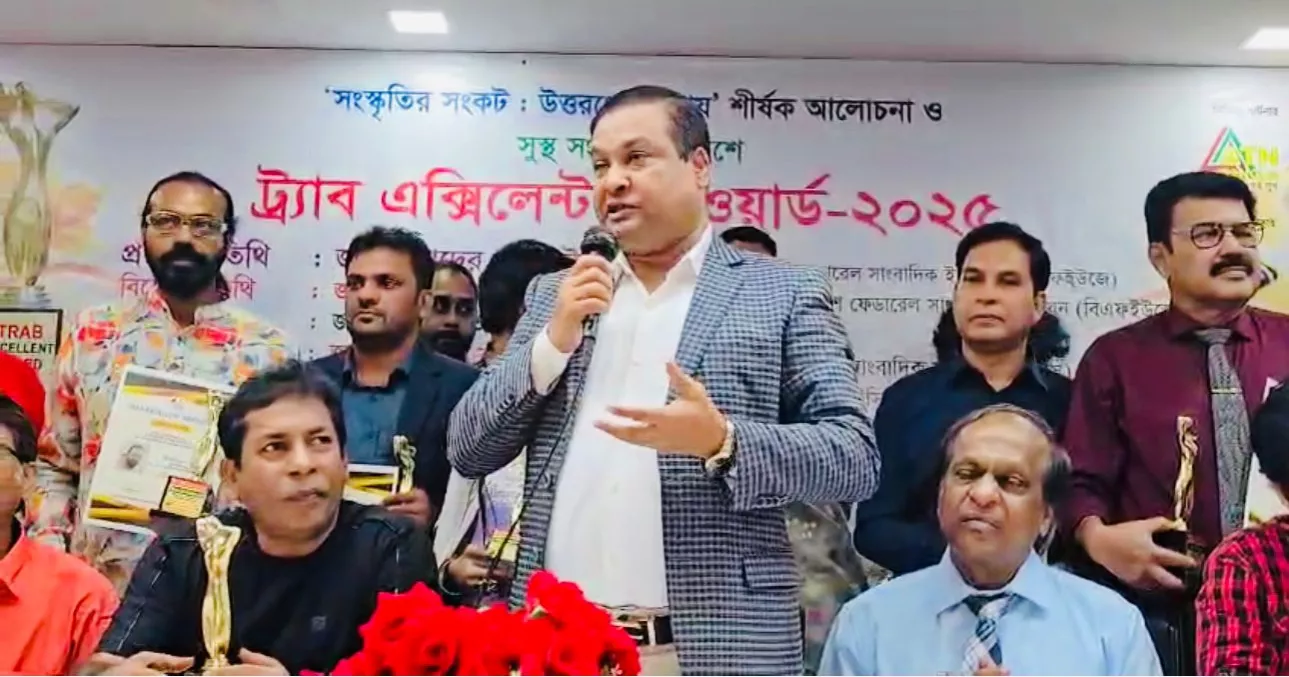
Quader Gani Chowdhury, Secretary General of the Bangladesh Federal Union of Journalists (BFUJ), has said that culture serves as a key indicator of how civilized and advanced a nation truly is.
The most important aspect of culture is that it 'contains and carries a civilization', he said.
Quader Gani was speaking as the chief guest at a discussion titled "Cultural Crisis: Ways to Overcome" and the TRAB Excellent Award-2025 ceremony organized by the Television Reporters Association of Bangladesh (TRAB) at the National Press Club on Saturday evening.
Quader Gani Chowdhury said that Bangladesh has a rich and glorious cultural heritage. “The culture of Bengal is what defines us as Bangladeshis,” he noted, adding that the country's cultural history spans thousands of years and is rooted in harmony and diversity.
He said that people of different religions and ethnicities — Muslims, Hindus, Buddhists, Christians, and others — live together peacefully here. “They express their beliefs and celebrate religious and social rituals from the heart, often inviting others to join in and share the joy,” he added.
“The social, political, and economic changes after independence have reshaped our culture. Traditional forms like folk dance, Jari, Sari, Bhawaiya, and Palagan are being replaced by Western and Indian influences,” he said.
He pointed to what he called “evil politics” — including power-driven, compromise-based, and fanatical politics — as key forces driving this cultural decline. “Religion is now being misused in politics, dividing communities. Even Hindus and Muslims are being pitted against each other.
Shrines are attacked, temples are destroyed, and people with differing views are being exhumed and burned — this is not the Bangladesh we dreamed of.”
Chowdhury also lamented the growing restrictions on cultural expression. “Now, even Pohela Baishakh has a fixed time for celebration. For celebrating Jatrapala and Kabigan we need official permission. Our shrines, which are not just spiritual havens but vibrant centers of folk culture, are under threat. It feels like there's a coordinated effort to erase them.”
Recalling his own childhood experiences, he said, “When we were young and visited villages, we’d watch Jatrapala, enjoy fairs, and be immersed in cultural life. But that beauty is vanishing. Our children don’t go to libraries, don’t listen to music, and don’t read Rabindranath or Nazrul.
But these things are essential. Just living isn’t enough — living beautifully is what brings true joy.”
He emphasized the transformative power of the arts. “There’s such strength in music — it can brighten your morning, uplift your soul, fight off depression, and bring light to a dark life.”
“Today, everyone is consumed by coaching, exams, and ambition. Culture has become optional — sidelined by the rush to become doctors or engineers. Big institutions get all the attention, while cultural organizations are forgotten,” he added, stressing the need to reintroduce the value of the arts in everyday life.
The discussion, chaired by TRAB President Quader Mansur, was attended by Erfanul Haque Nahid, Organizing Secretary of Bangladesh Federal Union of Journalists, film director, producer, and playwright Chatku Ahmed, ATN Bangla Advisor Tashik Ahmed, Bangladesh Film Journalists Association (BACHSAS) President Kamrul Hasan Darpan, TRAB General Secretary Suhrid Jahangir, actor Mosharraf Karim, actress Farzana Chobi, and singers Nadia Dora, Sumon, and Sharmin Ahmed Minni.