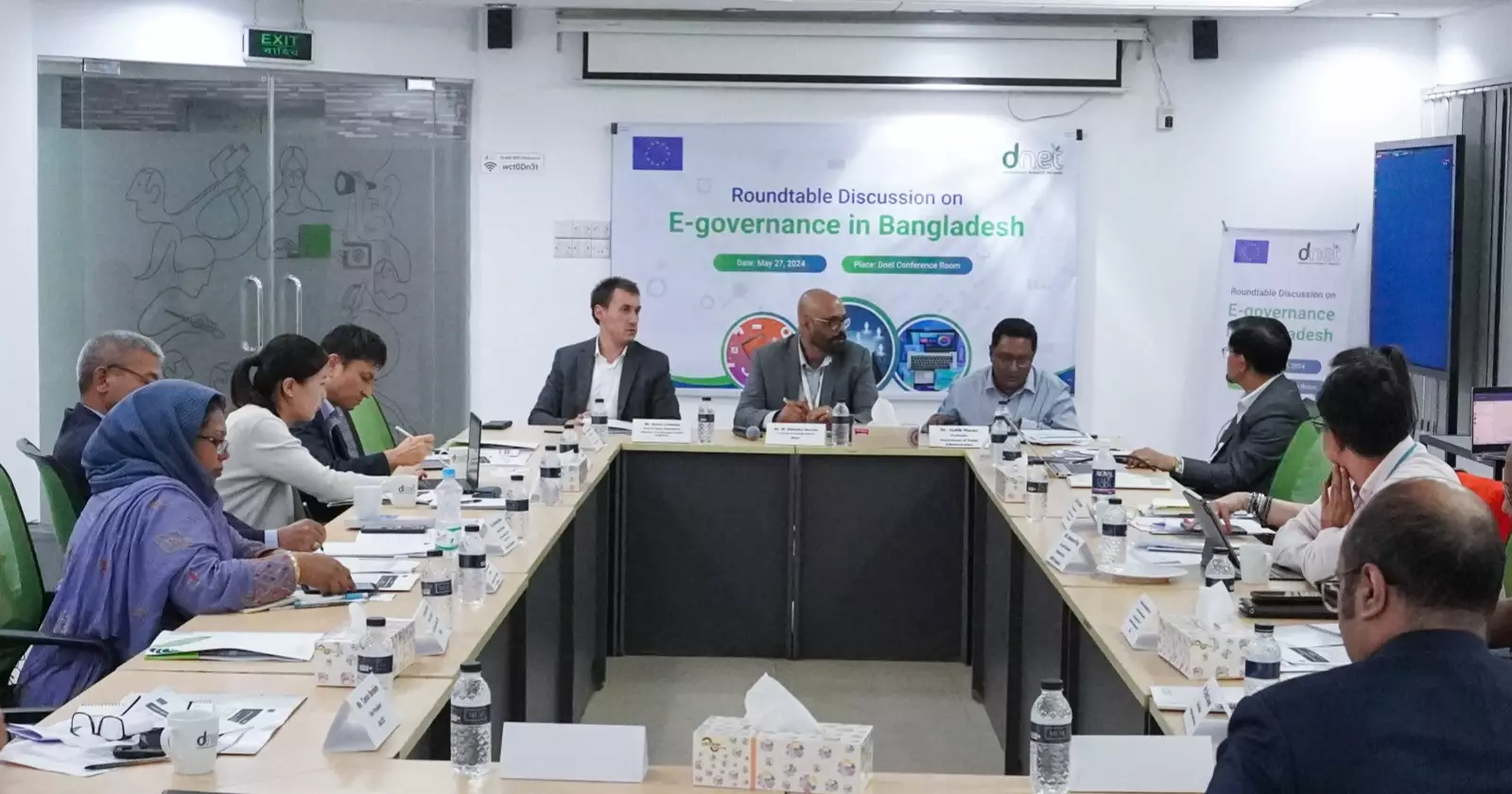
Dnet-Development Research Network on Monday organised a roundtable discussion on E-Governance in Bangladesh highlighting significant gaps in accessibility to digital services among low-income women.
In facilitating this event, the European Union Delegation to Bangladesh provided crucial technical support. This enabled the convening of prominent experts and specialists from the public and private sectors, academia, and international development partners.
Co-Founder & Executive Director of Dnet M. Shahadat Hossain said that they had recently conducted a study to understand the digital divide amongst low income women both in the formal and informal sectors.
He said the findings revealed stark disparities in digital access, literacy, and usage in both sectors.
“Despite the proliferation of government service apps aimed at enhancing citizen engagement and service delivery, the study revealed significant gaps in their accessibility among low-income women. While this study is limited in scope it does give a glimpse into the gaps that exist in the domain," he said.
The roundtable discussion aimed to evaluate the effectiveness of e-governance in Bangladesh, focusing on service delivery, transparency, and accountability. It will address challenges like the digital divide and organizational issues, propose solutions for equitable access, and develop strategies to raise awareness among all citizens, particularly young, female, vulnerable, rural, and hard-to-reach populations.
This roundtable discussion also highlighted the need so that digital services are simultaneously efficient and inclusive, to avoid increasing current inequality.
According to a UN report, Bangladesh achieved the highest E-Government Development Index (EGDI) score among the top Least Developed Countries (LDCs) and has continued to rank highly in two surveys.
Bangladesh has moved up 37 spots in 8 years from 2014-2022) on the index. This achievement can be attributed to the government’s efforts to streamline and improve the provision of public services. However, with vision 2041 and smart Bangladesh there’s still a long way to go to reach the desired level.
Deputy Secretary of Development, Implementation, Monitoring & Evaluation Branch of ICT Division Mohammad Manir Hossain, representative of Japan International Cooperation Agency (JICA) Kurokami Minami, Norwegian Embassy Trade Adviser Bayzid Sayeed, Programme Manager of Delegation of the European Union to Bangladesh Fani Farmaki and Head of Sector (Governance) Enrico Lorenzon spoke in the programme.
Professor of Public administration DU Dr. Sadik Hasan moderated the session.