
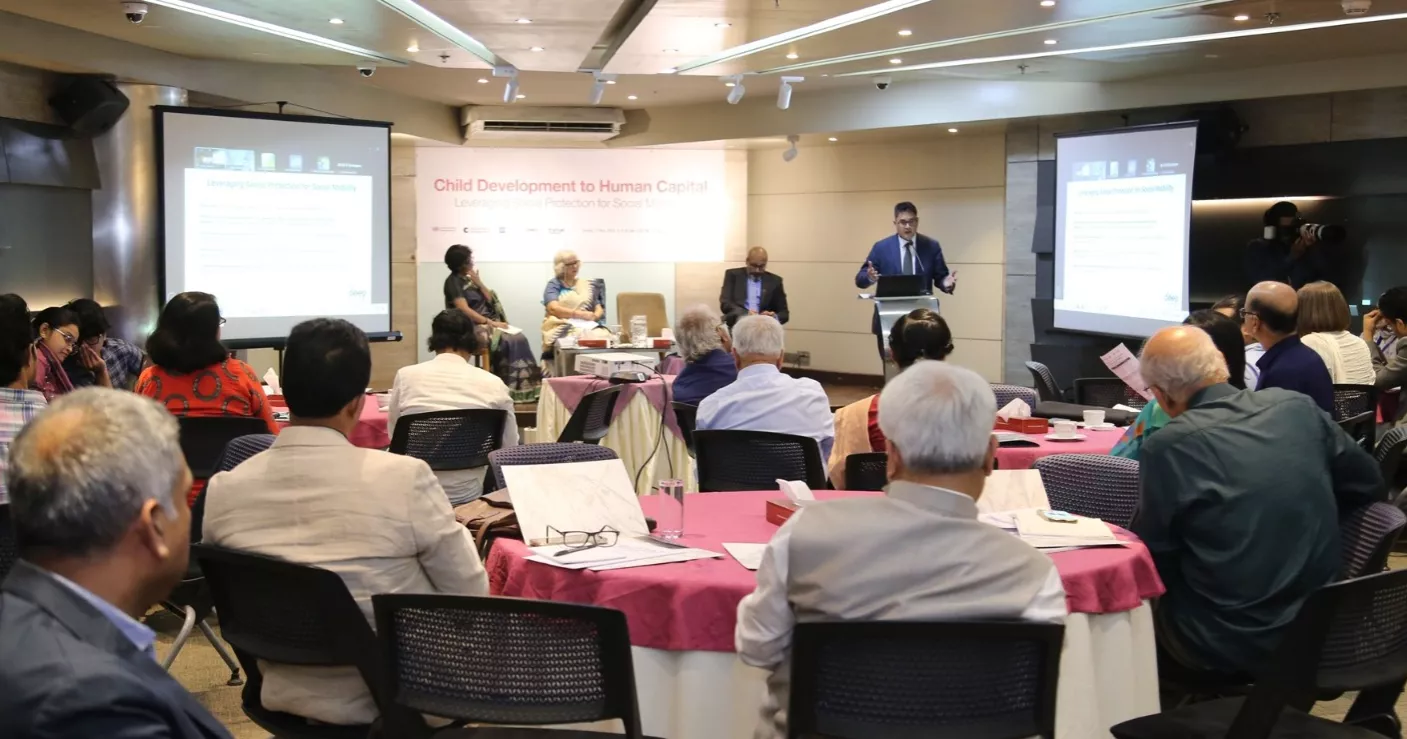
Bangladesh must place children at the heart of its national poverty strategy if it hopes to build a skilled, mobile workforce capable of navigating the challenges of the 21st century, experts and senior government officials said at a high-level policy workshop at BRAC Center, Mohakhali, on Sunday.
"Investments prioritising our children are a forward-looking investment in our collective future. That is an investment worth making," said Dr Mohammad Abu Yusuf, Secretary of the Ministry of Social Welfare, during the closing session of the event jointly organised by BRAC Institute of Governance and Development (BIGD) and Oxford Policy Management (OPM).
The workshop brought together government officials, development agency representatives, academics and civil society leaders to examine the causal links between early childhood development (ECD), education, poverty and social mobility, and to identify social protection strategies to address these challenges.
Delivering the keynote perspective, Dr Jena Hamadani, Emeritus Scientist at icddr,b, made the economic case for early investment.
"Supporting early childhood development promotes a skilled workforce that can take advantage of opportunities and contribute to a productive and healthy economy," she said, adding that ECD "provides an incredible return on investment when compared with later interventions."
Participants heard research from BIGD on social mobility and from OPM's Thrive and DEEP programmes on early childhood development and poverty.
Professor Andy McKay of the University of Sussex, joining online, explored how inter-generational an intra-generational mobility connect to poverty dynamics, building on work presented at the DEEP International Conference in Arusha in 2025.
On the financing side, Dr Abdur Razzaque, Chairman of RAPID, argued that adequate resourcing is within reach.
He said that if implemented properly, a three percent commitment of Bangladesh's GDP "can accommodate both the Family Card and wider lifecycle-based expansion" of social protection.
A note of alarm was sounded by Dr Hossain Zillur Rahman, Executive Chairman of PPRC, who said education, historically a driver of equality, was now widening the gap.
"Historically, education had been a driver of equality, but now education is driving inequality," he said, pointing to growing aspirational deficits among populations facing prolonged unemployment as a troubling sign of stalled mobility.
On delivery challenges, Dr Imran Matin, Executive Director of BIGD, warned against treating integration in isolation.
He argued that fragmentation in Bangladesh's social safety net could not be resolved without simultaneously addressing decentralisation challenges and strengthening local government. "We really need to do more implementation research and put the people back at the centre."
The role of data in shaping effective policy was also highlighted. Dr Dipankar Roy, Joint Secretary and Project Director at the Statistics and Informatics Division of the Ministry of Planning, called for closer collaboration between researchers and the Bangladesh Bureau of Statistics (BBS) and greater public access to data, describing it as a public good.
The event also featured sessions on integrating parenting support with cash transfers and a case study on the intergenerational impacts of productive safety nets, including Thrive's Saving Bangladeshi Babies' Brains programme, which is delivering ECD interventions at scale through the Government of Bangladesh.