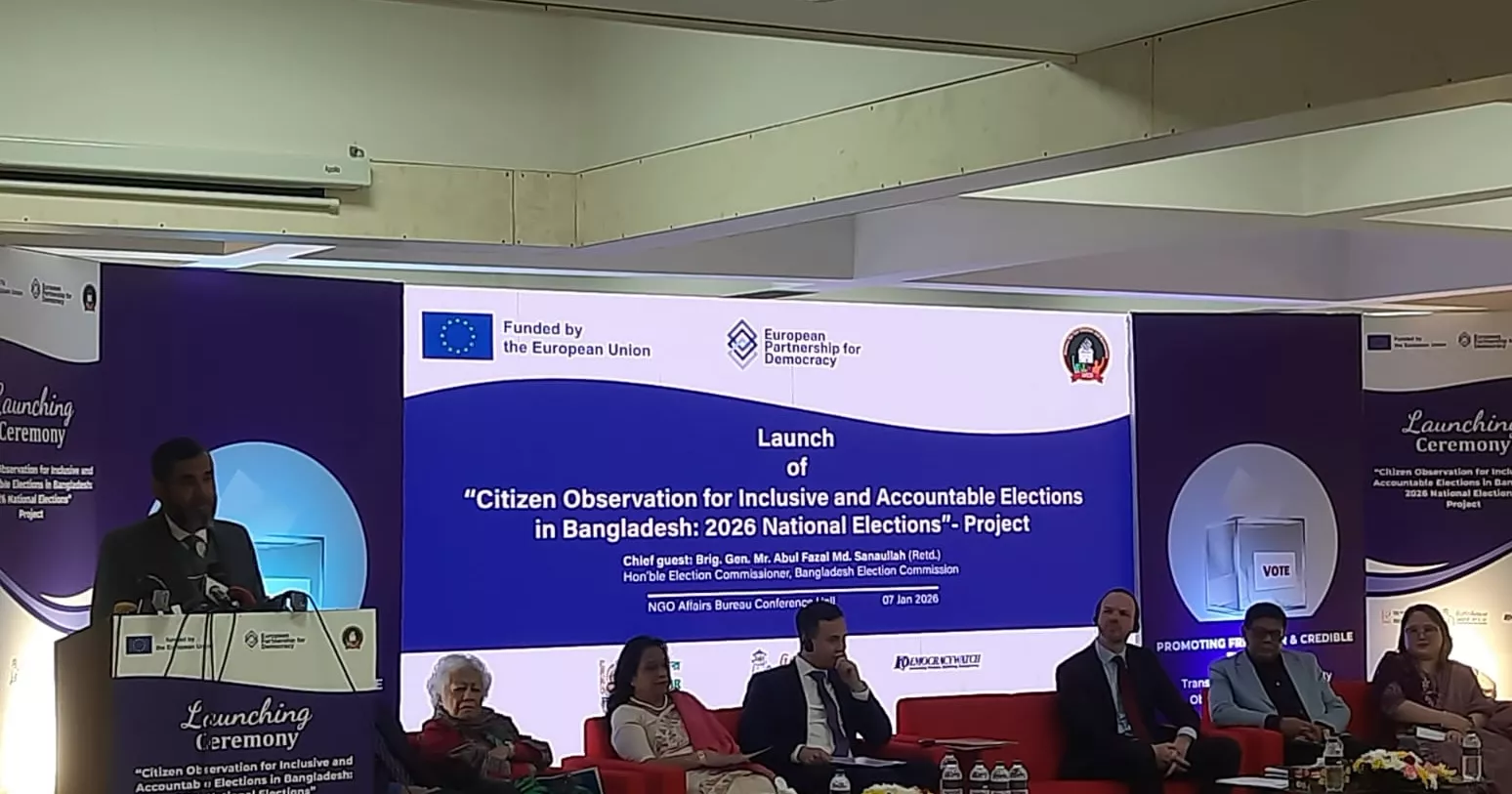
Election Commissioner Abul Fazal Md Sanaullah on Wednesday said the upcoming election will bring a derailed electoral system back on track.
“If I use an analogy, the 2026 election is like putting a derailed train back on the track and making it run again,” he said.
Sanaullah made the remarks while speaking as the chief guest at the inauguration of a project of the Alliance for Fair Election and Democracy (AFED), a platform comprising 81 organisations, at the NGO Bureau office in the city’s Agargaon area.
He said the first phase of reform would be achieved if the Election Commission could restore momentum to the electoral process by carrying out minimum repairs and replacing some parts.
Referring to public expectations, the Election Commissioner said there is a significant democratic vacuum, noting that the country still appears to be stuck in a pre-2008 situation due to the absence of credible elections.
“In this reality, our expectations must be aligned with what is realistically achievable,” he said.
About the election observer organisations, Sanaullah said unfortunately a good number of citizen observation organisations didn't play their role properly during the last three controversial and staged elections which became a constraint for the Commission in granting them registration.
He said more than 300 organisations had applied for observer registration but only 81 were finally approved.
“I would have been happier if we could register 200 or 300 organisations instead of 81,” he added.
The Election Commissioner said the minimum age for election observers has been reduced to 21 years, noting that while this allows broader participation, it also raises concerns about lack of experience.
Calling for collective efforts, Sanaullah urged all stakeholders to work together to ensure a credible and conscience-driven election in 2026.
About the postal voting, he said around 1.533 million voters from home and abroad have completed registration.
Referring to global experiences, he said international inclusion rates for overseas voting remain low at around 2.7 percent, while Bangladesh has crossed 5 percent participation by expatriate voters, which he described as a good start.
However, he cautioned that the global ballot wastage rate stands at around 24 percent, meaning one out of every four ballots become wastes.
Urging observers to remain vigilant, Sanaullah said their feedback would be crucial in further improving the newly introduced postal voting system.
“I hope that together we can deliver on our national expectations and present the nation with a free, fair and credible election,” he added.
The event was attended by Democracy Watch chairperson Talleya Rahman, Khan Foundation co-chair Roksana Khondker, as well as representatives from government and non-government organisations.